Owl Box Guide: Sizes and Placement for Barn and Screech Owls
An owl box works when it matches the owl: a 3-inch hole 10 to 30 feet up for screech-owls, a big 4.5-inch box on open land for Barn Owls. Sizes, height, timing.
If you buy through links on this page we may earn a commission, at no cost to you. It never decides what we recommend. How we earn
In this article
- Quick answer: owl box basics
- How we chose
- Which owls use owl boxes?
- Which size owl box do I need?
- Owl box decision table: will owls use it in my yard?
- Where should I put an owl box?
- When should I put up an owl box?
- Will owls actually use an owl box?
- What else moves into owl boxes, and how do I stop it?
- How do I clean an owl box, and how often?
- How much does an owl box cost?
- Should I buy or build an owl box?
- Owl boxes compared
- JCs Wildlife Cedar Screech Owl Nest Box: best for screech-owls
- Coveside Saw-Whet and Screech Owl House: best traditional box
- JCs Wildlife Barn Owl Nesting Box: best for Barn Owls
- Common owl box mistakes
- What are the alternatives to an owl box?
- Sources
- Gear mentioned in this guide
- Frequently asked questions
An owl box works when it matches the owl and its land. For Eastern and Western Screech-Owls, use a box with a 3-inch (76 mm) entrance mounted 10 to 30 feet (3 to 9 m) up at a wooded edge. For Barn Owls, use a much larger box 8 to 25 feet up beside open fields. Install in fall.
Everything else in this guide is detail: exact dimensions, where to mount the box, how to keep starlings and squirrels out, whether to buy or build, and how long to wait.
Quick answer: owl box basics
- Pick the owl first. Screech-owls live in woods, parks and suburbs with big trees. Barn Owls need open hunting land: pasture, hayfields, marsh, orchards and vineyards.
- Screech-owl box: 3-inch (76 mm) hole, floor about 8 x 8 to 10 x 10 inches, inside depth 12 to 15 inches, hole 9 to 12 inches above the floor, mounted 10 to 30 feet up.
- Barn Owl box: hole about 4.5 inches (115 mm) high, floor roughly 12 x 23 inches (30 x 58 cm) or larger, inside depth about 16 inches (40 cm), mounted 8 to 25 feet up.
- Always add wood shavings. Owls do not build nests.
- No perch, no paint inside, drainage in the floor, vents near the top, and a door you can open.
- Install in fall or early winter, and expect to wait one to three seasons.
How we chose
We have not installed or monitored these owl boxes ourselves. This guide is research-led. We took box dimensions, hole sizes and mounting heights from Cornell Lab’s NestWatch species pages, the UK Barn Owl Trust and published conservation plans. For the products named here, we used only specs on the makers’ own product pages, plus repeated patterns in verified owner feedback. We left out any spec we could not confirm.
Which owls use owl boxes?
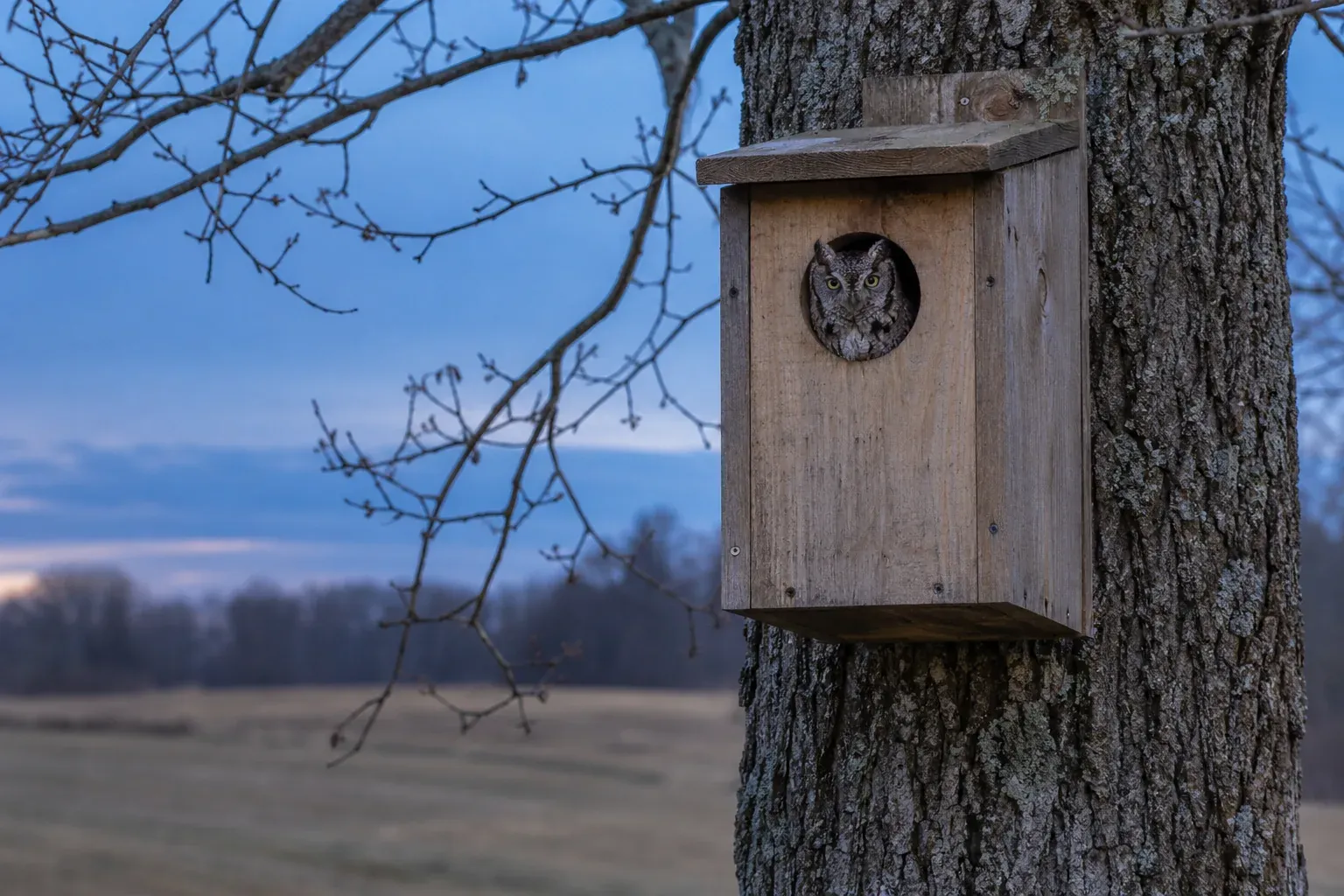
Only cavity-nesting owls use enclosed boxes. In North America the reliable box users are Eastern and Western Screech-Owls, Barn Owls and Northern Saw-whet Owls, with Barred Owls using larger boxes in mature forest. Great Horned Owls do not use enclosed boxes.
Eastern Screech-Owl lives east of the Rockies, from southern Canada to Texas and Florida. It is small, about 6 to 10 inches (16 to 25 cm) long, comes in gray and rufous forms, and is common in older suburbs with mature trees. Western Screech-Owl replaces it in the West and uses the same box.
Barn Owl is found across much of the lower US and on every continent except Antarctica. It hunts voles and mice over open ground and nests in barns, silos, hollow trees and large boxes where old barns have been lost.
Northern Saw-whet Owl is a tiny owl of northern and mountain forests that uses the same 3-inch box as screech-owls.
For a typical backyard, the realistic target is a screech-owl. For more on how owls hunt at night, see why owls are silent in flight.
Which size owl box do I need?
The owl decides the size. A screech-owl box is about the size of a tall bluebird box; a Barn Owl box is closer to a small dog crate. This sizing chart combines NestWatch guidance and published plans.
Owl box sizing chart
| Owl | Entrance | Inside floor | Inside depth | Hole above floor | Mount height | Habitat |
|---|---|---|---|---|---|---|
| Eastern and Western Screech-Owl, Northern Saw-whet Owl | 3 in (76 mm) round | About 8 x 8 to 10 x 10 in (20 to 25 cm square) | 12 to 15 in (30 to 38 cm) | 9 to 12 in (23 to 30 cm) | 10 to 30 ft (3 to 9 m) | Woodland edge, older suburbs, parks, forest |
| Barn Owl | About 4.5 in (115 mm) high, often oval | About 12 x 23 in (30 x 58 cm) or larger | About 16 in (40 cm) | High enough that owlets cannot tumble out | 8 to 25 ft (2.5 to 7.5 m) | Fields, pasture, marsh, orchards |
Two numbers matter most. The entrance decides who gets in: a 3-inch hole admits screech-owls, saw-whets and kestrels but keeps out larger predators. The hole height above the floor keeps owlets inside until they are ready and keeps eggs beyond a raccoon’s reach. For other species, see our birdhouse hole size chart.
Owl box decision table: will owls use it in my yard?
A perfect box on the wrong property stays empty. Check your land against this table before you buy.
| Your land | Likely owl | Put up | Chance of use |
|---|---|---|---|
| Suburban yard with several mature shade trees, eastern two-thirds of the US | Eastern Screech-Owl | 3-inch box on a trunk | Good if screech-owls call nearby |
| Western town, orchard or riverside woods | Western Screech-Owl | 3-inch box | Good in suitable range |
| Farm, pasture, hayfield or vineyard with plenty of open ground | Barn Owl | Large Barn Owl box on a pole or barn | Moderate, higher where Barn Owls already hunt |
| Northern or mountain conifer forest | Northern Saw-whet Owl | 3-inch box | Low, but possible |
| New subdivision, small lawns, few trees | None likely | A songbird box instead | Very low |
A simple test: listen outside on a still night in late winter. Eastern Screech-Owls give a descending whinny and a long even trill. Barn Owls give a harsh, drawn-out scream, not a hoot. If you hear them, a box has a real chance. See our guide to using Merlin Sound ID to confirm what you hear.
Where should I put an owl box?
Put a screech-owl box on a tree trunk or pole 10 to 30 feet up at the edge of woods. Put a Barn Owl box 8 to 25 feet up on a pole, barn wall or tree beside open fields. Both need a clear flight path to the entrance.
Screech-owl box placement
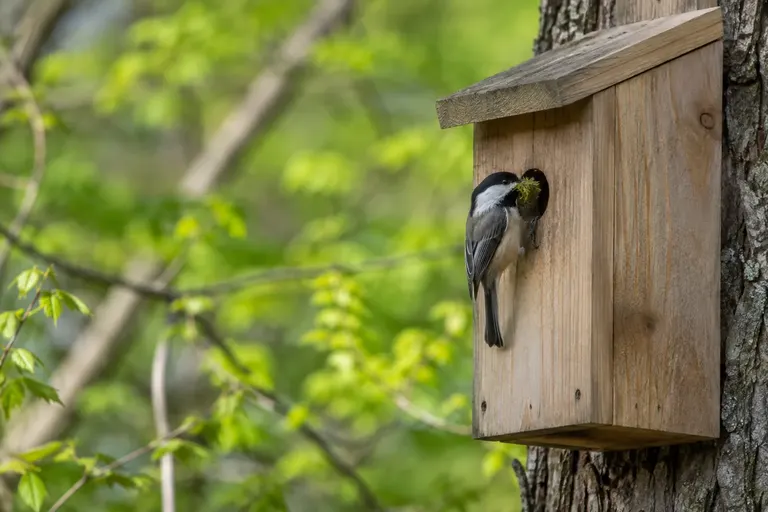
- Use a large trunk under a limb. This mimics a natural cavity. NestWatch also allows a pole with a predator guard.
- Go high enough. Ten feet is the minimum; 12 to 20 feet is easier to defend.
- Face it any reasonable direction. In hot climates avoid full afternoon sun; in cold areas turn the hole away from winter wind.
- Keep the approach open, but leave a branch within a few feet so fledglings can climb out and perch.
- Place it near hunting cover, such as a field, wetland, stream or overgrown corner.
Barn Owl box placement
- Put it beside open land. Barn Owls hunt low over rough grass. A box inside a wood is wasted.
- Mount it 8 to 25 feet up on a sturdy pole, a barn wall or a large isolated tree, with the entrance facing open ground.
- Mind the neighbors. Barn Owl chicks hiss and scream at night for weeks, so NestWatch advises considering noise near houses.
- Space boxes at least 100 feet (30 m) apart.
For poles, fixings and guards, see our guide to mounting a birdhouse on a pole, tree or wall. Use heavier hardware for a Barn Owl box.
When should I put up an owl box?
Put an owl box up in fall or early winter. Owls choose roost and nest sites months before laying, and a box hung in spring is often too late for that year.
Eastern Screech-Owls nest from about March through June in most of their range, peaking in April and May. They also roost in boxes all winter, so a box up by late fall can be in use within weeks. Barn Owls can breed in almost any month in mild climates such as the South and California. For other species, see when to put up birdhouses.
Will owls actually use an owl box?
Often yes, when the habitat is right. Screech-owls take readily to boxes in suitable woods and suburbs, and Barn Owl box programs on farms and vineyards in the US and Europe are well established. In poor habitat, a box may stay empty for good.
To raise the odds:
- Add 2 to 3 inches of coarse pine or aspen shavings, not sawdust, which packs down and stays wet.
- Put up a second box nearby. NestWatch suggests a backup site for screech-owls.
- Stop using rodent poison. Owls eat poisoned rodents, and NestWatch advises avoiding rodenticides where owls hunt.
- Keep lights off the box and its approach.
- Give it time. If nothing moves in after three years, move the box closer to hunting cover.
Signs of use include whitewash on the trunk below the hole, pellets on the ground and small feathers at the entrance.
What else moves into owl boxes, and how do I stop it?
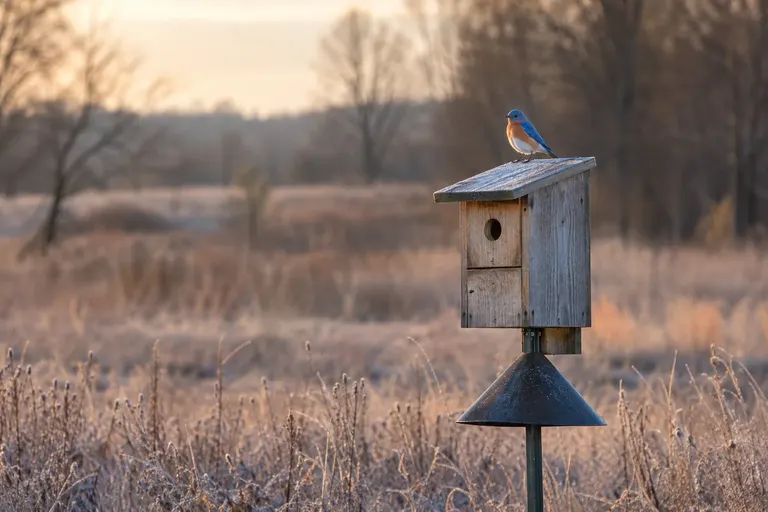
European Starlings, squirrels and raccoons are the main problems. American Kestrels and Wood Ducks also use boxes this size, and both are native birds worth hosting.
- Starlings fill owl boxes with grass in early spring. They are invasive and not protected by federal law, so you may remove their nests. Check in late winter and early spring.
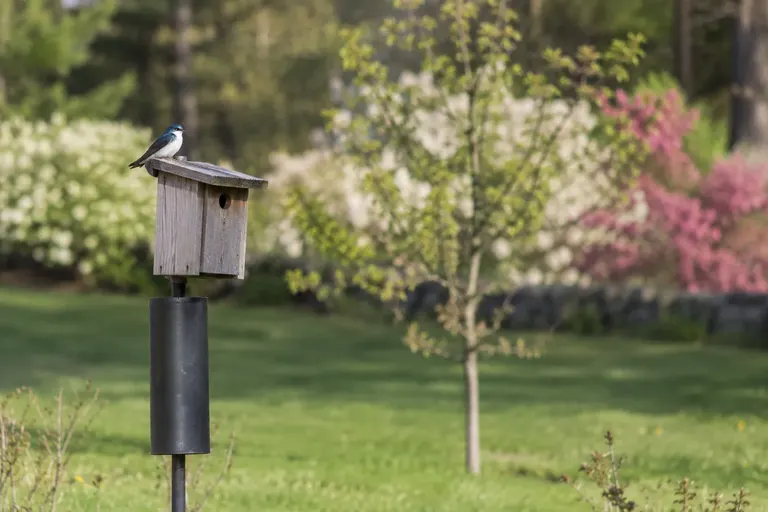
- Squirrels stuff boxes with leaves. A smooth metal band about 2 feet (60 cm) tall around the trunk, or a baffle on a pole, stops climbing. Keep the box away from jumping-off branches.
- Raccoons reach into shallow boxes. A deep box with a high hole is the defense.
- Kestrels and Wood Ducks are protected natives: leave them and add another box.
All native owls, kestrels and ducks are protected under the Migratory Bird Treaty Act, so never disturb an active native nest.
How do I clean an owl box, and how often?
Clean an owl box once a year, after nesting and before the next season. NestWatch suggests December for Barn Owl boxes.
- Confirm it is empty. Screech-owls roost in boxes all winter, so look in carefully first.
- Wear gloves and a dust mask. Old pellets and droppings are dusty.
- Scrape out old material and any starling nests.
- Check the structure: screws, drainage holes and the door latch.
- Add fresh shavings. Two to three inches for screech-owls. For Barn Owl boxes, NestWatch describes a thin layer about 3/4 inch deep, since Barn Owls build a base from shredded pellets.
Never open an owl box during egg-laying or early incubation; NestWatch warns females may abandon. For the full method, see when and how to clean out a birdhouse.
How much does an owl box cost?
A screech-owl box is one of the cheaper nest boxes to buy or build. A well-made Barn Owl box costs several times more because it uses far more material. For either, safe mounting at height is often the bigger expense: a tall pole, sleeve and predator guard can cost more than the box, and you need a stable extension ladder and a second person.
Should I buy or build an owl box?
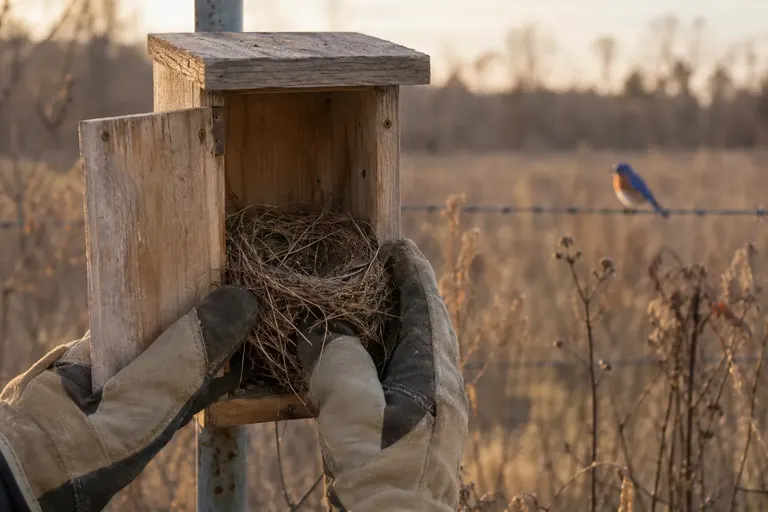
Build if you have basic woodworking tools and a proven plan; buy if you want the details right with no guesswork. A screech-owl box is an easy first build. A Barn Owl box is large and heavy.
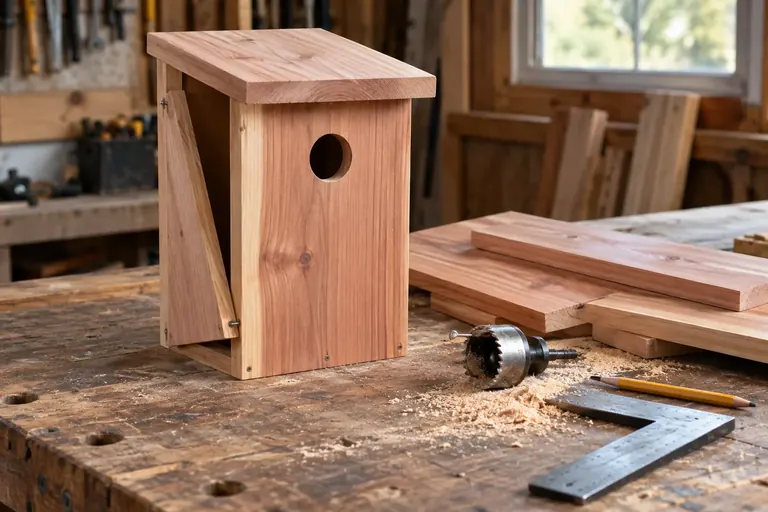
Build it if you can cut 3/4-inch (19 mm) boards squarely, drill a clean 3-inch hole with a hole saw, and follow a published plan such as NestWatch’s. Use untreated cedar, pine or exterior plywood and leave the inside raw.
Buy it if you want proven details, such as a divider in a Barn Owl box or a flip-open door, you need a box this fall, or you want rot-proof recycled poly lumber.
A middle route is a kit. JCs Wildlife sells a do-it-yourself version of its Barn Owl box with pre-cut plywood, stainless screws, mounting strips and shavings, at the same 24 x 21 x 19.25-inch size.
Owl box buyer’s checklist
A good box ticks every line:
- Entrance sized for your owl: 3 inches for screech-owls, about 4.5 inches high for Barn Owls
- Hole well above the floor
- Walls about 3/4 inch (19 mm) thick, untreated inside
- Drainage holes in the floor and vents near the roof
- A door or panel that opens for cleaning
- Roof that overhangs the entrance
- Rough inside wall or grip slats below the hole
- No perch
- Wood shavings included or on hand
- A mounting plan and predator guard that suit your site
Owl boxes compared
These four boxes come from two US makers that publish full specs. Dimensions are the makers’ own figures.
| Box | Target owl | Entrance | Size | Material | Cleaning access |
|---|---|---|---|---|---|
| JCs Wildlife Cedar Screech Owl Nest Box with Poly Lumber Roof | Screech-owls, saw-whets | 4 x 3 in oval, 9.75 in above floor | 12 x 14 x 10.5 in overall | 5/8 in cedar, poly roof | Flip-open front door |
| Coveside Saw-Whet and Screech Owl House | Screech-owls, saw-whets | 3 in round | 11 x 9 x 17.75 in | Eastern white pine | Lift-up side panel |
| JCs Wildlife Barn Owl Nesting Box | Barn Owl | 5.5 x 4.5 in oval | 24 x 21 x 19.25 in | Exterior grade plywood | End door |
| JCs Wildlife Poly Barn Owl Nesting Box | Barn Owl | 5.5 x 4.5 in oval | 24 x 21 x 19 in | Recycled poly lumber | End door |
JCs Wildlife Cedar Screech Owl Nest Box: best for screech-owls
What it is: A made-in-USA cedar box with a recycled poly lumber roof, a latched flip-open front door and fledgling grip slats inside.
Who it suits: Wooded yards, parks and woodland edges with Eastern or Western Screech-Owls. The maker also lists it for saw-whets.
Key specs: JCs lists a 4 x 3-inch oval entrance set 9.75 inches above the floor, 5/8-inch cedar walls and an overall size of 12 x 14 x 10.5 inches, with drainage, ventilation and shavings included.
Strengths: The high hole keeps eggs out of easy reach, the poly roof will not rot, and the front door speeds up clean-outs on a ladder.
Drawbacks: Walls are thinner than the 3/4-inch boards many plans use, and the oval hole is wider than the classic 3-inch round.
Skip it if: You want a traditional round-hole, all-wood box.
Coveside Saw-Whet and Screech Owl House: best traditional box
What it is: A tall Eastern white pine box made in the USA with a 3-inch round entrance and a bag of wood chips.
Who it suits: Anyone who wants the plan-style box conservation groups describe.
Key specs: Coveside lists a 3-inch entrance and outside dimensions of 11 x 9 x 17.75 inches, with vent slots, drainage holes and a latched side panel.
Strengths: The deep interior and standard hole match NestWatch guidance, and the included chips mean it is ready to hang.
Drawbacks: Pine weathers and needs checking every few years, and like any tall box it may be claimed by squirrels without a guard.
Skip it if: You cannot safely mount and reach a box 10 feet or more up.
JCs Wildlife Barn Owl Nesting Box: best for Barn Owls
What it is: A large exterior plywood box designed with owl expert Steve Simmons, with an interior divider that separates the entrance from the nest area.
Who it suits: Farms, ranches, orchards and vineyards with open fields.
Key specs: JCs lists a 5.5 x 4.5-inch elliptical entrance, a size of 24 x 21 x 19.25 inches, grip grooves below the hole and an end door that also fits a wildlife camera. Shavings and stainless screws are included.
Strengths: The divider keeps the nest beyond reach of raccoons and Great Horned Owls at the entrance. A recycled poly version and a DIY kit share the same size.
Drawbacks: It is big and heavy, needing a strong mount and two people. It has shown as backordered on the maker’s site.
Skip it if: You have no open grassland nearby.
Common owl box mistakes
- Wrong habitat: a Barn Owl box in a wooded suburb, or a screech-owl box on a bare lawn pole.
- Too low: boxes under 10 feet are easy for raccoons and cats. See keeping cats away from birds.
- No shavings, so eggs roll and chill.
- A perch or paint inside.
- Spring installation instead of fall.
- Checking during early incubation.
- Rodent poison nearby.
What are the alternatives to an owl box?
If an owl box is not a fit, make the yard better for owls: leave safe dead trees standing, keep rough grass and brush for mice and insects, and turn off unneeded outdoor lights.
For small yards, a songbird box is the easy alternative. Our roundup of the best birdhouses covers bluebird, wren and chickadee boxes. On larger rural land, a kestrel box with a similar 3-inch hole on an open-country pole supports another rodent-hunting bird.
Sources
- Barn Owl nest box guidance, NestWatch, Cornell Lab of Ornithology
- Eastern Screech-Owl nest box guidance, NestWatch, Cornell Lab of Ornithology
- Barn Owl, All About Birds, Cornell Lab of Ornithology
- Eastern Screech-Owl, All About Birds, Cornell Lab of Ornithology
- Barn Owl nestboxes, Barn Owl Trust
- JCS Wildlife Barn Owl Nesting Box, manufacturer page
- JCS Wildlife Cedar Screech Owl Nest Box, manufacturer page
Gear mentioned in this guide
JCs Wildlife Cedar Screech Owl Nest Box with Poly Lumber Roof
A US-made cedar box with a recycled poly roof, an oval entrance set high above the floor, a flip-open front door, interior grip slats and nesting shavings included.
- Best for
- Wooded yards and woodland edges with Eastern or Western Screech-Owls.
- Skip it if
- You want a traditional round 3-inch hole or an all-wood box.
- Entrance
- 4 in W x 3 in H oval
- Hole above floor
- 9.75 in
- Overall size
- 12 in W x 14 in H x 10.5 in D
- Material
- 5/8 in cedar, poly lumber roof
Coveside Saw-Whet and Screech Owl House
A tall Eastern white pine box made in the USA with a round 3-inch entrance, vent slots, drainage holes, a lift-up side panel and wood chips included.
- Best for
- People who want the classic plan-style box that owl groups describe.
- Skip it if
- You cannot mount and clean a box 10 feet or more up.
- Entrance
- 3 in (76 mm) round
- Size
- 11 in L x 9 in W x 17.75 in H
- Material
- Eastern white pine
JCs Wildlife Barn Owl Nesting Box
A large plywood box with an elliptical entrance, an interior divider that keeps the nest out of reach from the hole, an end door for clean-outs and pine shavings included.
- Best for
- Farms, ranches, orchards and rural properties with open fields.
- Skip it if
- You have no open grassland nearby or no way to mount a heavy box 8 to 25 feet up.
- Entrance
- 5.5 in W x 4.5 in H oval
- Size
- 24 in W x 21 in D x 19.25 in H
- Material
- Exterior grade plywood
Frequently asked questions
Where is the best place to put an owl box?
Match the place to the owl. Screech-owl boxes go on a tree trunk or pole 10 to 30 feet up at a woodland edge, ideally near a field or wetland. Barn Owl boxes go 8 to 25 feet up on a pole, barn wall or tree beside open fields or grassland. Keep boxes at least 100 feet apart and away from bright lights and busy doors.
What size hole does an owl box need?
Eastern and Western Screech-Owls and Northern Saw-whet Owls use an entrance about 3 inches (76 mm) across. Barn Owls need a much larger opening, about 4.5 inches high, often cut as an oval roughly 5.5 inches wide. Too large a hole on a screech-owl box lets in bigger competitors and predators, so stick to the recommended size.
When should I put up an owl box?
Fall and early winter are the best times. Screech-owls start nesting from about March, and pairs look for cavities before that, so a box up by January has a real chance in its first spring. Barn Owls can nest in almost any month in mild climates, but a box installed in autumn has time to be found.
How long does it take owls to use an owl box?
It varies from weeks to several years. Screech-owl boxes in good habitat are often used for winter roosting within the first season, and nesting may follow the next spring. Barn Owl boxes can take one to three seasons, longer where Barn Owls are scarce. If a box stays empty for three years, move it closer to open hunting ground.
Do owl boxes attract other animals?
Yes. European Starlings, squirrels, American Kestrels, Wood Ducks and even honeybees can move into owl boxes. Kestrels and Wood Ducks are welcome native tenants. Starlings and squirrels are the common problem: check the box in late winter, remove starling nests (they are an unprotected invasive species) and use a pole or trunk guard to block squirrels and raccoons.