Swift Nest Box: Sizes, Height and Chimney Swift Towers
A swift nest box works only at 16 ft (5 m) or higher under the eaves with a clear drop below. Sizes, entrance holes, call playback and chimney swift towers.
If you buy through links on this page we may earn a commission, at no cost to you. It never decides what we recommend. How we earn
In this article
- Quick answer: swift nest box basics
- How we chose
- Why do swifts need nest boxes?
- Which birds use a swift nest box?
- Which size swift nest box do I need?
- Swift nest box or chimney swift tower: which one fits your home?
- Where should I put a swift nest box?
- How do I attract swifts to a new nest box?
- What are swift bricks, and are they better than boxes?
- How do I build a chimney swift tower?
- When should I install a swift nest box?
- How much does a swift nest box cost?
- How do I keep a swift nest box clean?
- Vivara Pro WoodStone Swift Nest Box: best overall
- Schwegler Swift Box 1A: best lightweight box
- Green Feathers Handmade Swift Nest Box: best for a camera
- Swift nest box buyer’s checklist
- Common swift nest box mistakes
- What are the alternatives if swifts will not use a box?
- Sources
- Gear mentioned in this guide
- Frequently asked questions
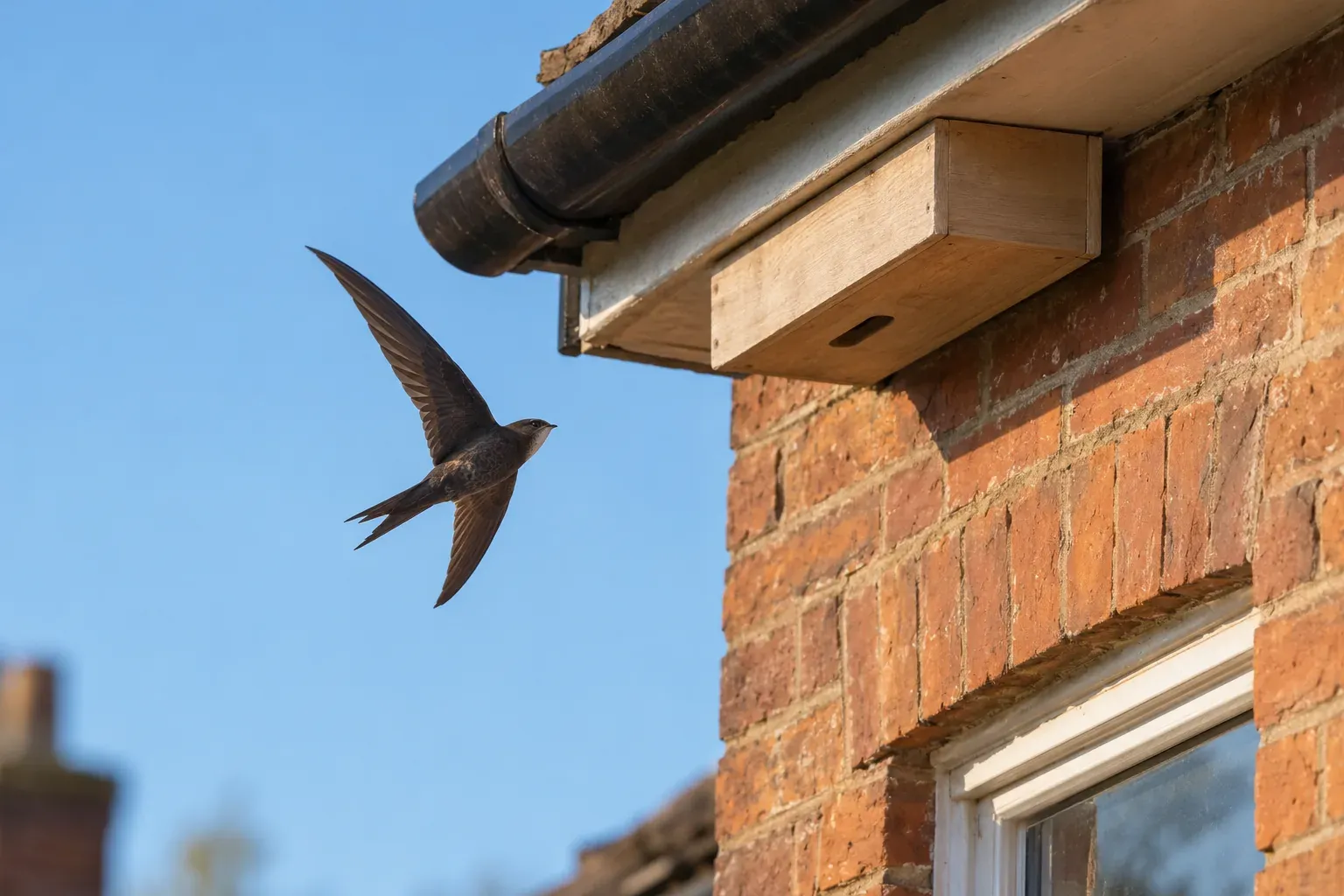
A swift nest box works when it copies a gap under a roof: an oblong entrance about 30 x 65 mm, mounted at least 16 feet (5 m) up under the eaves, with a clear drop below and swifts already flying nearby. In North America, Chimney Swifts need a tall swift tower or open chimney instead.
Quick answer: swift nest box basics
- Check for swifts first. No swifts over your street in summer means a box is unlikely to be found.
- Europe and the UK: fix a box for Common Swifts directly under the eaves or on a high gable, at least 16 feet (5 m) up.
- North America: Chimney Swifts do not use hanging boxes. They need an open masonry chimney or a freestanding tower 8 to 12 feet tall or more.
- Entrance: an oblong slot about 30 x 65 mm (1.2 x 2.6 in), ideally on the underside.
- Flight path: no trees, wires, shrubs or ledges in front of or below the entrance.
- Play swift calls in early summer, and put up several boxes together.
How we chose
We have not installed or monitored these swift boxes ourselves. This guide is research-led. Box sizes, entrance dimensions, heights and call-playback timing come from swift conservation groups, including Swift Conservation Ireland and Bristol Swifts, and tower specifications come from Texas Parks and Wildlife. Bird facts come from Cornell Lab’s All About Birds. For the three boxes named here, we used only specs on manufacturer or retailer product pages, and we left out any number we could not confirm.
Why do swifts need nest boxes?
Swifts need boxes because the gaps they nest in are disappearing. They evolved to nest in cliffs, caves and hollow trees, moved into buildings centuries ago, and now lose those sites every time an old roof is repaired, a soffit is sealed or a chimney is capped or lined with metal.
Swifts are loyal to a site, so when a roof is renovated the pair returns to find its hole sealed and often fails to breed that year. Modern buildings have no cavities at all.
The result shows in the numbers. According to All About Birds, the Chimney Swift population fell by an estimated 74 percent between 1966 and 2023, and it is listed as an Orange Alert Tipping Point species. Common Swifts are also declining across much of Europe and are red-listed in the UK. Lost nest sites are the part a homeowner can fix. For the wider picture, see why bird populations are declining.
Which birds use a swift nest box?
Box design depends on where you live. In Europe, the target is the Common Swift, which nests inside walls and roofs. In North America, the Chimney Swift nests inside vertical shafts, so it needs a tower, not a box.
Common Swift. A sooty-brown bird with long scythe-shaped wings that breeds across Europe and winters in Africa. It spends most of its life in the air, landing only to nest. Birds arrive from late April into May and leave by August. The nest is a shallow cup of feathers and airborne plant fluff glued with saliva, inside a dark cavity. Pallid Swifts in southern Europe use similar boxes.
Chimney Swift. A small, cigar-shaped swift of eastern North America that winters in the upper Amazon basin. It cannot perch like a songbird. Instead it clings to rough vertical walls and builds a half-saucer of twigs glued to the wall with saliva. All About Birds records clutches of 3 to 5 white eggs, incubation of 16 to 21 days and a nestling period of 14 to 19 days. Many birds may roost in one chimney, but normally only one pair nests in it.
House Sparrows and European Starlings take swift boxes if they find them first, so size the entrance to exclude starlings and block boxes until swifts return.

Which size swift nest box do I need?
A Common Swift box needs a floor of about 12 x 6 inches (30 x 15 cm) or more, a low roof and an oblong entrance about 30 x 65 mm. A Chimney Swift tower needs an inside width of at least 14 inches and a height of 8 feet or more.
Swift nest box sizing chart
| Bird | Nest structure | Entrance | Inside space | Height above ground | Notes |
|---|---|---|---|---|---|
| Common Swift (Europe, UK) | Single or twin-chamber box | Oblong, about 30 x 65 mm (1.2 x 2.6 in); 28 mm high to deter starlings | Floor about 12 x 6 in (30 x 15 cm) or larger, low and dark | At least 16 ft (5 m) | Group several boxes; a shallow nest cup helps |
| Pallid Swift (southern Europe) | Same as Common Swift | Same oblong slot | Same | At least 16 ft (5 m) | Uses the same boxes |
| Chimney Swift (eastern North America) | Freestanding tower or open masonry chimney | Open top, no more than half the inside area | At least 14 in (36 cm) across inside, rough walls | Tower 8 ft minimum, 12 ft preferred | One nesting pair per tower |
Bristol Swifts’ free plans use a nest cup depression about 4 inches (100 mm) across on the floor, which stops eggs rolling. The entrance slot matters most: a round hole invites tits and sparrows, while the low oblong slot suits the swift’s flat head and short legs.
Swift nest box or chimney swift tower: which one fits your home?
Your region and your building decide it. This decision table is the fastest way to pick the right project.
| Your situation | Best option | Why |
|---|---|---|
| Europe or UK, house with eaves 16 ft (5 m) or higher, swifts overhead | External swift box under the eaves | Copies the roof gaps swifts already use |
| Europe or UK, new build or re-roofing project | Integrated swift bricks or boxes inside the roof | Permanent, hidden, no maintenance |
| Europe or UK, single-story house or low walls | Skip the box; support a colony nearby | Boxes below 16 ft are rarely used |
| Eastern North America, old open masonry chimney | Keep it open and uncapped in summer | The best existing Chimney Swift site |
| Eastern North America, open yard, no usable chimney | Freestanding Chimney Swift tower | Replaces a lost chimney |
| North America, want a colonial nester near the house | Purple martin housing | Martins use hanging houses and gourds; swifts do not |
| No swifts seen in summer | Songbird boxes instead | A swift box will not create a colony from nothing |
Where should I put a swift nest box?
Mount it at least 16 feet (5 m) up, directly under the eaves or roof overhang, with nothing below or in front of the entrance. Swifts drop out of the hole and need a clear fall to gain speed, and they fly in fast and straight.
- Go high. Under the eaves of a two-story house or on a high gable is ideal. Higher is better.
- Keep the flight path clear. No trees, climbing plants, wires, satellite dishes or window ledges directly below or in front. Bristol Swifts advises clear flight paths free from trees and wires.
- Use shade. Any direction can work, but on a sun-facing wall make sure an overhang shades the box at midday, because chicks can overheat.
- Group boxes. Put two to four boxes along the same stretch of eaves, a short gap apart. Swifts are colonial and more likely to settle where others are.
- Stay near a colony. Boxes within earshot of an existing swift colony fill fastest.
For drilling, fixings and ladder safety, see our guide to mounting a birdhouse on a pole, tree or wall. Work from a scaffold tower or hire a contractor for anything above a first-floor window.
How do I attract swifts to a new nest box?
Play recorded swift calls near the box during early summer. Prospecting swifts investigate the sound of other swifts, and call playback is the most widely recommended way to get a new box noticed.
Bristol Swifts’ advice on timing is specific:
| Period | What is happening | Playback value |
|---|---|---|
| Late April to early May | Breeding adults return to their own old sites | Low, they are not looking |
| Late May to mid June | Younger birds search for new sites | Peak; play 6 to 11 am and 8 to 10 pm on calm, dry days |
| Mid July | First-year birds visit before migrating | Useful; same schedule |
Use a small weatherproof speaker beside or inside the box, playing Common Swift screaming parties at moderate volume, and tell neighbors what the noise is. For Chimney Swifts, the tower’s shape and texture matter more than playback.
What are swift bricks, and are they better than boxes?
A swift brick is a hollow block built into a wall during construction, with a small entrance on the face and a nest chamber inside. For new homes and extensions it is the best option, because it lasts as long as the building, needs no maintenance and stays cool inside the wall.
Swift bricks are standard advice in UK and European conservation guidance for new buildings, and a growing number of planning authorities ask for them. Several bricks are normally placed high on the same wall.
For an existing house, an external box is easier. If you are re-roofing, ask your builder about leaving or creating access to the roof void behind the fascia, which is what swifts used before the work.
How do I build a chimney swift tower?
Build a hollow, insulated shaft at least 8 feet tall (12 feet is better), about 14 inches or more across inside, with a rough interior wall and an open top. Texas Parks and Wildlife’s tower guide sets out the key specifications.
| Part | Specification from Texas Parks and Wildlife |
|---|---|
| Height | 8 ft minimum, 12 ft preferred |
| Inside width | No less than 14 in |
| Inner wall | Textured siding the birds can cling to |
| Walls | Double-walled wood with at least 3/4 in rigid foam insulation |
| Top | Opening no larger than half the inside area, placed on the north top edge to cut summer sun |
| Predator guard | A 24 in band of metal flashing around the top |
| Base | Ventilation grid of 3/8 in holes, 1.5 in apart |
| Foundation | Reinforced concrete slab, or steel legs for ant protection |
Place the tower in the open, away from overhanging trees, where swifts can drop in from above. Many towers are built by Audubon chapters, scout groups and nature centers. If you already have an old masonry chimney, keeping it open and uncapped in summer, with the damper closed, may be the best thing you can do. Chimney Swifts and their active nests are protected under the Migratory Bird Treaty Act, so never remove a nest in use; schedule chimney sweeps for late fall or early spring when the birds are gone.
When should I install a swift nest box?
Install swift boxes between fall and early spring, and have them ready by early April in Europe. Chimney Swift towers should be complete before the birds return north in spring.
Common Swifts begin arriving in late April, and the key prospecting period is late May to July. A box installed in winter is ready for call playback that first summer. Do not install or repair near an active colony between May and August. For how swift timing compares with other cavity nesters, see when to put up birdhouses.
Be patient. Swifts commonly take two to five years to occupy a new box. Young birds find sites a year or more before they breed, so visits come first and nesting later.
How much does a swift nest box cost?
A single swift box costs about the same as a quality songbird box, with concrete-fiber models at the higher end. The real cost is usually installation: scaffolding, a tower platform or a contractor to fix a box safely under the eaves of a two-story house. A Chimney Swift tower is a bigger outlay in lumber, insulation, flashing and concrete.
How do I keep a swift nest box clean?
Swift boxes need very little cleaning. Swifts bring in little material, and chicks keep the nest tidy, so most groups advise leaving boxes alone and never disturbing them between May and August.
- Inspect only in winter. If a box has a rear or side opening, check it between November and March.
- Remove sparrow or starling nests out of season, since these fill the box with grass and straw.
- Leave swift nests in place. A returning pair reuses its old cup.
- Clean towers after migration. Texas Parks and Wildlife advises opening the base in fall to remove droppings and old nests.
Our guide on when and how to clean out a birdhouse covers tools and hygiene.
Vivara Pro WoodStone Swift Nest Box: best overall
This is a purpose-built swift box made from WoodStone, a concrete and wood-fiber composite. It measures 405 x 290 x 269 mm, has a rear opening for inspection and carries a 10-year maker guarantee. The retailer’s listing repeats the standard advice: mount near the eaves at least 5 m high, shaded, with a clear flight path.
On paper, the maker states the material resists rot and predator damage. The trade-off is weight: at several kilograms it needs a solid masonry wall and sturdy fixings.
Skip it if you are fixing to timber cladding or cannot lift a heavy box safely.
Schwegler Swift Box 1A: best lightweight box
Schwegler’s lightweight 1A was developed with the German conservation group BUND. It measures about 34 x 13.5 x 15 cm, weighs about 2.7 kg and is made from Schwegler woodcrete, which the retailer describes as breathable. It can be fitted with the entrance to the left or right and is designed to be grouped.
On paper, it is the easiest box here to mount in a row under the eaves or on an insulated wall.
Skip it if you want a camera or a large inspection door.
Green Feathers Handmade Swift Nest Box: best for a camera
This handmade larch box measures 47 x 25 x 19 cm, is designed to take a nest box camera and comes with screws and fixings. Larch is a durable timber, and the maker quotes a lifespan of up to 15 years.
It suits anyone who wants to watch a swift nest. See our best birdhouse cameras for camera options.
Skip it if your wall takes full midday sun with no overhang, or you want a box that lasts decades.
Swift nest box buyer’s checklist
Use this before you buy or build. A box that fails any of the first four points is unlikely to be used.
| Check | What to look for | Why it matters |
|---|---|---|
| Swifts nearby | Screaming groups over your street in June and July | Boxes are found by local birds |
| Height | A fixing point 16 ft (5 m) or higher | Swifts need a drop to take off |
| Clear drop | Nothing below or in front of the entrance | Fast, direct approach |
| Entrance | Oblong slot about 30 x 65 mm, ideally underneath | Admits swifts, deters larger birds |
| Shade | Overhang or non-sunny wall | Prevents chicks overheating |
| Material | Concrete-fiber or woodcrete for longevity; timber for lighter walls | Decides weight and lifespan |
| Access | Inspection opening | Lets you remove sparrow nests in winter |
Common swift nest box mistakes
- Mounting too low. Below 16 feet, occupancy drops sharply.
- Placing it above a tree, shrub or climbing plant. The swift cannot drop out safely.
- A round entrance hole. It invites sparrows and tits.
- No shade on a hot wall. Chicks can overheat under direct sun.
- Hanging a box for Chimney Swifts. They need a vertical shaft, not a box.
- Giving up after one summer. Occupation often takes years.
- Capping or lining an old chimney without checking for swifts first.
What are the alternatives if swifts will not use a box?
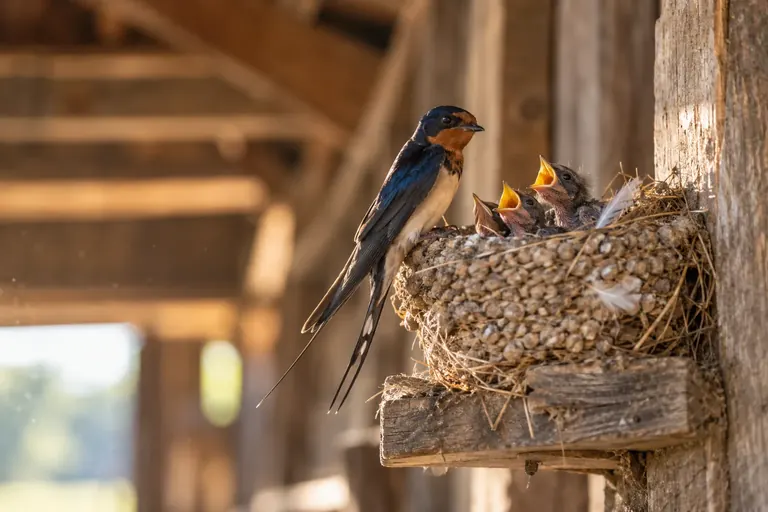
If swifts do not breed near you, support other aerial insect-eaters. In North America, purple martin houses and gourds serve a colonial swallow that accepts man-made housing readily. Barn Swallows nest on ledges in porches and outbuildings; see our barn swallow nest guide for nest cups and ledges. You can also report colonies to local swift groups and ask builders to protect nest holes during roof work.
Sources
- Chimney Swift life history, All About Birds, Cornell Lab of Ornithology
- Chimney Swift nesting tower guide, Texas Parks and Wildlife
- Swift nest box designs and call playback advice, Bristol Swifts
- Nest box and nest site advice, Swift Conservation Ireland
- Swift brick, Wikipedia
- Schwegler Lightweight Swift Box Type 1A, Living with Birds
- WoodStone Swift Nest Box, Vivara
- Handmade Swift Nest Box, Green Feathers
Gear mentioned in this guide
Vivara Pro WoodStone Swift Nest Box
A heavy concrete and wood fiber box designed for swifts, with a rear opening for inspection and a maker guarantee of 10 years.
- Best for
- Brick or block walls under the eaves where a durable, rot-proof box can stay up for decades.
- Skip it if
- You need a light box for a timber gable or cannot safely lift a heavy box to 16 feet or more.
- Size
- 405 x 290 x 269 mm (about 16 x 11.4 x 10.6 in)
- Material
- WoodStone (concrete and wood fiber)
- Access
- Rear opening for cleaning and inspection
Schwegler Swift Box 1A
A long, low woodcrete box developed with the German conservation group BUND, light enough for insulated walls and designed to be grouped for a colony.
- Best for
- Rendered or externally insulated walls, and anyone planning a row of boxes.
- Skip it if
- You want a box with a large inspection door or room for a camera.
- Size
- 34 x 13.5 x 15 cm (about 13.4 x 5.3 x 5.9 in)
- Weight
- About 2.7 kg (6 lb)
- Material
- Schwegler woodcrete
Green Feathers Handmade Swift Nest Box
A handmade larch box built with space for a nest box camera, supplied with screws and fixings.
- Best for
- People who want to watch a swift nest live and can mount a wooden box under a sheltered overhang.
- Skip it if
- Your wall faces full midday sun with no overhang, since a timber box heats up faster than a masonry one.
- Size
- 47 x 25 x 19 cm (about 18.5 x 9.8 x 7.5 in)
- Material
- Larch timber
- Camera
- Designed to take a nest box camera

Frequently asked questions
How high should a swift nest box be?
At least 16 feet (5 m) above the ground, and higher is better. Swifts drop out of the entrance before they gain flying speed, so they need height and a clear fall below the box. Mounting directly under the eaves or a roof overhang also shades the box. Swifts have nested lower, but a box below about 16 feet is far less likely to be used.
What size entrance does a swift nest box need?
An oblong slot about 30 x 65 mm (roughly 1.2 x 2.6 in) is the standard for Common Swifts. Reducing the height to about 28 mm helps keep starlings out. The slot usually sits on the underside or low on the front of the box, so the swift can drop straight out. Chimney Swift towers use a wide open top instead of a hole.
How long does it take swifts to use a new nest box?
Often two to five summers, sometimes longer. Young swifts prospect for nest sites a year or more before they breed, so a new box is usually found first by visiting birds in June and July. Playing swift calls near the box in early summer shortens the wait. Boxes placed close to an existing colony are occupied fastest.
Do Chimney Swifts use nest boxes?
Not ordinary boxes. Chimney Swifts cannot perch and must cling to a rough vertical surface, so they nest inside open masonry chimneys and purpose-built swift towers. A tower is a tall hollow wooden or masonry shaft, at least 8 feet high and ideally 12, with a textured inside wall about 14 inches across and an open top.
When should I put up a swift nest box?
Install it in fall, winter or early spring, well before swifts return. Common Swifts arrive in Europe from late April into May and leave by August, so a box fixed by early April is ready for prospecting birds that summer. Chimney Swift towers should be finished before the birds return from South America in spring.