How Do Owls Turn Their Heads So Far?
How do owls turn their heads so far? Up to 270 degrees, thanks to 14 neck vertebrae and blood vessels built to avoid being pinched. Here is the anatomy and why.
In this article
- Quick answer: owl neck rotation at a glance
- Can owls turn their heads 360 degrees?
- Why do owls have to turn their heads at all?
- How does an owl’s neck bend so far?
- Why doesn’t turning cut off the blood supply?
- What would happen if a person tried it?
- Is head rotation the same in every owl species?
- How do owls use this flexibility?
- How do owl eyes work in the dark?
- Do other birds turn their heads far?
- Myths and facts about owl heads
- What this means for backyard birders and owl watchers
- How can you watch this behavior yourself?
- Quick facts about owl head rotation
- Sources
- Frequently asked questions
How do owls turn their heads so far? Owls can rotate their heads up to about 270 degrees, roughly 135 degrees to each side, because they have 14 neck vertebrae instead of our 7, a single joint where the skull meets the spine, and blood vessels specially arranged so that twisting does not cut off blood to the brain. They need that flexibility because their huge eyes are fixed in place and cannot swivel in their sockets.
A 2013 study from Johns Hopkins University finally showed how the blood supply survives such extreme twisting. It is a neat piece of anatomy, and it also explains a lot of the head-bobbing and tilting you see when an owl looks at you.
Quick answer: owl neck rotation at a glance
| Question | Short answer |
|---|---|
| How far? | Up to about 270 degrees in total, roughly 135 degrees each way |
| Can they spin 360 degrees? | No, that is a myth |
| Why do they need to? | Their tubular eyes are almost immobile in the skull |
| Neck vertebrae | 14 in owls, 7 in humans and nearly all mammals |
| Skull-to-spine joint | One occipital condyle (a single pivot), versus two in mammals |
| Blood-flow protection | Roomy bony canals, blood-pooling reservoirs and cross-connections between arteries |
Can owls turn their heads 360 degrees?
No. An owl cannot spin its head all the way around. The real figure is up to about 270 degrees, which is still remarkable: an owl facing north can look over its left shoulder to the south-east or over its right shoulder to the south-west without moving its feet. Because it can go either way, the owl can effectively see everything behind it with a quick switch from one side to the other.
That switch can be so fast that it looks like a full spin. That is where the 360-degree myth comes from.
Why do owls have to turn their heads at all?
The short answer is their eyes.
Tube-shaped eyes
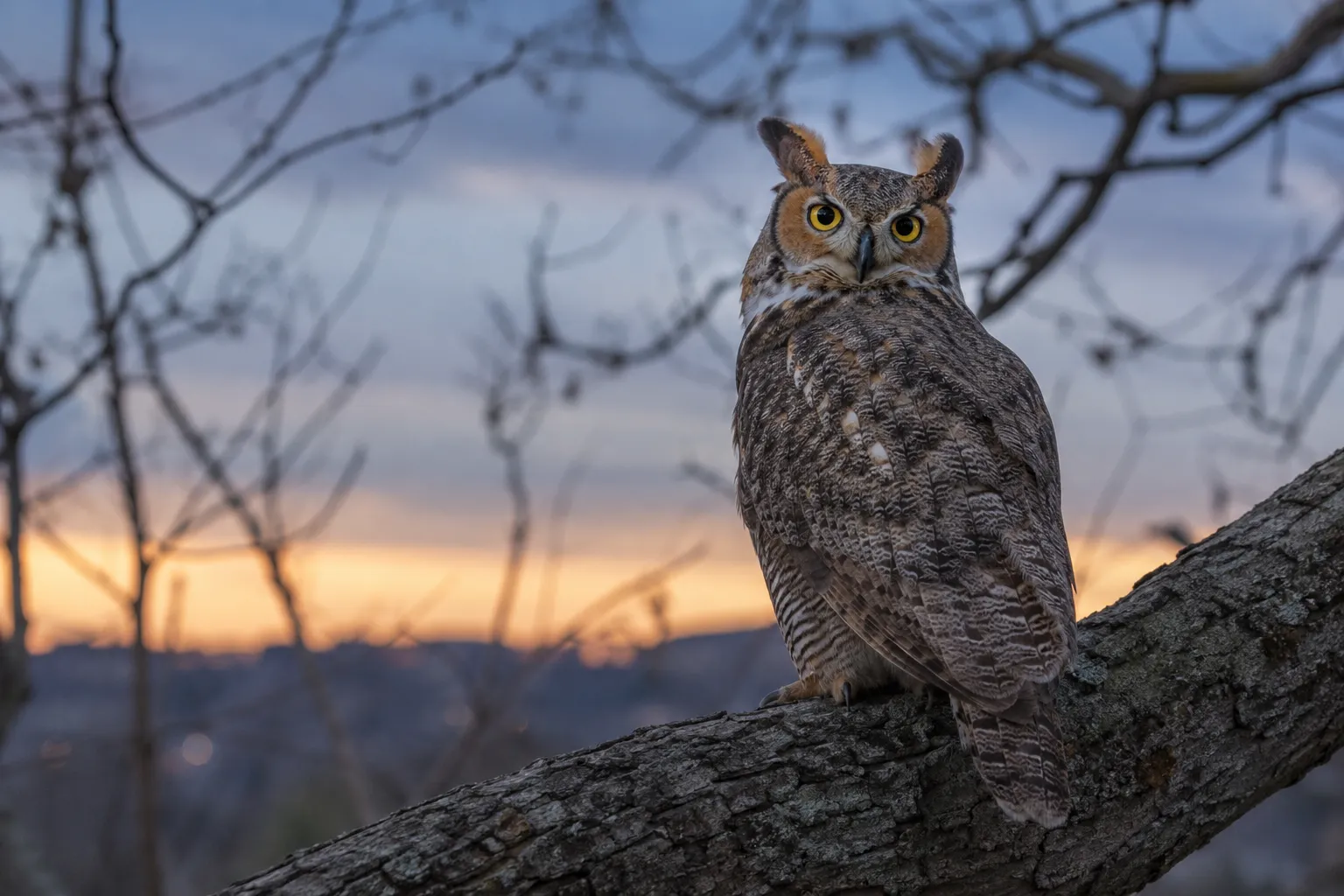
Most animals, including us, have roughly spherical eyeballs that roll in their sockets. Owl eyes are different. They are elongated, more like short tubes or cylinders, with a large cornea and lens at the front and a wide retina at the back. That shape packs a big light-gathering eye into a skull that has limited space, which helps owls see in dim light.
Held by bone
Owl eyes are held in place by sclerotic rings, rings of small bony plates in the wall of the eye. Many birds and reptiles have them, but in owls they are especially prominent and form a tube-shaped support. Combined with the eye’s shape, this leaves the eyes almost immobile. An owl can make only tiny eye movements.
Forward-facing vision
Owls’ eyes face forward, which gives a wide area of binocular vision where both eyes see the same scene. That improves depth perception, useful when judging a strike on a mouse. The trade-off is a narrower total field of view than, say, a pigeon or a duck, whose eyes sit on the sides of the head and cover almost the whole horizon.
Put those facts together and the logic is clear: with eyes fixed in place and aimed forward, the only way to look somewhere else is to move the whole head.
How does an owl’s neck bend so far?
Twice as many neck bones
Owls have 14 cervical vertebrae. Humans have 7, and so do nearly all mammals, including giraffes, whose neck bones are simply very long. More vertebrae mean more joints, and the twist can be spread across many small rotations rather than forced through a few.
Birds in general have more neck vertebrae than mammals, and the number varies widely between groups, from roughly 10 to more than 20 in swans. So owls are not unusual among birds for having many neck bones. What sets them apart is how the whole system, bone and blood supply, is tuned for extreme rotation.
A single pivot at the skull
Mammals have two rounded knobs, called occipital condyles, where the skull rests on the first vertebra. Birds have just one. A single condyle works more like a ball-and-socket pivot, allowing freer rotation. This is shared with other birds and with reptiles, and it contributes to the general head mobility of birds.
Flexible joints and muscles
The joints between the vertebrae, the ligaments and the arrangement of neck muscles all allow a large range of twisting and bending. Owls can not only rotate their heads, but also tilt them sideways and even turn them nearly upside down, which you often see in young owls peering at something unfamiliar.
Why doesn’t turning cut off the blood supply?
This is the really interesting part, and it puzzled scientists for a long time.
In humans, sudden, forceful twisting of the neck can injure the arteries that run through it, especially the vertebral arteries, which pass through small holes in the neck vertebrae. Damage to the lining of these arteries can lead to clots and strokes. Owls twist much further, every day, without harm.
In 2013, a team at Johns Hopkins University, led by medical illustrator Fabian de Kok-Mercado with neuroradiologist Philippe Gailloud, published a study in the journal Science that examined the necks of owls that had died of natural causes, including Snowy, Barred and Great Horned Owls. They injected dye into the blood vessels and used imaging and careful dissection to trace them. They reported several adaptations.
Wide bony canals
In owls, the vertebral artery runs through holes in the vertebrae (the transverse foramina) that are much wider than the artery itself. The study reported that in most of the neck vertebrae these holes are about ten times the diameter of the artery. The extra space, cushioned by surrounding tissue and air sacs, lets the artery move and slide instead of being stretched or pinned when the neck twists.
Extra slack
The researchers found that the vertebral artery enters the neck canal higher up the neck than in many other birds. That leaves a longer, looser section of artery lower down, giving slack for twisting.
Blood reservoirs at the base of the head
At the base of the skull, the researchers found that major arteries could widen into expandable pools. When the owl twists its head, flow through the neck may be partly restricted. These reservoirs are thought to store blood that keeps the brain and eyes supplied during the turn, and to refill when the neck straightens.
Cross-connections between arteries
Small connecting vessels, called anastomoses, link the carotid and vertebral arteries. If one route is squeezed during a turn, blood can reroute through another. Humans have far fewer routes of this kind, which is one reason a damaged neck artery can be so serious in people.
The lesson of the study is that an owl’s head-turning depends not just on bone, but on a blood supply built to tolerate being twisted.
What would happen if a person tried it?
Human necks are built for a much smaller range of motion. A typical adult can turn the head roughly 70 to 90 degrees to each side, and much of the movement happens at the joint between the first two vertebrae. Beyond that range, the bones, ligaments and blood vessels start to limit movement.
The vertebral arteries in people pass through tight bony holes in the neck vertebrae and bend around the top of the spine before entering the skull. Sudden, forceful twisting or overstretching, for example in a car crash or other trauma, can tear the inner lining of these arteries. That kind of injury, called a dissection, can lead to a clot and a stroke. It is uncommon, but it is exactly the kind of damage an owl’s neck seems designed to avoid.
This contrast is one reason the owl study drew attention from medical researchers. It did not produce a treatment, but it showed in detail how a vascular system can be arranged to tolerate extreme movement, which helps clinicians think about why human vessels are vulnerable.
Is head rotation the same in every owl species?
Most sources describe owls as a group as able to turn their heads up to about 270 degrees, and the anatomy behind it, 14 neck vertebrae, fixed tubular eyes and the adapted arteries, appears to be shared widely across owls. The 2013 study, however, examined a small number of individuals from a few North American species. Exact maximum angles have not been measured carefully for most of the roughly 250 owl species worldwide.
What you will notice in the field is that small owls often seem especially animated with their heads. Eastern Screech-Owls in North America, Little Owls in Europe and Burrowing Owls across the Americas often bob, swivel and tilt their heads when watching an observer. Large owls such as Great Horned Owls or Eurasian Eagle-Owls tend to move more slowly and deliberately, but they have the same flexible range.
How do owls use this flexibility?
Scanning without moving
An owl perched still in a tree is harder for prey and predators to spot than one shifting its body. A rotating head lets it scan all around while the body stays motionless and camouflaged.
Locating sound
Owls hunt largely by ear. Their facial disc gathers sound, and in some species the ear openings sit at different heights, which helps them pinpoint noises in three dimensions. Turning the head lines the face up with the sound source. See do birds have ears for how that works.
Judging distance with head bobs
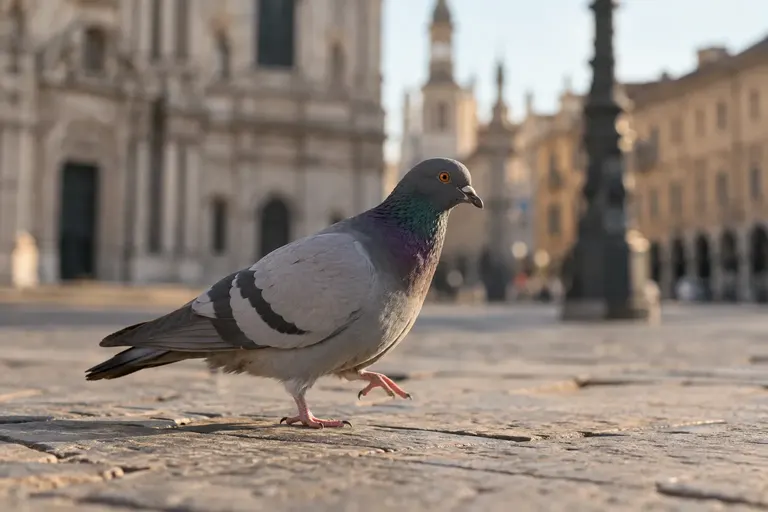
Owls often bob, sway or circle their heads when studying something. Because their eyes cannot move, moving the whole head gives them views from slightly different positions. That parallax helps them judge distance and depth. Pigeons use a different head movement for a related reason, which we explain in why pigeons bob their heads.
Flying quietly while looking
Owls must hear and watch while flying, which is one reason their flight is so quiet. Our guide to why owls are silent in flight explains the feather features behind it.
How do owl eyes work in the dark?
Head rotation makes sense only because owl eyes are so specialized for low light. Their large corneas and lenses gather as much light as possible, and the retina is dominated by rods, the photoreceptors that work in dim conditions. Owls have fewer cones, the cells used for color vision, than most daytime birds. That suggests they see color less richly than songbirds, although some owls likely retain some color vision. Our article on whether birds can see color explains how bird color vision normally works.
Owls are not blind in daylight, a common misconception. Many species hunt at dawn and dusk, and some, such as the Northern Hawk Owl and Burrowing Owl, are regularly active in full daylight. What they lack is the ability to move their eyes to track something, and that brings us back to the neck.
Do other birds turn their heads far?
Most birds have very mobile heads compared with mammals. Watch a sleeping duck or goose and you will see it tuck its bill into its back feathers, which requires turning the head right round. Many birds reach every part of their plumage with their bills during preening.
A few examples from around the world:
- Eurasian Wryneck. This small relative of woodpeckers, found across Europe and Asia, twists its head and neck in a slow, snake-like display when threatened, often with a hissing sound. The name comes from this behavior.
- Herons and bitterns. Long, flexible necks with many vertebrae let them strike quickly and aim their bills precisely.
- Swans. They have among the highest counts of neck vertebrae of any bird, allowing them to reach deep underwater while floating.
- Nightjars and frogmouths. Like owls, they rely on camouflage and stillness, but they generally depend on wide eye placement rather than extreme head rotation.
Owls stand out not because they are the only flexible-necked birds, but because they combine forward-fixed eyes, a strong need to scan while motionless, and a specialized blood supply.
Myths and facts about owl heads
| Claim | Reality |
|---|---|
| “Owls can turn their heads all the way around.” | False. About 270 degrees is the maximum. |
| “Owls have extra-long necks.” | Not really. Their necks look short because they are covered by dense feathers, but they have 14 vertebrae and a long, S-shaped neck underneath. |
| “Owls can move their eyes like we do.” | False. Their eyes are almost fixed in place. |
| “Owls twist their necks without any special adaptations.” | False. Their arteries and bony canals are specially adapted. |
| “Head bobbing means an owl is agitated.” | Not necessarily. It is often a way to judge distance. |
What this means for backyard birders and owl watchers
- An owl looking straight at you may be facing away. If you see an owl’s back, don’t assume it hasn’t noticed you.
- Head bobbing means it is studying something. It may be you. Stay still and keep your distance.
- Give owls space. Roosting owls are easily disturbed, and repeated flushing costs them energy and exposes them to mobbing by crows and jays. See our guide to birding etiquette and photography ethics.
- Watch at dusk. Many owls become active near sunset. For where birds spend their nights, see where birds go at night.
- Use good optics. An owl roosting in dense branches is easier to study with binoculars that handle dim light; our guide to how to choose binoculars explains what matters.
How can you watch this behavior yourself?
- Find a known roost. Local birders, eBird hotspot reports and nature centers often know where owls roost, but keep locations of sensitive owls private.
- Keep your distance. Watch from far enough away that the owl stays relaxed and does not stare at you or flatten its feathers.
- Watch at dusk. As light fades, owls wake, stretch, preen and begin scanning, which is when head turns are most frequent.
- Notice the pattern. Look for long, slow turns followed by stillness, sideways tilts, and bobbing when the owl focuses on a sound or movement.
- Leave quietly. Do not use playback near roosting owls, and never approach a nest.
Quick facts about owl head rotation
- Owls can rotate their heads up to about 270 degrees, not 360.
- Their tube-shaped eyes are held in place by bony sclerotic rings and barely move.
- Owls have 14 neck vertebrae; humans have 7.
- Birds have a single occipital condyle, a pivot that aids rotation.
- A 2013 Johns Hopkins study found owl neck arteries run through bony holes about ten times wider than the artery.
- Blood pools and cross-connections help keep the brain supplied during turns.
- Head bobbing helps owls judge distance.
Sources
Frequently asked questions
How far can an owl turn its head?
Most owls can rotate their heads up to about 270 degrees, which means roughly 135 degrees to either side of straight ahead. That lets an owl look directly behind itself over either shoulder. They cannot turn their heads a full 360 degrees; that is a popular myth. Many can also tilt the head sharply and even turn it nearly upside down.
Why do owls need to turn their heads so far?
Owls have very large, tube-shaped eyes that are held firmly in place by a ring of bone, so they can barely move their eyes in the sockets. To look in a new direction, an owl has to move its whole head. The flexible neck makes up for eyes that are fixed, letting the owl scan all around without moving its body.
How many neck bones do owls have?
Owls have 14 neck vertebrae, twice as many as humans, who have 7. Nearly all mammals, including giraffes, have 7 neck vertebrae. Birds as a group vary widely, from roughly 10 to more than 20 in long-necked species such as swans. The extra joints spread the twist across many small movements.
Why don't owls cut off blood to their brain when they turn their heads?
A 2013 study by researchers at Johns Hopkins University found several adaptations. The bony holes that carry an artery through the neck are much wider than the artery, leaving room to move. Blood vessels at the base of the head can expand to store blood, and connections between arteries allow blood to reroute if one path is squeezed.
Can owls move their eyes?
Only very slightly. Owl eyes are elongated tubes rather than spheres and are held in place by bony sclerotic rings. This design gives large, light-gathering eyes in a skull with limited space, but it means the eyes are almost immobile. Owls compensate by turning, tilting and bobbing their heads.
Can other birds turn their heads as far as owls?
Many birds have very flexible necks, and some can turn their heads close to 180 degrees or more, but owls are unusual in how far they can rotate. The Eurasian Wryneck, a relative of woodpeckers, is famous for twisting its head and neck in a snake-like display when threatened.