Do Birds Have Hollow Bones?
Do birds have hollow bones? Many do: air-filled, braced bones linked to the lungs. Yet bird bones are dense, and diving birds have solid ones. Here is why.
In this article
- Quick answer: do birds have hollow bones?
- What does “hollow” actually mean in a bird bone?
- Which birds have the most hollow bones?
- Are bird bones really lighter than mammal bones?
- Where do birds save weight, if not in bone?
- What is inside a bird bone besides air?
- Did dinosaurs have hollow bones too?
- Myths and facts about bird bones
- How can scientists tell if a bone is hollow?
- Do bones become hollow as a bird grows?
- How does a bird skeleton compare with a human skeleton?
- Do hollow bones do anything else?
- Why do diving birds have solid bones?
- How strong are bird bones?
- What does this mean for backyard birders?
- Quick facts
- Sources
- Frequently asked questions
Yes, many birds have hollow bones, but not all bones, not all birds, and not in the simple way most people imagine. Some bird bones are “pneumatized,” meaning they are filled with air from the respiratory system instead of marrow, and they are braced inside by thin struts. Yet a 2010 study by Elizabeth Dumont found bird bones are actually denser than mammal bones, and diving birds such as penguins have mostly solid bones. The real secret of the bird skeleton is smart engineering, not simply less bone.
That nuance matters because “birds have hollow bones so they are light enough to fly” is one of the most repeated bird facts in the world, and it is only partly right.
Quick answer: do birds have hollow bones?
- Some of them. Certain bones in many birds are air-filled and connected to the air sacs of the lungs.
- Which bones varies. The upper arm bone (humerus), parts of the spine and the skull are commonly air-filled. Leg bones are often filled with marrow, though some large birds have air in them too.
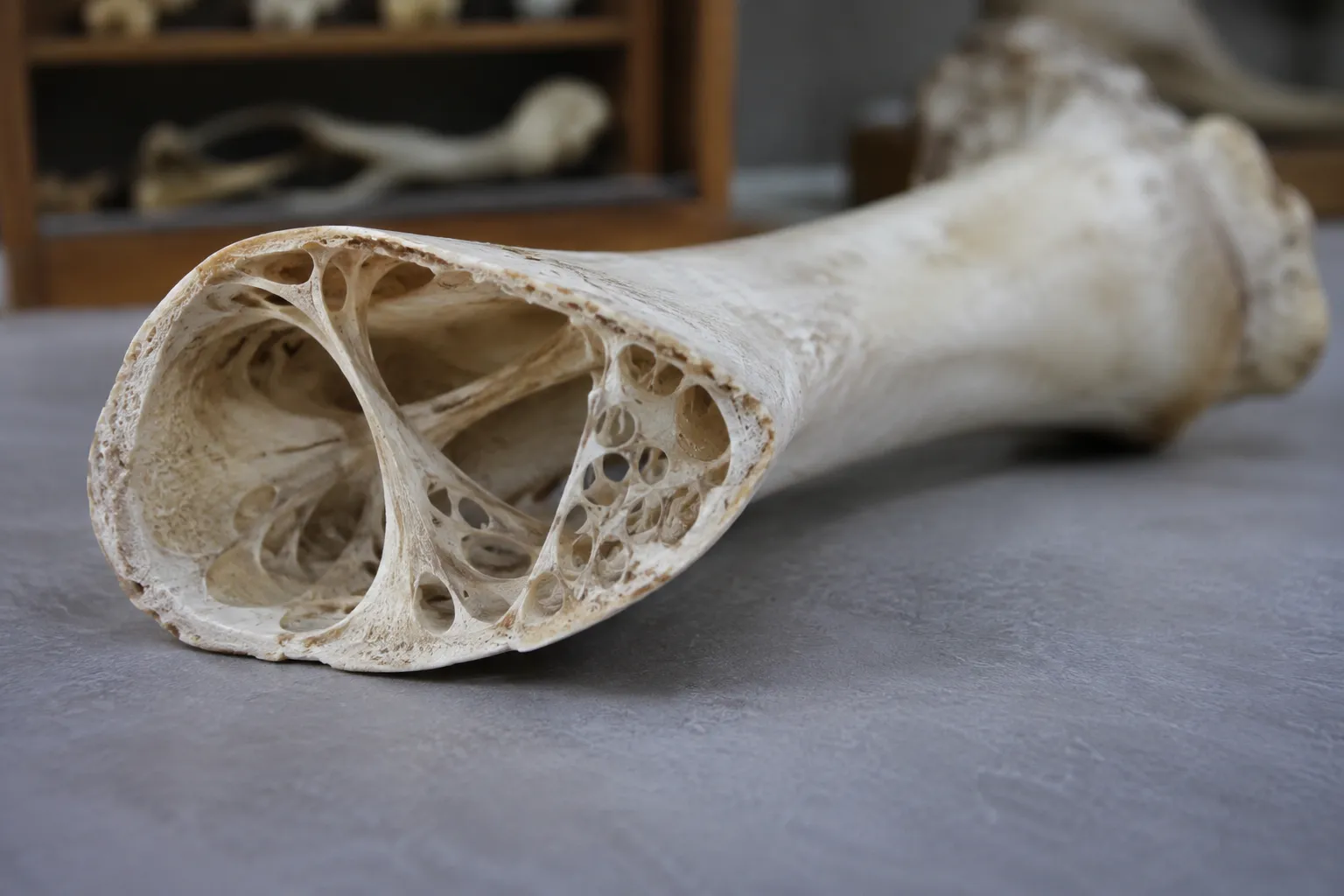
- Not empty tubes. Hollow bones are crossed by struts and a lattice of fine bone that add strength.
- Not lighter overall. Research suggests bird skeletons weigh about as much, relative to body size, as those of similar-sized mammals.
- Diving birds differ. Penguins, loons and many diving ducks have reduced air spaces or solid bones, which helps them stay underwater.
What does “hollow” actually mean in a bird bone?
Bird bones come in two broad types.
What are pneumatic bones?
Pneumatic bones contain air spaces connected to the respiratory system. During development, thin-walled extensions of the air sacs, called diverticula, grow into certain bones and replace much of the marrow. The result is a bone with a thin, hard outer wall and an air-filled interior. Many of these bones have internal struts, called trabeculae, running across the cavity, like cross-bracing in a bridge or the ribs inside an airplane wing.
What are non-pneumatic bones?
These bones are filled with marrow, like most mammal bones. They may still have thin walls and a large central cavity, but that cavity holds tissue rather than air. In many birds, the leg bones and the bones of the lower wing are of this type.
How do the air sacs connect to the bones?
Birds have a system of air sacs, usually nine in total, that act as bellows for the lungs. Some of them send extensions into bones. For example, the clavicular air sac often connects to the humerus through an opening near the shoulder. Air in the bones is not used for gas exchange in a significant way; it simply fills space. For the full picture of how this system moves air, see how birds breathe.
Which birds have the most hollow bones?
Pneumaticity varies a lot across species, and it tends to follow lifestyle and body size.
| Bird type | Typical bone pneumaticity | Likely reason |
|---|---|---|
| Large soaring birds (pelicans, vultures, storks, albatrosses) | Extensive, often including leg bones | Large bodies benefit from wide, stiff bones without extra mass |
| Hornbills | Extensive, reported to include many bones throughout the skeleton | Uncertain; linked to large size and possibly display or thermoregulation |
| Small songbirds | Limited, often mainly skull and humerus | Small bones are already strong for their size |
| Penguins | Largely absent | Solid, dense bones reduce buoyancy for diving |
| Loons and many diving ducks | Reduced | Denser skeleton helps with diving |
| Hummingbirds | Limited | Very small body size |
Scientists have found that, broadly, larger birds tend to have more pneumatic bones, and diving birds tend to have fewer. Brown Pelicans are a well-known extreme, with air spaces not only in many bones but also beneath the skin, which may cushion them when they plunge into water.

Are bird bones really lighter than mammal bones?
This is where the popular story breaks down.
What did research on bone density find?
A study published in 2010 in Proceedings of the Royal Society B by Elizabeth Dumont compared the skull, humerus and femur of songbirds, bats and rodents. She found that bird bones were, on average, denser than those of the mammals, not less dense. She also noted that earlier work had shown bird skeletons make up about the same proportion of body mass as mammal skeletons of similar size.
Her interpretation: birds did not get light by having less bone. Instead, they use dense bone arranged efficiently. A hollow, thin-walled tube is much more resistant to bending and twisting than a solid rod of the same mass, which is why bicycle frames and aircraft struts are tubes. For a flying animal, whose wing bones face strong twisting forces with every stroke, that is exactly the right design.
So why do people say birds have light skeletons?
Partly because it sounds logical, and partly because a dried bird skeleton does look delicate. A few extreme cases are often quoted, such as the claim that a Magnificent Frigatebird’s feathers weigh more than its skeleton. That claim appears in many references, but it comes from older measurements, and the exact figures should be treated with caution.
The more accurate way to put it: birds have skeletons that are strong and stiff for their weight, with weight saved in many other ways across the body.
Where do birds save weight, if not in bone?
Flight rewards low weight, and birds trim it in several places:
- No teeth and no heavy jaw. A lightweight keratin beak replaces teeth and heavy jaw muscles, with grinding moved to the gizzard, near the center of gravity. Read more in do birds have teeth.
- Fused bones. Many bones that are separate in other vertebrates are fused in birds. The collarbones fuse into the wishbone (furcula), the hip and lower spine fuse into the synsacrum, the tail vertebrae end in a fused pygostyle, and hand bones fuse into the carpometacarpus. Fusion creates a rigid frame without heavy joints and muscles.
- Simplified reproduction. Most female birds have only one working ovary, usually the left, and the reproductive organs shrink dramatically outside the breeding season in many species.
- Egg laying. Developing young outside the body in eggs avoids carrying a growing fetus during flight.
- Efficient lungs. The air sac system provides very efficient breathing with relatively small, rigid lungs.
- Quick digestion. Many birds process food quickly, which reduces the mass of food carried in the gut.
What is inside a bird bone besides air?
What is medullary bone?
Female birds have a special tissue called medullary bone. In the weeks before egg laying, they lay down this calcium-rich bone inside the marrow cavities of certain bones, commonly the leg bones. It acts as a calcium store for building eggshells and is drawn down rapidly as eggs are produced. Medullary bone has even been reported in some dinosaur fossils, where it has been used to identify females, although some of those identifications have been debated.

Do birds still make blood cells?
Yes. Birds make blood cells in bone marrow in their non-pneumatic bones, much as mammals do.
Did dinosaurs have hollow bones too?
Yes, many did, and this is one of the clearest links between birds and their ancestors.
Theropod dinosaurs, the group that includes Tyrannosaurus, Velociraptor and the ancestors of modern birds, had air-filled bones, especially in their vertebrae. Sauropods, the long-necked giants such as Brachiosaurus, also had extensively air-filled vertebrae, which likely made their huge necks much lighter than solid bone would allow. Pterosaurs, the flying reptiles, had thin-walled, air-filled bones as well.
This suggests that air-filled bones and an air sac system evolved long before flight in the bird lineage. Hollow bones were not “invented for flying,” though birds clearly put them to good use.
Myths and facts about bird bones
| Claim | What the evidence says |
|---|---|
| All bird bones are hollow. | False. Only some bones are air-filled, and many are filled with marrow. |
| Bird bones are fragile. | Partly false. They are dense and strong for their size, though thin walls can snap under sharp impacts. |
| Hollow bones evolved for flight. | Probably false as a sole explanation. Non-flying dinosaurs had them too. |
| Birds have lighter skeletons than mammals. | Mostly false. Skeleton mass relative to body mass is similar in birds and mammals of the same size. |
| Penguins have hollow bones like other birds. | False. Penguin bones are largely solid, which helps with diving. |
| Hollow bones are empty tubes. | False. Many contain internal struts and fine bony lattices. |
How can scientists tell if a bone is hollow?
Pneumatic bones usually have a telltale opening called a pneumatic foramen, a small hole in the bone surface where an air sac extension entered. On a bird humerus, it is often found near the shoulder end. Inside, the bone has a thin wall and an open, strut-crossed cavity.
These openings survive in fossils, which is how paleontologists know that many dinosaurs had air-filled bones. By mapping which vertebrae and limb bones have foramina, researchers can infer where air sacs sat in extinct animals, even though the soft tissue itself is long gone. That evidence was central to the 2005 Nature study by O’Connor and Claessens, which argued that meat-eating dinosaurs had an air sac arrangement much like that of living birds.
Modern tools add detail. CT scanning lets researchers see inside bones without cutting them, measuring wall thickness and the density of internal struts in museum specimens of both living and extinct species.
Do bones become hollow as a bird grows?
Generally, yes. In many birds, bones start out filled with marrow in the chick, and air sac extensions invade them gradually as the bird grows. The pattern and timing differ between species and between bones, and not every bone that could become pneumatic does so in every individual. In some species, the degree of pneumaticity can even vary between the left and right sides of the same bird.
This helps explain why describing a species as simply “hollow-boned” misses the detail. Pneumaticity is a developmental process shaped by body size, lifestyle and ancestry.

How does a bird skeleton compare with a human skeleton?
Birds and humans share the same basic vertebrate plan, but birds have reshaped it for flight and for walking on two legs.
| Feature | Bird | Human |
|---|---|---|
| Air-filled bones | Common in parts of the skeleton | Only air spaces in the skull, such as the sinuses |
| Collarbones | Fused into a wishbone (furcula) | Two separate clavicles |
| Breastbone | Usually a large keel anchoring flight muscles | Flat sternum |
| Hand | Reduced digits, with bones fused into the carpometacarpus | Five separate fingers |
| Tail | Short, ending in a fused pygostyle that supports tail feathers | Small fused coccyx |
| Hip and lower spine | Fused into a rigid synsacrum | Separate vertebrae and pelvis |
| Neck vertebrae | Often many more than seven, very flexible | Seven |
| Teeth | None in living birds | Present |
Interestingly, humans also have air-filled bones of a sort: our sinuses are air spaces inside skull bones. They are not connected to a flow-through breathing system, though.
Do hollow bones do anything else?
Researchers have proposed other roles for skeletal air spaces, but the evidence is thinner than for the mechanical and developmental explanations. Ideas include helping with heat loss in large birds, reducing the energetic cost of building and maintaining bone tissue, and, in plunge-diving birds such as pelicans and gannets, cushioning impacts along with air spaces under the skin. Treat these as hypotheses under study rather than settled facts.
Why do diving birds have solid bones?
Air is buoyant. A bird full of air spaces floats easily and must work hard to stay underwater. Penguins, which cannot fly and spend much of their lives swimming, have dense, largely solid bones that reduce buoyancy and save energy on dives. Loons, grebes, cormorants and many diving ducks show reduced pneumaticity as well. Some diving birds also press air out of their plumage before diving.
It is a neat example of trade-offs. A solid skeleton helps a diver but would be a burden for a soaring pelican, and vice versa. For more on how water birds handle life in water, see why ducks do not get wet.
How strong are bird bones?
Strong for their weight, but with limits. Thin-walled bones resist bending and twisting well, which suits the stresses of flight. Hummingbirds, which beat their wings extremely fast, rely on a stiff skeleton to anchor powerful flight muscles, as described in how hummingbirds hover. Woodpeckers have their own skull adaptations for hammering, explored in why woodpeckers do not get headaches.
Yet a sharp impact, such as a window strike or a cat’s bite, can still fracture a bird’s bone, and thin-walled bones can splinter. Because some bones connect to the air sacs, a fracture can also let air escape or disrupt breathing, which is why injured birds need specialist care.
What does this mean for backyard birders?
The anatomy has a few practical consequences:
- Handle birds gently and minimally. If you must move an injured bird, support its body loosely in a towel and place it in a ventilated box. Do not squeeze its chest, since birds need to move their ribs and breastbone to breathe.
- Do not splint a wing yourself. Bird bones heal quickly but often in the wrong position if not set correctly. Contact a licensed wildlife rehabilitator. Our guide on what to do with an injured bird walks through the steps.
- Prevent window strikes. Collisions are a major cause of injury. Marking windows is one of the most effective ways to protect birds, as explained in how to stop birds hitting windows.
- Support egg-laying females. In spring, females need calcium for medullary bone and eggshells. Some people offer crushed, baked eggshell near feeders; check local guidance first, especially regarding disease hygiene.
Quick facts
- Many birds have some air-filled, or pneumatic, bones connected to their air sacs.
- Pneumatic bones are braced by internal struts rather than being empty tubes.
- Which bones are hollow varies by species; large soaring birds have the most.
- Penguins and many diving birds have largely solid bones to reduce buoyancy.
- Bird bones are, on average, denser than mammal bones.
- Bird skeletons weigh about the same fraction of body mass as similar-sized mammal skeletons.
- Many dinosaurs and pterosaurs had air-filled bones too.
- Female birds store calcium for eggshells in special medullary bone.
Sources




Frequently asked questions
Are all bird bones hollow?
No. Only some bones are air-filled, and which ones varies by species. Large soaring birds such as pelicans and vultures tend to have many air-filled bones, while small songbirds have fewer. Penguins and many other diving birds have largely solid bones. Even in hollow bones, the space is usually braced by internal struts rather than being an empty tube.
Are bird bones lighter than mammal bones?
Not in the way people assume. A 2010 study found that bird bones are, on average, denser than mammal bones, and that birds' skeletons weigh about the same fraction of body mass as those of similar-sized mammals. The advantage is in shape and strength: thin-walled, air-filled tubes resist bending and twisting very well for the bone mass used.
Why are bird bones hollow?
Air-filled bones are part of the bird respiratory system. Extensions of the air sacs invade certain bones, replacing marrow with air. Scientists think this lets birds build wide, stiff bones without extra weight, and may reflect the evolution of the air sac system itself. Many dinosaurs, including large non-flying species, also had air-filled bones.
Can a bird breathe through a broken wing bone?
In birds whose humerus is connected to an air sac, air can move through a fracture in that bone, and wildlife vets are aware of this. It is one reason a bird with a broken wing needs professional care rather than home treatment. The idea that a bird can breathe normally through a broken bone with its airway blocked is an oversimplification.
Do dinosaurs have hollow bones like birds?
Many did. Theropod dinosaurs, the group that includes Tyrannosaurus and the ancestors of birds, had air-filled bones, especially in their vertebrae. Sauropods such as Brachiosaurus also had heavily air-filled vertebrae, which helped lighten their enormous necks. Pterosaurs, which were flying reptiles rather than dinosaurs, had air-filled bones too.