Why Do Pigeons Bob Their Heads When They Walk?
Why do pigeons bob their heads when they walk? To keep their vision steady: the head locks still in space while the body catches up, then snaps forward again.
In this article
- Quick answer: how pigeon head bobbing works
- What is actually happening when a pigeon bobs its head?
- How did scientists prove bobbing is about vision?
- Why don’t pigeons just move their eyes like we do?
- How does a pigeon’s brain control head bobbing?
- Which other birds bob their heads?
- Is pigeon head bobbing the same as other bird “bobbing”?
- Myths vs facts about head bobbing
- Where did city pigeons come from?
- What does this mean for backyard birders?
- Quick facts
- Sources
- Frequently asked questions
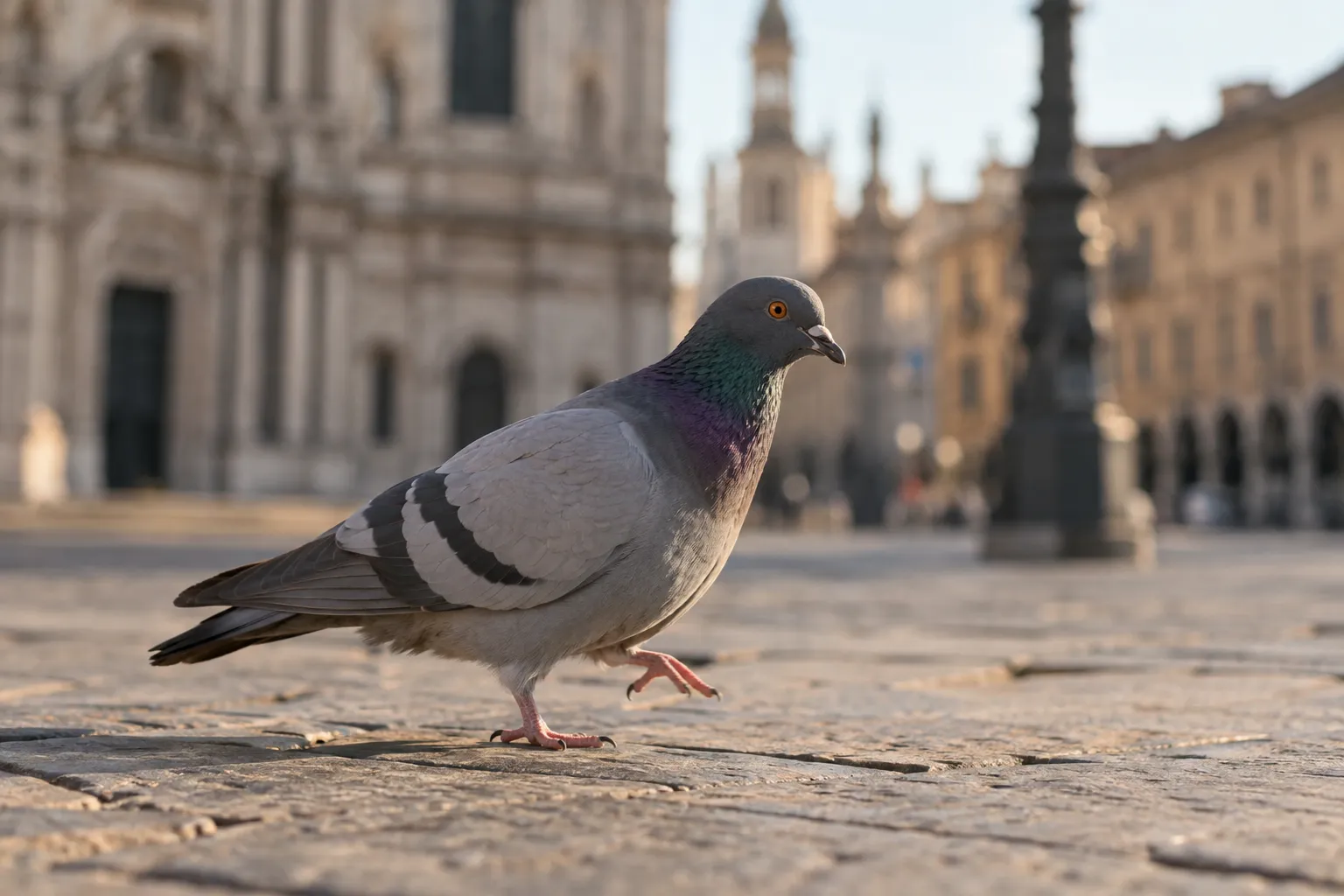
Why do pigeons bob their heads when they walk? To keep their vision steady, as a 1978 treadmill experiment by Barrie Frost showed. The head is not really bobbing back and forth: it thrusts forward, then locks in place in space while the body walks underneath it, then thrusts forward again. During each still moment, the eyes get a sharp, stable image of the ground and surroundings, which helps a pigeon spot food, predators and other pigeons.
This explanation was confirmed by a neat experiment in the 1970s, and it turns out that pigeons are doing something very similar to what your own eyes do every second you are awake. Here is how the motion works, how scientists proved it, which other birds do it, and some common myths.
Quick answer: how pigeon head bobbing works
- It is a hold-and-thrust cycle. The head stays nearly still relative to the ground (the hold phase), then quickly moves forward (the thrust phase).
- It is linked to steps. Each step of the feet is paired with one head thrust, so the rhythm matches the walk.
- It is visual, not about balance. Pigeons on a treadmill with nothing moving past their eyes stop bobbing.
- It gives stable images. A still eye sees fine detail and detects moving objects much more easily.
- Humans do the same with eye movements. We hold our gaze, then jump. Pigeons move the whole head because their eyes move very little.
What is actually happening when a pigeon bobs its head?
Watch a pigeon walking across a plaza, and the head seems to jerk back and forth like a piston. Slow-motion footage shows something different.
What is the hold phase?
In the hold phase, the pigeon’s head stays almost perfectly fixed in position relative to its surroundings. The body continues to walk forward, and the neck gradually folds, so the body “catches up” with the head. To a watcher this looks like the head sliding backward, but it is not moving backward at all. It is simply staying where it was while everything else moves.
Research by Nikolaus Troje and Barrie Frost, published in the Journal of Experimental Biology in 2000, measured head position in walking pigeons with high precision. They found that the head was held remarkably steady during the hold phase, with only small drift, which is consistent with the head being actively stabilized against visual motion.
What is the thrust phase?
In the thrust phase, the neck extends and the head moves rapidly forward to a new position ahead of the body. The thrust is fast, so it takes up only part of the cycle, and the eye is moving during it. Then a new hold begins.
How does bobbing sync with walking?
The two phases are coordinated with the legs. Typically one thrust occurs per step, so a pigeon walking briskly produces a quick rhythm of thrusts and holds. When a pigeon speeds up, the pattern adjusts. When it stops walking, the bobbing stops too.
How did scientists prove bobbing is about vision?
For a long time people offered several explanations: balance, momentum, a quirk of neck anatomy, or signaling to other pigeons. Two lines of experiments settled the main question.
What did the treadmill experiment show?
In a study published in 1978 in the Journal of Experimental Biology, Barrie Frost trained pigeons to walk on a treadmill. The key detail was that the scene around the birds stayed still relative to them. The pigeon walked, but because the treadmill carried it backward at the same speed, its head was not moving through the world, and the view in front of its eyes did not change.
In that situation, the pigeons did not bob their heads. Their legs moved normally, so balance and gait were unchanged. What was missing was the scene sliding past the eyes. That strongly indicated that head bobbing is an optokinetic response, meaning it is driven by the motion of the visual scene.
Earlier work in the 1930s, and later experiments with moving visual surroundings, pointed the same way: when the visual world moves relative to the bird, the head tends to track it; when the world is still relative to the eyes, the bird does not need to bob.
Why does keeping the head still help a pigeon see?
When an image moves across the retina, it blurs. Think of taking a photo from a moving car without a fast shutter: detail smears. Photoreceptors need a brief moment of stability to register fine detail.
A stable head gives the pigeon’s eyes that moment. During each hold phase, the scene is effectively frozen on the retina, which helps with several tasks.
- Seeing detail. Seeds, crumbs and small insects on the ground are easier to pick out in a steady image.
- Spotting motion. When the background is still, anything that moves, such as a hawk, a cat or a rival pigeon, stands out. Detecting movement against a moving background is much harder.
- Judging where things are. A steady view may help the bird localize objects before it pecks.
Does the thrust phase help with depth perception?
Possibly. Pigeons have eyes on the sides of their heads, giving them a very wide field of view but limited overlap between the two eyes. That means less of the binocular depth perception humans rely on.
One hypothesis is that the rapid forward thrust produces motion parallax, where nearer objects shift more in the visual field than distant ones. That shift can be used to estimate distance. This idea is plausible and has some support, but it is less firmly established than the image-stabilization explanation. It is fair to say the hold phase is clearly for stable vision, and the thrust phase may add depth information as a side benefit.
Why don’t pigeons just move their eyes like we do?
Here is where the comparison with humans gets interesting.
When you walk, read or look around a room, your eyes do not glide smoothly. They make rapid jumps called saccades, several times a second, with short pauses called fixations in between. You take in detailed information mainly during the fixations. Your brain also runs reflexes that keep your gaze steady while your head moves, so the world does not seem to bounce as you walk.
Pigeons have the same basic need but a different toolkit:
| Humans | Pigeons | |
|---|---|---|
| Eye position | Forward-facing | Sides of the head |
| Eye movement | Large, free rotation in the socket | Limited movement |
| How gaze is stabilized when walking | Eye movements and reflexes | Head movements (bobbing) |
| Fast shift between views | Saccade of the eye | Thrust of the head |
| Stable viewing period | Fixation | Hold phase |
Bird eyes are large relative to the skull, and in many species they are tightly fitted in the orbit, so they cannot rotate as much as ours. Birds compensate with flexible necks, which have more vertebrae than a mammal’s neck. The pigeon’s head bob is essentially a saccade-and-fixation strategy performed by the neck.
How does a pigeon’s brain control head bobbing?
Keeping the head still while the body moves takes constant, fast feedback. Two systems work together.
What role does the inner ear play?
The vestibular system in the inner ear senses rotation and acceleration of the head. In birds, as in people, it drives reflexes that push the head or eyes in the opposite direction to unwanted movement. In birds the reflex that acts on the neck is called the vestibulocollic reflex. It is the main reason a held chicken can keep its head nearly motionless while its body is moved around.
How does the eye detect that the world is slipping?
The second system reads optic flow, the overall sliding of the visual scene across the retina. Pigeons have been a model species for this research. Work by Barrie Frost, Douglas Wylie and colleagues over several decades showed that two small regions in the pigeon’s midbrain, the nucleus of the basal optic root and the pretectal nucleus lentiformis mesencephali, contain neurons that respond strongly to large patterns moving in particular directions. These areas are thought to help detect when the whole scene is drifting, which is exactly the signal a walking pigeon needs to keep its head locked in place.
Why does bobbing need both systems?
The inner ear responds quickly but cannot tell the bird where it is relative to the ground. Vision is slower but tells the bird whether the scene is actually steady. Combining the two lets the pigeon hold its head still during the hold phase and correct small drifts. The treadmill experiment removed the visual signal of forward motion, and bobbing disappeared, which fits this picture well.
Which other birds bob their heads?
Pigeons are the famous example, but they are far from the only ones.
Doves
All pigeons and doves belong to the same family, Columbidae, and head bobbing while walking is typical across the group. In North America, the Mourning Dove bobs as it walks under feeders, as do Eurasian Collared-Doves in much of Europe, the Middle East and now North America. You can learn more about the species in our guide to attracting Mourning Doves.
Chickens and other gamebirds
Chickens bob when they walk, and they are also famous for another kind of head stabilization. If you hold a chicken and gently move its body up, down or sideways, its head stays almost perfectly still in space. That is the same principle, gaze stabilization through the neck, shown in a dramatic way.
Cranes, herons and shorebirds
Head bobbing during walking has been reported in a range of other ground-foraging birds, including some cranes, herons, rails and shorebirds. Herons stalking fish in shallow water often move their heads in a smooth or stepwise way that keeps the eyes steady while scanning the water.
Which birds don’t bob?
- Ducks and geese walk with a side-to-side waddle and do not show the classic pigeon bob.
- Most small songbirds hop rather than walk, so their heads and bodies move together in short jumps. Some, such as starlings and crows, walk with alternating steps.
- Hovering birds, such as kestrels, do not bob at all. Instead they hold their heads astonishingly still while the wings and body adjust to the wind. This is the same goal, a stable view, achieved by a different method.
Is pigeon head bobbing the same as other bird “bobbing”?
Not always. Several birds make bobbing or dipping motions that have nothing to do with walking.
- American Dippers and White-throated Dippers of Europe bob their whole bodies up and down on rocks in streams. The function is debated; ideas include communication in noisy water and signaling to predators.
- Spotted Sandpipers in the Americas and Common Sandpipers in Eurasia teeter their rear ends up and down. Again, the purpose is not fully settled.
- Wagtails pump their tails, which may serve to flush insects or signal alertness.
- Many birds bob their heads during courtship. Male pigeons bow and coo while puffing out their necks, which is a display rather than a vision behavior.
These are separate behaviors with different explanations. When you see a pigeon or dove bobbing rhythmically as it walks, though, you are seeing gaze stabilization.
Myths vs facts about head bobbing
| Claim | Verdict | Explanation |
|---|---|---|
| Pigeons bob to keep their balance. | False | Treadmill birds walked normally without bobbing. |
| The head moves backward during each step. | False | The head stays still in space; the body walks forward under it. |
| Pigeons bob because they can’t see well. | Misleading | They bob to see well. Pigeons have good vision and excellent motion detection. |
| All birds bob their heads when walking. | False | Ducks, geese and most hopping songbirds do not. |
| Bobbing is only about depth perception. | Partly | The main, well-supported function is image stabilization; depth cues may be a secondary benefit. |
| Pigeons bob in time with music. | Not established | Viral videos show birds moving to beats, notably some parrots, but walking head bobs are tied to steps and vision. |
Where did city pigeons come from?
The pigeons in most city squares are Rock Pigeons, also called Rock Doves or feral pigeons. The wild ancestor lives on sea cliffs and rocky gorges across parts of Europe, North Africa and western Asia. People domesticated it thousands of years ago for food, messages and sport, and escaped domestic birds formed the feral populations now found on nearly every continent. In North America, the Rock Pigeon was brought over by European settlers in the early 1600s.
That history matters for our topic. A bird whose ancestors foraged for seeds on open ground, while watching for falcons, benefits greatly from sharp detail and quick motion detection. Head bobbing fits that lifestyle well.
Pigeon vision has been studied intensively, partly because pigeons are easy to keep and train. They have been taught to discriminate complex images in laboratory experiments, and they have a wide visual field. They are also known for navigation and homing, a topic we cover in how birds know where to migrate.
What does this mean for backyard birders?
Why do doves under my feeder look so jerky?
Mourning Doves and collared-doves walk slowly while they pick seed off the ground. The jerky motion is the same hold-and-thrust pattern. Each hold is when the bird gets a clear look at the ground and checks for danger. If you see a dove suddenly freeze in a hold phase and then flush, it probably detected movement, such as a hawk overhead. Our guide to stopping hawks from hunting at your feeder has tips for giving ground feeders better cover.
Can I use head bobbing to identify birds?
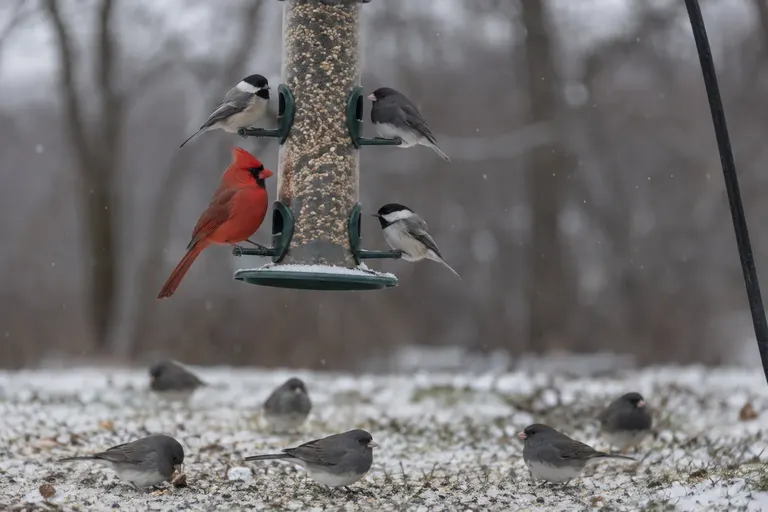
It helps as a clue. A bird walking with a steady pigeon-style bob is often a dove, pigeon or gamebird. A bird hopping with both feet together is more likely a sparrow, junco or finch. Walking versus hopping is one of the behavior clues we recommend in how to identify birds, and paying attention to movement can help when the light is poor. For more on interpreting what birds are doing, see reading bird behavior.
Does head bobbing affect photography?
Yes. If you photograph walking doves or pigeons, time your shot for the hold phase. The head is stationary then, so you have a better chance of a sharp eye even at modest shutter speeds. During the thrust, the head moves fast enough to blur. Our guide to photographing birds through a window covers settings for backyard shots.
Quick facts
- Pigeon head bobbing is a hold-and-thrust cycle, not a true back-and-forth motion.
- The head stays nearly fixed in space during the hold phase.
- One head thrust usually accompanies each step.
- A 1978 treadmill experiment showed that pigeons do not bob when the visual scene is not moving past them.
- The main function is stabilizing the image on the retina for detail and motion detection.
- Humans achieve the same with eye movements called saccades and fixations.
- Doves, chickens and several other ground-walking birds bob; ducks and most hopping songbirds do not.
- Rock Pigeons were introduced to North America in the early 1600s.
Sources
- Frost, B. J. (1978). The optokinetic basis of head-bobbing in the pigeon. Journal of Experimental Biology
- Troje, N. F. and Frost, B. J. (2000). Head-bobbing in pigeons: how stable is the hold phase? Journal of Experimental Biology
- Cornell Lab of Ornithology, All About Birds: Rock Pigeon
- Audubon Guide to North American Birds: Rock Pigeon
Frequently asked questions
Do pigeons bob their heads to keep their balance?
No. Experiments in the 1970s put pigeons on a treadmill surrounded by a stationary scene. The birds walked normally but did not bob, because their surroundings were not moving past their eyes. That result showed head bobbing is driven by vision, not balance. The head holds still so the eyes get a stable image, then jerks forward to catch up with the body.
Is the pigeon's head actually moving backward?
No, it only looks that way. During the hold phase the head stays nearly fixed in space while the body walks forward beneath it. Because the body keeps moving, the head appears to slide backward relative to the body. Then the neck extends and the head thrusts forward to a new fixed position, ready for the next hold.
Do pigeons bob their heads when they fly?
No. The walking bob is tied to the rhythm of footsteps and to the scene sliding past the eyes at walking speed. In flight, pigeons and other birds stabilize their heads and gaze in other ways, and the familiar forward-and-hold pattern is not seen. Birds standing still do not bob either unless they are reacting to something.
What other birds bob their heads like pigeons?
Head bobbing while walking is common in doves, chickens and other gamebirds, and has been described in some cranes, herons, shorebirds and rails. Many birds do not do it, including ducks and geese, which have a waddling gait, and most small songbirds, which hop rather than walk. The pattern appears mainly in birds that walk with alternating steps while watching the ground.
Why don't humans bob their heads when we walk?
We stabilize our vision with our eyes instead of our heads. Human eyes rotate freely in their sockets, holding steady on a target and then jumping to the next with quick movements called saccades. Pigeons have large eyes that move only a little, so they achieve the same result by moving the whole head. The strategy is the same; the body part is different.