Why Do Birds Peck at Car Mirrors? And How to Stop It
Why do birds peck at car mirrors? They see their reflection as a rival bird invading their territory. Learn why it happens in spring and how to stop it safely.
In this article
- Quick answer: what is going on?
- Why do birds attack their own reflection?
- Why car mirrors in particular?
- Which birds peck at car mirrors?
- When does mirror pecking happen, and how long does it last?
- Is it a male or a female doing it?
- Does pecking at mirrors hurt the bird?
- How do you stop a bird from pecking at your car mirror?
- Common mistakes to avoid
- Myths and facts
- What does mirror pecking tell backyard birders?
- Quick facts
- Sources
- Frequently asked questions
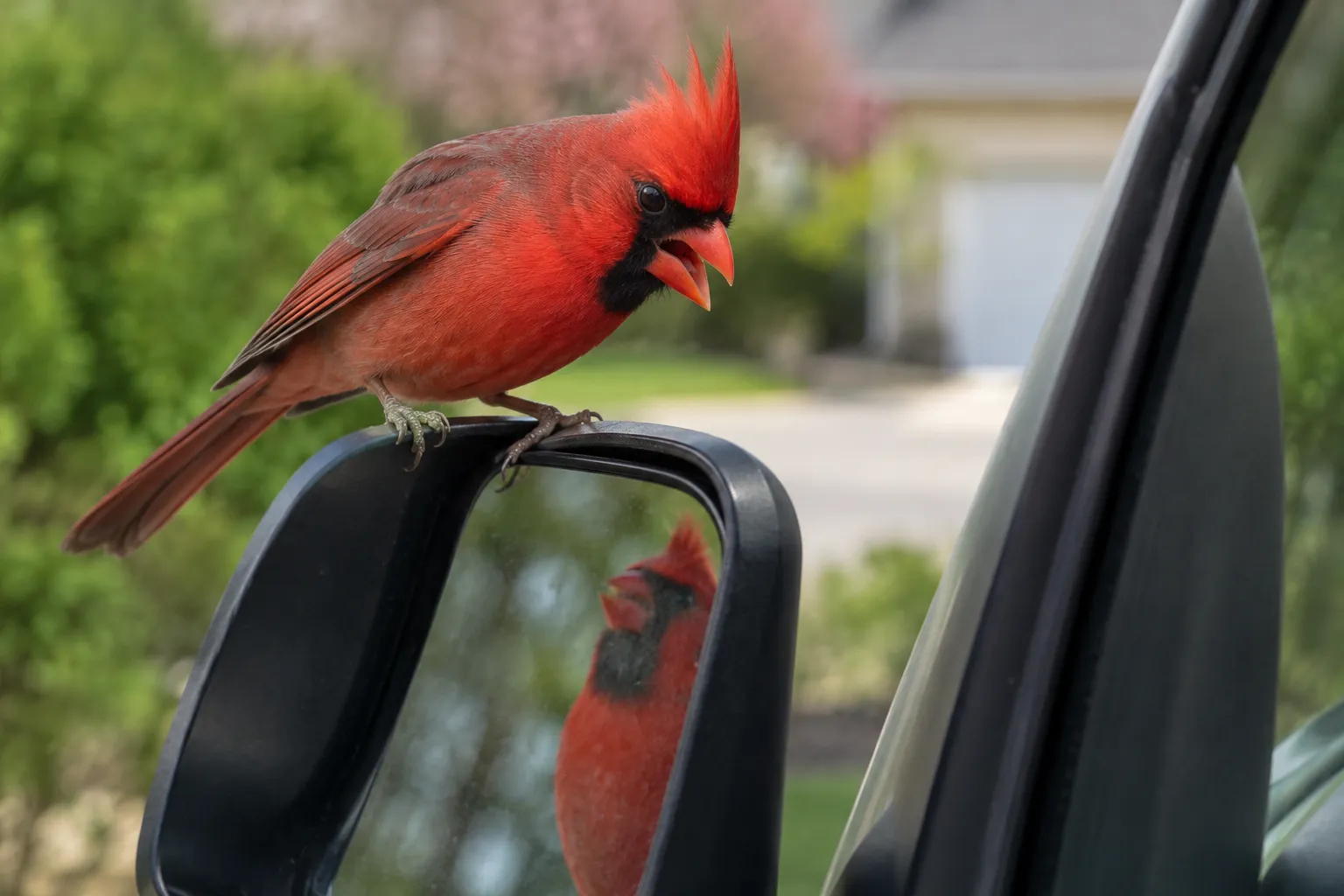
Why do birds peck at car mirrors? Because they think their reflection is another bird. During breeding season, a territorial bird sees what looks like a rival of its own species standing right in the middle of its territory, and it attacks to drive the intruder away. Because the “rival” copies every move and never leaves, the bird can keep fighting it for days or weeks, which is why a mirror usually needs covering for a full 2 to 3 weeks.
It looks strange, even obsessive, but it is ordinary territorial behavior aimed at the wrong target. The good news is that it is usually seasonal, rarely harmful and easy to stop without hurting the bird.
Quick answer: what is going on?
- The bird sees a rival, not itself. Most birds do not recognize their own reflection.
- It is driven by hormones. Territorial aggression rises sharply in spring and early summer.
- Both sexes can do it. Males are more common attackers, but females of some species join in.
- It is temporary. It usually fades when nesting ends, though some birds persist for many weeks.
- The fix is simple. Cover, fold or move the mirror so the reflection disappears.
Why do birds attack their own reflection?
To understand the behavior, it helps to see the world from a songbird’s point of view in spring.
Territory is everything in breeding season
Most backyard songbirds defend a territory while they nest. The territory holds the food, cover and nest sites that a pair needs to raise young. Birds advertise ownership with song and displays, and they chase off neighbors of the same species that cross the boundary. Our article on why birds sing in the morning explains how song works as a “keep out” sign.
When a real intruder shows up, the resident usually needs only a few chases. The intruder retreats, and the matter is settled. A reflection breaks this pattern. It appears the moment the resident lands in front of the mirror, it adopts exactly the same aggressive posture, and it pecks back at exactly the same time. From the resident’s point of view, it is facing the most stubborn rival it has ever met.
Hormones raise the stakes
In spring, rising day length triggers hormonal changes in birds. In many male songbirds, testosterone levels rise sharply as the breeding season starts, and this is linked to singing, displays and aggression. Females also undergo hormonal changes that can increase aggression near the nest. These changes make birds far more likely to react to anything that resembles a rival, including a reflection.
As nesting moves on and chicks hatch, the hormonal picture changes and parents switch much of their effort to feeding young. That is why mirror attacks often fade in mid to late summer.
Most birds cannot recognize themselves
The classic test of self-recognition is the “mark test”: an animal gets a small mark somewhere it can only see in a mirror, and researchers watch whether it investigates the mark on its own body. Great apes, dolphins and a few other animals pass. Among birds, a 2008 study reported that Eurasian Magpies passed, but later attempts to repeat the result have had mixed success, and the question remains debated.
What is clear is that typical backyard birds, such as cardinals, robins, wagtails and sparrows, treat their reflection as another bird. Some intelligent species, such as crows and parrots, may learn over time that a mirror is not a real bird, but that is not what drives a cardinal fighting a car.
Why car mirrors in particular?
Birds also attack house windows, sliding glass doors, chrome bumpers, hubcaps, shiny grills and dark tinted car windows. Side mirrors are especially common targets for a few reasons.
- They are at perch height. A side mirror sticks out from the car at roughly the height of a low shrub, and it gives the bird a convenient place to stand while it faces the glass.
- They reflect clearly. A car mirror is a real mirror, not partly transparent glass, so the reflection is sharp in almost any light.
- The angle is perfect. From the mirror housing or the door, a bird sees its own image at eye level and very close.
- Cars sit still in the territory. A car parked in the same driveway every day becomes a fixed part of the territory, so the “rival” is always there when the bird checks.
Birds also peck at car windows, especially dark tinted ones, because tint turns glass into a better mirror. You may find droppings running down the door beneath the mirror, a sign that the bird has been perching there for long periods.
Which birds peck at car mirrors?
Mirror fighting has been reported in many species worldwide. The common thread is a strongly territorial bird that nests near houses and parked cars.
| Region | Species often reported |
|---|---|
| North America | Northern Cardinal, American Robin, Eastern Bluebird, Northern Mockingbird, Chipping Sparrow, Song Sparrow |
| United Kingdom and Europe | White Wagtail (Pied Wagtail in Britain), Common Chaffinch, European Robin, Common Blackbird, Great Tit |
| Turkey and the Middle East | White Wagtail, Common Blackbird and other urban songbirds |
| Brazil and South America | Thrushes such as the Rufous-bellied Thrush, and other territorial songbirds in gardens |
| Australia | Magpie-lark, Willie Wagtail |
The Northern Cardinal: North America’s classic mirror fighter
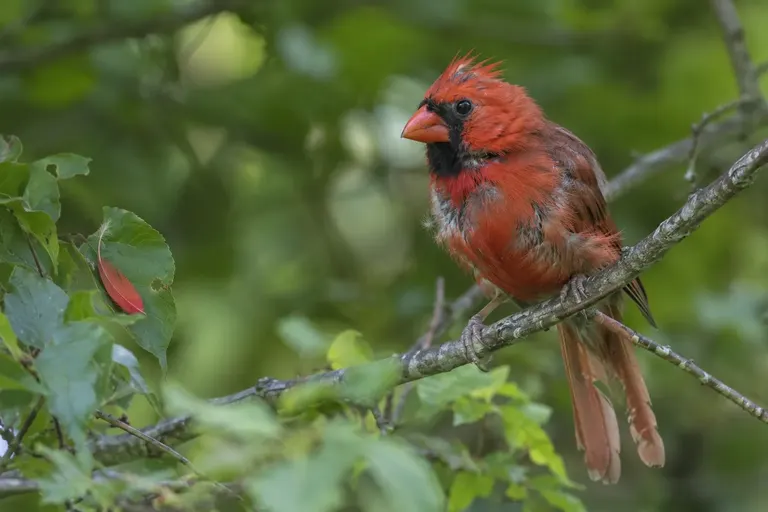
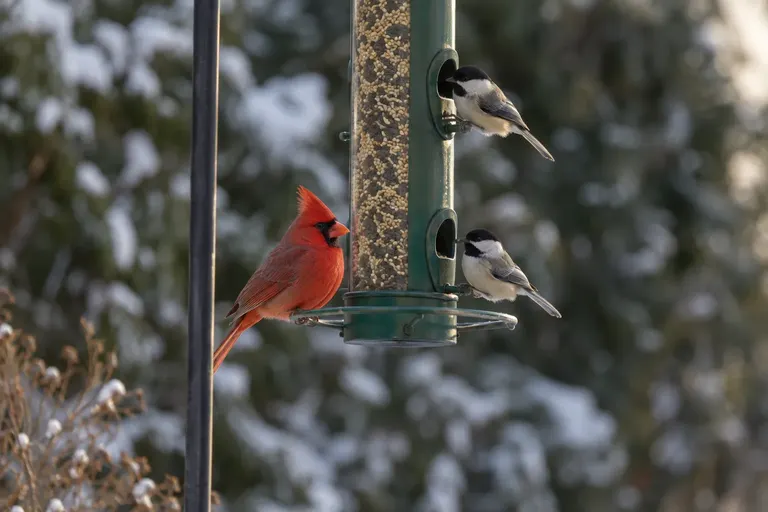
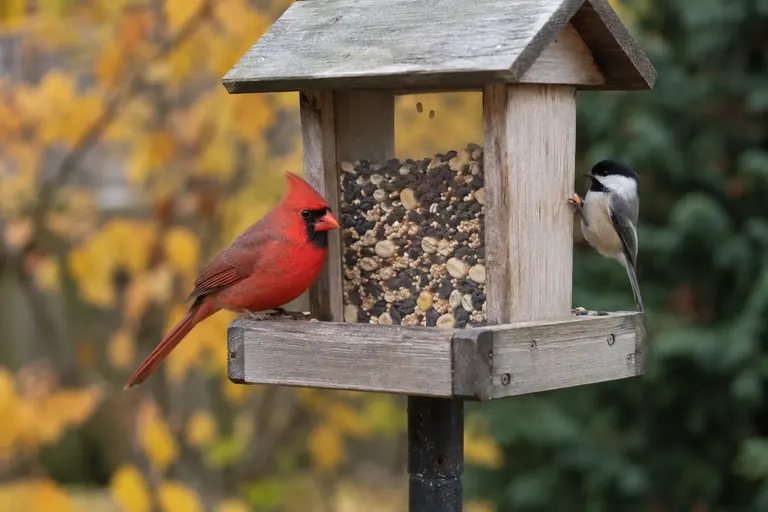
Northern Cardinals are probably the species most often reported pecking at windows and mirrors in the eastern United States. Both males and females defend territories, and pairs nest in dense shrubs close to houses. Our guide to attracting Northern Cardinals covers their nesting habits in more detail. Cardinal mirror fights can start as early as late winter, when males begin singing, and may last into summer if the pair nests more than once.
American Robins and bluebirds
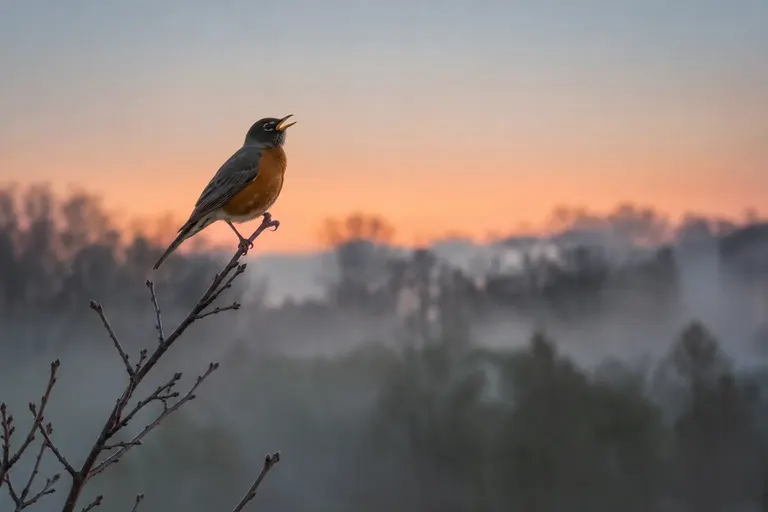
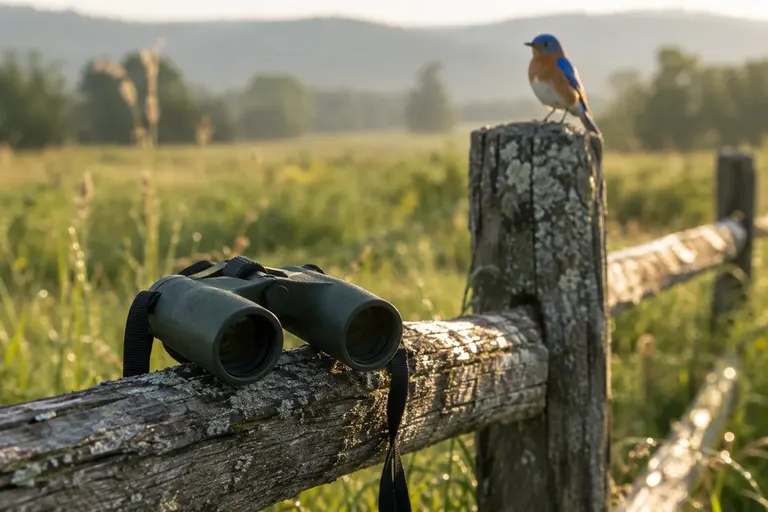
American Robins often nest on ledges, porches and in shrubs next to driveways, putting them right beside parked cars. Both sexes may attack reflections. Eastern Bluebirds, which nest in boxes often placed in open lawns near homes, are also known for it. See our species pages on American Robins and Eastern Bluebirds for more on their breeding behavior.
Mockingbirds
Northern Mockingbirds are famously bold territory holders, chasing much larger birds, cats and even people. A mirror rival is exactly what sets them off. Read more on our Northern Mockingbird page.
Wagtails in Europe and Turkey
In Britain and across Europe and western Asia, White Wagtails are the bird people most often see attacking car mirrors. Wagtails feed on open ground such as parking lots, driveways and lawns, and they nest in holes and ledges on buildings, so parked cars are a big part of their world.
Magpie-larks in Australia
In Australia, the black-and-white Magpie-lark is well known for attacking reflections in windows and car mirrors, sometimes for weeks on end. Pairs defend territories year-round in many areas, so attacks are not always limited to one season there.
When does mirror pecking happen, and how long does it last?
In most temperate regions, mirror fighting follows the breeding calendar.
- Late winter to early spring. Attacks often begin as days lengthen and birds start singing and settling territories. In the southern United States, cardinals may start in February. In Britain and much of Europe, wagtails and chaffinches often start in March or April.
- Spring to midsummer. This is the peak. Birds that raise two or three broods a season, such as cardinals, robins and bluebirds, can keep defending territory for months, so attacks may come in waves with each new nesting attempt.
- Late summer. Attacks usually fade as breeding ends and adults begin to molt.
A single bird may fight a mirror for a few days or for several weeks. Owners commonly report that the same bird comes back at the same time each morning, often soon after dawn, when territorial singing and patrolling are at their most intense.
Can it happen in fall or winter?
Yes, though less often. Some species hold territories outside the breeding season. American Robins and Northern Mockingbirds in some areas defend winter feeding territories around fruiting trees and shrubs. In the Southern Hemisphere, the calendar is reversed, so mirror attacks in Brazil, southern Africa or Australia are most common between roughly August and December. In the tropics, where some birds breed over long periods, attacks can happen in almost any month.
Why does the bird come back after I remove the cover?
Territorial birds remember where they met a rival and return to check. If the reflection reappears while the bird is still in breeding condition, the fight often restarts right away. This is why covering the mirror for only a day or two rarely works. Keeping the reflection away for a full two to three weeks gives the bird time to stop patrolling that spot, or for the hormonal peak to pass.
Is it a male or a female doing it?
It can be either, depending on the species.
- Males are the usual attackers in most species, because they are typically the main territory defenders.
- Females of several species, including Northern Cardinals and American Robins, also attack reflections. A female may be defending the nest site or reacting to what looks like another female approaching her mate.
In species where males and females look alike, such as robins in Europe or wagtails, it can be hard to tell. In cardinals it is easy: the bright red bird is the male, and the warm brown bird with a red-orange bill is the female.
Does pecking at mirrors hurt the bird?
Usually not seriously, but it has costs.
- Wasted energy. A bird fighting a mirror for hours a day is not feeding, resting, guarding its mate or feeding chicks. In a demanding breeding season, that matters.
- Minor injuries. Birds can scuff the bill or face and sometimes appear exhausted after long bouts.
- Distraction from predators. A bird focused on a reflection may be less alert to cats and hawks.
For the car owner, the costs are droppings on paintwork, scratches in the mirror housing and a noisy tapping that can start at dawn. Bird droppings are acidic and can mark paint if left for days, so rinse them off promptly.
How do you stop a bird from pecking at your car mirror?
The goal is to remove the reflection, not the bird. Once there is no rival to fight, the bird goes back to normal territorial behavior.
Step-by-step
- Cover the mirrors. Slip a cloth bag, an old sock, a pillowcase or a plastic bag over each side mirror while the car is parked. Secure it with a hair tie or rubber band. Remember to remove it before you drive.
- Fold the mirrors in. Many cars have folding mirrors, and a folded mirror faces the door instead of the yard. This alone often stops the attacks.
- Change where you park. Moving the car a short distance, into a garage, carport or another part of the driveway, can take it out of the territory’s core.
- Remove the launch perch. If the bird uses a nearby shrub, fence or trellis as a staging post, making that spot less convenient can help.
- Keep it up for two to three weeks. Birds may return to check. Consistency is what breaks the habit.
- Clean up droppings. Rinse paint with water and a soft cloth to prevent marks.
What about windows on the house?
The same approach works for windows. Break up the reflection from the outside with window screens, removable exterior film, soap or washable paint on the glass, or closely spaced vertical cords hanging outside the pane. Inside curtains usually do not help, because the reflection forms on the outer surface. Our guides on why birds fly into windows and how to stop window collisions explain how reflections fool birds and which treatments work best. Treating glass has the added benefit of preventing fatal collisions.
Common mistakes to avoid
- Trying to scare the bird with fake predators. Plastic owls and hawks usually stop working within days, because birds learn they never move.
- Using sticky products or netting on the car. These can trap and injure birds.
- Trying to trap or relocate the bird. In the United States, most native songbirds, including cardinals, robins and bluebirds, are protected under the Migratory Bird Treaty Act. In the United Kingdom and the European Union, wild birds and their active nests are also protected by law. Relocation also rarely works, because another bird will simply take over the territory.
- Covering only one mirror. Birds will switch to the other side.
- Stopping too soon. A week of covering may not be enough during the peak of the breeding season.
Myths and facts
Myth: “The bird is trying to get into the car”
Fact: The bird is not interested in the car. It is fighting the image it sees in the glass.
Myth: “The bird is sick or confused”
Fact: A mirror-fighting bird is usually healthy and behaving exactly as a territorial bird should. Only the target is wrong.
Myth: “It is a sign of bad luck” or a message
Fact: Many cultures have folk beliefs about birds tapping on glass. The scientific explanation is simple territorial aggression, and it is common enough that wildlife agencies receive calls about it every spring.

Myth: “It will go on forever”
Fact: Almost all cases end when breeding hormones decline, typically by mid to late summer. Some birds do return the next spring, especially if the same car and the same territory holder are still there.
What does mirror pecking tell backyard birders?
Mirror fights are a window into how seriously birds take territory. If a bird is attacking your car, it almost certainly has a mate and a nest nearby. That is useful to know.
- Look for the nest, from a distance. Watch where the bird flies after a bout. Cardinals often nest in dense shrubs, robins on ledges or in trees, and wagtails in holes in walls or roof spaces.
- Give the pair some space. Avoid trimming hedges or shrubs near an active nest during the breeding season.
- Enjoy the behavior for what it is. Watching the bird’s posture, raised crest, spread wings and fluffed feathers is a lesson in bird body language. Our guide to reading bird behavior covers the signals birds use in disputes.
Quick facts
- Birds peck at mirrors because they see their reflection as a rival.
- Most cases happen in spring and early summer, driven by breeding hormones.
- Northern Cardinals, American Robins, White Wagtails and Magpie-larks are well-known mirror fighters.
- Both males and females can attack reflections.
- Covering or folding mirrors for two to three weeks usually solves it.
- Treating house windows with exterior patterns can stop the same behavior and prevent collisions.
- Native songbirds are protected by law in the United States, the United Kingdom and the European Union.
Sources
- Cornell Lab of Ornithology, Northern Cardinal species account. https://www.allaboutbirds.org/guide/Northern_Cardinal/overview
- Cornell Lab of Ornithology, Eastern Bluebird species account. https://www.allaboutbirds.org/guide/Eastern_Bluebird/overview
- Prior, H., Schwarz, A., and Güntürkün, O. (2008). Mirror-induced behavior in the magpie (Pica pica): evidence of self-recognition. PLoS Biology. https://doi.org/10.1371/journal.pbio.0060202
Frequently asked questions
Why does a bird keep attacking my car mirror every day?
The bird sees its reflection as a rival of the same species that has moved into its territory. Because the rival never leaves, the bird keeps returning to drive it away. This behavior is driven by breeding-season hormones, so it usually peaks in spring and early summer and fades once nesting ends, though some birds persist for weeks.
Will pecking at a mirror hurt the bird?
Usually not seriously, but it is not harmless either. The bird burns energy and time that it would otherwise spend feeding, singing, guarding its mate or caring for chicks. Occasionally birds scuff their bills or become exhausted. Covering the mirror for a few weeks is a simple way to end the fight and protect both the bird and your car.
Which birds peck at car mirrors?
In North America, Northern Cardinals, American Robins, Eastern Bluebirds, Northern Mockingbirds and Chipping Sparrows are frequent offenders. In Europe and Turkey, White Wagtails, Common Chaffinches, European Robins and Common Blackbirds are often reported. In Australia the Magpie-lark is well known for it, and thrushes do it in Brazil.
How do I stop a bird from pecking my car mirror?
Break the reflection. Cover each side mirror with a cloth bag, sock or plastic bag while parked, fold the mirrors in, park in a garage or a different spot, or move the car away from the bird's favorite perch. Keep this up for two to three weeks. Never try to harm, trap or scare the bird with anything dangerous.
Is it a female or male bird attacking the mirror?
It can be either. Males are the most common attackers because they defend territories most aggressively, but females of some species, including Northern Cardinals and American Robins, also attack reflections. Females may be defending the nest site or reacting to another apparent female near their mate.