Can Birds See Color?
Can birds see color? Yes, and most see more than we do: four cone types, ultraviolet vision and oil-droplet filters. Here is how bird color vision works.
In this article
- Quick answer: bird color vision at a glance
- How does bird color vision work?
- Do birds see more colors than we do?
- What do birds use color vision for?
- How do scientists know what colors birds see?
- Do birds see color in dim light?
- Do birds see motion faster than we do?
- Can all birds see color?
- Are feather colors real?
- Why don’t photos show what birds see?
- Myths and facts about bird color vision
- What bird color vision means for backyard birders
- Quick facts about bird color vision
- Sources
- Frequently asked questions
Yes, birds see color, and most species see it better than we do. Humans have three types of color-sensitive cones in the retina. Most birds have four, including one that picks up violet or ultraviolet light invisible to us, so UV-sensitive species see roughly 300-700 nm against our 400-700 nm. Each bird cone also contains a tiny colored oil droplet that acts as a filter, sharpening the distinction between similar colors.
The result is a world with more colors in it than we can imagine. Feathers, flowers, fruits and eggs carry patterns that only birds can see. The main exceptions are owls and other nocturnal birds, which trade some color vision for better sight in the dark.
Quick answer: bird color vision at a glance
| Feature | Most birds | Humans |
|---|---|---|
| Color cone types | Four | Three |
| Ultraviolet vision | Yes, in many species | No |
| Oil droplets in cones | Yes, act as color filters | No |
| Double cones | Yes, likely used for brightness and motion | No |
| Visible range | Roughly 300-700 nm in UV-sensitive species | Roughly 400-700 nm |
| Color dimensions | Four (tetrachromatic) | Three (trichromatic) |
How does bird color vision work?
Cones and rods
Like us, birds have two main kinds of light-sensing cells in the retina. Rods work in dim light and don’t distinguish colors. Cones work in brighter light and come in several types, each most sensitive to a different part of the spectrum. The brain compares signals from the different cone types to work out color.
Humans have three cone types, roughly tuned to blue, green and red light. That is why we are called trichromats and why screens can fool us with just red, green and blue pixels.
A fourth cone
Most birds have four types of single cones used for color vision. Three roughly correspond to ours, sensitive to short (blue), medium (green) and long (red) wavelengths. The fourth is tuned to very short wavelengths.
That fourth cone comes in two main forms:
- Ultraviolet-sensitive (UVS). Most sensitive to ultraviolet light. Found in most songbirds, as well as parrots and gulls, among others.
- Violet-sensitive (VS). Most sensitive to violet, but still able to detect some near-ultraviolet. Found in many other birds, including many raptors, waterbirds and fowl.
Either way, birds have a fourth dimension of color that we lack. Scientists call them tetrachromats. Our article on whether birds can see ultraviolet light goes further into the UV side of the story.
Oil droplets as filters
Inside each bird cone sits a tiny oil droplet, positioned so that light passes through it before reaching the light-sensitive pigment. Most droplets are colored by carotenoid pigments, which birds get from their diet, and they act like colored filters on a camera.
Each droplet cuts off shorter wavelengths, narrowing the range of light each cone responds to. That reduces overlap between cone types, which is thought to improve a bird’s ability to tell similar colors apart. The trade-off is that filtering loses some light, which is one reason bird cones are less useful in very dim conditions.
Double cones
Birds also have double cones, pairs of joined cells that are the most common cone type in many bird retinas. They do not seem to be used for color in the usual way. Most researchers think they help with judging brightness, detecting motion and perhaps sensing fine patterns. Some researchers have also suggested a role in sensing the Earth’s magnetic field, which is still being studied.
Do birds see more colors than we do?
Most likely. With four cone types, a bird’s color space has an extra dimension. In theory, birds can distinguish many more color combinations than people.
Colors we cannot imagine
Humans perceive purple, which is not a single wavelength of light but a mix of blue and red, the two ends of our visible spectrum. Colors like this are called nonspectral colors.
Birds can, in principle, see many more nonspectral colors, because they can combine ultraviolet with any of the other cone signals. A 2020 study led by Mary Caswell Stoddard of Princeton University tested this with wild Broad-tailed Hummingbirds in the Colorado mountains. The birds learned to find sugar water paired with specific colored lights, and they reliably distinguished combinations such as ultraviolet plus green and ultraviolet plus red from pure green or red. Those colors look identical to us. The team also estimated that a large share of plumage and plant colors contain nonspectral mixes that birds can perceive.
What these colors actually look like to a bird is unknowable. We can measure what birds can distinguish, not what their experience is like.
Sharper color discrimination
Because oil droplets narrow each cone’s sensitivity, birds are thought to be better than humans at telling apart subtly different hues, at least in bright light. That would help with judging fruit ripeness, spotting camouflaged insects and assessing the plumage of rivals and mates.
What do birds use color vision for?
Finding food
Many fruits signal ripeness with color. Birds are major seed dispersers for fruiting shrubs and trees, and fruits eaten by birds are often red, purple or black. Some fruits, such as those with a waxy “bloom” on the skin, also reflect ultraviolet light, which may make them stand out to birds against foliage. For planting ideas, see berry shrubs that feed birds all winter.
Flowers pollinated by birds, especially hummingbird flowers in the Americas and sunbird flowers in Africa and Asia, are often red or orange. That is less about birds loving red than about the flowers being less conspicuous to bees, which see red poorly. Hummingbirds can see and learn any color. Red is not required in nectar, and adding red dye to feeder solution is unnecessary; see our hummingbird nectar recipe.
Choosing mates
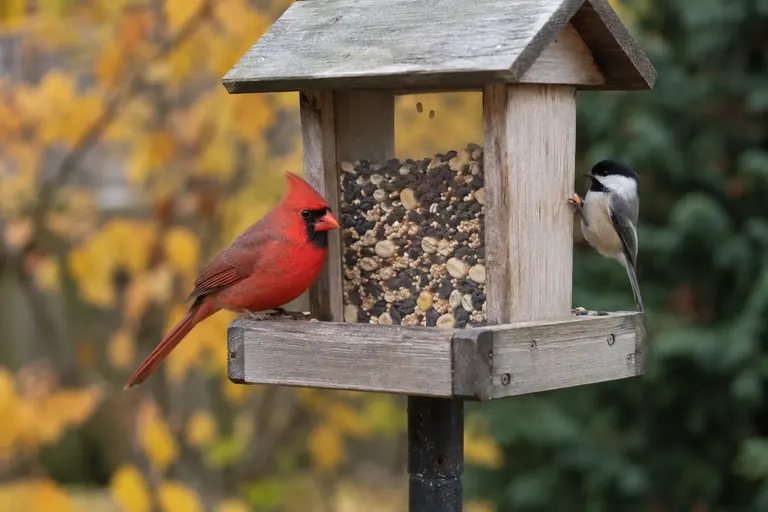
Color is central to courtship in many birds. The bright red of a male Northern Cardinal, the orange of a Baltimore Oriole or the iridescent throat of a hummingbird all send signals about age, health and quality. Our article on why male birds have brighter colors covers why these signals evolve.
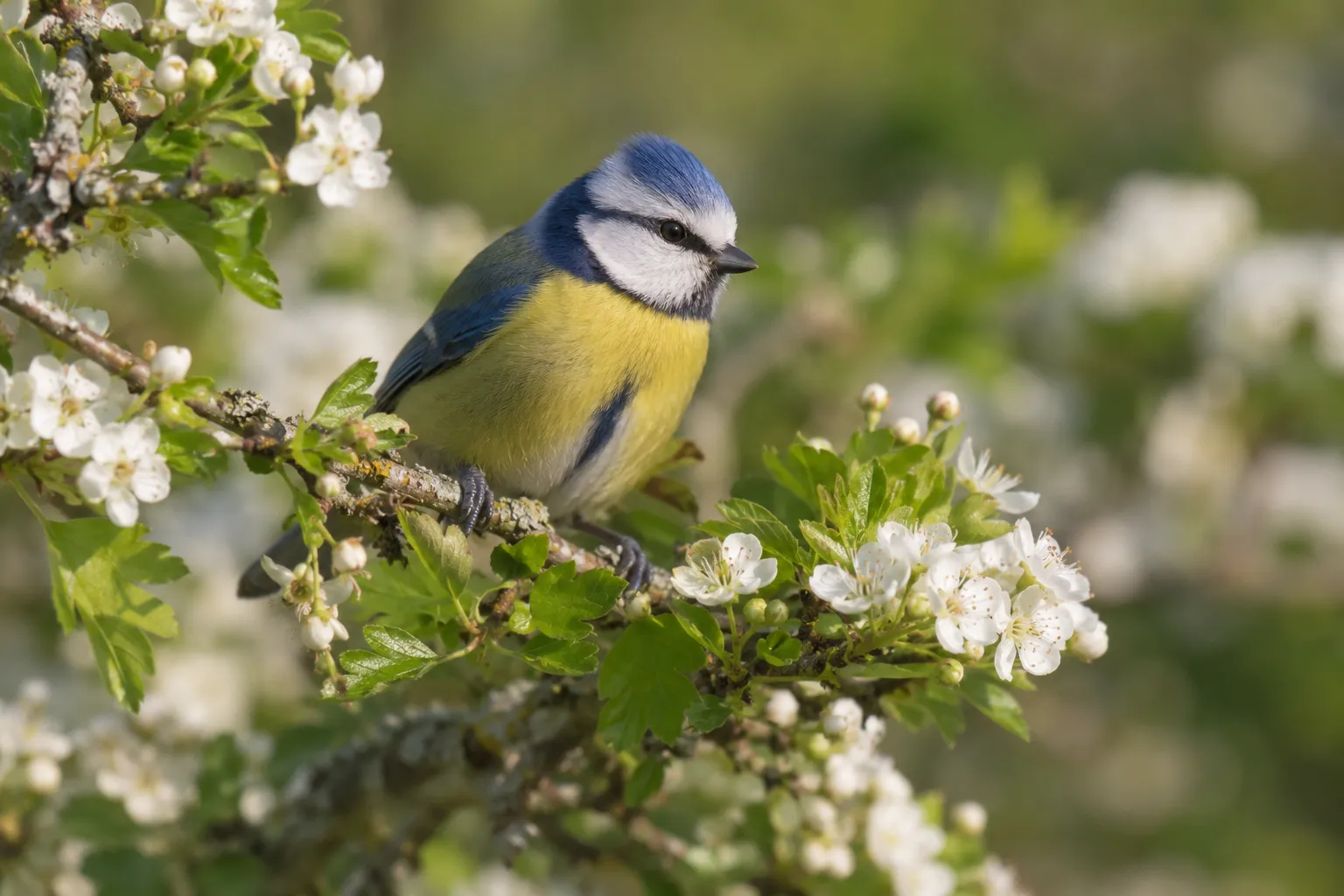
Because birds see ultraviolet, some signals are hidden from us entirely. The best-studied example is the Eurasian Blue Tit. The male’s blue crown reflects strongly in ultraviolet, and research has found that females pay attention to this UV signal when choosing mates. To us, males and females look almost the same.

Telling the sexes apart
Many birds that look identical in both sexes to people are not identical to birds. A 2005 study by Muir Eaton used measurements of feather reflectance and models of bird vision to analyze 139 North American songbird species that humans see as sexually monochromatic. It concluded that the large majority, more than 90 percent, actually differ between males and females in ways birds could perceive.
Recognizing eggs and chicks
Some birds use color and UV patterns to recognize their own eggs, a skill that matters when cuckoos or cowbirds try to slip eggs into their nests. Nestling mouths are often brightly colored, and in some species reflect UV, which may help parents feed chicks in dark nests.
Hunting
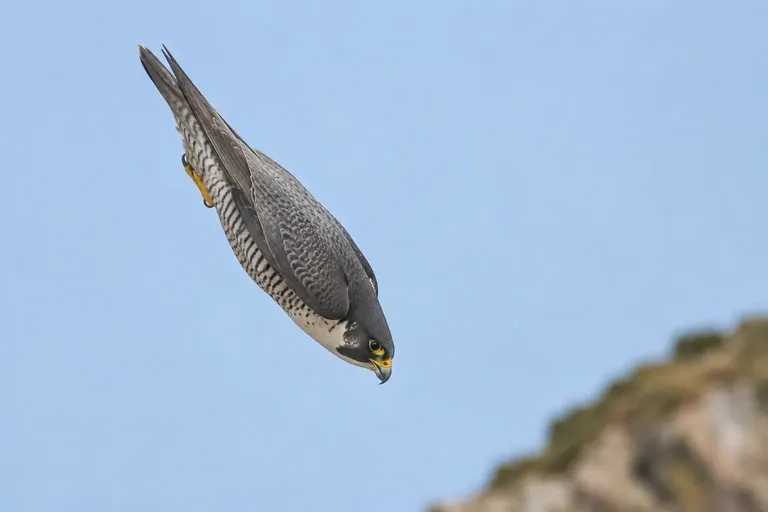
It was once widely reported that Eurasian Kestrels could track voles by seeing the UV reflectance of vole urine trails. Later research questioned how strongly vole urine reflects UV and how sensitive kestrel eyes are to it, so this example is now considered uncertain. It is a good illustration of how appealing ideas in bird vision need careful testing.
How do scientists know what colors birds see?
We cannot ask a bird what it sees, so researchers combine several lines of evidence.
- Measuring the cones directly. A technique called microspectrophotometry shines tiny beams of light through individual cone cells from a retina and records which wavelengths each one absorbs. This is how the four cone types and their oil droplets were characterized.
- Reading the genes. Each cone type uses a light-sensitive protein called an opsin. By sequencing opsin genes, especially the one for the shortest-wavelength cone, scientists can predict whether a species has an ultraviolet-sensitive or violet-sensitive system. In many cases, a change at just one or a few key positions in the protein shifts the cone between the two forms.
- Measuring the world. Spectrophotometers record how much light feathers, fruits, flowers and eggs reflect at each wavelength, including ultraviolet.
- Modeling bird vision. Researchers feed cone sensitivities and reflectance measurements into mathematical models of color vision to estimate whether two colors would look different to a bird.
- Training birds. Behavioral experiments, like the hummingbird study above, test whether birds can actually learn to tell colors apart. This is the gold standard, but it is slow and has been done for relatively few species.
Each method has limits. Models depend on assumptions about how the brain combines cone signals, and genetics only predicts sensitivity. Where several methods agree, as they do on birds having four cone types and widespread UV sensitivity, the conclusions are solid.
Do birds see color in dim light?
Less well. Cones need relatively bright light, and the oil droplets that sharpen bird color vision also absorb some light, making bird cones less sensitive than they would be without filters. As light fades at dusk, birds shift toward rod vision, like us, and colors become harder to distinguish.
This is one reason many songbirds head to roost as light fails and why the dawn chorus starts before feeding begins in earnest. Early in the morning, light may be too dim for birds to forage efficiently by sight. Owls, with rod-rich retinas, take over the night shift.
Do birds see motion faster than we do?
Many birds appear to process visual changes faster than people. Scientists measure this as the flicker fusion rate, the speed at which a flickering light starts to look steady. Humans typically stop seeing flicker somewhere around 50 to 90 flashes per second, depending on conditions. A 2016 study of wild-caught Pied Flycatchers, small insect-catching birds from Europe, found they could detect flicker at much higher rates, well above 100 per second.
That fast vision probably helps small birds track flying insects and dodge obstacles. It also means that some lights that look steady to us may flicker visibly to birds, although the practical effects of that on wild birds are not well understood.
Can all birds see color?
Not equally.
- Owls. Owl retinas are packed with rods for night vision and have relatively few cones. Studies of several owl species suggest they have fewer functional cone types than songbirds, and some may be effectively limited in color vision. They still likely see some color in good light.
- Other nocturnal birds. Nightjars, kiwis and some seabirds that feed at night also appear to have reduced cone systems, though research is uneven.
- Penguins and some seabirds. Some species that live in blue-dominated marine light environments appear to have cone sensitivities shifted toward blue, although details vary.
- Daytime songbirds, parrots and hummingbirds. These are among the most color-rich visual systems measured in any animal.
For more on how owls see, and why they turn their heads so far to compensate for fixed eyes, see how owls turn their heads so far.
Are feather colors real?
Birds make color in two ways, and both matter to how birds see each other.
- Pigments. Carotenoids produce many reds, oranges and yellows, and birds must get them from food. Melanins produce blacks, browns, grays and some rusty tones.
- Structure. Blues, most iridescent colors and much ultraviolet reflectance come from the microscopic structure of feathers scattering light, not from pigment. There is no blue pigment in a Blue Jay’s feathers.
Our article on why blue feathers are not actually blue explains structural color. Structural colors often reflect strongly in ultraviolet, which is one reason bird plumage can look richer to birds than to us.
Why don’t photos show what birds see?
Ordinary cameras are built to mimic human vision. Their sensors record red, green and blue, and most lenses and sensor filters block ultraviolet light. A photo of a Blue Tit or a starling therefore shows the bird as we see it, not as another bird does.
Researchers who want to capture bird-visible colors use cameras modified to record ultraviolet, often combined with separate visible-light images and software that maps the results onto a bird’s cone sensitivities. The resulting “false color” images are useful for science, but they are still translations. They show which parts of a bird reflect UV, not what that UV looks like to the bird. If you enjoy photographing birds, our guide to photographing birds through a window covers practical technique.

Myths and facts about bird color vision
| Claim | Reality |
|---|---|
| “Birds see in black and white.” | False. Most birds have richer color vision than humans. |
| “Hummingbirds only visit red.” | False. They learn to associate any color with food. Red helps flowers avoid bees. |
| “You need red dye in hummingbird nectar.” | False. Red on the feeder is enough, and dye is unnecessary. |
| “Birds see the same colors we do, plus UV.” | Partly. They also see many mixed colors that have no human equivalent. |
| “Owls see color as well as other birds.” | Unlikely. Owls have fewer cones and probably weaker color vision. |
| “Male and female birds that look alike are identical.” | Often false. Many differ in colors only birds can see. |
What bird color vision means for backyard birders
- Feeder color matters less than you think. Birds respond mainly to food, safety and location. A red feature helps hummingbirds find a new feeder, but it is not essential for seed feeders.
- Plant for color and ultraviolet. Native fruiting shrubs and flowering plants provide signals birds evolved to read.
- Window decals need to be dense. Some decals are marketed as visible only to birds because they reflect UV. Evidence on UV-only products is mixed, and bird conservation groups generally recommend markings spaced about 2 inches apart, visible to both birds and people. See how to stop birds hitting windows.
- Remember birds see more than we do. Two birds that look identical to you may be clearly different to each other. That is worth keeping in mind when identifying birds.
Quick facts about bird color vision
- Most birds have four cone types for color; humans have three.
- Many songbirds, parrots and gulls have an ultraviolet-sensitive cone.
- Many raptors and waterbirds have a violet-sensitive cone that detects some near-ultraviolet.
- Colored oil droplets in bird cones act as filters, improving color discrimination.
- Double cones likely help with brightness and motion.
- Hummingbirds have been shown to distinguish colors that mix ultraviolet with visible light.
- Many birds that look alike to us differ in colors birds can see.
- Owls and other nocturnal birds have weaker color vision.
Sources
- Eaton, M. D. (2005). Human vision fails to distinguish widespread sexual dichromatism among sexually “monochromatic” birds. PNAS 102: 10942-10946
- Cornell Lab of Ornithology: All About Birds
- RSPB: Blue Tit species information
- American Bird Conservancy: glass collisions
- Audubon Guide to North American Birds
Frequently asked questions
Can birds see color?
Yes. Most birds have excellent color vision, and in several ways it is richer than ours. Humans have three types of color-sensing cones, while most birds have four, including one sensitive to violet or ultraviolet light. Colored oil droplets inside bird cones sharpen their color discrimination. Owls and some other nocturnal birds have fewer cones and weaker color vision.
Do birds see more colors than humans?
Most likely, yes. With four cone types, birds can in principle distinguish more color combinations than people, and they see ultraviolet light we cannot. Experiments with hummingbirds have shown they can tell apart colors that mix ultraviolet with visible light, colors that have no equivalent in human vision. How those colors look to a bird is unknown.
What colors are birds attracted to?
It depends on the bird and what it has learned. Hummingbirds visit red flowers often, but they are not born preferring red and learn to associate colors with nectar. Many birds are attracted to the colors of ripe fruit, such as red, purple and black. At feeders, food, safety and location matter far more than feeder color.
Can birds see ultraviolet light?
Many birds can. Songbirds, parrots and gulls typically have a cone type most sensitive to ultraviolet light, while many other birds, including raptors, have a violet-sensitive cone that still picks up some near-ultraviolet. Many feathers, fruits and flowers reflect ultraviolet patterns that birds see but people do not.
Do male and female birds look different to other birds?
Often more different than they look to us. Research using models of bird vision has found that many songbird species that appear identical in both sexes to humans actually differ in ultraviolet or other plumage colors that birds can see. For example, male Blue Tits have a crown patch that reflects ultraviolet more strongly than females.
Can owls see color?
Probably, but less well than daytime birds. Owl retinas are dominated by rods, the cells that work in dim light, and they have relatively few cones. Studies suggest many owls have fewer functional cone types than songbirds. They trade color vision for sensitivity, which suits hunting at dusk and at night.