Do Birds Pee? Why Bird Poop Is White and Wet
Do birds pee? Most don't: their kidneys make a white urate paste that leaves with the poop through one opening. Ostriches and hummingbirds are exceptions.
In this article
- Do birds pee like humans?
- How does a bird get rid of waste?
- Why don’t birds have a bladder?
- Why is bird poop white?
- Is the white stuff really uric acid?
- Which birds do pee?
- What is a fecal sac?
- Why are bird droppings hard to clean off?
- Is bird poop dangerous?
- Do birds use their droppings for anything?
- Quick facts: do birds pee?
- What this means for backyard birders
- Sources
- Frequently asked questions
Most birds don’t pee the way people and other mammals do. Instead of liquid urine stored in a bladder, their kidneys make a thick white paste of urates that leaves the body together with the faeces through a single opening, the cloaca. The white part of a bird dropping is that urine. Ostriches and hummingbirds are the exceptions.
So the honest answer to “do birds pee?” is: yes, in the sense that birds get rid of urinary waste, and no, in the sense that you’ll almost never see a bird release a separate stream of liquid. This guide explains how the system works, why bird poop is white, which birds break the rule, and what it means for anyone who feeds birds, keeps a bird bath or has to clean droppings off a car.
It draws on an ornithologist at the British Trust for Ornithology (BTO), a 2019 chemistry study from the University of Texas at Austin, Audubon’s reporting on hummingbird research, National Geographic on ostriches, ornithologist Roger Lederer, bluebird nest monitoring guidance and the US Centers for Disease Control and Prevention (CDC).
Do birds pee like humans?
No. Mammals dissolve their nitrogen waste in water and store it as liquid urine in a bladder. Most birds have no bladder and turn the same waste into a semi-solid white paste that leaves with the faeces.
Every animal that eats protein ends up with nitrogen waste it has to get rid of. Mammals convert it into urea, which dissolves easily, so it needs plenty of water to flush it out. That’s why our urine is liquid and why we need a bladder to hold it until it’s convenient to empty.
Birds take a different route. Their nitrogen waste leaves mainly as uric acid and its salts, called urates. Uric acid barely dissolves in water, so it doesn’t need much water to carry it. As it moves through the system, water is pulled back into the body and the waste thickens into a cream or white paste. Ornithologist Roger Lederer puts uric acid at 60 to 80 percent of all the nitrogen a bird excretes.
Here is the difference side by side:
| Feature | Mammals (including people) | Most birds |
|---|---|---|
| Main nitrogen waste | Urea, dissolved in water | Uric acid and urates, mostly insoluble |
| What the urine looks like | Clear to yellow liquid | White or cream paste |
| Storage | Urinary bladder | No bladder in most species |
| Exit | Separate openings for urine and faeces | One opening, the cloaca, for both |
| Water use | High: urea needs water to be flushed out | Low: water is reabsorbed before the waste leaves |
| Weight carried | A full bladder can be heavy | Nothing stored, so nothing extra to carry |
How does a bird get rid of waste?
Through the cloaca. It’s a single chamber at the end of the body where the gut, the kidneys and the reproductive system all empty, and it opens to the outside through the vent under the tail.
Waste from the kidneys runs down the ureters straight into the cloaca. Waste from the intestine arrives there too. Inside the cloaca, more water is reabsorbed, which concentrates the urates even further, and then both kinds of waste leave together as one dropping.
Mike Toms of the BTO describes bird droppings as a combination of material from two systems, the excretory system and the gut, both emptying into the cloaca. The same opening is used for mating and, in females, for laying eggs.
The result is the familiar bird dropping:
- a white or cream part, which is the urinary waste
- a darker, firmer part, which is the actual faeces
- sometimes a small amount of clear liquid around the edge
Because nothing is stored for long, small birds can drop waste often, including just before take-off. That’s one reason droppings collect under perches, on fence posts and below a bird feeder.
Why don’t birds have a bladder?
Mostly because of weight. A bladder full of liquid is heavy, and every gram counts for an animal that flies.
Lederer describes the missing bladder as a weight-saving adaptation and links the whole system (insoluble waste, water recycled by the kidneys and cloaca, and solids and liquids leaving together) to keeping birds light. Ornithologist Sushma Reddy of the University of Minnesota told Live Science that flight probably shaped the one-hole system too.
Water is the other part of the story. A bird that doesn’t have to flush its waste out with water can get by on less of it. That matters for birds that live in dry places or that can’t drink often, and it explains why most backyard birds only visit a bird bath now and then to drink. If you want to know how they do it, see our guide to how birds drink water.
There’s also a link to eggs. Lederer notes that uric acid plays a part in eggshell formation by binding calcium into insoluble salts.
Why is bird poop white?
Because the white part is urine, not poop. It’s the urate paste from the kidneys. The darker centre of the dropping is the faeces.
Toms explains that bird urine is usually cream-coloured and full of urates, and that whitish crystals form as water is reabsorbed in the cloaca. Those crystals give bird droppings their white look. The faeces themselves are the remains of undigested food, so their colour follows the diet.
What you see in a dropping is a quick clue to what the bird has been eating:
| What the bird eats | What the dropping usually looks like | Examples |
|---|---|---|
| Fish | Almost entirely white | Herons, gulls, Ospreys, cormorants |
| Berries and fruit | Dark purple, red or blue faeces, often runny | Thrushes, waxwings, Blackcaps, starlings |
| Seeds | Small, firm, dark faeces with a white cap | Finches, sparrows, doves |
| Insects | Dark faeces, sometimes with shiny bits of insect shells | Woodpeckers, wrens, flycatchers |
| Nectar | Mostly clear liquid | Hummingbirds |
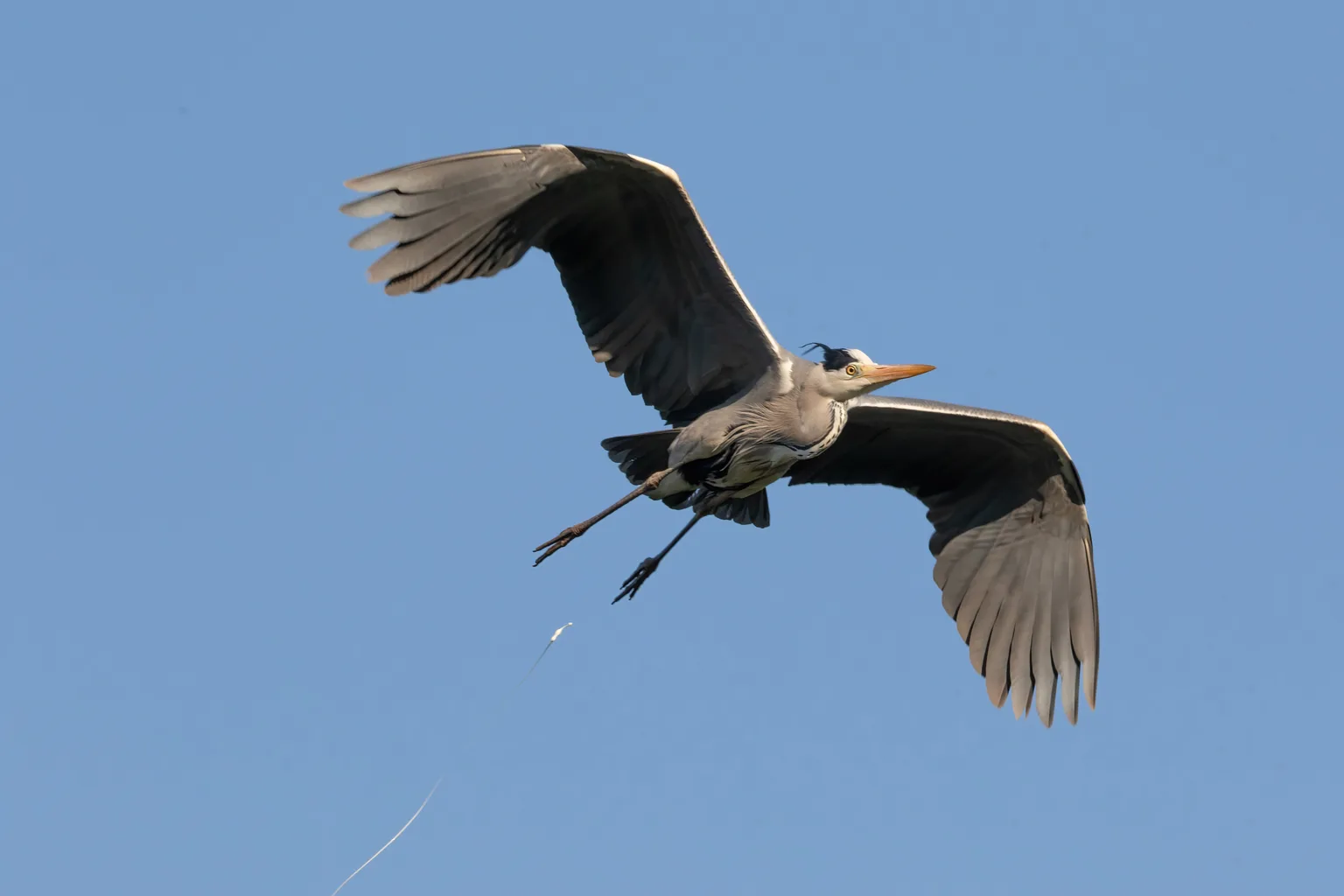
The Montana Natural History Center notes that fish-eating birds such as Great Blue Herons, gulls and Ospreys produce droppings that are almost entirely white. The heron in the photo at the top of this page is doing exactly that.
If you feed berries or fruit in autumn and winter, expect purple and red splashes on the patio. That’s normal. Our guide to fruit for birds covers what to put out and when.
Is the white stuff really uric acid?
Mostly urates, and it may be more complicated than textbooks say. A 2019 study found no plain uric acid in the droppings it tested.
Researchers Nick Crouch, Julia Clarke and Vincent Lynch at the University of Texas at Austin used X-ray diffraction to identify the crystals in fresh droppings from six bird species, from a Great Horned Owl to a chicken. Most samples came from the Austin Zoo. The work appeared in the Journal of Ornithology.
They found ammonium urate, struvite (a magnesium ammonium phosphate mineral) and two compounds they couldn’t identify. They did not detect uric acid itself. Crouch suggested, based on other research, that gut bacteria may break uric acid down into these compounds before the dropping leaves the bird. That last point is an idea to test, not a finding of the study.
None of this changes the basic picture. The kidneys still excrete nitrogen as uric acid, and the white part of a dropping is still the urinary waste. What the study changes is the chemistry of the final product. In everyday terms, “the white part is urine” remains the right answer.
Which birds do pee?
Two well-studied groups break the rule: ostriches and their relatives, and hummingbirds.
Ostriches
Ostriches can urinate and defecate separately. Writing for National Geographic, Riley Black describes how ostriches release fluid in a strong stream first and then pass their faeces afterwards, unlike most birds, which combine the two into one package.
Lederer explains the anatomy behind it. In ratites (ostriches, emus, cassowaries, rheas and kiwis), urine is stored mainly in one section of the cloaca called the proctodeum, which works as a kind of bladder. With somewhere to hold it, an ostrich can release liquid urine in one go.
This habit has even helped palaeontologists. Researchers looking at fossil trackways in Brazil found traces that looked like a falling stream of fluid beside dinosaur footprints, and they pointed to ostriches as a living model for how it could have happened.
Hummingbirds
Hummingbirds pee a lot, and they have to. Nectar is mostly sugar and water, and a hummingbird drinks so much of it that holding on to the water would make it too heavy to fly.
Audubon reported in 2025 on the work of biologist Anusha Shankar of the Tata Institute of Fundamental Research in Hyderabad, India, who studies hummingbird metabolism by collecting their urine. Her research describes very dilute urine with only trace amounts of salts and sugars, passed frequently. Unlike most birds, hummingbirds get rid of much of their nitrogen as ammonia rather than uric acid. Shankar estimates a meal takes about an hour to pass from beak to cloaca.
Hummingbirds live only in the Americas. If you have them, our guide to hummingbird feeders covers feeder choice and cleaning, which matters because sugar water spoils quickly.
What is a fecal sac?
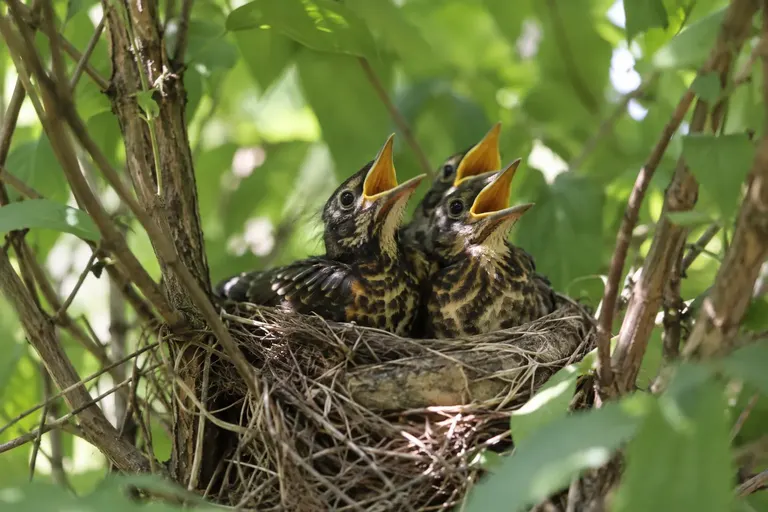
A fecal sac is a small white package of droppings wrapped in a tough mucous membrane, made by the chicks of many songbirds. It lets the parents keep the nest clean by carrying the waste away.
If you watch a nest box in late spring, you may see an adult fly out with something small and white in its bill. That’s a fecal sac. Nest box monitoring guidance from Sialis, which draws on the Cornell Lab’s Birds of North America account for Western Bluebird, describes nestlings producing a sac after most feeds, with parents removing as many as 60 to 70 a day between them.
Why parents bother:
- Hygiene. Droppings left in the nest would breed bacteria and parasites.
- Warmth. Wet, soiled chicks lose heat, and liquid droppings can stick to feathers.
- Safety. The smell of a dirty nest may draw predators.
Parents usually drop the sacs away from the nest. With very young chicks, they often swallow them instead, because the chick’s immature gut leaves nutrients in the waste. Near fledging, older chicks may stop producing sacs, and the box walls get splashed white.
Not every bird does this. Barn Swallow chicks in open cup nests back up to the rim and drop their waste over the edge, which is why a pile builds up under the nest. Ducklings leave the nest soon after hatching, so they don’t need the system at all.
The practical takeaway: a nest box is cleaned by the parents during the season, and by you once the season is over. See when and how to clean out a birdhouse for timing and the rules on old nests.
Why are bird droppings hard to clean off?
Because the urate paste dries into a hard, sticky crust, and the longer it sits, the harder it is to remove.
Lederer notes that uric acid is acidic, can stain or etch surfaces and becomes more difficult to remove as it dries. That’s why it pays to deal with droppings on cars, windows, garden furniture and solar panels while they’re fresh.
A few simple rules:
- Soak first. Lay a wet cloth or paper towel over the dropping for a few minutes to soften the crust.
- Lift, don’t scrub. Wipe gently once it’s soft. Dry scrubbing drags grit across the surface.
- Rinse. Finish with clean water, and on a car, a normal wash.
- Move the source. If droppings keep landing in the same spot, a perch, wire or feeder is probably above it. Moving the feeder a little often solves it; see where to put a bird feeder.
Seed hulls and droppings under feeders build up together. A seed catcher tray keeps the ground below cleaner and makes the mess easier to deal with.
Is bird poop dangerous?
Usually not in small amounts, but large, old piles of droppings can carry disease risks, and feeders and baths need regular cleaning.
The main concern with big accumulations is histoplasmosis, a lung infection caused by a fungus that grows in soil mixed with bird or bat droppings. According to the CDC, most people who breathe in the spores don’t get sick, and the illness doesn’t spread between people. The CDC advises avoiding work that stirs up contaminated soil and dust, and leaving large amounts of bird or bat droppings to professional clean-up companies. People with weakened immune systems, adults over 55 and infants are at higher risk.
At the backyard scale, the realistic risks are about hygiene:
- Wash your hands after filling feeders, cleaning bird baths or handling nest boxes.
- Wear gloves for cleaning jobs.
- Clean feeders and baths on a schedule, because droppings in food and water can spread disease between birds as well.
Our guides on whether you can get sick from bird feeders, how to clean bird feeders and how to clean a bird bath go into detail. If you see fluffed-up, lethargic birds at your feeders, read about sick birds at the feeder and take the feeders down for a while.
Do birds use their droppings for anything?
Yes. Some birds build with it, some mark territory with it, and some cool off with it.
-
Nest material. Toms notes that cormorants use guano as a nesting material. Seabird colonies can coat whole cliffs and islands in white.
-
Marking territory. Audubon notes that Eurasian Eagle-Owls defecate on prominent spots, and that conspicuous droppings play a part in marking territory.
-
Finding colonies. Researchers have located Emperor Penguin colonies by spotting the reddish-brown stains their droppings leave on the ice.
-
Fertiliser. Seabird guano from the coast of Peru was so valuable as fertiliser that it was in high demand in the 19th-century United States, as the Montana Natural History Center notes.
-
Keeping cool. Some long-legged birds excrete onto their own legs on hot days, a behaviour called urohidrosis. Field research on breeding White Storks found that it can lower the surface temperature of their legs by up to about 6 degrees C as the liquid evaporates. It’s a reminder that bird urine, though mostly paste, still carries some water.
Quick facts: do birds pee?
| Question | Short answer |
|---|---|
| Do birds make urine? | Yes, as a white urate paste, not a liquid |
| Do birds have a bladder? | Most don’t; ratites store urine in part of the cloaca |
| How many openings? | One, the cloaca, for urine, faeces, mating and eggs |
| What’s the white part of a dropping? | Urinary waste (urates) |
| What’s the dark part? | Faeces, coloured by diet |
| Which birds pee a liquid stream? | Ostriches; hummingbirds pass dilute liquid urine often |
| Why the system? | Saves water and weight |
What this means for backyard birders
The white splash on your car or patio is a bird’s urine and faeces delivered in one go. It’s normal, it tells you something about what the bird ate, and it’s harmless in small amounts if you clean up with ordinary hygiene.
The useful habits are simple: place feeders where droppings won’t land on seating or paths, clean feeders and baths regularly, wear gloves for cleaning, and wash your hands afterwards. If you watch a nest box in spring, look for parents carrying out fecal sacs. It’s one of the easiest signs that chicks are being fed, and our guide to what baby birds eat explains the feeding behind it.
Sources
- Mike Toms (BTO), Why is bird poo white, rather than brown like most poop?, BBC Wildlife / Discover Wildlife
- University of Texas at Austin, Jackson School of Geosciences (2019), Bird droppings defy expectations
- Audubon (2025), Do Birds Pee? Hummingbirds Do, a Lot
- Riley Black, The surprising science of dinosaur pee, National Geographic
- Roger Lederer, Uric acid and the cloaca, Ornithology.com
- Sialis, Fecal sacs: what parents carry out of the nest box
- CDC, Reducing risk for histoplasmosis
- Dryad dataset, Keeping cool with poop: urohidrosis lowers leg surface temperature in breeding White Storks

Frequently asked questions
Do birds pee at all?
Birds do get rid of liquid waste, but most don't pee the way mammals do. Their kidneys turn nitrogen waste into a white, mostly insoluble paste that mixes with the faeces in the cloaca and leaves through the same opening. That white part of a dropping is the bird's version of urine. Ostriches and hummingbirds are the main exceptions.
Why is bird poop white?
The white part is not poop. It is the bird's urine, packed with urates (salts of uric acid) after water has been pulled back into the body. The darker blob in the middle is the actual faeces, and its colour depends on what the bird ate. Fish-eating birds and seabirds produce droppings that are almost entirely white.
Do birds have a bladder?
Most birds have no urinary bladder. Waste from the kidneys runs straight down to the cloaca, a shared chamber for the gut, the urinary system and the reproductive system, where water is reabsorbed. Skipping the bladder saves weight. Ostriches, emus and other ratites are different: they store urine in part of the cloaca, which works much like a bladder.
Can any birds pee in a stream?
Yes. Ostriches release a stream of liquid urine first and pass their faeces separately afterwards, which is why researchers have used them to explain fluid traces beside fossil dinosaur tracks. Hummingbirds also produce very dilute, liquid urine that they pass often, because a nectar diet floods them with water they can't afford to carry.
Is bird poop dangerous to touch?
A single dropping on your hand or car is a hygiene issue rather than a real danger: wash it off with soap and water. The bigger risk comes from large, old accumulations, because soil mixed with bird or bat droppings can carry the fungus that causes histoplasmosis. The CDC advises not stirring up that dust and leaving large clean-ups to professionals.