How Long Do Baby Birds Stay in the Nest?
How long do baby birds stay in the nest? Most backyard songbirds leave 2 to 3 weeks after hatching; ducklings leave in a day, and hawks and owls take weeks.
In this article
- Quick facts
- How long do common backyard birds stay in the nest?
- Why do some baby birds stay longer than others?
- How do you know baby birds are about to leave the nest?
- What happens after baby birds leave the nest?
- What does a baby songbird look like as it grows?
- How fast do baby birds grow?
- Why is fledging such a risky time?
- How many times a year do birds nest?
- Examples from around the world
- Myths vs facts about baby birds leaving the nest
- What this means for backyard birders
- Sources
- Frequently asked questions
How long do baby birds stay in the nest? Most backyard songbirds stay for about two to three weeks after hatching, roughly 10 to 21 days depending on the species. Small open-cup nesters such as cardinals and sparrows tend to leave at the short end, around 10 days or a little more, while cavity nesters such as bluebirds and woodpeckers often stay closer to three weeks. At the extremes, ducklings leave within a day of hatching, while eagles and albatrosses can spend months in the nest.
Leaving the nest, called fledging, is not the end of parental care. Most young birds leave before they can fly well and are fed by their parents for days or weeks afterward. Here is how long common species stay, why the timing varies so much, and what it means if you have a nest in your yard.
Quick facts
- Typical nestling period for small songbirds: about 10 to 21 days.
- Cavity nesters usually stay longer than open-cup nesters of similar size.
- Precocial birds such as ducks, geese, quail and Killdeer leave the nest within hours to a day.
- Large raptors can stay in the nest for 6 weeks to 3 months.
- Most young leave before they can fly well and continue to be fed afterward.
- Disturbing a nest near fledging time can make chicks leave too early.
How long do common backyard birds stay in the nest?
Nestling periods vary between individuals, broods and seasons, so the figures below are approximate ranges drawn from standard species accounts such as those of the Cornell Lab of Ornithology. Treat them as typical, not fixed.
| Species | Nest type | Approximate time in nest after hatching |
|---|---|---|
| Northern Cardinal | Open cup in shrubs | About 7 to 13 days |
| House Sparrow | Cavity or enclosed spot | About 10 to 14 days |
| Mourning Dove | Flimsy platform | About 12 to 15 days |
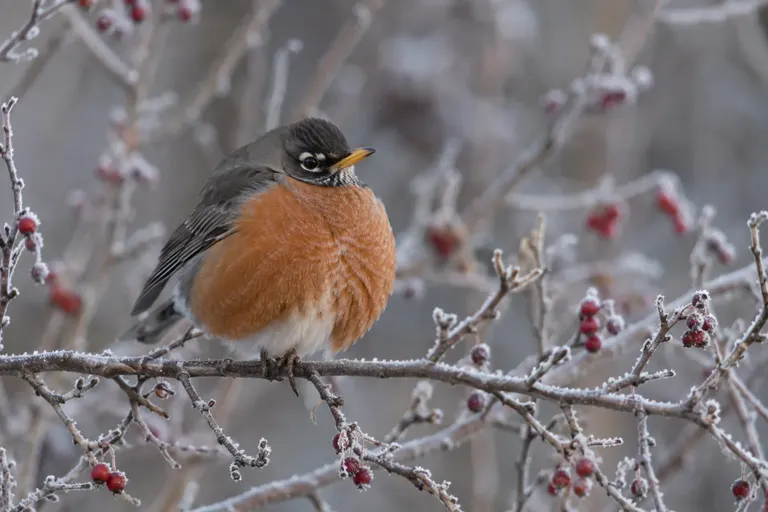
| American Robin | Mud-lined cup | About 13 days, varies by a few days |
| American Goldfinch | Tight cup in shrubs | About 11 to 17 days |
| Black-capped Chickadee | Cavity or nest box | About 12 to 16 days |
| House Wren | Cavity or nest box | About 15 to 17 days |
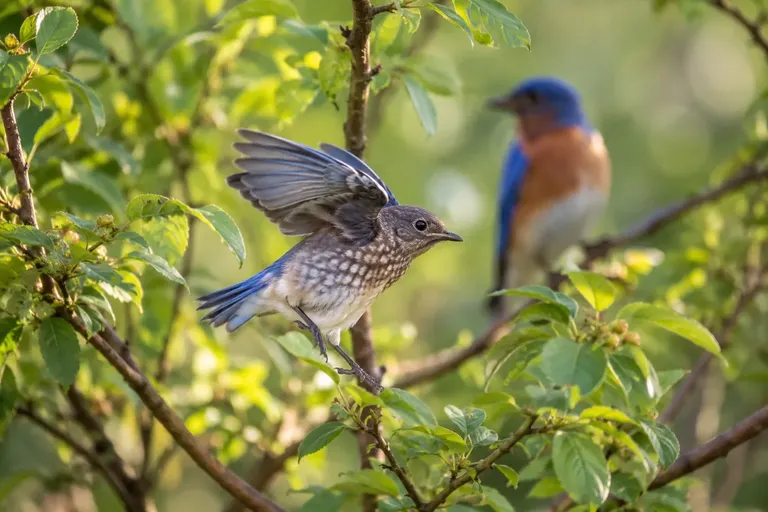
| Eastern Bluebird | Cavity or nest box | About 17 to 21 days |
| Blue Jay | Open cup in trees | About 17 to 21 days |
| Downy Woodpecker | Excavated cavity | About 18 to 21 days |
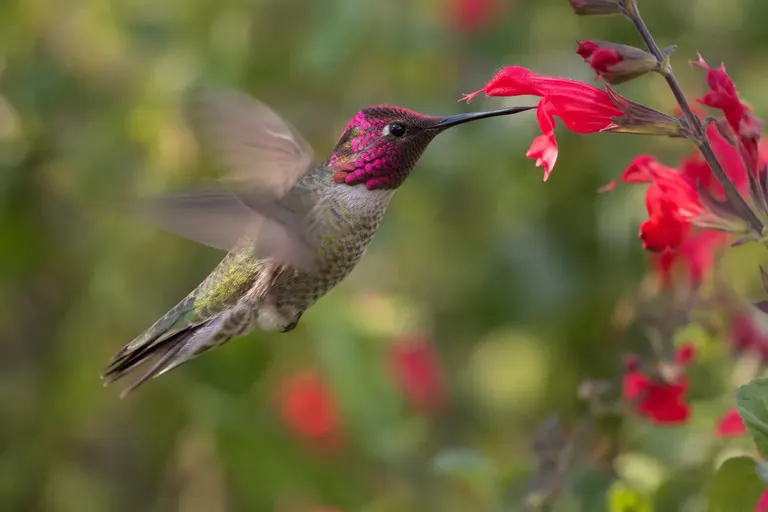
| Ruby-throated Hummingbird | Tiny cup on a branch | About 18 to 22 days |
| Red-tailed Hawk | Large stick nest | About 6 weeks |
| Bald Eagle | Very large stick nest | About 8 to 14 weeks |
In Europe, familiar garden birds follow a similar pattern. European Robins and Eurasian Blackbirds typically leave the nest at around two weeks, while Blue Tits and Great Tits, which nest in holes and boxes, usually stay somewhat longer, often close to three weeks. Common Swifts, which nest in building crevices, can spend well over a month in the nest, and the length varies with weather because chicks grow slowly when bad weather cuts the insect supply.
For how long eggs take before this stage begins, see how long it takes bird eggs to hatch.
Why do some baby birds stay longer than others?
Altricial vs precocial chicks
The biggest difference is how developed a chick is at hatching.
- Altricial chicks hatch naked or nearly naked, with eyes closed, unable to keep warm or feed themselves. Songbirds, woodpeckers, hummingbirds, doves, hawks and owls are altricial or close to it. They depend on the nest and their parents for weeks.
- Precocial chicks hatch with open eyes and a coat of down, and they can walk soon after drying off. Ducks, geese, quail, grouse, chickens and many shorebirds are precocial. They leave the nest almost immediately and follow their parents to food.
Some species fall in between. Gulls and terns, for example, hatch with down and open eyes but stay at or near the nest site while parents bring them food.
Precocial birds lay larger, more yolk-rich eggs and incubate them longer, so chicks do more of their development inside the egg. Altricial birds hatch sooner and do more growing in the nest.
Cavity nests vs open nests
Across many species, birds that nest in enclosed cavities tend to stay in the nest longer than birds of similar size that nest in open cups. The widely accepted explanation is predation. Open nests are easier for predators to find and reach, so there is strong pressure for chicks to grow fast and leave early. Cavities are safer, so chicks can afford to stay until they are better developed and stronger fliers.
You can see this in the table. A cardinal in an open shrub nest may leave in under two weeks, while a bluebird of broadly similar size in a nest box stays close to three.
Body size and food
Larger birds generally take longer to grow. A hummingbird chick weighs a fraction of a gram at hatching and is ready to leave in about three weeks, while an eagle chick needs months to grow into a large, powerful bird. Food supply matters too. When insects are scarce because of cold or wet weather, chicks grow more slowly and may stay longer.
Brood size and timing
Large broods can mean less food per chick, which may slow growth. In some species, siblings hatch on different days, and the oldest often fledge first. In many songbirds, though, all the chicks in a nest leave within a day or so of one another.
How do you know baby birds are about to leave the nest?
Near the end of the nestling period you may notice:
- Chicks fully feathered, with short tails and visible wing feathers.
- Chicks crowding the nest, perched on the rim, or clearly too big for the cup.
- Wing flapping and stretching in the nest.
- Louder, more frequent begging calls.
- Parents sometimes holding food just out of reach, which some observers interpret as encouraging chicks out, though this behavior is not well studied.
Fledging often happens in the morning, and in many songbirds all the chicks leave over the course of a day. Once they are gone, the nest is usually not used again by that brood.
What happens after baby birds leave the nest?
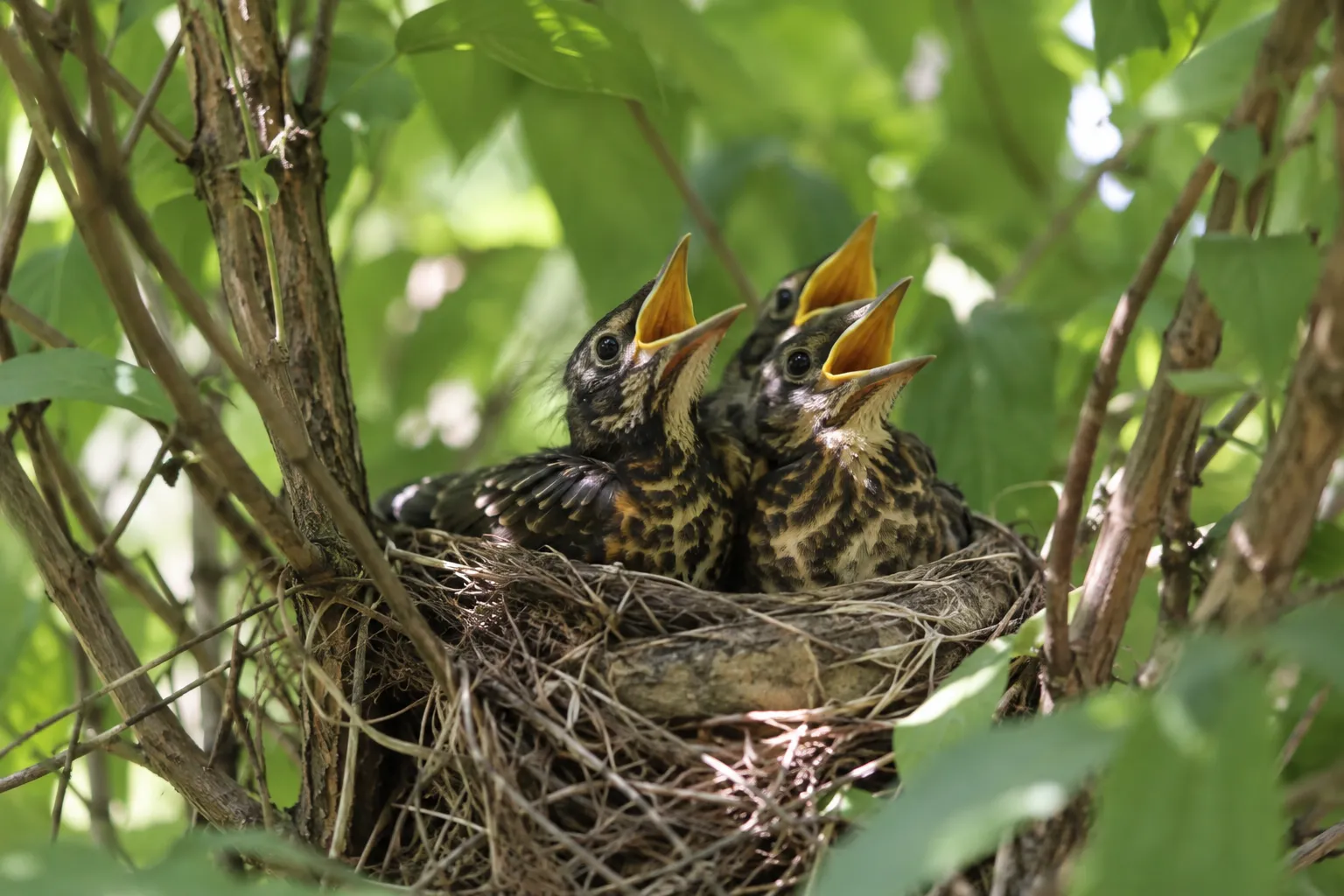
A newly fledged songbird is usually a short-tailed, fluffy bird that can hop, flutter and grip well but cannot yet fly strongly. It spends its time hiding in shrubs, low branches or on the ground while its parents feed it. This fledgling stage is normal, and it is when most people find “abandoned” baby birds that are not abandoned at all.
The length of post-fledging care varies:
- Many small songbirds are fed for about one to three weeks after they leave the nest.
- In species that raise more than one brood a year, such as American Robins, Northern Cardinals and Eastern Bluebirds, the male often takes over feeding the fledglings while the female starts the next nest.
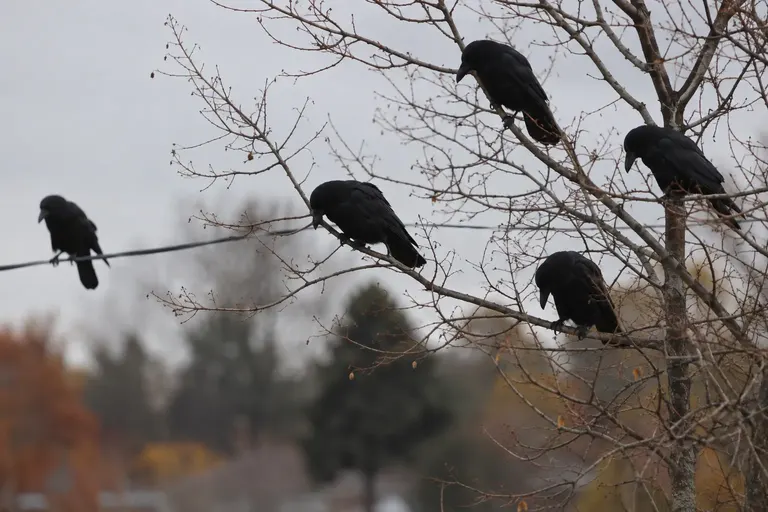
- Larger birds, including crows, jays, hawks and owls, may be fed for many weeks or months. Young American Crows can stay with their family for years and help raise later broods.
- Great Horned Owl young often leave the nest before they can fly well, clambering onto nearby branches, a stage sometimes called branching, and are fed by their parents for months afterward.
For more on this stage, see when baby birds learn to fly and what baby birds eat.
What does a baby songbird look like as it grows?
For a typical small songbird with a two-week nestling period, development follows a fairly predictable path. Exact timing varies by species, so think of this as a rough guide rather than a precise schedule.
| Approximate age | What you would see |
|---|---|
| Hatching to day 3 | Naked or with a few wisps of down, eyes closed, pink or gray skin, bright gape at the mouth corners. Parents brood them much of the time. |
| Days 4 to 6 | Eyes begin to open. Dark pin feathers appear as rows of quills along the wings and back. |
| Days 7 to 9 | Pin feathers start to break open into real feathers. Chicks look spiky and scruffy. They can now hold body heat better, so parents brood less. |
| Days 10 to 13 | Mostly feathered, with short tails. Chicks fill the nest, stretch and flap their wings, and beg loudly. |
| Fledging | Chicks leave the nest, usually able to hop, grip and flutter but not yet fly strongly. |
This progression is useful if you ever find a young bird out of the nest. A bird with few feathers is a nestling that belongs in a nest. A fully feathered bird that hops and grips is a fledgling that has left on purpose.
How fast do baby birds grow?
Songbird nestlings are among the fastest-growing vertebrates. Many increase their weight several times over in the first week or so, and by the time they fledge, small species can be close to adult weight, even though their wings and tail are still short. Feathers, muscles and bones continue developing after they leave the nest, which is why fledglings look stubby and fly clumsily at first.
That speed has a cost. Parents may make hundreds of feeding trips a day at peak demand, mostly bringing insects and other invertebrates, which are rich in protein. Even many seed-eating birds, such as cardinals and sparrows, feed their chicks mainly insects. One notable exception is the American Goldfinch, which feeds its young largely on regurgitated seeds, and is known to be a poor host for Brown-headed Cowbirds partly for that reason.
Why is fledging such a risky time?
Leaving the nest is one of the most dangerous stages in a bird’s life. Studies of songbird fledglings in several species have found that a large share of deaths in the first weeks after leaving the nest happen in the first few days, when young birds fly poorly and are easy prey for cats, hawks, snakes and other predators. Survival improves quickly as they gain strength.
It may seem odd, then, that chicks leave before they fly well. The trade-off is that a nest full of noisy, well-grown chicks is a large, obvious target. Spreading out into cover means a predator that finds one fledgling does not find them all. Parents can also move fledglings toward places with more food and better cover.
Brood parasites add another twist. Brown-headed Cowbirds in North America and Common Cuckoos in Europe and Asia lay their eggs in other birds’ nests, and their chicks often grow fast and can outcompete or, in the cuckoo’s case, eject the host’s own young. We explain this in why some birds lay eggs in other birds’ nests.
How many times a year do birds nest?
Many backyard songbirds raise more than one brood in a season, which is why you may see young birds from late spring well into summer. American Robins, Northern Cardinals, Eastern Bluebirds, Mourning Doves and House Sparrows commonly raise two or more broods where the season is long enough. Mourning Doves in warm regions can nest many times in a year.
Other species raise just one brood. Many long-distance migrants, such as warblers, have a short window between arriving and leaving, and American Goldfinches nest late in summer to match the ripening of thistle and other seeds.
When a species raises multiple broods, the gap between broods can be short. The female may begin a new nest while the male is still feeding fledglings from the first.
Examples from around the world
- Wood Duck (North America): ducklings leave their tree cavity nest about a day after hatching by jumping to the ground or water, sometimes from considerable height, and are unharmed because they are so light.
- Mallard (Northern Hemisphere, widely introduced): ducklings typically leave the nest within about a day and are led to water by the female.
- Killdeer (the Americas): chicks leave the nest within hours of hatching once their down dries and start finding their own food.
- Blue Tit (Europe and Turkey): a hole-nester whose chicks usually stay close to three weeks, and whose breeding is closely timed to a peak in caterpillars.
- Rufous Hornero (South America): chicks are raised in an enclosed mud oven nest, which offers good protection from predators and weather.
- Wandering Albatross (Southern Ocean): the chick spends many months on the nest, often cited as around nine months, one of the longest nestling periods of any bird.
Myths vs facts about baby birds leaving the nest
Myth: A baby bird on the ground has fallen out and been abandoned. Fact: Most are fledglings that left the nest on purpose and are still being fed. See what to do if you found a baby bird.
Myth: Baby birds leave the nest when they can fly. Fact: Most songbirds leave before they can fly well and learn over the following days.
Myth: If you touch a baby bird, its parents will reject it. Fact: Most birds have a limited sense of smell and will not abandon young because a person touched them. Read do mother birds reject babies touched by humans.
Myth: Birds reuse the same nest for all their broods. Fact: Some do, but many build a new nest for each brood. It depends on the species.
What this means for backyard birders
A nest in your yard is a chance to watch the whole cycle, as long as you keep your distance.
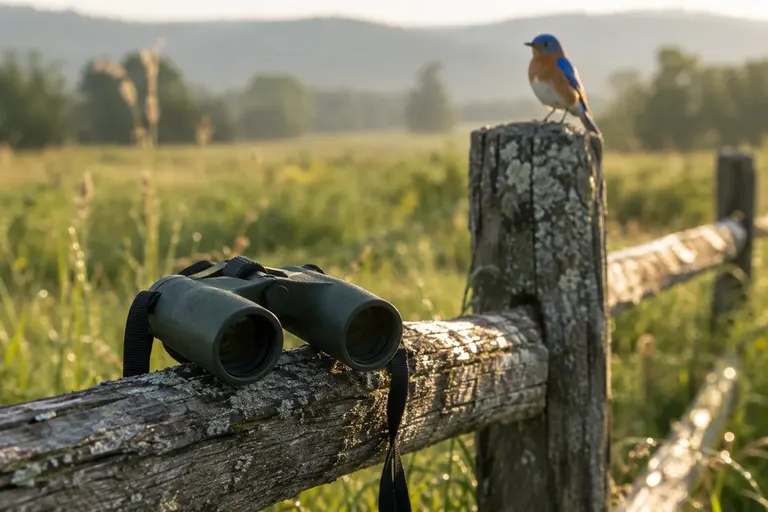
- Watch from afar. Binoculars from a window let you follow progress without disturbing the birds.
- Avoid the nest near fledging time. Nest monitoring programs such as NestWatch advise against approaching songbird nests in the last few days before young are due to leave, because disturbance can cause chicks to leave early before they are ready.
- Keep pets indoors. Fledglings on the ground are highly vulnerable to cats and dogs for their first days out. Our guide to cats and birds has practical steps for keeping a yard safe during nesting season.
- Leave fledglings alone. A feathered, hopping baby bird with a short tail is usually fine. Parents are nearby.
- Wait before cleaning boxes. Check that a nest box is truly empty before cleaning it, since some species raise a second brood. Our guide on when and how to clean out a birdhouse covers timing.
- Record what you see. Noting when eggs hatch and chicks leave builds a useful record and teaches you the rhythm of each species.
Sources
Frequently asked questions
How long do baby robins stay in the nest?
American Robin nestlings usually leave the nest about two weeks after hatching, commonly cited as around 13 days, though it can vary by a few days. After fledging, the young stay on the ground and in low branches while the parents, especially the male, keep feeding them for up to a couple more weeks as they learn to fly well and find food.
Do baby birds come back to the nest after they leave?
Most do not. Once songbird young fledge, they spend their days and nights perched in cover near the nest while their parents feed them. A few species, including some swallows and wrens, may return to roost at or near the nest for a short time, but the nest has generally done its job once the chicks leave.
What happens if baby birds leave the nest too early?
Chicks that leave before they are ready, often because a person or predator disturbed the nest, may be unable to fly or keep warm and can be more vulnerable. This is why nest monitoring programs advise against approaching nests when young are close to fledging. If a feathered fledgling is on the ground, it is usually normal and should be left alone.
How long do parents feed baby birds after they leave the nest?
It varies widely. Many small songbirds are fed for about one to three weeks after fledging, while some larger birds, such as hawks, owls and crows, depend on their parents for many weeks or even months. In some species the male takes over care of the fledglings while the female starts another nest.
Which birds leave the nest the day they hatch?
Precocial birds, whose chicks hatch with open eyes and downy feathers and can walk soon after, leave very early. Mallard and Wood Duck ducklings typically leave the nest within about a day of hatching, and Killdeer, quail, grouse and many shorebird chicks leave within hours once their down dries.