Best Blue Jay Feeders: Peanut, Platform and Hopper Picks
The best blue jay feeder for most yards is a whole peanut feeder with a roof. Compare 5 peanut, wreath, platform and hopper picks, plus what jays eat.
If you buy through links on this page we may earn a commission, at no cost to you. It never decides what we recommend. How we earn
In this article
- Quick picks
- How we chose
- What makes a good blue jay bird feeder?
- Birds Choice Magnet Mesh Whole Peanut Feeder: best blue jay feeder overall
- Songbird Essentials Whole Peanut Wreath: best peanut wreath feeder
- Woodlink Going Green Recycled Premier Platform Feeder: best platform feeder for jays
- Woodlink Going Green Fly Through Feeder: best covered platform for jays
- Absolute II Hopper Feeder: best large hopper for cardinals and blue jays
- Comparison table
- What do blue jays eat at feeders?
- What is the best peanut feeder for blue jays?
- Do blue jays scare other birds away from feeders?
- When do blue jays visit feeders most?
- How do you keep blue jays from hogging a bird feeder?
- Where should you put a blue jay feeder?
- Why are blue jays not coming to my feeder?
- Common mistakes with blue jay feeders
- Sources
- Frequently asked questions
The best blue jay feeder for most yards is the Birds Choice Magnet Mesh Whole Peanut Feeder. It’s an all-steel cage with a roof and drainage holes that holds about 2 quarts of peanuts in the shell, and its wide mesh lets jays pull out whole nuts to carry away. Pair it with a sturdy platform or hopper and you cover everything the Cornell Lab says Blue Jays look for at feeders.
Quick picks
- Best overall: Birds Choice Magnet Mesh Whole Peanut Feeder. About 2 quarts, steel, roof.
- Best peanut wreath: Songbird Essentials Whole Peanut Wreath. About 5 cups of whole peanuts.
- Best platform: Woodlink Going Green Recycled Premier Platform Feeder. Recycled plastic, screen floor.
- Best covered platform: Woodlink Going Green Fly Through Feeder. About 2 lb, clear roof.
- Best large hopper: Absolute II Hopper Feeder. Up to 12 lb, steel, pole included.
Birds Choice Magnet Mesh Whole Peanut Feeder
A powder-coated steel feeder with wide mesh for whole peanuts in the shell, an overhanging roof, drainage holes and a center seed diverter.
- Best for
- Yards where you want jays and woodpeckers at a dedicated peanut station.
- Skip it if
- You only offer shelled peanut pieces for chickadees and titmice.
- Capacity
- About 2 quarts
- Material
- Powder-coated steel
- Size
- 10.5 x 7 in (about 27 x 18 cm)
- Mounting
- Hanging cable included
Songbird Essentials Whole Peanut Wreath
A spiral wire wreath you fill with whole peanuts in the shell. Jays perch on the coil and twist the nuts free.
- Best for
- A low-cost, fun way to watch jays work for every peanut.
- Skip it if
- Squirrels already run your yard; they find wreaths quickly.
- Capacity
- About 5 cups of whole peanuts
- Size
- 13 in outside, 7 in inside diameter
- Coil
- 2.75 in spring diameter
- Mounting
- Hanging hook
Woodlink Going Green Recycled Premier Platform Feeder
An open tray made from up to 90% recycled plastic with a powder-coated metal screen floor that drains rain.
- Best for
- Mixed foods for jays and cardinals: peanuts, sunflower and corn on one tray.
- Skip it if
- Grackles and starlings already crowd your yard.
- Size
- 12.75 x 12.75 x 2.5 in (about 32 x 32 x 6 cm)
- Material
- Recycled plastic, metal screen floor
- Mounting
- Hanging
- Made in
- USA
Woodlink Going Green Fly Through Feeder
A roofed tray with open sides, a perforated metal screen floor and a clear roof, so food stays drier than on an open platform.
- Best for
- Wet climates where food on an open tray turns soggy.
- Skip it if
- You want a feeder you never have to scrape out by hand.
- Capacity
- About 2 lb of food
- Size
- 12 x 8 x 9 in (about 30 x 20 x 23 cm)
- Material
- Recycled plastic lumber, metal screen
- Mounting
- Hanging cable; pole mount sold separately
Absolute II Hopper Feeder
A two-sided steel hopper holding up to 12 lb of seed, with adjustable spring perches and both a hanger and a pole included.
- Best for
- Bird feeders for cardinals and blue jays in one busy, squirrel-prone yard.
- Skip it if
- You cannot set up a sturdy pole for a heavy, full feeder.
- Capacity
- Up to 12 lb seed
- Material
- Steel
- Size
- 11 x 14 x 9 in
- Mounting
- Hanger and 58 in pole included
How we chose
We haven’t hung these feeders in our own yard yet. This guide is research-based. We started with what the Cornell Lab of Ornithology, Project FeederWatch and the National Audubon Society say about how Blue Jays feed, then compared manufacturer and retailer specifications for capacity, materials, drainage, mesh size and mounting. We confirmed each model is currently sold by its maker or a major retailer. We also read verified owner reviews for repeated patterns, especially wet peanuts, rust, squirrel damage and whether jays actually used the feeder. Designs that suit how jays really eat, on a firm perch with room to land, scored higher than pretty feeders built for finches.
What makes a good blue jay bird feeder?
A good blue jay bird feeder gives a big bird room to land and offers food it can grab whole. The Blue Jay is a large songbird, and the Cornell Lab says it prefers tray feeders or hopper feeders on a post rather than hanging feeders. That rules out most small tube feeders.
Look for four things:
- A firm place to stand. A wide ledge, tray edge or sturdy mesh. Short tube perches don’t work for jays.
- Food jays want. Cornell lists peanuts, sunflower seeds and suet as their feeder favorites.
- Drainage. Peanuts and seed spoil fast when wet. A screen floor, drain holes or a roof matters.
- Easy access for whole nuts. Jays carry food off to hide it. Cornell notes they carry food in their throat and upper esophagus, in an area often called a gular pouch, and can carry up to five acorns at once.
That caching habit explains why jays can clear a feeder fast. They aren’t eating everything on the spot. Many trips are to stash food for later.
Birds Choice Magnet Mesh Whole Peanut Feeder: best blue jay feeder overall
What it is: A powder-coated, all-steel peanut feeder built for whole peanuts in the shell. Retail listings give a capacity of about 2 quarts and a size of 10.5 in long by 7 in high (about 27 x 18 cm), or 15.5 in with the hanging cable. It has an overhanging roof, a center seed diverter and drainage holes. Listings name jays and woodpeckers as the target birds.
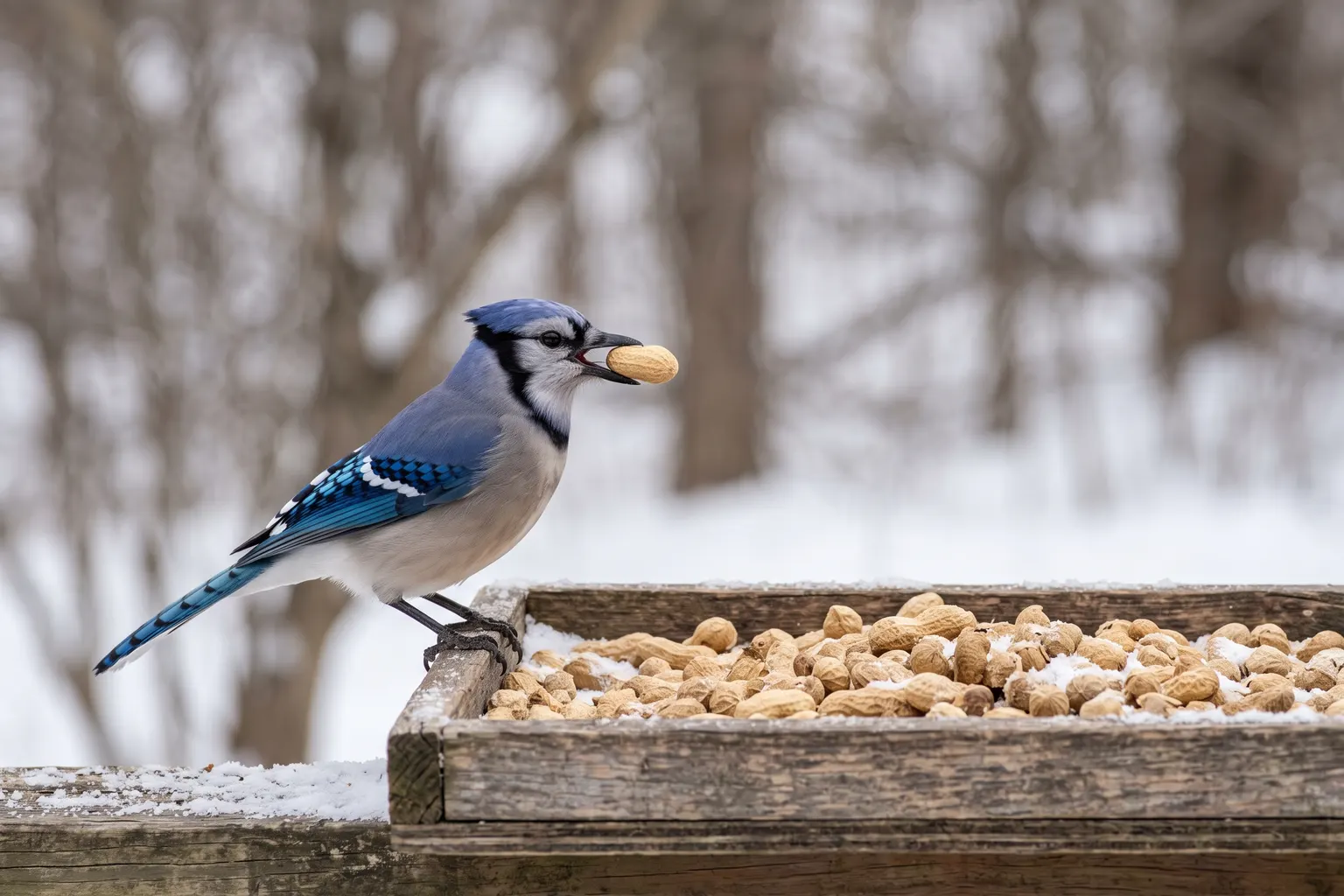
Why it stands out: Most peanut feeders have mesh sized for shelled kernels, which suits chickadees and nuthatches but frustrates jays. This one uses wide mesh made for nuts in the shell, so jays can cling, pick and pull a whole peanut free. The roof keeps rain off, which matters because damp peanuts can grow mold. Steel stands up to chewing far better than plastic. It also takes shelled peanuts or suet nuggets if you want to switch foods in summer.
Owner patterns: Owners mainly mention how quickly jays find it once it’s filled with in-shell peanuts, and that woodpeckers use it too. The recurring caution is squirrels: steel resists chewing, but a squirrel that can reach the feeder will still pull nuts out, so hang it from a baffled pole or a line away from jump-off points.
Key specs: About 2 quarts, powder-coated steel, 10.5 x 7 in, roof and drainage holes, cable included.
- Best for: A dedicated jay and woodpecker station.
- Skip it if: You only feed shelled peanut pieces for small birds.
See available listings on Amazon
Songbird Essentials Whole Peanut Wreath: best peanut wreath feeder
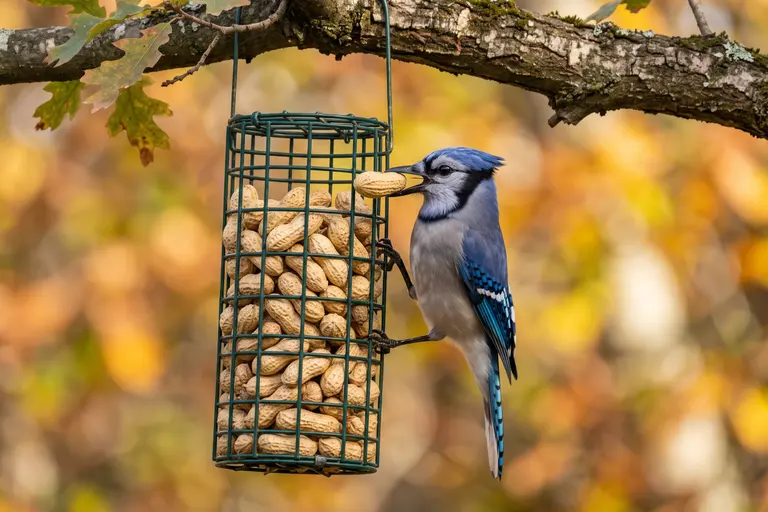
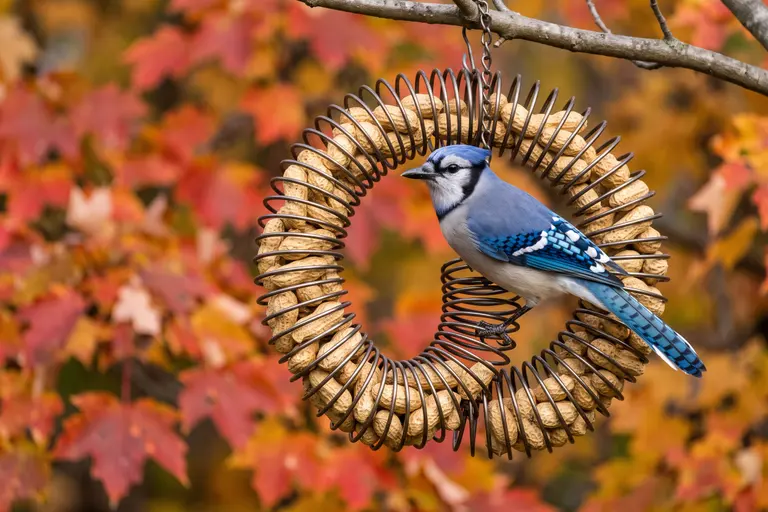
What it is: A spiral wire coil bent into a ring. You open the coil and thread whole peanuts in the shell into it. Retail listings give an outside diameter of 13 in, an inside diameter of 7 in and a spring diameter of 2.75 in, and say it holds about 5 cups of whole peanuts. It hangs from a hook.
Why it stands out: A peanut wreath feeder is simple and works with how jays feed. The coil holds each nut loosely, so a jay can land, grip the wire and twist a peanut out. That small effort slows them down a little, so a wreath lasts longer than a pile of peanuts on a tray. It also looks good hanging from a tree branch.
Owner patterns: Owners like watching jays, titmice and woodpeckers work the coil. The most common complaint is that squirrels love it too. Some owners hang a wreath on purpose away from the main feeders as a squirrel distraction. Others say the coil can be fiddly to open and refill with cold hands.
Key specs: About 5 cups, 13 in outside diameter, spiral wire, hanging hook.
- Best for: A cheap second jay feeder, or a starter whole peanut bird feeder.
- Skip it if: Squirrels can reach it. Our guide on keeping squirrels off feeders covers placement.
See available listings on Amazon
Woodlink Going Green Recycled Premier Platform Feeder: best platform feeder for jays
What it is: An open, square tray made from up to 90% post-consumer recycled plastic, with a powder-coated metal screen floor. Listings give a size of 12.75 x 12.75 x 2.5 in (about 32 x 32 x 6 cm). It hangs from a hook and is made in the USA.
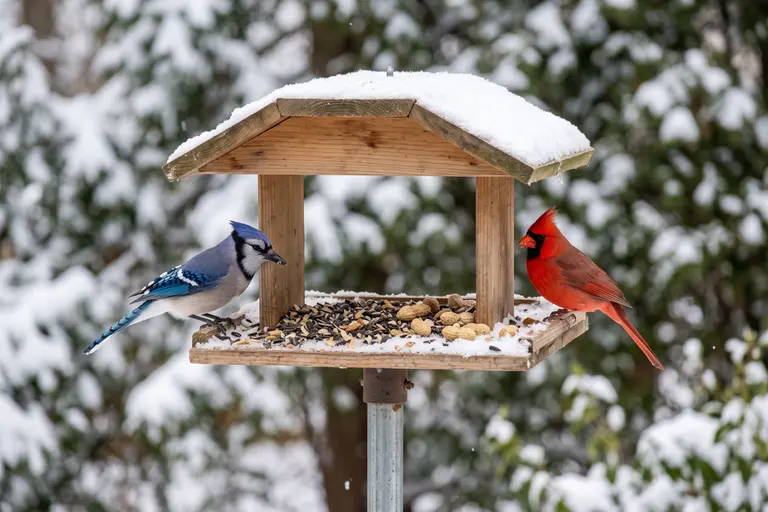
Why it stands out: This is the feeder style the Cornell Lab says jays prefer. A tray lets you mix foods: in-shell peanuts, sunflower seed, cracked corn and a few suet nuggets. The screen floor lets rain drain away, and recycled plastic doesn’t soak up water or rot the way wood can. Cardinals, doves and sparrows will use it too. Our full guide to platform bird feeders compares more trays.
Owner patterns: Owners like how easy it is to brush out and hose clean. The main complaint is the flip side of any open tray: in a yard with grackles, starlings or squirrels, the food goes fast.
Key specs: 12.75 x 12.75 x 2.5 in, recycled plastic, metal screen floor, hanging.
- Best for: Yards that want jays, cardinals and doves at one feeder.
- Skip it if: Big flocks of grackles already empty your feeders. See our guide on keeping starlings and grackles off feeders.
See available listings on Amazon
Woodlink Going Green Fly Through Feeder: best covered platform for jays
What it is: A roofed tray with open sides. Retail listings give a size of 12 x 8 x 9 in (about 30 x 20 x 23 cm) and a capacity of about 2 lb of food. The frame is recycled plastic lumber, the feeding floor is a perforated metal screen and the roof is clear plastic. It hangs from an attached cable, and a pole mount is sold separately.
Why it stands out: Jays can fly straight in, land on the tray and leave with a peanut, which suits their grab-and-go style. The roof is the reason to choose it over an open tray. Food stays drier in rain and snow, so you waste less. The open sides keep the jay’s view clear, which helps a wary bird feel safe.
Owner patterns: Owners say the roof makes a real difference in wet weather. The common complaint is that the screen still collects shells and wet bits that need scraping out every few days.
Key specs: About 2 lb, 12 x 8 x 9 in, recycled plastic lumber, metal screen, clear roof.
- Best for: Wet or snowy climates.
- Skip it if: You want a feeder that needs almost no cleaning.
See available listings on Amazon
Absolute II Hopper Feeder: best large hopper for cardinals and blue jays
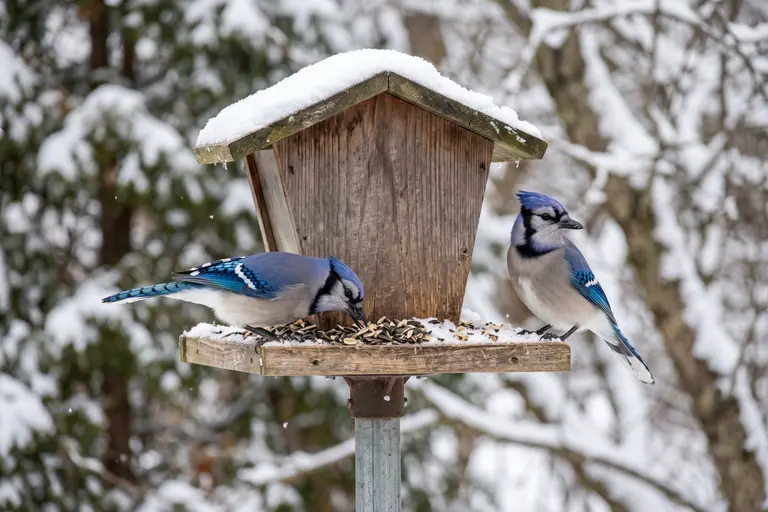
What it is: A two-sided steel hopper. Duncraft lists a capacity of up to 12 lb of mixed seed, a size of 11 x 14 x 9 in and a locking roof. It comes with a metal hanger and a 58 in, 1 in round sectional pole with a ground socket. Duncraft says it’s designed and built in Concord, NH.
Why it stands out: The Cornell Lab notes jays like hopper feeders on a post, and this one comes with the post. Long ledges on both sides give big birds room to land. Duncraft says the spring-activated perches are adjustable and designed to keep out gray squirrels. Steel resists chewing, and 12 lb of capacity means fewer refills in winter. It’s a good choice if you’re shopping for bird feeders for cardinals and blue jays at once. Our guide to feeders for cardinals has more options.
Owner patterns: Owners praise the capacity and how well the steel holds up. The repeated caution is weight: a full feeder is heavy, so set the pole firmly. Some owners also say they needed to adjust the perch tension so it didn’t close under larger birds.
Key specs: Up to 12 lb seed, steel, adjustable perches, hanger and pole included.
- Best for: Busy winter yards with squirrels.
- Skip it if: You can’t set a pole in the ground. Our hopper feeder guide covers lighter models.
See available listings on Amazon
Comparison table
| Feeder | Type | Capacity | Material | Best food | Mounting |
|---|---|---|---|---|---|
| Birds Choice Magnet Mesh | Whole peanut cage | About 2 qt | Steel | Peanuts in shell | Hanging |
| Songbird Essentials Wreath | Peanut wreath | About 5 cups | Wire coil | Peanuts in shell | Hanging |
| Woodlink Premier Platform | Open tray | Not listed | Recycled plastic | Peanuts, sunflower, corn | Hanging |
| Woodlink Fly Through | Covered tray | About 2 lb | Recycled plastic | Peanuts, sunflower | Hanging or pole |
| Absolute II | Hopper | Up to 12 lb | Steel | Sunflower, mixed seed | Pole or hanger |
What do blue jays eat at feeders?
Blue Jays eat peanuts, sunflower seed and suet at feeders, according to the Cornell Lab. Audubon says most of their diet over the year is plant food, up to about 75%, including acorns, beechnuts, seeds, grain and berries, plus insects such as caterpillars, beetles and grasshoppers.
What to offer, in order of appeal:
- Peanuts in the shell. The classic jay food. Project FeederWatch says raw or roasted is fine, but avoid salted or flavored nuts.
- Shelled peanuts. Easier for small birds too. Our guide to peanuts for birds covers types and storage.
- Black oil sunflower seed. Fine in a hopper or on a tray.
- Suet. Especially in cold weather.
- Cracked or whole corn. Cheap, and jays take it, though it also draws grackles and squirrels.
Audubon notes jays pound on hard nuts or seeds with the bill to break them open. That’s why you often see a jay hold a peanut under its foot on a branch and hammer at it.
What is the best peanut feeder for blue jays?
The best peanut feeder for blue jays has mesh wide enough for whole peanuts in the shell, or no mesh at all. Standard peanut tubes use small mesh for shelled kernels. That design is right for chickadees and nuthatches, because it stops small birds from taking large pieces, but jays struggle with it.
Three styles work well:
- Wide-mesh whole peanut feeders, such as the Birds Choice Magnet Mesh. A roof keeps nuts dry.
- Peanut wreaths, which hold in-shell nuts in a loose coil.
- Trays, where you simply scatter a handful of in-shell peanuts each morning.
Project FeederWatch notes that jays may grab several peanuts and hide them, while chickadees, nuthatches and titmice do better with shelled peanuts. If you want both groups, run two feeders: a whole peanut bird feeder for jays and a small-mesh tube for the small birds.
Do blue jays scare other birds away from feeders?
Blue Jays can scatter other birds for a moment, but they are less of a bully than their reputation. The Cornell Lab describes them as far less aggressive than many other species, and says Red-bellied Woodpeckers and gray squirrels often dominate jays at feeders and keep them from food.
Cornell also notes that jays sometimes mimic hawk calls when approaching feeders, which can make other birds scatter so the jay can take over. If it seems like jays chase everything off, watch for a few minutes. Smaller birds usually come back as soon as the jay leaves with its peanut.
What about nest raiding? Jays do sometimes take eggs and nestlings, but Cornell says the evidence is limited: in a study of 530 stomachs, traces of bird eggs and nestlings were found in only 6.
When do blue jays visit feeders most?
Blue Jays visit feeders all year in much of their range, but how they behave changes with the seasons. The Cornell Lab says fewer than about 20 percent of Blue Jays probably migrate, and some stay put year-round across the whole range, so most backyards keep at least a few jays through winter.
| Season | What jays are doing | What to offer |
|---|---|---|
| Spring and early summer | Nesting. Cornell says jays are as secretive as possible while nesting, so visits are quieter and shorter. | A small daily handful of peanuts, sunflower on a tray |
| Late summer and fall | Families join flocks, and some move south. Cornell notes this overlaps with hawk migration. Jays get noisy and busy. | In-shell peanuts for caching, refilled often |
| Winter | Most jays stay. Audubon says they do not go south of the United States. | Peanuts, sunflower and suet |
Fall is when jays empty a peanut feeder fastest. They are storing food, not just eating it, a habit our guide on why birds hoard food explains. In hot weather, switch to processed no-melt suet, because Project FeederWatch warns plain suet can go rancid.
How do you keep blue jays from hogging a bird feeder?
To make a blue jay proof bird feeder setup, give small birds feeders that jays can’t use, and give jays their own spot. You can’t really ban jays, and most people wouldn’t want to, but you can stop them clearing your sunflower in one morning.
Project FeederWatch suggests:
- Tube feeders with short perches. Jays and grackles can’t balance on them. Our guide to tube feeders lists good ones.
- Feeders that close under the weight of a large bird. Weight-activated hoppers can be set to shut for jays.
- Wire mesh cages that only small birds can pass through.
- No open trays or food on the ground near the small-bird feeders.
Then put the jay food somewhere else. A peanut feeder or wreath on the far side of the yard draws jays away from the tube feeders. Many owners find that once jays have a reliable peanut source, they spend less time at the seed feeders.
Where should you put a blue jay feeder?
Put a blue jay feeder on a post or near mature trees, about 10 feet from dense shrubs. Project FeederWatch calls that distance a good compromise between giving birds cover and limiting ambushes by cats and squirrels. Jays are wary of open lawns and busy patios, so a quiet corner near oaks or other big trees often works best.
Pole mounting is the easiest way to protect any feeder from squirrels, because one baffle under the feeder blocks the only route up. Our guide to bird feeder poles and baffles explains heights and baffle sizes. For a feeder that keeps squirrels out on its own, see our squirrel proof feeder guide.
Keep feeders clean. Project FeederWatch recommends cleaning seed feeders every week or two, more often in wet weather, and soaking them for 10 minutes in one part bleach to nine parts water. Rinse and dry completely before refilling.
Why are blue jays not coming to my feeder?
If jays ignore a new blue jay feeder, the cause is usually the season, the spot or the food. Work through these checks:
- It is nesting season. In early summer, Cornell says jays keep a low profile to avoid leading predators to their nests. Many reappear in late summer and fall.
- There are no big trees nearby. Cornell says Blue Jays are found in all kinds of forests but especially near oak trees, and are more common near forest edges than deep woods. A feeder in an open lawn far from trees gets fewer visits.
- The spot is too busy. Project FeederWatch recommends a quiet area near natural cover. Move the feeder away from doors, dogs and a busy patio.
- The peanuts are stale. FeederWatch says to watch for mold and throw away moldy peanuts right away. Offer smaller amounts and refill more often.
- Other diners got there first. Cornell notes squirrels and other birds often dominate jays at feeders. A baffle, or a second peanut station elsewhere in the yard, gives jays a chance.
Once you find a good spot, leave the feeder there. Jays are wary, and a feeder that keeps moving is harder for them to trust.
Common mistakes with blue jay feeders
- Using a small tube feeder. Jays can’t perch on short pegs, so they’ll ignore it or knock it about.
- Buying salted or flavored peanuts. Project FeederWatch advises against salt, coatings and flavorings.
- Putting out too many peanuts at once. Wet nuts can mold. Offer what jays take in a day or two.
- Only feeding shelled pieces in fine mesh. That suits small birds, not jays.
- Hanging peanuts within squirrel jumping range. Squirrels love peanuts more than jays do.
- Putting the jay feeder next to the small-bird feeders. Spread them out so everyone eats.
Sources
- Cornell Lab of Ornithology, All About Birds: Blue Jay overview
- Cornell Lab of Ornithology, All About Birds: Blue Jay life history
- Project FeederWatch: Feeding birds
- National Audubon Society: Blue Jay field guide
- Duncraft: Magnet Mesh Peanut Feeder
- Duncraft: Absolute II Bird Feeder
- Walmart listing: Songbird Essentials Whole Peanuts Wreath
- Walmart listing: Woodlink Going Green Fly Through Bird Feeder
- Johnson’s Garden Center: Woodlink Going Green Recycled Premier Platform Bird Feeder
- Cornell Lab of Ornithology, All About Birds: Why are Blue Jays far more noisy in fall than earlier in the summer?

Frequently asked questions
What is the best feeder for blue jays?
The best blue jay feeder is one that offers peanuts on a stable surface. The Cornell Lab says Blue Jays prefer tray feeders or hopper feeders on a post rather than hanging feeders, and that they like peanuts, sunflower seed and suet. A wide-mesh whole peanut feeder or a sturdy platform covers both preferences. Add a peanut wreath if you enjoy watching jays work.
Do blue jays eat peanuts in the shell?
Yes, and many jays prefer them. Project FeederWatch says you can offer peanuts shelled or in the shell, and notes that jays may grab several at once to hide. Raw or roasted is fine, but avoid salted peanuts or any with coatings or flavorings. Offer only what birds clear in a day or two so nuts stay dry.
Do blue jays scare away other birds?
Sometimes, but less than their reputation suggests. The Cornell Lab describes Blue Jays as far less aggressive than many other species, and says Red-bellied Woodpeckers and gray squirrels often push them off feeders. Jays do sometimes mimic hawk calls as they arrive, which can scatter smaller birds for a moment. A separate peanut feeder usually spreads the crowd out.
How do I stop blue jays from emptying my feeder?
Give jays their own peanut station and use small-bird feeders for everything else. Project FeederWatch suggests tube feeders with short perches, feeders that close under the weight of a large bird, or wire cages that only small birds can pass through. It also advises skipping open trays and food on the ground if large birds are the problem.
Where should I put a blue jay feeder?
Put it on a post or hang it near trees, about 10 feet from dense cover. Project FeederWatch calls that distance a good compromise between giving birds cover and keeping cats and squirrels from ambushing them. Jays are wary, so a quiet edge of the yard with mature trees works better than a busy patio. Add a baffle if squirrels can climb the pole.