How to Attract Blue Jays: Peanuts, Oaks and Feeders
How to attract blue jays: put peanuts, sunflower seed and suet on a platform or post-mounted hopper, add a birdbath, and plant oaks for acorns and cover.
In this article
- Blue Jay at a glance
- How to identify a Blue Jay
- Where do Blue Jays live?
- What do Blue Jays eat?
- What kind of feeder attracts Blue Jays?
- Where to put a feeder for Blue Jays
- Water for Blue Jays
- Plants and habitat that attract Blue Jays
- Do Blue Jays use nest boxes?
- Why aren’t Blue Jays coming to my feeder?
- Seasonal calendar: Blue Jays through the year
- Common problems and fixes
- Common mistakes when trying to attract Blue Jays
- Sources
- Frequently asked questions
Here is how to attract Blue Jays: offer peanuts, sunflower seed and suet on a platform feeder or a hopper mounted on a post, add a birdbath, and plant or protect oak trees. The Cornell Lab of Ornithology lists exactly those foods and feeder styles as Blue Jay favorites, and oaks supply the acorns that are central to a natural diet the Cornell Lab puts at about 78 percent plant matter.
Blue Jays are loud, clever and wary. Once they learn that your yard has peanuts, they tend to return daily, often announcing themselves long before they land.
Blue Jay at a glance
| Feature | Details |
|---|---|
| Size | 9.8 to 11.8 in long; 2.5 to 3.5 oz; wingspan 13.4 to 16.9 in (Cornell Lab) |
| Range | Eastern and central North America, from southern Canada to the Gulf Coast; spreading northwest |
| Season | Year-round in most of the range; some individuals migrate |
| Diet | About 78 percent plant matter (acorns, nuts, fruit, grain) and 22 percent insects |
| Best feeder foods | Peanuts, sunflower seed, suet |
| Best feeders | Platform, post-mounted hopper, peanut ring or wreath |
| Nesting | Open cup in trees, 10 to 25 ft up |
| Nest boxes | Not used |
| Conservation | Low concern; long-term decline of about 27 percent from 1966 to 2019 |
How to identify a Blue Jay
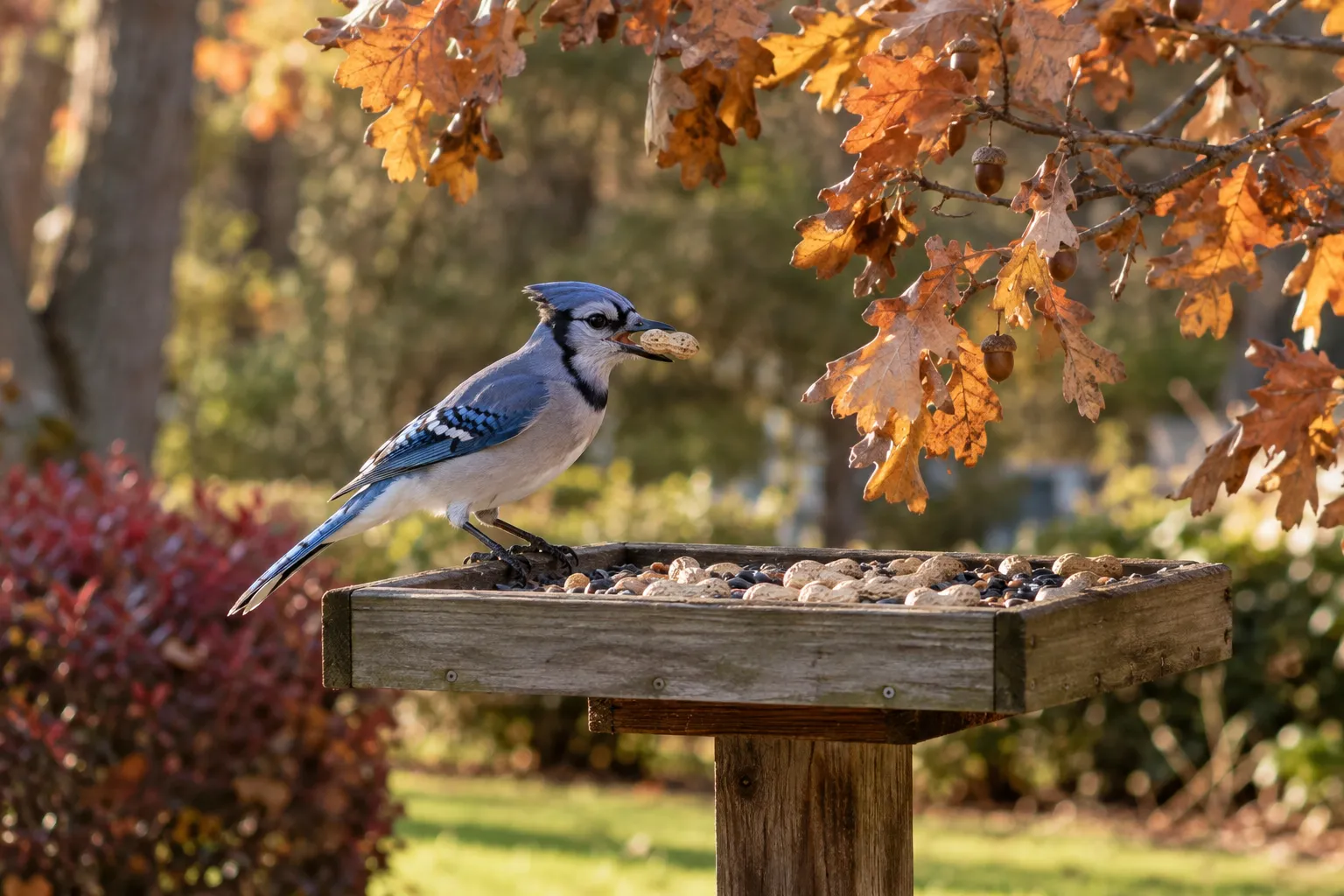
The Blue Jay is a large songbird, bigger than a robin and smaller than a crow. The Cornell Lab describes it as blue above and white below, with a prominent crest and a bold black necklace.
Key field marks
- Crest: Perky and adjustable. Jays raise it when excited or aggressive and flatten it when relaxed.
- Necklace: A black band around the white throat and face.
- Wings and tail: Bright blue with black barring, bold white wing bars and white tail tips.
- Underparts: Grayish white, fading to white on the belly.
Males, females and juveniles
Males and females look alike. Young birds in summer look similar to adults but duller and grayer, with a shorter crest. Watch for begging juveniles following adults to feeders in mid to late summer.
Why a Blue Jay is blue
The blue is not a pigment. The Cornell Lab explains that the color comes from light scattering through modified cells on the surface of the feather barbs, with melanin providing the underlying brown. A crushed Blue Jay feather looks brown, not blue.
Calls
Blue Jays make a large variety of calls that carry long distances. The best known is a loud “jeer” or “jay.” They also give whistled, bell-like and rattling notes, and they are good mimics of hawk calls. A hawk scream from a treetop with no hawk in sight is often a Blue Jay.
Similar species
- Steller’s Jay: In the West, darker blue with a black crest and head, and no white face or wing bars.
- Florida Scrub-Jay, California Scrub-Jay and Woodhouse’s Scrub-Jay: No crest and no black necklace.
- Eastern Bluebird: Much smaller, with no crest and a rusty-orange breast.
- Belted Kingfisher: Blue-gray and crested, but found near water, with a huge bill and a blue breast band.
Where do Blue Jays live?
Blue Jays live across eastern and central North America, from southern Canada to Florida and the Gulf Coast, and west into the Great Plains. Audubon notes the species is expanding its range toward the northwest.
The Cornell Lab says Blue Jays use all kinds of forests but are especially drawn to oak trees, and are more abundant near forest edges than deep in the woods. Audubon adds that they favor habitat with many oak or beech trees. They also do well in towns and suburbs wherever there are oaks or bird feeders, which makes many backyards good jay habitat.
Do Blue Jays migrate?
Partly, and in ways scientists still do not fully understand. The Cornell Lab describes thousands of Blue Jays migrating in daytime flocks along the Great Lakes and Atlantic coasts, while some stay all winter throughout the range. Individual jays may migrate one year and stay the next. Fewer than 20 percent are thought to migrate. For most backyard feeders within the range, jays can be seen all year, with numbers shifting in spring and fall.
What do Blue Jays eat?
The Cornell Lab reports that about 22 percent of a Blue Jay’s diet is insects and roughly 78 percent is plant matter, mainly acorns, nuts, fruits and grains. They hold food in their feet and hammer it open with their bills.
Acorns and caching
Acorns are the heart of the Blue Jay diet in fall. Jays harvest acorns and bury them in the ground for later, and the Cornell Lab notes a jay can carry off 5 acorns at a time using its throat pouch, mouth and bill. Not every cached acorn is recovered, and Blue Jays are widely credited with helping spread oak forests by planting forgotten acorns.
Eggs and nestlings
Blue Jays have a reputation as nest robbers. They do sometimes take eggs and nestlings, but it is a small part of their diet. In a large study cited by the Cornell Lab, only about 1 percent of jays had evidence of eggs or birds in their stomachs, and the Cornell Lab’s life history notes such items in only 6 of 530 stomachs examined.
Best foods for Blue Jays at feeders
| Food | How much Blue Jays like it | Notes |
|---|---|---|
| Whole peanuts in the shell | Very high | Jays carry them off to eat or cache |
| Shelled peanuts | Very high | Unsalted, plain only; keep dry |
| Black oil sunflower | High | Easy to find and widely eaten |
| Striped sunflower | High | Jays crack thicker shells easily |
| Suet cakes | High | Especially in winter; nut blends popular |
| Cracked corn | Moderate | Small amounts on platforms; keep dry |
| Acorns and nuts | Very high (natural) | Plant oaks for a long-term supply |
| Nyjer | Low | Too small; for finches |
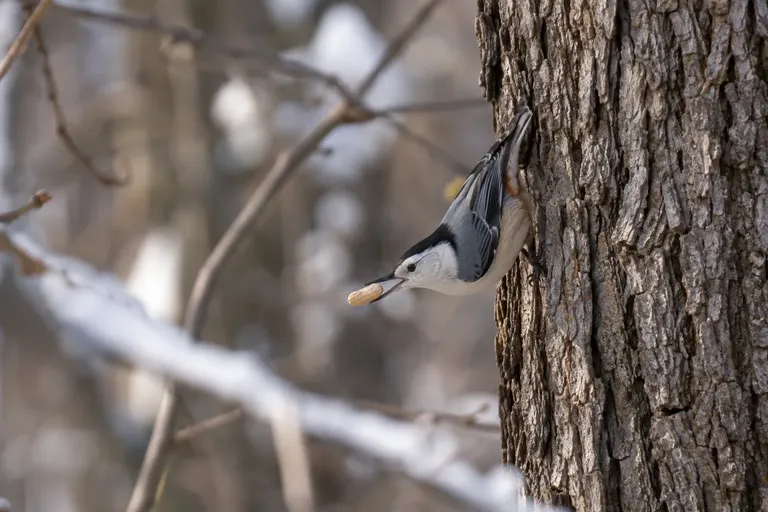
Peanuts are the fastest way to attract Blue Jays. Offer them in the shell on a platform or in a peanut ring, or shelled in a mesh peanut feeder. The Cornell Lab warns that peanuts, like corn, can harbor aflatoxins, so keep them dry and use them up fairly quickly. Never offer salted, seasoned or coated peanuts.
Sunflower seed draws jays along with most other birds. See our guide to black oil sunflower seed, and our roundup of the best bird seed to attract the most species for blends with peanuts.
Suet is a winter favorite. Our roundup of suet cakes and blends covers options, including no-melt cakes for warm months.
What kind of feeder attracts Blue Jays?
The Cornell Lab says Blue Jays prefer tray feeders or hopper feeders on a post rather than hanging feeders. That matches their size and style: they land heavily, look around, grab food and leave.
Platform and tray feeders
A platform is the easiest way to attract jays. Put whole peanuts in the shell or sunflower seed on it, and jays can land, pick and go. Choose a platform with drainage so food stays dry, and clean it often. Our roundup of platform and tray feeders compares models.
Post-mounted hopper feeders
A large hopper on a pole gives jays a solid ledge. Project FeederWatch notes that large hoppers attract most species of feeder birds, while small hoppers keep larger species from perching comfortably.
Peanut rings, wreaths and mesh feeders
Ring or wreath feeders hold whole peanuts in the shell, and jays learn to pull them out. Mesh peanut feeders hold shelled peanuts and make jays work a little, which slows how fast they empty it.
Suet feeders
A suet cage with a tail-prop extension, or a suet cage on a platform, lets jays cling or perch. See our roundup of suet feeders.
Feeders that exclude jays
If you want jays, avoid relying only on these. Project FeederWatch notes that feeders with short perches accommodate small birds but exclude larger birds such as grackles and jays. Caged feeders and some weight-activated squirrel-proof feeders can also shut jays out, depending on their weight setting.
Where to put a feeder for Blue Jays
- Near trees: Jays approach from treetops and mid-canopy branches. A feeder within a short flight of large trees suits them.
- In the open enough to scan: Jays are wary. A platform with a clear view of the surroundings helps them feel safe.
- Separate from small-bird feeders: Place the jay feeder some distance from tube feeders for chickadees and finches so jays do not dominate everything. Our guide to where to put a bird feeder covers spacing and window safety.
- Squirrel-aware: Squirrels love peanuts as much as jays do. A baffle on the pole keeps peanuts for the birds.
Water for Blue Jays
The Cornell Lab notes Blue Jays frequent birdbaths for drinking. Jays are big, splashy bathers.
- Offer a wide, shallow basin with a gently sloping edge.
- Place it near trees for cover, but with a clear view around it.
- Scrub and refill it every few days.
- In freezing climates, a heated birdbath keeps water open, when jays are most likely to use it.
Plants and habitat that attract Blue Jays
Plant oaks
If you can plant one thing for Blue Jays, plant a native oak. Oaks supply acorns for food and caching, and support many of the caterpillars and beetles jays eat. Oaks are slow to produce acorns, so think of it as a long-term investment. Audubon’s native plants database lets you search by ZIP code for oaks and other species native to your area.
Native plants by region
| Region | Native trees and shrubs for Blue Jays |
|---|---|
| Northeast and Great Lakes | White oak, northern red oak, bur oak, American beech, American hazelnut, black cherry, eastern white pine |
| Southeast | Southern live oak, water oak, willow oak, pignut hickory, American beautyberry, flowering dogwood |
| Midwest and Great Plains | Bur oak, shingle oak, shagbark hickory, black walnut, serviceberry, wild plum |
| Northwest edge of range | Bur oak and other native oaks where suitable, native hazelnut, serviceberry, conifers for cover |
Mature trees and conifers
Blue Jays nest in trees and hide in dense canopies. Mature trees and evergreens such as pines and spruces give them nest sites and winter shelter.
Fruit and berries
Jays eat fruit too. Native serviceberry, black cherry, elderberry and dogwood provide summer and fall food.
Do Blue Jays use nest boxes?
No. Blue Jays build open cup nests in trees and do not use enclosed birdhouses.
The Cornell Lab describes nests placed in the crotch or thick outer branches of a tree, 10 to 25 feet above the ground. Both sexes build, with the male doing more gathering and the female more building, using twigs, grass and sometimes mud, lined with rootlets.
| Detail | Blue Jay |
|---|---|
| Clutch size | 2 to 7 eggs |
| Eggs | Bluish or light brown with brownish spots |
| Incubation | 17 to 18 days (female only; male feeds her) |
| Nestling period | 17 to 21 days |
| Broods per year | 1 |
Young jays stay dependent on their parents for at least a month, sometimes two. The Cornell Lab notes Blue Jays mate for life and stay together year-round.
How to help Blue Jays nest
- Keep mature trees, especially oaks and conifers.
- Leave twigs, rootlets and small branches on the ground in spring for nest material.
- Avoid heavy tree pruning in spring and early summer.
- Keep cats indoors.
Why aren’t Blue Jays coming to my feeder?
If jays call from your trees but never land at the feeder, check these common causes:
- The feeder is the wrong shape. Narrow tube feeders with short perches exclude jays. Add a platform or a large post-mounted hopper.
- No peanuts. A seed mix of millet and milo holds little appeal. Whole peanuts in the shell are the strongest draw.
- Too little cover or too few trees. Jays like to watch from high perches before dropping in. A feeder in an open lawn far from trees may be ignored.
- Acorn season. In a good acorn year, jays may spend fall harvesting and caching acorns and visit feeders less. They often return when natural food runs low.
- Migration. In spring and fall, local numbers can rise or fall as some jays move through or leave.
- They are simply wary. Jays often take time to trust a new food source. Keep it stocked and give it a few weeks. Our guide on why birds are not coming to a new feeder covers the general causes.
A useful trick is to set a few whole peanuts on a deck rail or platform at the same time each morning. Jays are quick learners, and a predictable routine gives them a reason to check your yard first.
Seasonal calendar: Blue Jays through the year
| Season | What Blue Jays are doing | What to offer |
|---|---|---|
| Winter | Visiting feeders for stored and fresh food | Peanuts, sunflower, suet, open water |
| Spring | Some migrate north in flocks; pairs nest | Peanuts, water, nest materials, quiet trees |
| Summer | Raising one brood; juveniles follow adults | Peanuts, sunflower, water |
| Fall | Caching acorns and nuts; some migrate south | Whole peanuts in shell, acorns, sunflower |
Common problems and fixes
Blue Jays empty the feeder too fast
Jays grab and cache food, so a platform of peanuts can vanish in minutes. Offer a measured amount once or twice a day, use a mesh peanut feeder to slow them, or place peanuts in a ring feeder.
Blue Jays chase small birds away
Jays are dominant at feeders. Add more feeders spread around the yard, and keep tube feeders with short perches for small birds. The jays will favor the platform.
Squirrels steal the peanuts
Put peanuts on a baffled pole away from trees and fences.
Jays are noisy
Loud alarm calls are part of the deal. Jays often call when they spot a hawk, cat or owl, which alerts other birds. If you hear sudden harsh screaming, look around for a predator. Our guide to hawks at feeders explains what to do if one starts hunting there.
Moldy peanuts
Throw out damp or moldy peanuts immediately, clean the feeder, and offer smaller amounts in wet weather.
Common mistakes when trying to attract Blue Jays
- Only using hanging tube feeders. Jays want a platform or a post-mounted hopper.
- Offering salted or roasted, flavored peanuts. Use plain, unsalted peanuts only.
- Putting out more peanuts than get eaten in a day in wet weather. Damp peanuts spoil.
- Removing oaks and large trees. They are the backbone of jay habitat.
- Expecting quick trust. Jays are wary. Give them time.
Sources
- Cornell Lab of Ornithology, All About Birds: Blue Jay Overview
- Cornell Lab of Ornithology, All About Birds: Blue Jay Identification
- Cornell Lab of Ornithology, All About Birds: Blue Jay Life History
- Audubon Guide to North American Birds: Blue Jay
- Cornell Lab of Ornithology, All About Birds: A Quick Guide to Seed Types
- Project FeederWatch: Feeder Types
- Audubon: Native Plants Database
Frequently asked questions
What is the best food to attract blue jays?
Peanuts are the classic Blue Jay food, especially whole peanuts in the shell, which jays carry off to eat or cache. The Cornell Lab says Blue Jays prefer peanuts, sunflower seeds and suet. Unsalted peanuts, black oil or striped sunflower seed, and suet cakes cover their favorites. Acorns from native oaks are their top natural food.
What kind of feeder do blue jays prefer?
The Cornell Lab says Blue Jays prefer tray feeders or hopper feeders on a post rather than hanging feeders. Project FeederWatch notes that feeders with short perches exclude larger birds such as jays. A sturdy platform with room to land, or a wide hopper on a pole, works best. Ring-style peanut feeders are also popular.
Are blue jays bad for other birds?
Blue Jays can be loud and dominant at feeders, and they do sometimes eat eggs or nestlings. However, the Cornell Lab reports that in a large diet study only about 1 percent of jays had evidence of eggs or birds in their stomachs; most ate insects and nuts. Offering several feeders spread apart helps smaller birds get their share.
Do blue jays migrate?
Some do. The Cornell Lab says Blue Jay migration is poorly understood: thousands migrate in flocks along the Great Lakes and Atlantic coasts, yet some jays stay all winter throughout the range. Individuals may migrate one year and stay the next. Fewer than 20 percent are thought to migrate, so most yards within the range can see jays year-round.
Why do blue jays take so many peanuts?
They are caching them. Blue Jays store food for later, hiding nuts and acorns in the ground and other spots. The Cornell Lab notes a jay can carry off 5 acorns at a time using a throat pouch, mouth and bill. Jays that grab peanut after peanut are building winter stores, not eating them all at once.
Do blue jays use birdhouses?
No. Blue Jays build open cup nests of twigs, grass and sometimes mud in trees, usually 10 to 25 feet off the ground according to the Cornell Lab. They do not use enclosed nest boxes. Mature trees, especially oaks and conifers, give them nest sites and cover.