How to Attract White-breasted Nuthatches to Your Yard
How to attract white-breasted nuthatches: offer sunflower, peanuts and suet near large trees, keep mature oaks and dead limbs, and try a 1 1/4 inch nest box.
In this article
- White-breasted nuthatch at a glance
- How to identify a white-breasted nuthatch
- Where do white-breasted nuthatches live?
- What do white-breasted nuthatches eat?
- Best feeders for white-breasted nuthatches
- Trees and plants that attract white-breasted nuthatches
- White-breasted nuthatch nest box specs
- Water
- Nuthatch pairs, territories and winter flocks
- Do white-breasted nuthatches migrate?
- Why does a nuthatch take one seed and fly off?
- Seasonal calendar
- Why aren’t nuthatches coming to my feeder?
- Common mistakes
- Conservation status
- The short version
- Sources
- Frequently asked questions
Here is how to attract white-breasted nuthatches: offer sunflower seeds, peanuts and suet, ideally in yards with large, mature trees nearby. They live in pairs on the same territory year-round, so once a pair adopts your feeder, you can expect them daily. Keeping big trees and safe dead limbs, and placing food roughly 10 feet from trees, matters more than feeder style.
This guide covers identification, diet, the best foods and feeders, native trees, nest boxes, a seasonal calendar and common mistakes.
White-breasted nuthatch at a glance
| Trait | Details |
|---|---|
| Size | 5.1 to 5.5 in long, 0.6 to 1.1 oz, wingspan 7.9 to 10.6 in |
| Range | Year-round across much of the US, southern Canada and into Mexico, wherever large trees grow |
| Season in yards | All year |
| Diet | Insects and spiders, plus seeds and nuts such as acorns and sunflower |
| Best feeder foods | Black oil sunflower, peanuts, suet, peanut butter |
| Feeder type | Tube, hopper, suet, peanut and window feeders |
| Nesting | Natural tree cavities and old woodpecker holes; nest boxes occasionally |
| Clutch | 5 to 9 speckled eggs, 1 brood a year |
Measurements and nesting data are from the Cornell Lab of Ornithology’s All About Birds.
How to identify a white-breasted nuthatch
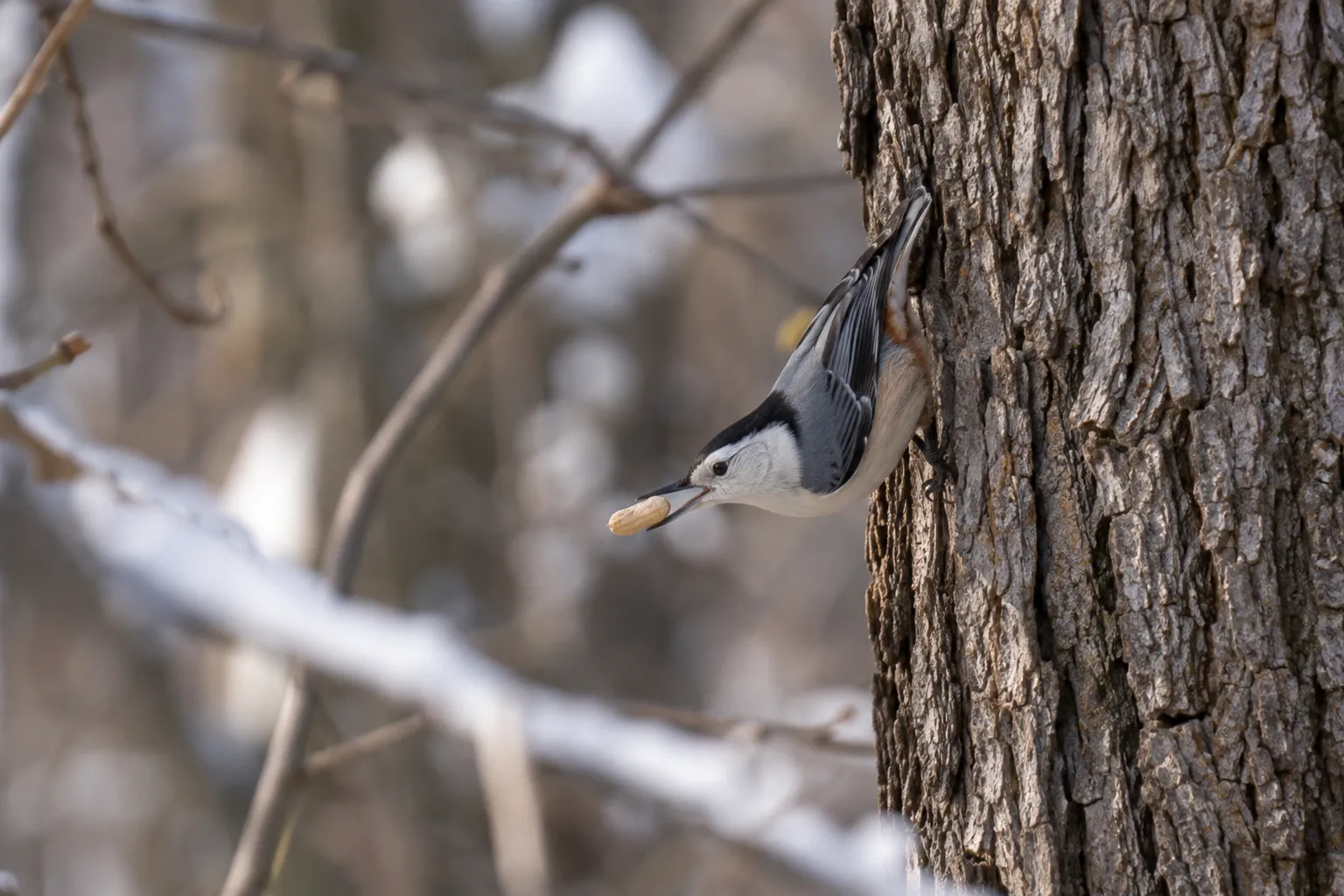
The Cornell Lab describes them as “gray-blue on the back, with a frosty white face and underparts,” often with chestnut on the lower belly and under the tail. They have a large head, almost no neck, a short tail and a long, straight bill that often looks slightly upturned.
The easiest clue is behavior. Nuthatches move “sideways and upside down on vertical surfaces as they forage,” in the Cornell Lab’s words, and they regularly creep headfirst down tree trunks. Woodpeckers brace on their tails and climb upward.
Male vs female
Males have a solid black cap. Females in many populations have a grayer crown and paler rusty underparts. When a pair comes to the feeder together, the difference is often visible side by side. In some populations the contrast is faint, so do not expect to sex every bird.
Regional differences
The Cornell Lab notes that western populations tend to be darker above than eastern birds, but “the best way to differentiate groups is by voice.” Eastern, interior western and Pacific birds give noticeably different calls, and ornithologists have discussed whether some of these groups could be separate species.
Calls and song
- Call: a nasal yank or quank, often repeated. Pairs keep in touch with softer versions as they forage.
- Song: a rapid series of nasal whistles, heard mostly in late winter and spring.
Similar species
| Species | Key differences | Where |
|---|---|---|
| Red-breasted Nuthatch | Smaller; black eye line, white eyebrow, rusty underparts | Conifer forests; moves south in some winters |
| Brown-headed Nuthatch | Smaller; brown cap | Southeastern pine forests |
| Pygmy Nuthatch | Smaller; gray-brown cap | Western pine forests |
| Black-capped and Carolina Chickadees | Black bib; small bill; do not creep down trunks | Widespread |
| Downy Woodpecker | Black-and-white pattern; climbs up using tail | Widespread |
See our guides to the Red-breasted Nuthatch and Black-capped Chickadee for more detail.
Where do white-breasted nuthatches live?
White-breasted Nuthatches live year-round across most of the lower 48 states and southern Canada, and south into Mexico, wherever there are large trees. They are scarce or absent in treeless areas such as the open Great Plains and low deserts, and in the West they are tied to woodlands such as oak, pine-oak and ponderosa pine forests.
The Cornell Lab calls them “birds of mature woods,” found more often in deciduous forest than in conifers, and also along woodland edges and “in open areas with large trees, such as parks, wooded suburbs, and yards.” A useful tip from the Cornell Lab: look for them “along the main branches of large deciduous trees.”
What do white-breasted nuthatches eat?
Insects make up much of the diet. The Cornell Lab lists weevil larvae, other beetles and their larvae, caterpillars and spiders, among others. They also eat seeds and nuts, including acorns, hawthorn fruits and sunflower seeds, with plant food more important in fall and winter.
How nuthatches open seeds
Nuthatches “jam” large seeds and nuts into bark crevices and hammer them open with their bills. This “hatching” behavior is widely considered the origin of the name nuthatch. It is also why they fly off with each seed instead of eating at the feeder: they need a crevice to work in.
Caching food for winter
White-breasted Nuthatches “store seeds and insects one at a time” under loose bark and in furrows, according to the Cornell Lab, usually in trees near the feeder. Much of the traffic you see in fall is caching, not eating, so a nuthatch can move a surprising amount of seed.
Best feeder foods for white-breasted nuthatches
The Cornell Lab recommends “offering large nuts such as sunflower and peanuts, and by putting out suet.”
| Food | Why it works | Tips |
|---|---|---|
| Black oil sunflower | Easy to wedge and crack; high fat | The best single seed to start with |
| Striped sunflower | Larger seed that nuthatches handle well | Also draws titmice, jays and cardinals |
| Shelled peanuts (unsalted) | Fat and protein; nuthatches favor them | Mesh peanut feeder or chopped on a tray |
| Suet | Dense winter energy | No-melt dough for warm months |
| Peanut butter | Clings to bark; nuthatches eat it readily | Unsalted; mix with cornmeal or suet |
| Sunflower hearts | No shells to crack | Buy small amounts for freshness |
Our guides to black oil sunflower seed and suet cakes and suet blends explain how to choose each food. Project FeederWatch advises against salted peanuts and peanuts with coatings or flavorings.
Best feeders for white-breasted nuthatches
Nuthatches are agile and comfortable upside down, so they use nearly any feeder.
- Suet cages: nuthatches cling on any side. Our roundup of the best suet feeders compares designs, including ones that also suit woodpeckers.
- Mesh peanut feeders: a good match for their pry-and-pull feeding style.
- Tube feeders: with ports large enough for in-shell sunflower.
- Hopper feeders: roomy and easy; also used by titmice and chickadees.
- Log or bark-style feeders: holes in a hanging log filled with suet or peanut butter mimic natural bark.
- Window feeders: nuthatches often visit them readily.
Where to put a nuthatch feeder
Nuthatches live on trunks and big branches, so feeders placed near large trees work best. Hanging a feeder from a tree limb or on a pole within a short flight of a trunk lets them grab a seed and immediately wedge it into bark. Roughly 10 feet from trees or large shrubs is a widely used compromise between quick cover and a clear view of approaching cats. Our guide to where to put a bird feeder covers height and window safety.
Smearing suet or peanut butter on bark
Because nuthatches naturally forage in bark, a small smear of suet dough or unsalted peanut butter pressed into the furrows of a tree trunk can draw them in. Use only small amounts in cool weather, since soft fats can go rancid and coat feathers in heat.
Trees and plants that attract white-breasted nuthatches
Large trees are the single biggest factor. White-breasted Nuthatches forage on trunks and main limbs, cache food in bark and nest in cavities of old trees.
Best native trees for nuthatches
- Oaks: acorns, insect-rich bark and foliage, and cavities in older trees.
- Hickories and American beech: nuts and deep bark furrows.
- Maples, elms and ashes: mature bark for foraging and cavities.
- Pines in the West: ponderosa and other pines host the western groups.
- Hawthorns: the Cornell Lab lists hawthorn among foods eaten.
Native tree ideas by region
| Region | Trees to consider |
|---|---|
| Northeast and Great Lakes | White oak, red oak, shagbark hickory, sugar maple, American beech |
| Southeast | White oak, southern red oak, mockernut hickory, American beech |
| Midwest and Plains edge | Bur oak, shagbark hickory, hackberry, cottonwood |
| Interior West | Ponderosa pine, Gambel oak, narrowleaf cottonwood |
| Pacific Coast | Oregon white oak, California black oak, coast live oak |
Check with your state native plant society or cooperative extension service to confirm what is native to your county.
Leave dead limbs and snags when safe
Nuthatches nest in natural cavities and old woodpecker holes. Standing dead trees and dead limbs, where safe, provide cavities, insect food and caching sites. Woodpeckers that dig holes in snags create the nest sites nuthatches later use.
White-breasted nuthatch nest box specs
NestWatch calls the White-breasted Nuthatch “an uncommon nest box occupant” that “does occasionally use boxes when natural cavities are lacking.” Boxes can also serve as winter roosts. If you want to try, NestWatch recommends:
| Spec | Recommendation |
|---|---|
| Entrance hole | 1 1/4 in diameter |
| Floor | 5 1/2 x 5 1/2 in |
| Interior depth | 8 in |
| Mounting height | 5 to 20 ft |
| Mount | Live tree or pole, ideally facing south |
| Bedding | About 1 in of wood shavings |
NestWatch also advises moving boxes into the forest interior if House Sparrows take over, since sparrows favor open areas near buildings.
Nesting facts
- Nests are in natural tree cavities or abandoned woodpecker holes in both deciduous and coniferous trees.
- The cavity is lined with fur, bark and lumps of dirt, with a cup of fine grass, shredded bark and feathers.
- Clutches are 5 to 9 eggs, creamy white to pinkish white and speckled with reddish brown, gray or purple.
- Incubation lasts 13 to 14 days, and the nestling period is about 26 days.
- Pairs raise one brood a year.
Water
A shallow bird bath near trees draws nuthatches to drink, especially in dry weather and freezing winters. A heated bath keeps water open in cold climates. Change water every few days.
Nuthatch pairs, territories and winter flocks
The Cornell Lab notes White-breasted Nuthatches “live in pairs year round” and defend territories through the year, with stable pair bonds. In winter, they “join foraging flocks led by chickadees or titmice,” along with woodpeckers, moving through the woods together.
For backyard birders, this means two things. First, you will usually see the same pair day after day rather than a changing crowd. Second, a yard that already attracts chickadees and titmice is likely to draw nuthatches too, because they travel with those flocks. See our guides to the Tufted Titmouse and chickadees for building that winter flock.
Do white-breasted nuthatches migrate?
No. White-breasted Nuthatches are year-round residents that stay on their territories, which is a key difference from the Red-breasted Nuthatch. Red-breasted Nuthatches irrupt southward in some winters when conifer seed crops fail in the North, so they may appear at feeders one winter and be absent the next. If you see a nuthatch at your feeder in July in the lowland East or South, it is almost certainly a White-breasted.
Because White-breasted Nuthatches stay put, the birds you feed in winter are probably the same ones nesting in your neighborhood. Consistent food, water and big trees through the year build a long relationship with a single pair.
Why does a nuthatch take one seed and fly off?
Watching a nuthatch at a feeder can be confusing. It lands, tosses aside a seed or two, picks one, and flies off, only to return seconds later. Three things are going on:
- Selecting. Nuthatches often handle and drop a few seeds before settling on one.
- Opening. They need a bark crevice to wedge the seed in and hammer it open, so they carry it to a nearby tree.
- Caching. In fall especially, many trips end with the seed hidden in bark rather than eaten.
That pattern is normal. It also explains why feeders near big trunks attract more nuthatch visits than feeders out in the open: every round trip is shorter.
Tossing seed out of the feeder
Owners commonly report nuthatches, chickadees and titmice flicking seeds out of tube feeders while searching for the ones they prefer. If you see a lot of discarded seed under the feeder, cheap mixes with filler grains are the usual cause. Switching to straight black oil sunflower or sunflower hearts reduces waste.
Seasonal calendar
| Season | What nuthatches are doing | What to offer |
|---|---|---|
| Winter (Dec to Feb) | Pairs in mixed flocks; heavy use of fat-rich foods | Sunflower, peanuts, suet, open water |
| Late winter (Feb to Mar) | Singing; pairs prepare nest sites | Put up boxes; keep feeders full |
| Spring (Apr to May) | Nesting in cavities | Suet, peanuts; avoid pesticides |
| Summer (Jun to Jul) | Feeding young insects; fledglings follow parents | Water, modest feeding |
| Fall (Aug to Nov) | Intense caching in bark | Fill feeders with sunflower and peanuts |
Why aren’t nuthatches coming to my feeder?
- No large trees nearby. Nuthatches are tied to mature trees.
- The feeder is far from any trunk. Move it closer to trees.
- It’s summer. Insects are plentiful and feeder use drops.
- The food is a filler mix. Switch to sunflower, peanuts or suet.
- The feeder is new. Give it time. Our guide on why birds aren’t coming to your new feeder covers the common causes.
Common mistakes
- Hanging feeders in open lawn far from trees.
- Removing every dead limb and snag, including safe ones.
- Offering salted or flavored peanuts.
- Smearing large amounts of fat on bark in warm weather.
- Expecting a nest box to be used quickly; nuthatches prefer natural cavities.
- Letting feeders get dirty. Project FeederWatch recommends cleaning every week or two with one part bleach to nine parts water.
Conservation status
White-breasted Nuthatches are common, widespread and of low conservation concern. The Cornell Lab reports their numbers increased by more than 1 percent per year between 1966 and 2019, with a global breeding population estimated at 10 million. The oldest known wild bird was at least 9 years, 9 months old.
The short version
Offer black oil sunflower, peanuts and suet close to large trees. Protect mature oaks, hickories and other big trees, and leave safe dead limbs. Try a 1 1/4 inch nest box if natural cavities are scarce, but expect it to be a long shot. Keep water fresh. White-breasted nuthatches are year-round residents that stay in pairs, so the pair that finds your feeder this winter may be with you for years.
Sources
Frequently asked questions
What do white-breasted nuthatches eat at feeders?
The Cornell Lab lists sunflower seeds, peanuts, suet and peanut butter as their feeder favorites and recommends offering large nuts such as sunflower and peanuts. Nuthatches usually grab one item, fly to a tree, wedge it into bark and hammer it open, or hide it for later. Hulled peanuts and black oil sunflower are the easiest starting foods.
Why do nuthatches go down trees headfirst?
White-breasted Nuthatches forage up, down and sideways over trunks and large branches, gripping the bark with strong feet instead of bracing with the tail like woodpeckers. Moving headfirst down a trunk lets them see and reach insects and eggs tucked into bark crevices from an angle that upward-climbing birds such as woodpeckers and Brown Creepers may miss.
Do white-breasted nuthatches use birdhouses?
Occasionally. NestWatch calls them an uncommon nest box occupant that sometimes uses boxes where natural cavities are lacking, and they may use boxes for winter roosting. Recommended specs are a 1 1/4 inch entrance hole, a floor about 5 1/2 by 5 1/2 inches, 8 inches deep, mounted 5 to 20 feet high on a tree or pole, with about an inch of wood shavings.
How can you tell a male from a female white-breasted nuthatch?
Look at the crown. Males have a solid black cap, while females in many populations have a grayer crown and slightly paler rusty coloring on the underparts. The difference is easiest to see when a pair visits together. In some populations, especially in the West, the contrast can be subtle, so not every bird can be sexed confidently.
What is the difference between white-breasted and red-breasted nuthatches?
White-breasted Nuthatches are larger, with a clean white face and breast and no eye line. Red-breasted Nuthatches are smaller, with a bold black line through the eye, a white eyebrow and rusty underparts. White-breasted favors large deciduous trees and stays put year-round, while Red-breasted favors conifers and moves south in some winters.