How to Attract Black-capped Chickadees to Your Yard
How to attract black-capped chickadees: offer sunflower, peanuts and suet near cover, plant native trees full of caterpillars and put up a 1 1/8 inch nest box.
In this article
- Black-capped chickadee at a glance
- How to identify a black-capped chickadee
- Where do black-capped chickadees live?
- What do black-capped chickadees eat?
- Best feeders for black-capped chickadees
- Plants that attract black-capped chickadees
- Black-capped chickadee nest box specs
- Water for chickadees
- Seasonal calendar: when chickadees visit
- Why chickadees bring other birds to your yard
- Common mistakes that keep chickadees away
- Conservation status
- The short version
- Sources
- Frequently asked questions
If you want to know how to attract black-capped chickadees, the good news is that they are one of the easiest birds to bring in. Offer black oil sunflower seed, peanuts or suet in a small feeder near trees or shrubs, and they usually find it within days to weeks, especially in fall and winter. To keep them year-round, plant native trees that grow caterpillars for their nestlings and put up a nest box with a 1 1/8 inch entrance hole.
This guide covers identification, the foods and feeders chickadees prefer, native plants, nest box specs, a seasonal calendar and the common mistakes that keep chickadees away.
Black-capped chickadee at a glance
| Trait | Details |
|---|---|
| Size | 4.7 to 5.9 in long, 0.3 to 0.5 oz, wingspan 6.3 to 8.3 in |
| Range | Year-round across Alaska, Canada and the northern half of the US, farther south in the mountains |
| Season in yards | All year; busiest at feeders in fall and winter |
| Diet | Insects, spiders and caterpillars most of the year; about half seeds and berries in winter |
| Best feeder foods | Black oil sunflower, sunflower hearts, peanuts, suet, mealworms |
| Feeder type | Small tube, hopper, window, suet cage and peanut feeders |
| Nesting | Cavities and nest boxes, 1 brood a year |
| Clutch | 1 to 13 white eggs with fine reddish-brown spots |
Measurements and nesting data are from the Cornell Lab of Ornithology’s All About Birds.
How to identify a black-capped chickadee
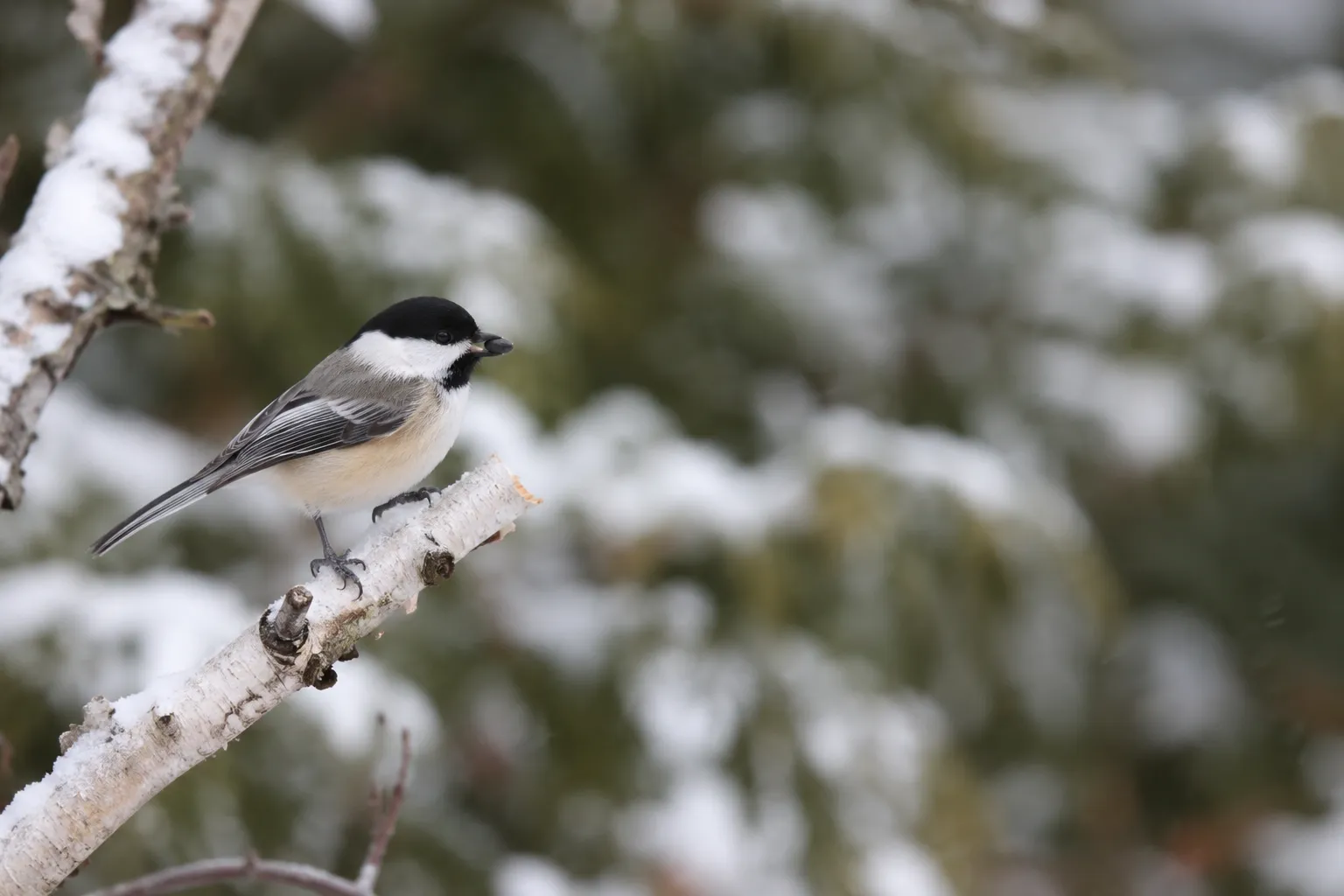
The Cornell Lab describes the combination well: “black cap and bib; white cheeks; gray back, wings, and tail; and whitish underside with buffy sides.” Add an oversized round head on a tiny body and a short, stubby bill, and you have the classic chickadee shape.
Male, female and juvenile
Males and females look alike. Juveniles in summer look like adults, sometimes a little scruffier with fresher, fluffier plumage. You cannot reliably sex chickadees by looks at the feeder.
Calls and song
- Chick-a-dee-dee-dee: the familiar call, used to keep flocks together and raise alarms. The Cornell Lab notes that more “dee” notes signal a higher threat level, so a long string of dees often means a small owl or hawk is perched nearby.
- Fee-bee: the song, a clear two-note whistle with the second note lower than the first. You will hear it most in late winter and spring.
Similar species
- Carolina Chickadee: nearly identical, found to the south. Black-capped shows bright white edges on the wing feathers, a slightly larger size and a bib with a ragged lower edge. Its song has two notes, the Carolina’s usually four. The two hybridize where they meet. See our Carolina Chickadee guide for the full comparison.
- Mountain Chickadee: western mountains; has a white eyebrow through the black cap.
- Boreal Chickadee: far north; brown cap and brownish flanks.
- Chestnut-backed Chickadee: Pacific Coast; rich chestnut back and sides.
If you are unsure what you are seeing, our guide to how to identify birds walks through size, shape, behavior, habitat and sound.
Where do black-capped chickadees live?
Black-capped Chickadees live year-round across the northern half of the continent: Alaska, most of Canada, and the northern United States, reaching farther south along the Rocky Mountains and the Appalachians where elevation keeps things cooler. The Cornell Lab lists their habitat as “deciduous and mixed forests, open woods, parks, willow thickets, cottonwood groves, and disturbed areas,” and more broadly “virtually any area with trees.”
In practical terms, if your neighborhood has mature trees and you live north of roughly the southern edge of the Midwest and mid-Atlantic, you are likely in Black-capped territory. Farther south, you will see Carolina Chickadees instead.
What do black-capped chickadees eat?
Their diet shifts with the seasons. According to the Cornell Lab:
- Spring through fall: insects, spiders and other animal food make up 80 to 90 percent of the diet. Caterpillars are especially important for nestlings.
- Winter: roughly half seeds, berries and other plant matter, and half animal food, including dormant insects, spiders and fat.
That split explains why feeders are busiest from fall into early spring and why yards with native trees full of insects hold chickadees in summer.
Best feeder foods for chickadees
The Cornell Lab calls chickadees “one of the easiest birds to attract to feeders, for suet, sunflower, and peanuts.” Here is how each food works:
| Food | Why it works | Tips |
|---|---|---|
| Black oil sunflower | Thin shell, high fat; the default chickadee seed | Buy fresh and store dry |
| Sunflower hearts | No shell to crack, no hull mess | Goes stale faster; buy smaller amounts |
| Peanuts (shelled, unsalted) | High fat and protein | Use a mesh peanut feeder or chopped pieces; avoid salted or coated peanuts |
| Suet | Dense energy in cold weather | Choose no-melt blends in warm months |
| Mealworms | Protein during nesting season | Offer in a dish; dried or live |
| Peanut butter | Clings well to bark or feeders | Use unsalted, and mix with cornmeal or suet |
Our guide to black oil sunflower seed explains why it beats most mixes, and our roundup of suet cakes and suet blends compares formulas.
Why do chickadees take one seed and leave?
Chickadees rarely sit and eat at the feeder. They grab one seed, fly to a nearby branch, pin it under their feet and hammer it open, or they tuck it away in bark, under lichen, or among conifer needles for later. The Cornell Lab notes chickadees can remember thousands of hiding places, and that each autumn chickadees replace some of their brain neurons, which may help them keep track of new caches. This caching habit is why a chickadee flock empties a feeder faster than their size suggests, and why having shrubs and trees within a short flight of the feeder matters.
Best feeders for black-capped chickadees
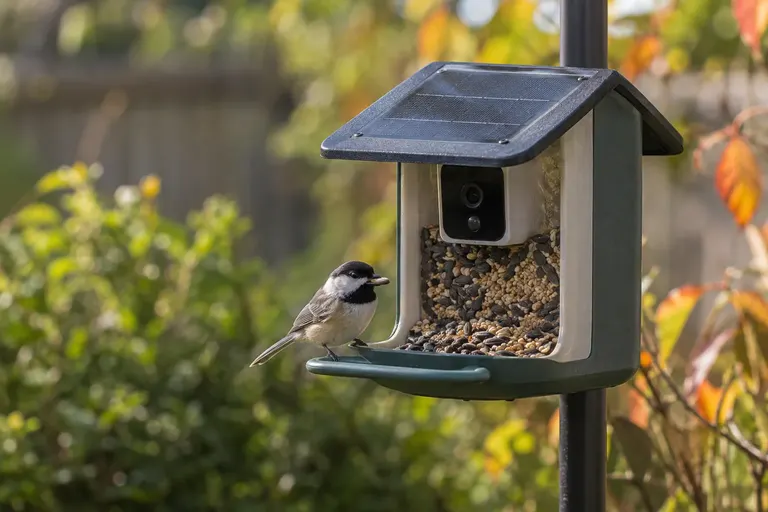
Chickadees are small, agile and fearless, so they use almost any feeder. The Cornell Lab notes they readily use “tiny hanging feeders” and window feeders.
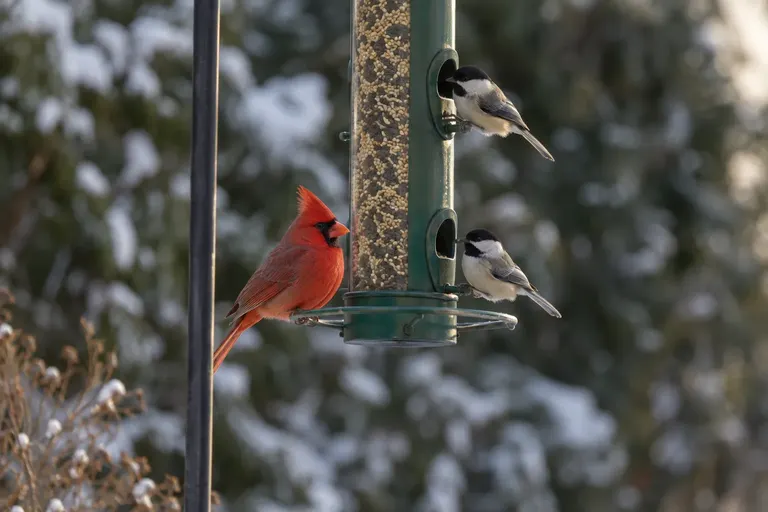
- Tube feeders with sunflower or sunflower hearts. Small ports and short perches favor chickadees over larger birds.
- Window feeders give close views and suit small yards. See our window bird feeder roundup.
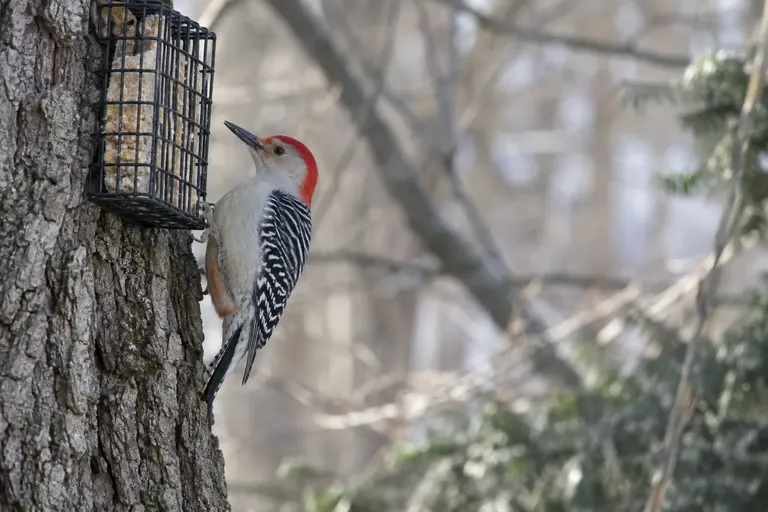
- Suet cages, including tail-prop designs for woodpeckers. Chickadees cling to any side.
- Mesh peanut feeders that make birds work peanut pieces out.
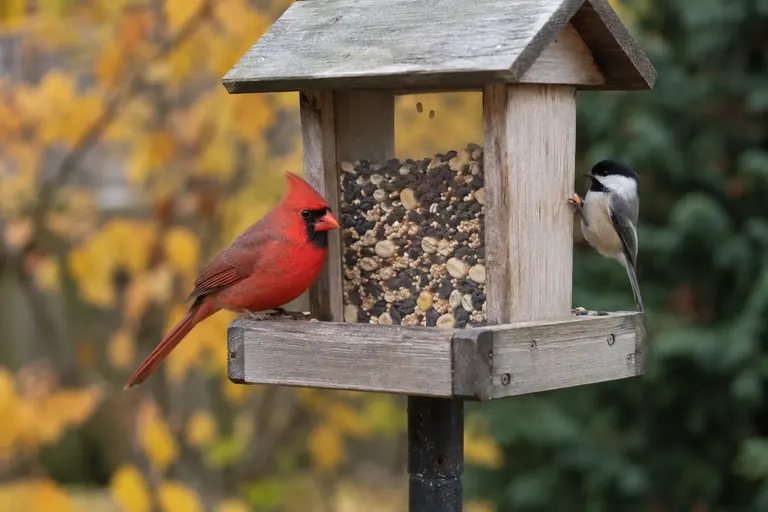
- Small hoppers and platforms, though these also invite bigger birds.
Since chickadees make quick round trips to cover, place feeders about 10 feet from shrubs or small trees, a widely used compromise between a quick escape from hawks and enough open space to spot a stalking cat. Our guide to where to put a bird feeder covers height and window safety.
Can you hand-feed chickadees?
Many people do. Black-capped Chickadees are bold and, with patience, individual birds often learn to take seed from an open palm. Stand still near a regularly used feeder with sunflower hearts or chopped peanuts in your hand, ideally on cold mornings when birds are hungry. It can take days or weeks. Keep the food wholesome and avoid chasing or grabbing birds.
Plants that attract black-capped chickadees
Feeders help, but insects feed chickadees for most of the year and nearly all of their nestlings. Native trees and shrubs that host caterpillars are the most valuable thing you can plant.
The evidence comes from a close relative. A 2018 study in the Proceedings of the National Academy of Sciences by Desiree Narango, Doug Tallamy and Peter Marra followed Carolina Chickadees in suburban Washington, D.C., yards and found that breeding populations were sustainable only in yards where native plants made up roughly 70 percent or more of the plant biomass. Non-native ornamentals support far fewer caterpillars. The same logic applies to Black-capped Chickadees, which feed their young the same kind of food.
Trees and shrubs
The Cornell Lab recommends willow, alder and birch, which offer nest sites in soft or decaying wood as well as insects. Other strong native choices across the Black-capped range include:
- Oaks: among the best caterpillar host trees in North America.
- Native cherries (black cherry, chokecherry): heavy insect loads plus fruit.
- Maples, aspens and cottonwoods: insects, and soft wood for cavities.
- Conifers such as spruce, pine, fir and eastern hemlock: winter shelter and wintering insects in the bark and needles.
- Viburnums, dogwoods and serviceberry: berries in fall and winter and insect food in summer.
Native plant ideas by region
| Region | Trees and shrubs to consider |
|---|---|
| Northeast and Great Lakes | White oak, red oak, paper birch, black cherry, eastern hemlock, gray dogwood, arrowwood viburnum |
| Upper Midwest and Plains edge | Bur oak, quaking aspen, box elder, American plum, chokecherry |
| Rocky Mountains | Quaking aspen, narrowleaf cottonwood, willows, Rocky Mountain juniper |
| Pacific Northwest | Red alder, Pacific willow, bigleaf maple, Douglas fir, red-osier dogwood |
Your cooperative extension service or state native plant society can confirm which species are native to your county.
Leave dead wood when safe
Black-capped Chickadees often excavate their own nest holes in rotten stumps and dead branches, typically in soft, decaying wood. If a dead snag or limb poses no risk to people or buildings, leaving it standing provides both nest sites and insect food.
Black-capped chickadee nest box specs
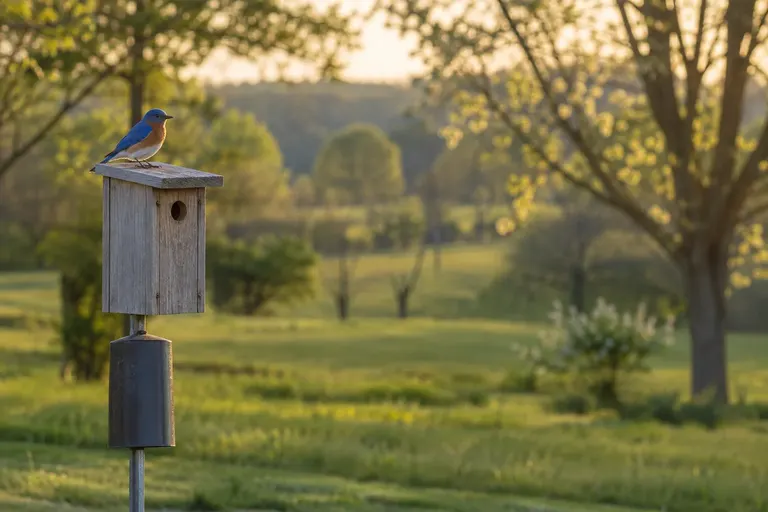
Black-capped Chickadees readily use nest boxes. NestWatch, the Cornell Lab’s nesting program, recommends:
| Spec | Recommendation |
|---|---|
| Entrance hole | 1 1/8 in diameter |
| Floor | 5 1/2 x 5 1/2 in |
| Interior depth | 8 in |
| Mounting height | 5 to 15 ft |
| Mount | Building, pole, post or tree |
| Orientation | Away from prevailing wind |
| Bedding | About 1 in of wood shavings on the floor |
The 1 1/8 inch hole is the key detail. It admits chickadees but is too small for House Sparrows, which need a larger opening. Adding wood shavings lets chickadees do some of the “excavating” they would do in a natural cavity.
Nest box tips
- Put boxes up by late winter. Chickadees scout sites early in spring.
- Use a predator guard. A baffle on the pole keeps out climbing predators such as raccoons and snakes. The same stovepipe or cone baffles sold for feeder poles work for nest box poles.
- Set boxes in wooded cover. The Cornell Lab suggests placing boxes back from open edges and into wooded areas, which reduces competition from House Wrens.
- Clean the box after the season. Remove old nesting material once young have fledged.
Nesting facts
- The foundation is moss and coarse material, lined with soft fur such as rabbit hair.
- Clutches range from 1 to 13 eggs, white with fine reddish-brown dots.
- Incubation lasts 12 to 13 days; nestlings fledge after 12 to 16 days.
- Pairs raise one brood a year.
- Natural nests are usually between about 5 and 23 feet up (1.5 to 7 meters).
Water for chickadees
Chickadees drink and bathe regularly. A shallow bird bath with fresh water draws them all year, and a heated bath in freezing climates makes your yard one of the few reliable water sources in January. Keep water shallow and change it every few days.
Seasonal calendar: when chickadees visit
| Season | What chickadees are doing | What to offer |
|---|---|---|
| Winter (Dec to Feb) | Flocking with nuthatches, titmice and woodpeckers; heavy feeder use | Sunflower, peanuts, suet, open water |
| Late winter (Feb to Mar) | Flocks breaking up, fee-bee songs start | Put up and clean nest boxes |
| Spring (Apr to May) | Nest building and egg laying | Mealworms, sunflower hearts, leave boxes undisturbed |
| Early summer (Jun to Jul) | Feeding nestlings caterpillars; fledglings follow parents | Keep feeders modest, water, avoid pesticides |
| Late summer (Aug to Sep) | Families roam; molting | Water, sunflower |
| Fall (Oct to Nov) | Intense caching; winter flocks form | Fill feeders fully; sunflower and peanuts |
In winter, Black-capped Chickadees roost in cavities and dense conifers and can lower their body temperature by several degrees overnight to save energy. A reliable fat-rich food source helps on the coldest days. Our winter bird feeding guide covers what birds need in freezing weather.
Why chickadees bring other birds to your yard
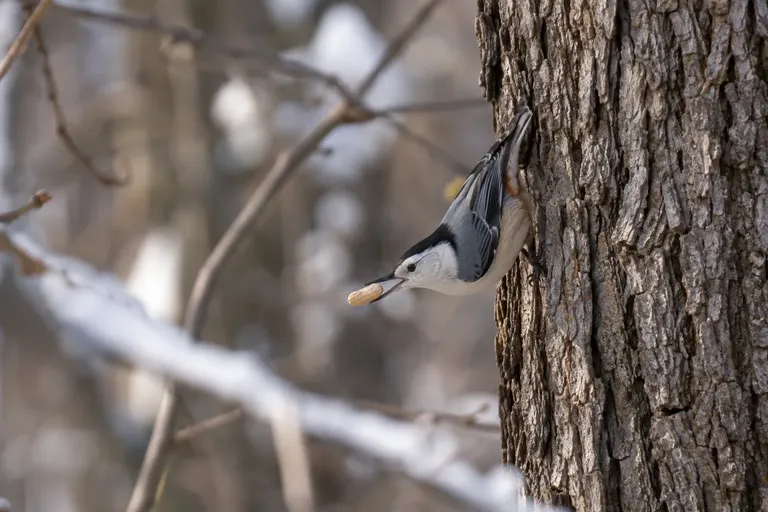
Chickadees are social birds that “live in flocks,” in the Cornell Lab’s words, and from late summer through winter those flocks become the core of mixed-species foraging groups. White-breasted and Red-breasted Nuthatches, Tufted Titmice where ranges overlap, Downy Woodpeckers, kinglets, Brown Creepers and, in migration, warblers often travel with them. Chickadee alarm calls act as an early warning system that other species listen to.
That makes chickadees a gateway species. Once a local flock adopts your feeder, the rest of the group tends to follow within days. If you want more variety in winter, make your yard work for chickadees first: steady sunflower and suet, nearby trees, and water.
How long does it take chickadees to find a new feeder?
It varies. Because chickadees patrol a regular winter territory and investigate anything new, they are usually among the first birds to discover a fresh feeder, sometimes within a day or two in fall and winter. In late spring and summer, when they are nesting and feeding on caterpillars, discovery can take much longer. Sprinkling a little seed on a platform or on the ground beside a new feeder can help birds notice it. If your feeder is still ignored after several weeks, check the seed, the placement and whether a hawk or cat is hanging around.
Do chickadees need feeders to survive winter?
Most do not. Studies of Black-capped Chickadees in Wisconsin by Margaret Brittingham and Stanley Temple found that birds with access to feeders still got most of their daily energy from natural food, and that they did not lose the ability to forage when feeders were removed. Feeders are most useful during severe cold snaps, ice storms and heavy snow, when natural food is hard to reach. So it is fine to take a break from feeding, but if you do feed in winter, try to keep it consistent through the harshest weather.
Common mistakes that keep chickadees away
- Feeders in open lawn far from cover. Chickadees want a quick escape route and nearby perches to eat and cache.
- Cheap seed mixes. Milo, wheat and red millet are largely ignored by chickadees.
- Salted or coated peanuts. Project FeederWatch advises against them.
- Spraying insecticides. Caterpillars feed chickadee nestlings.
- Tidying every dead branch and leaf. Chickadees forage in bark, leaf litter and snags.
- Wrong nest box hole size. Larger holes let in House Sparrows.
- Dirty feeders. FeederWatch recommends cleaning every week or two with one part bleach to nine parts water. Our guide to how to clean bird feeders has the steps.
Conservation status
Black-capped Chickadees are common and of low conservation concern. The Cornell Lab reports their numbers increased slightly between 1966 and 2019, with a global breeding population estimated at 43 million. The oldest known wild bird was at least 11 years, 8 months old, though most live far shorter lives.
The short version
Offer sunflower, peanuts and suet in small feeders about 10 feet from cover. Plant native trees that feed caterpillars, especially oaks, willows, birches and cherries. Put up a 1 1/8 inch nest box with a baffle by late winter. Keep feeders clean and skip the pesticides. Do those four things and black-capped chickadees will likely be the most reliable birds in your yard.
Sources
Frequently asked questions
What is the best food to attract black-capped chickadees?
Black oil sunflower seed is the easiest starting point, and the Cornell Lab also lists peanuts, suet, peanut butter and mealworms as feeder foods chickadees take. Hulled sunflower hearts and unsalted peanut pieces suit their small bills well. Chickadees take one item at a time and fly off to eat or hide it, so a steady supply matters more than a large feeder.
Do black-capped chickadees use birdhouses?
Yes. They nest in natural cavities, old Downy Woodpecker holes and nest boxes. NestWatch recommends a box with a 1 1/8 inch entrance hole, a floor about 5 1/2 by 5 1/2 inches, an interior depth of about 8 inches and about 1 inch of wood shavings on the floor, mounted 5 to 15 feet high.
Why do chickadees take one seed and fly away?
Chickadees usually carry a single seed to a nearby branch to hammer it open, or they hide it to eat later. Black-capped Chickadees cache food in bark crevices, under lichen and in other hiding spots, and the Cornell Lab notes they can remember thousands of hiding places. That is why one chickadee can make dozens of quick trips to a feeder.
Do black-capped chickadees stay all winter?
Yes. Black-capped Chickadees are year-round residents across most of their range and are among the most reliable winter feeder birds in the northern United States and Canada. In winter they travel in small flocks, often with nuthatches, titmice, woodpeckers and kinglets, and they survive cold nights by roosting in cavities and lowering their body temperature.
How can I tell a black-capped chickadee from a Carolina chickadee?
Range is the first clue, since the two overlap only in a narrow band. Black-capped Chickadees show bright white edges on the wing feathers, a bib with a ragged lower edge, and a slightly larger size. Their song is a clear two-note fee-bee, while Carolina Chickadees usually sing four notes. Hybrids in the overlap zone can be impossible to identify.