How to Attract Carolina Chickadees to Your Yard
How to attract Carolina chickadees: offer sunflower, peanut chips and suet near cover, grow native oaks for caterpillars and add a 1 1/8 inch nest box.
In this article
- Carolina chickadee at a glance
- How to identify a Carolina chickadee
- Where do Carolina chickadees live?
- What do Carolina chickadees eat?
- Best feeders for Carolina chickadees
- Native plants that attract Carolina chickadees
- Carolina chickadee nest box specs
- How to find Carolina chickadees by ear
- Can you hand-feed Carolina chickadees?
- Do Carolina chickadees need feeders?
- Water
- Seasonal calendar
- Why won’t Carolina chickadees come to my feeder?
- Common mistakes
- Conservation status
- The short version
- Sources
- Frequently asked questions
Here is how to attract Carolina chickadees: stock small feeders with sunflower, peanut chips and suet, and place them roughly 10 feet from trees or shrubs. They live in the same area all year, so a yard that offers food, cover, water and a nest box can host them in every season. The single most important long-term step is planting native trees and shrubs, because chickadee nestlings are raised almost entirely on caterpillars.
This guide covers how to identify Carolina Chickadees (and separate them from Black-capped), what they eat, the best feeders, native plants by region, nest box specs and a month-by-month calendar.
Carolina chickadee at a glance
| Trait | Details |
|---|---|
| Size | 3.9 to 4.7 in long, 0.3 to 0.4 oz, wingspan 5.9 to 7.9 in |
| Range | Year-round across the southeastern and south-central US |
| Season in yards | All year |
| Diet | 80 to 90 percent insects and spiders spring through fall; about half plant food in winter |
| Best feeder foods | Black oil sunflower, sunflower hearts, peanut chips, suet |
| Feeder type | Small tube, hopper, window, suet and peanut feeders |
| Nesting | Tree cavities and nest boxes, 2 to 25 ft up, 1 brood a year |
| Clutch | 3 to 10 white eggs with reddish-brown dots |
Measurements and nesting data are from the Cornell Lab of Ornithology’s All About Birds.
How to identify a Carolina chickadee
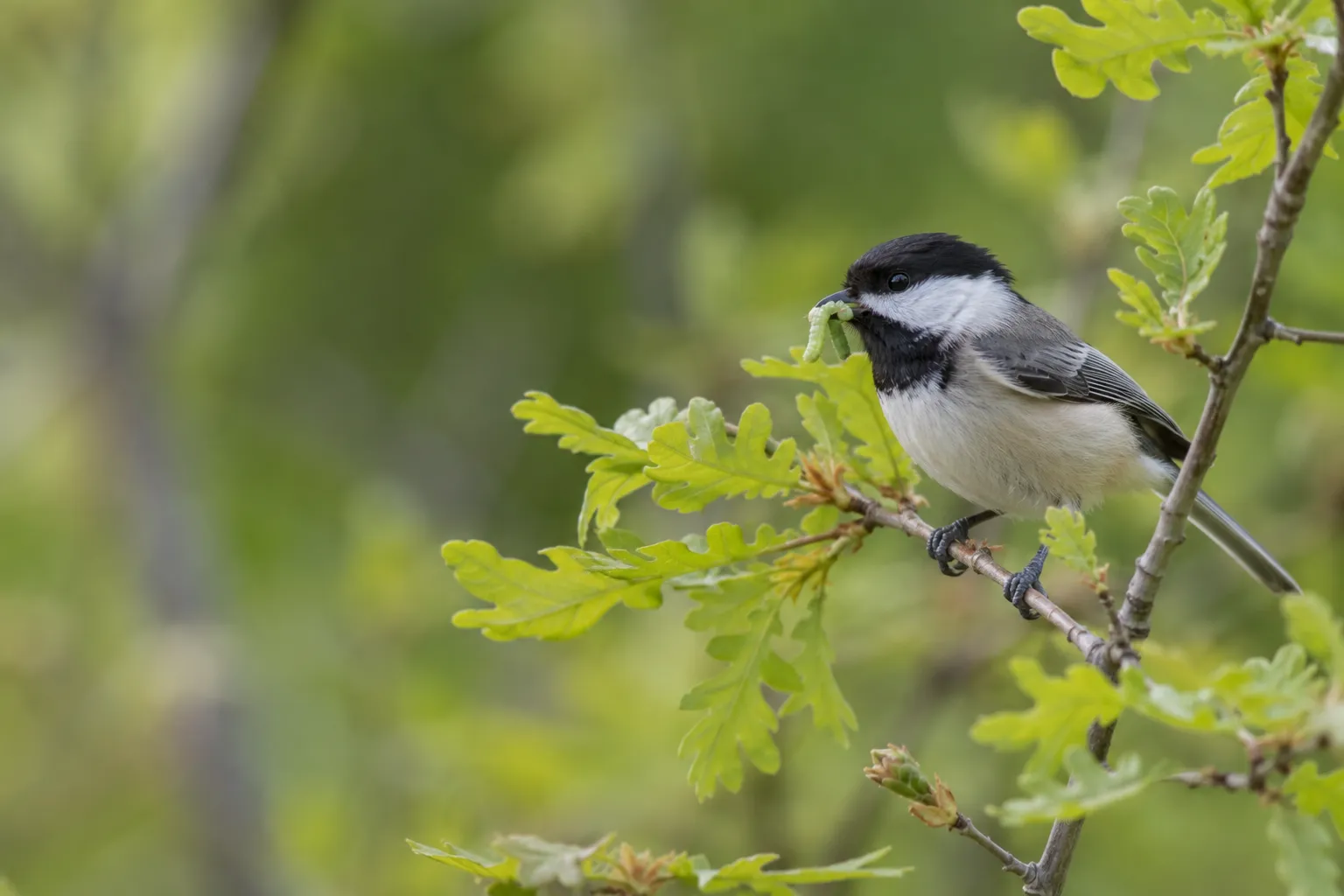
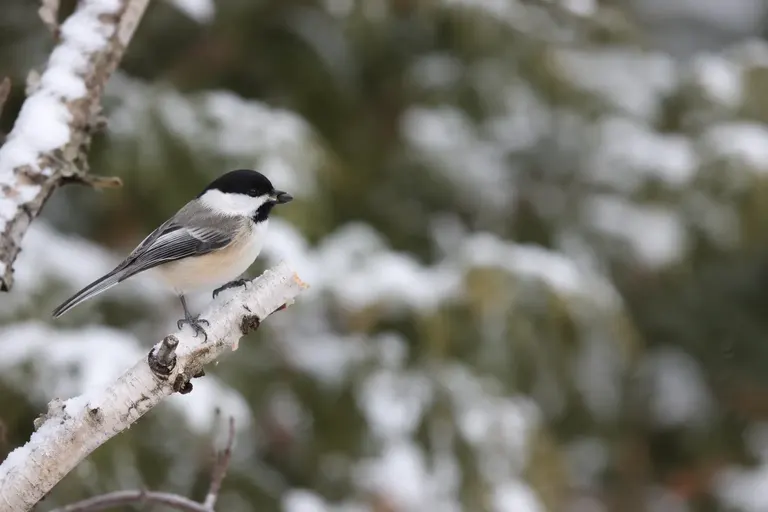
The Cornell Lab describes it as “a black cap and bib separated by stark white cheeks,” with a soft gray back, wings and tail and whitish underparts. The body is round with a short neck and a fairly long, narrow tail. Males and females look the same, and juveniles closely resemble adults.
Carolina vs black-capped chickadee
These two species look so similar that experienced birders often rely on location and sound rather than plumage. The Cornell Lab notes they probably diverged more than 2.5 million years ago, yet they still hybridize where their ranges meet.
| Feature | Carolina Chickadee | Black-capped Chickadee |
|---|---|---|
| Range | Southeast and south-central US | Northern US, Canada, Alaska, and southern mountains |
| Size | 3.9 to 4.7 in | 4.7 to 5.9 in |
| Wing edging | Grayish, subtle | Bright white edges on wing feathers |
| Bib | Neater lower edge | Ragged lower edge |
| Song | Usually 4 notes: fee-bee-fee-bay | 2 notes: fee-bee |
| Chick-a-dee call | Faster and higher-pitched | Slower and lower |
Plumage differences are subtle and vary with wear and lighting. Worn Black-capped Chickadees can lose some of their white edging by summer.
The hybrid zone
The two species meet along a narrow band that runs roughly from Kansas and Missouri east through Illinois, Indiana, Ohio and Pennsylvania to New Jersey, with Black-capped also found at higher elevations in the southern Appalachians. In that zone, the Cornell Lab notes, “hybrids can sing the songs of either species, or might sing something intermediate.” Sound-ID apps can be fooled here. If you live in the overlap band, record “chickadee” in eBird unless you are confident. Our guide to using Merlin Sound ID without getting fooled explains why song alone can mislead.
Other look-alikes
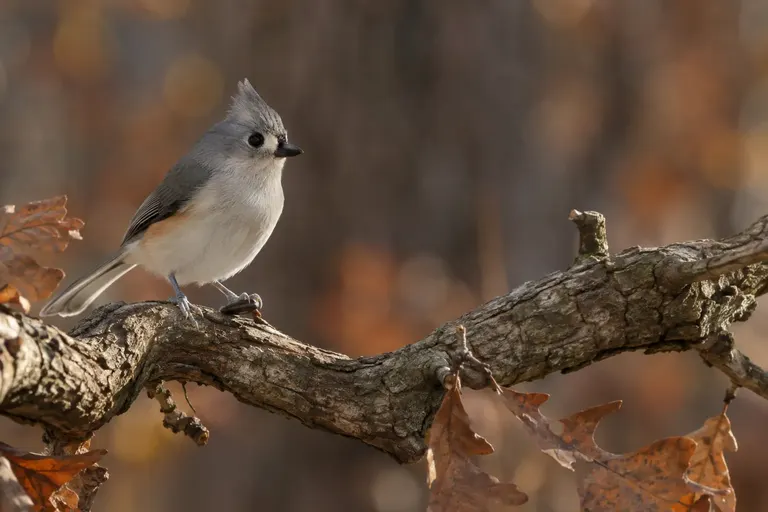
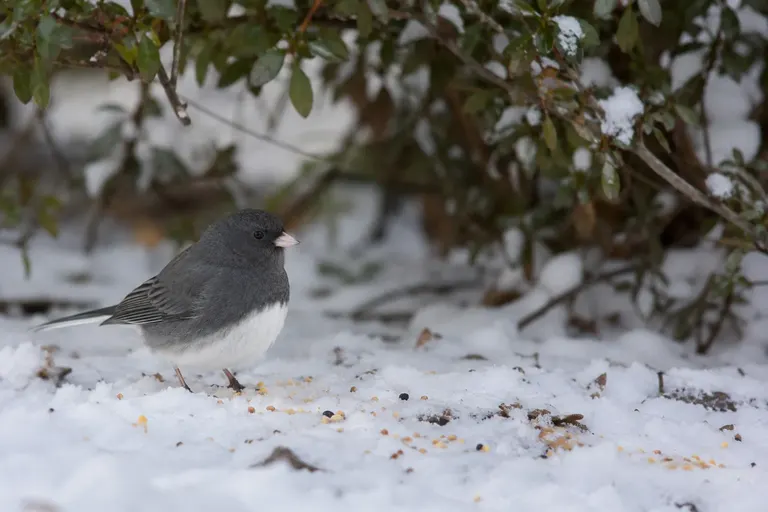
- Tufted Titmouse: larger, all gray above with a pointed crest and no black bib.
- White-breasted Nuthatch: black cap but white face and throat, no bib, and climbs down tree trunks headfirst.
- Black-and-white Warbler: streaked black and white all over, with a thin pointed bill, and creeps along trunks like a nuthatch.
Where do Carolina chickadees live?
Carolina Chickadees live year-round from the mid-Atlantic and southern Midwest south to Florida and the Gulf Coast, and west into eastern Kansas, Oklahoma and central Texas. The Cornell Lab lists their habitats as “deciduous and mixed deciduous-coniferous woodlands, swamps, riparian areas, open woods and parks, and also in suburban and urban areas.”
In practice, if you live in the Southeast and have a few mature trees nearby, you are likely within reach of a Carolina Chickadee flock.
What do Carolina chickadees eat?
According to the Cornell Lab, Carolina Chickadees eat about half plant food and half animal food in winter. For the rest of the year, 80 to 90 percent of their diet is animal food, mostly insects and spiders. They glean insects from leaves and bark, often hanging upside down on twig tips.
This is the key to attracting them year-round. Feeders fill the winter gap, but insects, and especially caterpillars, carry them through spring and summer.
Best feeder foods for Carolina chickadees
| Food | Why it works | Notes |
|---|---|---|
| Black oil sunflower | Thin shell, high fat, widely eaten | The best single seed to start with |
| Sunflower hearts | No shells, easy for small bills | Buy smaller bags to keep it fresh |
| Peanut chips (unsalted) | Fat and protein | The Cornell Lab lists peanut chips specifically |
| Suet | Energy in cold snaps | Use no-melt suet dough in the southern heat |
| Mealworms | Protein during nesting | Offer small amounts in a dish |
Cheap mixes packed with milo, wheat and red millet are largely wasted on chickadees. See our guide to black oil sunflower seed for why it outperforms most blends, and our roundup of suet cakes and suet blends for summer-friendly formulas.
Suet in hot climates
Much of the Carolina Chickadee’s range has long, hot summers. Traditional raw suet can go soft and rancid in heat, as Project FeederWatch warns. If you want to feed suet between late spring and early fall, choose processed “no-melt” suet dough, offer small amounts, place the feeder in shade, and replace anything that smells off.
Best feeders for Carolina chickadees
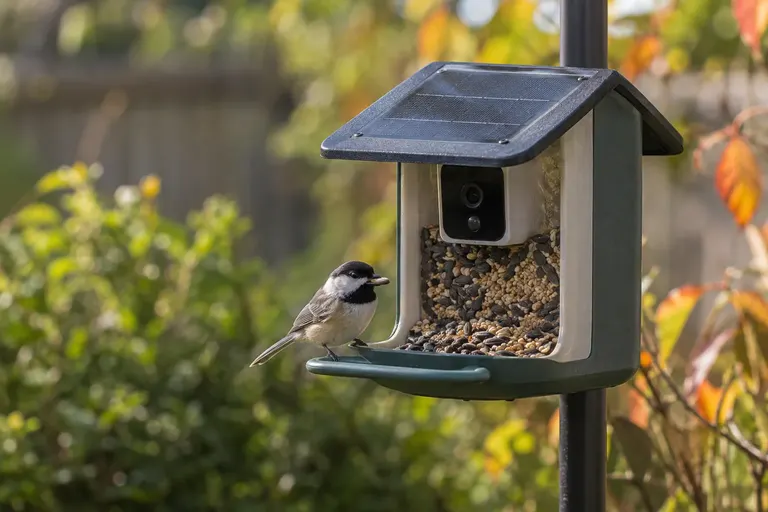
Carolina Chickadees use almost any feeder, but small feeders with short perches suit them best because they reduce crowding by larger birds.
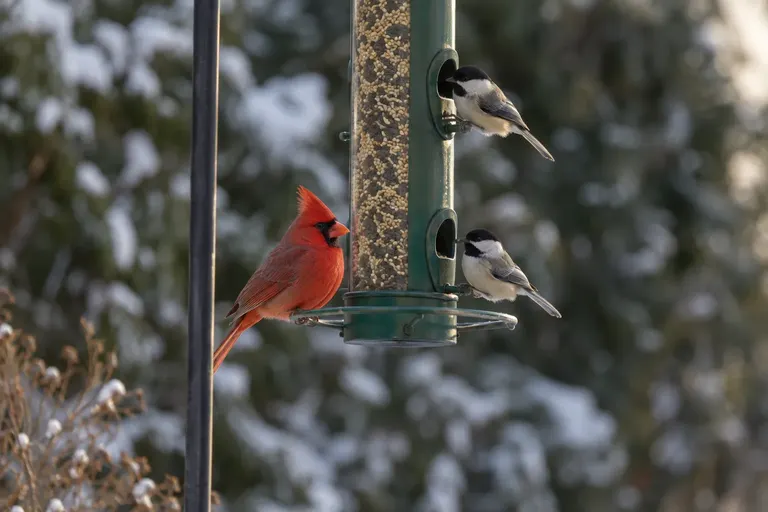
- Tube feeders with sunflower or sunflower hearts.
- Window feeders for close views; see our window bird feeder roundup.
- Suet cages and suet dough feeders.
- Mesh peanut feeders filled with peanut pieces.
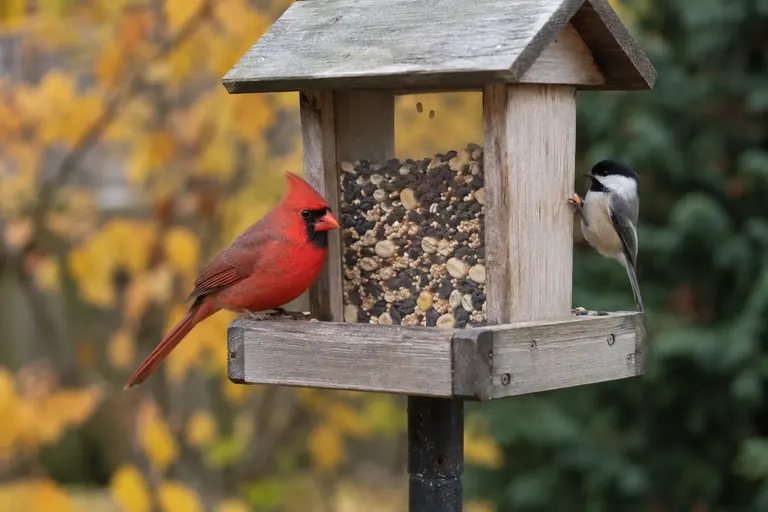
- Small hopper feeders, which also serve titmice and cardinals.
Chickadees grab a seed and fly to a nearby branch to hammer it open or hide it for later, so feeders need cover within a short flight. Roughly 10 feet from shrubs or small trees is a widely used compromise between a quick escape from hawks and a clear view of approaching cats. Our guide to where to put a bird feeder covers height, cover and windows in more detail.
If squirrels are raiding the feeder, a pole with a properly placed baffle usually solves it. Our roundup of bird feeder poles and baffles compares options.
Native plants that attract Carolina chickadees
This is where Carolina Chickadees have taught researchers the most. A 2018 study published in the Proceedings of the National Academy of Sciences by Desiree Narango, Doug Tallamy and Peter Marra followed Carolina Chickadees nesting in suburban yards around Washington, D.C. Yards dominated by non-native plants produced fewer caterpillars and fewer chickadee young, and the researchers found that chickadee populations were sustainable only where native plants made up roughly 70 percent or more of the yard’s plant biomass.
Tallamy’s broader work shows that native trees, especially oaks, support many times more caterpillar species than common non-native ornamentals. Chickadee parents need a very large number of caterpillars to raise a single brood, so the plants in and around your yard matter more than any feeder.
Best native trees and shrubs
- Oaks (white, willow, southern red, live and others): the top caterpillar hosts in most of the Southeast.
- Native cherries, especially black cherry: high insect loads and summer fruit.
- Hickories, maples and river birch: caterpillars and foraging bark.
- Pines: year-round cover and insects in the needles and bark.
- Blueberries, viburnums and native dogwoods: insects in summer, fruit in fall.
- Wax myrtle and American holly: dense evergreen cover for winter shelter.
Native plant ideas by region
| Region within the range | Trees and shrubs to consider |
|---|---|
| Mid-Atlantic and Ohio Valley | White oak, black cherry, tulip tree, flowering dogwood, arrowwood viburnum, spicebush |
| Coastal Southeast and Florida | Live oak, laurel oak, southern magnolia, wax myrtle, American holly, highbush blueberry |
| Interior South and Ozarks | Post oak, shagbark hickory, river birch, eastern redbud, rusty blackhaw |
| Central Texas and southern Plains | Texas live oak, bur oak, cedar elm, possumhaw, American beautyberry |
Confirm species for your county with your state native plant society or cooperative extension office.
Stop spraying insecticides
Broad-spectrum insecticides kill the caterpillars chickadees feed their young. If you are trying to attract chickadees, avoid spraying trees and shrubs, and accept some leaf-chewing as a sign your yard is producing bird food.
Carolina chickadee nest box specs
Carolina Chickadees nest in natural cavities, old woodpecker holes and nest boxes. The Cornell Lab notes nests are usually 2 to 25 feet up, and in territories at the forest edge about half face nearby clearings. NestWatch recommends:
| Spec | Recommendation |
|---|---|
| Entrance hole | 1 1/8 in diameter |
| Floor | 5 1/2 x 5 1/2 in |
| Interior depth | 8 in |
| Mounting height | 4 to 15 ft |
| Mount | Dead or live tree, pole or post |
| Entrance direction | Any |
| Bedding | Not necessary |
NestWatch points out that, unlike other chickadees, the Carolina Chickadee “does not do much excavating, so wood chips or sawdust are not necessary.” The All About Birds account notes no clear preference for filled or empty boxes, so either is fine.
Nest box tips
- Install boxes in late winter. Pairs choose sites in early spring.
- Mount on a pole with a baffle. This keeps out snakes, raccoons and cats, which are serious nest predators in the South.
- Use the right hole. 1 1/8 inches keeps out House Sparrows.
- Avoid perches under the hole. Chickadees do not need them, and they help predators.
- Clean out old nests after young fledge.
Nesting facts
- The female builds a base of moss and sometimes bark strips, then a thick lining of hair or plant fibers.
- Clutches are 3 to 10 eggs, white with fine reddish-brown dots or blotches.
- Incubation lasts 12 to 15 days; nestlings fledge after 16 to 19 days.
- Pairs raise one brood a year.
How to find Carolina chickadees by ear
The Cornell Lab suggests learning Carolina Chickadee calls to find them, and that advice applies in the yard too. You will usually hear a flock before you see it. Listen for:
- The chick-a-dee call: a rapid, buzzy chick-a-dee-dee-dee, used to keep the flock together and to scold predators. More and harsher dee notes generally mean more alarm, a pattern documented in chickadees.
- The song: a clear, whistled four-note fee-bee-fee-bay, heard most in late winter and spring as pairs settle territories.
- Soft contact notes: high, thin tseet calls as birds move through the trees.
When you hear a scolding flock in one spot, look for a perched owl, hawk or snake. Chickadees often lead the mobbing, and titmice, wrens and cardinals join in.
Can you hand-feed Carolina chickadees?
Often, yes, with patience. Chickadees are bold and curious, and birds that know a feeder well will sometimes land on an outstretched hand holding sunflower hearts or chopped peanuts. Stand still beside the feeder on a cold morning, when birds are hungriest, and repeat daily. It can take days or weeks. Individual birds vary a lot in boldness, so some never take to it. Never grab or chase a bird.
Do Carolina chickadees need feeders?
Not to survive. Chickadees forage naturally through the winter and stay well fed on insects, spiders, seeds and berries in most years. Feeders are a supplement that matters most during rare southern ice storms and hard freezes, when insects are inactive and branches are coated. If you feed, try to keep feeders stocked through those cold spells, and do not worry about taking a break during the summer.
Water
A shallow bird bath with fresh water attracts chickadees year-round and is especially valuable during hot, dry summers in the South. Keep water an inch or two deep, clean it every few days, and place it near cover. A dripper or small bubbler can make it more noticeable.
Seasonal calendar
| Season | What Carolina chickadees are doing | What to offer |
|---|---|---|
| Winter (Dec to Feb) | Small flocks of about 2 to 8, often with titmice and nuthatches | Sunflower, peanut chips, suet |
| Late winter (Feb to Mar) | Pairs claim territories; singing picks up | Put up and clean nest boxes |
| Spring (Mar to May) | Nest building, eggs and nestlings | Mealworms, sunflower hearts; no pesticides |
| Summer (Jun to Aug) | Fledglings follow parents; molting | Water, modest sunflower, no-melt suet in shade |
| Fall (Sep to Nov) | Flocks re-form; caching seeds | Fill feeders fully |
The Cornell Lab notes winter flocks have a pecking order, and the highest-ranking birds tend to nest within the flock’s territory the next spring. Many pairs stay together for several years.
Why won’t Carolina chickadees come to my feeder?
- The feeder is new. Discovery can take days to weeks. See why birds aren’t coming to your new feeder.
- It’s late spring or summer. Insects are abundant and chickadees are busy with young.
- The feeder is in the open. Move it closer to trees or shrubs.
- The seed is a cheap mix. Switch to black oil sunflower or hearts.
- A hawk or cat is nearby. Birds may stay away for days.
Common mistakes
- Putting feeders far from cover.
- Using a nest box with a hole larger than 1 1/8 inches.
- Mounting boxes on fences or trees where snakes and cats can climb.
- Spraying insecticide on trees and shrubs.
- Letting suet go rancid in summer heat.
- Skipping feeder cleaning. FeederWatch recommends cleaning seed feeders every week or two with one part bleach to nine parts water.
Conservation status
Carolina Chickadees are common and rated low conservation concern, but the Cornell Lab reports their numbers declined by about 16 percent between 1966 and 2019. The global breeding population is estimated at 13 million. Yards with native plants and safe nest sites give them real help.
The short version
Offer black oil sunflower, peanut chips and suet in small feeders near cover. Plant native oaks, cherries and shrubs, and skip the insecticides. Put up a 1 1/8 inch nest box on a baffled pole in late winter. Keep water fresh through the southern summer. Carolina chickadees stay put year-round, so a yard that meets those needs can host the same pair for years.
Sources
Frequently asked questions
What do Carolina chickadees eat at feeders?
The Cornell Lab notes Carolina Chickadees visit feeders for sunflower seeds, peanut chips and suet. Black oil sunflower and hulled sunflower hearts are the easiest starting foods, and unsalted peanut pieces and suet add fat in cold weather. Mealworms are welcome in spring. Chickadees usually grab one item and fly off to eat or hide it.
What size hole does a Carolina chickadee birdhouse need?
NestWatch recommends a 1 1/8 inch entrance hole, which admits chickadees but is too small for House Sparrows. The box should have a floor about 5 1/2 by 5 1/2 inches, an interior depth of about 8 inches, and be mounted 4 to 15 feet high. NestWatch notes wood shavings are not necessary for this species.
How do you tell a Carolina chickadee from a black-capped chickadee?
Start with location, since they overlap only in a narrow band. Carolina Chickadees are slightly smaller, have grayer wings without bright white edging, and a neater lower edge to the black bib. Their song is usually four notes, fee-bee-fee-bay, while Black-capped sings two. In the overlap zone, hybrids can sing either song or something in between.
Do Carolina chickadees stay all year?
Yes. Carolina Chickadees are year-round residents across the southeastern and south-central United States. Pairs stay on or near their territories, and in fall and winter they form small flocks of roughly two to eight chickadees that often travel with titmice, nuthatches, woodpeckers and kinglets. That makes them dependable feeder birds in every season.
Why do native plants matter for Carolina chickadees?
Carolina Chickadees feed their nestlings almost entirely on insects, especially caterpillars, and native trees and shrubs support far more caterpillars than most non-native ornamentals. A 2018 study of suburban Washington, D.C., yards found chickadee populations were sustainable only where native plants made up roughly 70 percent or more of plant biomass.