When Do Baby Birds Learn to Fly?
When do baby birds learn to fly? Most songbirds leave the nest at 2 to 3 weeks and fly well within days. Raptors take months, and albatrosses even longer.
In this article
- Quick facts: when baby birds fly
- Do baby birds learn to fly, or is it instinct?
- When do common backyard birds fly?
- Why do some baby birds leave the nest before they can fly?
- How do different kinds of birds learn to fly?
- What does science say about how flight develops?
- Do parents push baby birds out of the nest?
- How long until a young bird flies as well as an adult?
- What dangers do young birds face while learning to fly?
- Myths vs facts about baby birds and flying
- What should you do if you find a baby bird that can’t fly?
- How can backyard birders help fledglings?
- Common mistakes people make
- The bottom line
- Sources
- Frequently asked questions
When do baby birds learn to fly? Most backyard songbirds leave the nest at about 2 to 3 weeks old, before they can fly well, and become competent flyers within a few days to a couple of weeks after that. The basic flight movements are largely built in, but control, landing and stamina improve with practice. Bigger birds take much longer: hawks and owls typically fly at 5 to 10 weeks, eagles at around 10 to 12 weeks, and the largest albatrosses need most of a year.
Below is how flight develops, how the timeline differs across the bird world, and what it means when you find a young bird that cannot quite fly yet.
Quick facts: when baby birds fly
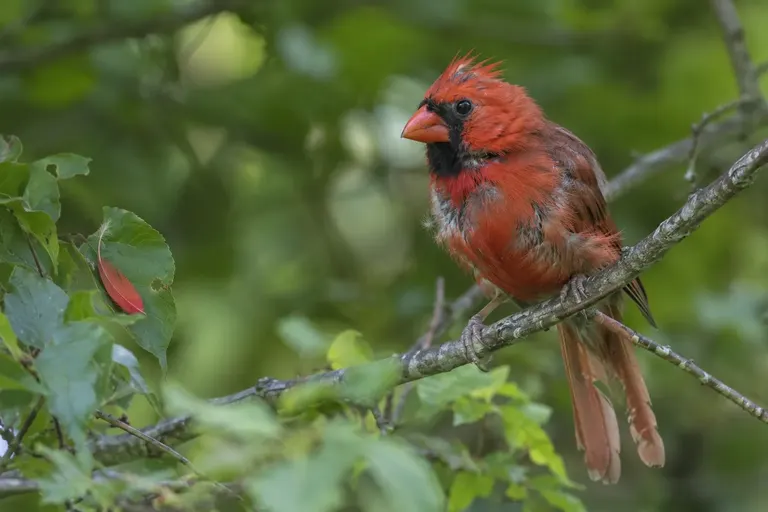
- Small songbirds (chickadees, cardinals, robins, sparrows): leave the nest at roughly 10 to 21 days, with short flights within days.
- Swallows and swifts: stay in the nest longer and often fly strongly as soon as they leave.
- Ducks and geese: leave the nest within a day of hatching but cannot fly for roughly 7 to 10 weeks or more, depending on species.
- Hawks and owls: often “branch” before true flight; first flights come at about 5 to 10 weeks.
- Eagles: Bald Eagle chicks usually make their first flights at about 10 to 12 weeks.
- Albatrosses: the largest species fledge after 5 to 9 months in the nest.
Do baby birds learn to fly, or is it instinct?
Mostly instinct, polished by practice. The flapping motion, the coordination of wings and tail, and the basic reflexes of flight are wired into the developing nervous system. Ornithologists have long noted that young birds kept from practicing flight, for example because they were raised in confined spaces, can still fly reasonably well once their feathers and muscles mature. Details of those older experiments vary, so treat them as supporting evidence rather than a definitive answer, but the modern consensus is that flight is not taught from scratch.
What practice adds is skill. First flights are often clumsy: short, low, with awkward landings. Over days and weeks, young birds get better at judging distance, braking, turning, and landing on thin perches. Species that hunt in the air, such as swallows, falcons and swifts, need the most refinement.
What has to mature before a bird can fly?
Three things must come together:
- Flight feathers. The primaries and secondaries of the wing, and the tail feathers, grow in as pin feathers wrapped in a waxy sheath, then unfurl. Fledglings often leave with short tails that finish growing after they leave the nest.
- Flight muscles. The large breast muscles that power the downstroke, and the smaller muscle that raises the wing, grow rapidly in the final days of the nestling period.
- The nervous system and balance. Vision, the inner ear and coordination all have to reach the point where the bird can control itself in the air.
Why do nestlings flap their wings in the nest?
You may see older nestlings stretching and flapping vigorously in or on the rim of the nest. This “wing exercising” helps build strength and coordination before the first flight. Young hawks and owls do a lot of it, sometimes hopping around on the nest platform in the wind.
When do common backyard birds fly?
Nestling periods vary even among closely related birds. The figures below are typical ranges drawn from Cornell Lab of Ornithology life-history accounts and standard references, and individual nests vary with weather and food.
| Bird | Approximate age at leaving the nest | Flight at leaving |
|---|---|---|
| Northern Cardinal | about 7 to 13 days | Weak, short flights at first |
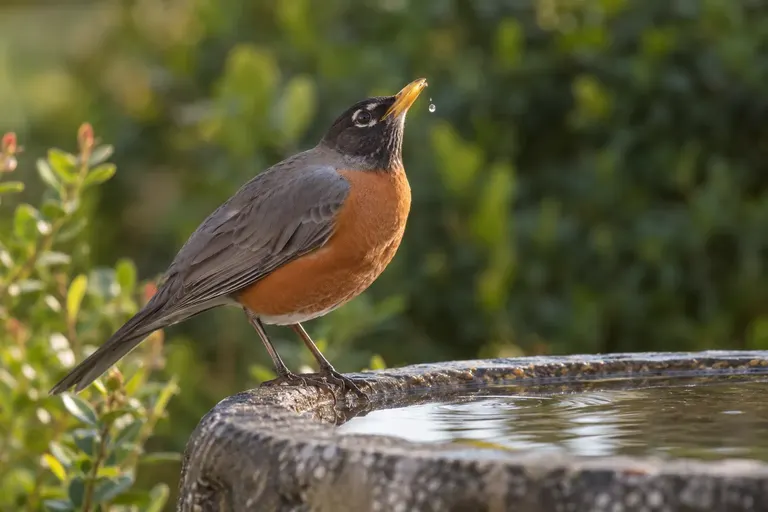
| American Robin | about 13 days | Weak; improves over several days |
| Black-capped Chickadee | about 12 to 16 days | Short flights, improving quickly |
| House Wren | about 15 to 17 days | Short flights |
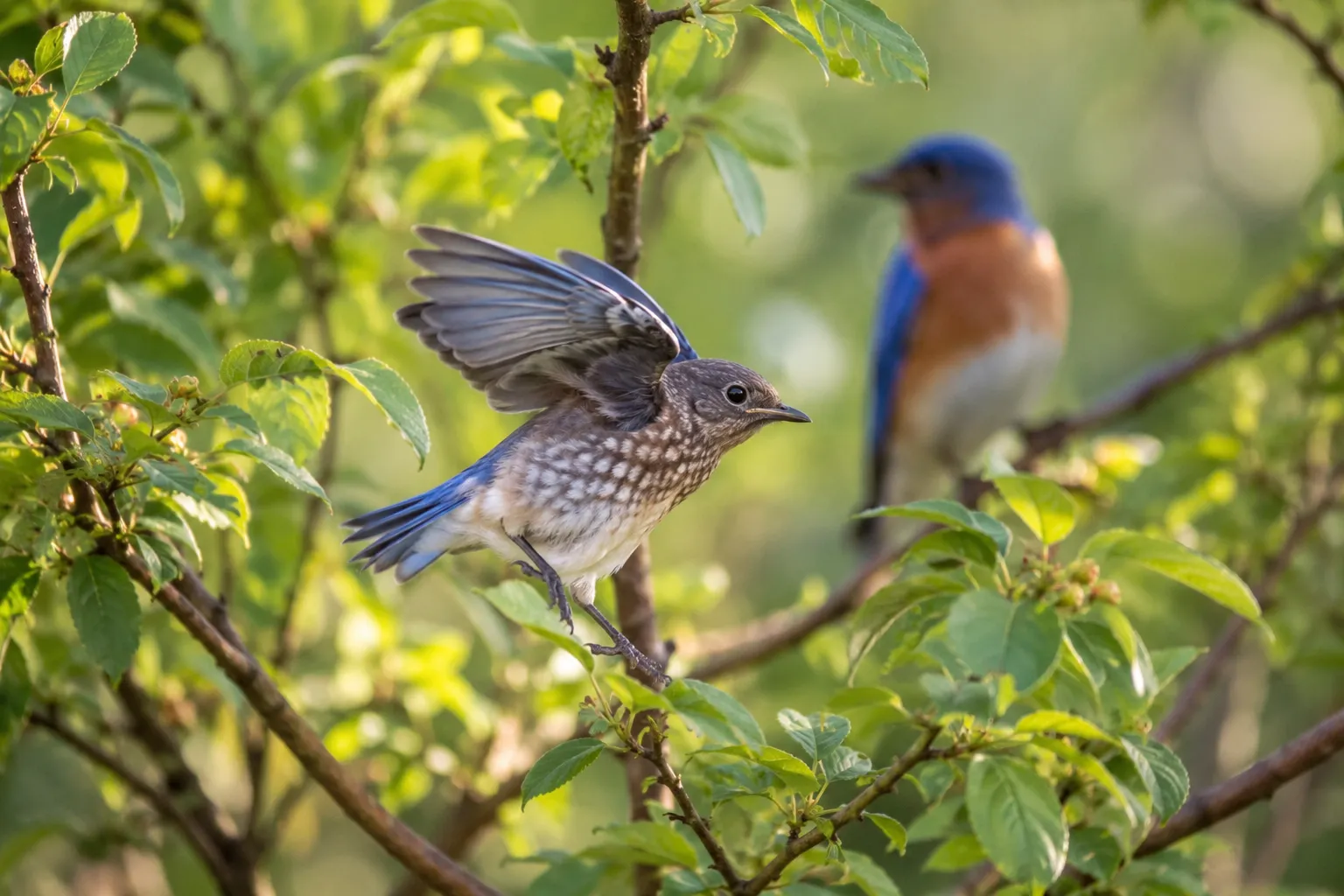
| Eastern Bluebird | about 17 to 21 days | Can usually fly to nearby trees |
| Barn Swallow | about 18 to 23 days | Often flies well |
| Ruby-throated Hummingbird | about 18 to 22 days | Flies well on leaving |
| Mourning Dove | about 13 to 15 days | Short flights |
| Bald Eagle | about 8 to 14 weeks | First flights at the end of this period |
For the full nest timeline by species, see how long baby birds stay in the nest.
Why do some baby birds leave the nest before they can fly?
Leaving early is a survival strategy. An open cup nest full of noisy, growing chicks is easy for predators to find, and a single visit by a snake, jay, squirrel or cat can wipe out an entire brood. Once the chicks spread out into surrounding vegetation, a predator is less likely to find all of them.
This is why so many songbirds, including robins, cardinals, sparrows and thrushes, leave the nest as fledglings: fully feathered but with short tails and limited flight. For several days they hop, climb and flutter through shrubs and across the ground while their parents keep feeding them. It looks precarious, and it is, but it is normal.
Birds that nest in protected cavities, like chickadees and bluebirds, or in hard-to-reach mud nests, like swallows, can often afford to stay in the nest a bit longer and tend to leave with better flight. Swifts, which nest in chimneys and cliffs, may stay until they are almost fully ready and then fly off strongly.
How do different kinds of birds learn to fly?
Songbirds: fledge first, fly soon
Most songbird fledglings make short, fluttering flights within a day or two of leaving, and within a week or two they are flying well. Parents often lead them to thicker cover and continue to feed them for one to three weeks, sometimes longer. In robins, the male often takes over care of the fledglings while the female starts another nest.
Hawks and owls: branching
Young raptors often go through a branching stage, climbing out of the nest onto nearby branches and hopping between them before true flight. Young Great Horned Owls may leave the nest and move around the tree for several weeks before flying well. Even after their first flights, young raptors depend on parents for food for weeks while they learn to hunt, and hunting skill is where learning really matters.
Ducks, geese and shorebirds: walk and swim first
Precocial birds hatch covered in down and leave the nest within hours to a day. Wood Duck ducklings famously jump from tree cavities, sometimes from a considerable height, the day after hatching, and bounce to the ground or water unhurt because they are so light. Killdeer chicks run around within hours of hatching. All of these chicks walk and swim for weeks before their flight feathers grow in. Many ducks and geese take roughly 7 to 10 weeks or more to fly, depending on species.
Seabirds: the leap before the flight
Common Murres, also known as Common Guillemots in Europe, nest on narrow cliff ledges. At about three weeks old, long before they can truly fly, the chicks leave the ledge, gliding and fluttering down to the sea, where the father joins them. The father then cares for the chick at sea for weeks while it grows its flight feathers. Atlantic Puffin pufflings, by contrast, usually leave their burrows at night when they are nearly ready to fly and head out to sea alone.
Albatrosses sit at the far end. Laysan Albatross chicks typically fledge around five months after hatching, and the huge Wandering Albatross can take around nine months. Young albatrosses spend days or weeks facing into the wind and flapping before their first flight, and may then spend years at sea before returning to land.
Megapodes: flying almost from hatching
The megapodes of Australia, New Guinea and nearby islands, such as the Australian Brushturkey and Malleefowl, bury their eggs in mounds of rotting vegetation or warm soil and leave them there. The chicks dig themselves out and are fully independent, with no parental care. They are well feathered at hatching and can reportedly fly within a day or so, which makes them some of the most precocial birds on Earth.
What does science say about how flight develops?
One of the most interesting findings comes from research by biologist Ken Dial on Chukar partridges, published in Science in 2003. Dial showed that young chukars flap their partly developed wings while running up steep slopes and tree trunks, a behavior he called wing-assisted incline running. The wings press the chick against the surface, like a spoiler on a race car, helping it climb to safety long before it can truly fly.
This matters for two reasons. It shows that half-developed wings are useful to a young bird, and it has been proposed as a model for how flight may have evolved in the ancestors of birds. That second idea remains debated among scientists, but the first is well supported: young birds use their wings in many ways before they are flight-ready.
Do parents push baby birds out of the nest?
Not literally, despite the popular image of an eagle nudging its chick off a cliff. What parents do is change the incentives. Near the end of the nestling period, some parents feed less often or call from nearby perches with food, which encourages chicks to move. Once fledglings are out, parents may lead them away from the nest site to denser cover.
In many species, the chicks themselves make the move once they reach a certain level of development, sometimes all within a few hours, sometimes over a day or two. A disturbance, such as a predator or a curious person peering in, can cause chicks to leave early, a process sometimes called “force fledging.” That is one reason to avoid checking a nest in its final days.
How long until a young bird flies as well as an adult?
Leaving the nest and flying well are two different milestones. A young songbird may manage a short, fluttering hop to a low branch on its first day out, but it takes longer to master sustained flight, quick turns and precise landings. For many small songbirds the gap is roughly one to three weeks, around the same period that parents keep feeding them.
Several things improve over that time:
- Feather length. Tail and wing feathers keep growing after the bird leaves the nest. A longer tail gives better steering and braking, which is why fledglings often look stubby-tailed and land clumsily.
- Muscle power. Flight muscles continue to strengthen with use.
- Judgment. Young birds learn how far they can fly, which perches will hold them, and how to land in wind. Watch a family of fledgling starlings or swallows and you will see plenty of overshot landings.
Species that feed on the wing need even longer. Young swallows are fed in the air by parents at first, and young falcons practice chasing and catching objects for weeks. Among raptors, learning to hunt successfully is the real bottleneck, and many young hawks and eagles die in their first year while they are still refining that skill.
What dangers do young birds face while learning to fly?
The first days after leaving the nest are among the most dangerous in a bird’s life. Fledglings are slow, noisy and often on or near the ground. The main threats are:
- Predators, including cats, hawks, snakes, crows, jays and raccoons. Free-roaming domestic cats are a major cause of fledgling deaths in suburban yards.
- Weather. Cold rain can chill young birds that are not yet fully insulated or able to find shelter.
- Collisions. Inexperienced flyers misjudge glass, vehicles and wires.
- Starvation, if parents are lost or food is scarce.
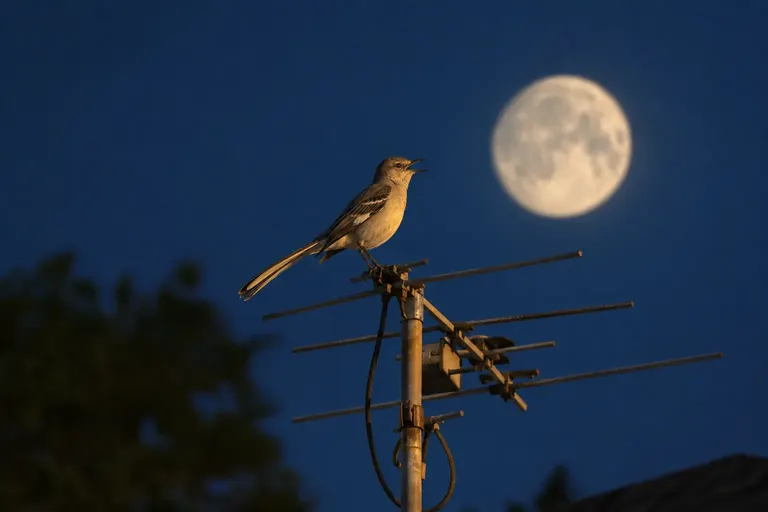
Parents reduce these risks by dispersing the brood, giving alarm calls that send fledglings into hiding, and sometimes dive-bombing predators, or people, that get too close. If you find yourself being scolded by a robin or mockingbird in early summer, there is probably a fledgling nearby.
Myths vs facts about baby birds and flying
| Myth | Fact |
|---|---|
| A baby bird on the ground has fallen and needs help | Most are fledglings that left the nest on purpose and are still cared for by parents |
| Parents teach chicks to fly step by step | Flight movements are largely innate; practice refines skill |
| All baby birds can fly as soon as they leave the nest | Many songbirds leave with weak flight; ducks and seabirds may not fly for weeks |
| If you put a fledgling back in the nest it will stay | Fledglings usually hop right back out; that is normal |
| Parents reject babies that people touch | Most birds rely little on smell and will not abandon young for that reason |
On the last point, see do mother birds reject babies touched by humans?
What should you do if you find a baby bird that can’t fly?
First, decide whether it is a fledgling or a nestling.
- Fledgling: fully feathered, perhaps with a short tail, hops and grips firmly. Leave it where it is. Its parents are almost certainly nearby. If it is in immediate danger, such as on a road, move it a short distance into cover.
- Nestling: sparse feathers, pinfeathers or down, cannot hop or grip well. Put it back in the nest if you can find it.
- Injured, cold, caught by a cat, or truly orphaned: contact a licensed wildlife rehabilitator.
Keep cats indoors for a few days when fledglings are around; the fledgling stage is one of the riskiest periods in a songbird’s life. Our guide to cats and birds covers practical steps, and found a baby bird? what to do walks through each scenario in detail.
How can backyard birders help fledglings?
- Keep pets indoors during peak fledging, which in much of North America runs from late spring through summer.
- Leave shrubs and dense cover where fledglings can hide. A yard with layered vegetation gives them safer places to practice. See our guide to designing a small bird-friendly garden.
- Reduce window strikes. Inexperienced flyers are more likely to hit glass. Our guide on how to stop birds hitting windows has proven fixes.
- Delay heavy pruning and mowing in areas where fledglings are active.
- Resist the urge to check nests in their final days, to avoid causing early departure.
Common mistakes people make
- Carrying a healthy fledgling indoors. This separates it from the parents that can raise it best.
- Trying to teach a bird to fly by tossing it into the air. This can injure it.
- Assuming a quiet fledgling is abandoned. Parents may visit only briefly between long foraging trips.
- Feeding it. The wrong food or water can harm a young bird; leave feeding to rehabilitators.
The bottom line
Most backyard songbirds leave the nest at about two to three weeks old and learn to fly well over the next few days to weeks. The ability to fly is largely built in, but skill improves with practice, and parents keep feeding fledglings while they learn. Timelines range from hours in megapodes to many months in albatrosses. When you see a fluffy, short-tailed bird hopping under your shrubs, the best help is usually to keep your distance and keep the cat inside.
Sources
- Cornell Lab of Ornithology, All About Birds: American Robin life history
- Cornell Lab of Ornithology, All About Birds: Eastern Bluebird life history
- Cornell Lab of Ornithology, All About Birds: Wood Duck life history
- Cornell Lab of Ornithology, All About Birds: Common Murre life history
- Dial (2003), Wing-assisted incline running and the evolution of flight, Science
Frequently asked questions
How old are baby birds when they learn to fly?
Most small backyard songbirds leave the nest at roughly 10 to 21 days old, depending on species, and can make short flights within a day or a few days afterward. Full flying skill takes longer. Larger birds need more time: many hawks fly at around 5 to 7 weeks, eagles at about 10 to 12 weeks, and some albatrosses only after 5 to 9 months.
Do parent birds teach their babies to fly?
Not in the way people teach a skill. The basic flying movements appear to be largely innate and develop as muscles and feathers mature. Parents do shape the process, though: they may reduce feeding visits, call from nearby perches, and lead fledglings to safer cover. Practice then refines control, landing and maneuvering.
Why is there a baby bird on the ground that cannot fly?
It is most likely a fledgling, a young bird that has left the nest before it can fly well. This is normal for many songbirds. Fledglings spend a few days on or near the ground hopping and fluttering while parents feed them nearby. If it is feathered, alert and uninjured, leave it alone and keep pets indoors.
Can a baby bird fly the day it leaves the nest?
Some can, many cannot. Songbirds such as robins and cardinals usually leave with short tails and weak flight, then improve over several days. Cavity nesters that stay longer, like swallows and swifts, often fly well from the moment they leave. Precocial birds like ducks leave the nest within a day of hatching but cannot fly for weeks.
How long do fledglings stay with their parents?
It varies widely. Many small songbirds are fed for one to three weeks after leaving the nest, sometimes longer. Some species stay in family groups for months, and young raptors may depend on parents for many weeks while they learn to hunt. Cooperative breeders such as Florida Scrub-Jays may stay with their family for a year or more.