Barn Swallow Nest: Nest Cups, Ledges and Legal Rules
A barn swallow nest needs a sheltered ledge, wet mud nearby and all-day open access. Nest cups, droppings boards, return dates and the laws on removing nests.
If you buy through links on this page we may earn a commission, at no cost to you. It never decides what we recommend. How we earn
In this article
- How we chose
- Which birds use swallow nests and nest cups?
- Where do barn swallows build their nests?
- How do you attract barn swallows to nest?
- Which barn swallow nest cup or ledge should you buy?
- Which setup suits your building? A decision table
- Where should you put a barn swallow nest cup?
- When do barn swallows return, and when should you put cups up?
- How do you keep a barn swallow nest clean?
- Is it illegal to remove a barn swallow nest?
- How do you remove an old swallow nest legally?
- What are the alternatives to a nest cup?
- How much does a barn swallow setup cost?
- Common mistakes
- Sources
- Gear mentioned in this guide
- Frequently asked questions
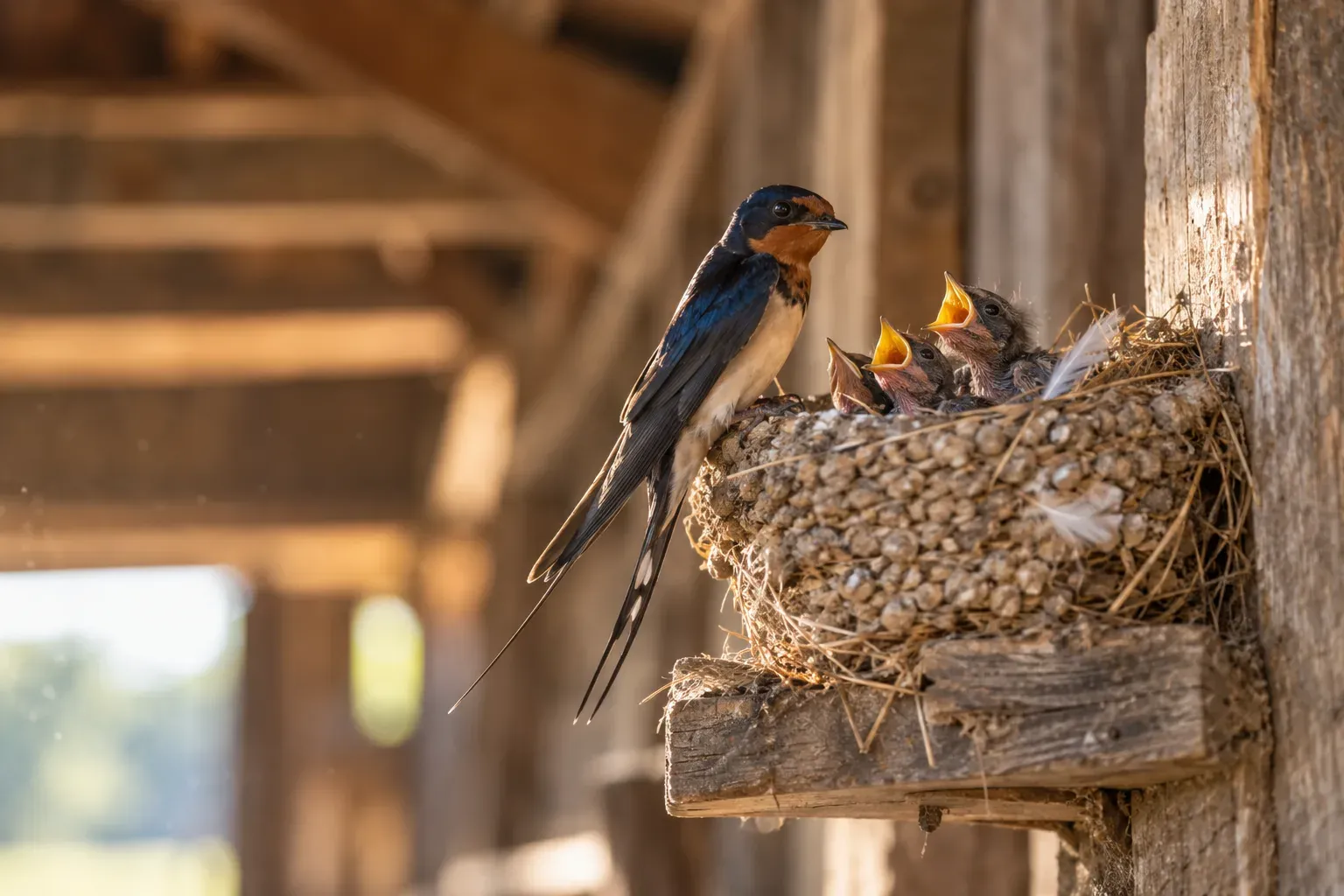
A barn swallow nest is an open cup of mud pellets, lined with grass and feathers, stuck to a beam, ledge or wall under a roof. To host one, mount a ledge about 5 to 6 inches square or a ready-made nest cup high inside a barn, garage, porch or shed, leave a door or window open all day, and keep wet mud nearby. Add a droppings board below, and never disturb a nest with eggs or young: in the US it is protected by the Migratory Bird Treaty Act.
How we chose
We have not installed these products ourselves. Picks are based on manufacturer specifications, published installation guidance from the makers, species life-history data from the Cornell Lab of Ornithology and the RSPB, and patterns in owner feedback. We favored cups made from breathable wood-concrete or concrete over thin plastic or resin shells, and we checked that every spec listed above appears on a maker or specialist retailer page. No prices are given because they change often.
Which birds use swallow nests and nest cups?
Three mud-nesting birds are the main users: Barn Swallow, Cliff Swallow and Common House-Martin. Each builds a different nest.
| Bird | Where it breeds | Nest shape | Where it builds | Best aid |
|---|---|---|---|---|
| Barn Swallow | North America, Europe, Asia | Open half-cup | Inside barns, garages, porches, under bridges | Nest cup or small ledge |
| Cliff Swallow | North America | Closed gourd with a tunnel entrance, in colonies | Outside walls under eaves, bridges, dams | Rough wall under overhang, mud source |
| Common House-Martin | Europe, Asia, North Africa | Closed cup with a small top entrance | Outside walls tight under eaves | Closed house martin nest |
| Purple Martin | Eastern and central North America | Plant material, not mud | Multi-room houses and gourds | Martin house or gourd rack |
Barn Swallows are the easiest to help because they accept artificial cups and simple ledges readily. Cliff Swallows rarely take cups; they mostly need a suitable rough wall and plenty of mud. Purple Martins are swallows too, but they nest in cavities, so see our guide to Purple Martin houses and gourds instead.
Where do barn swallows build their nests?
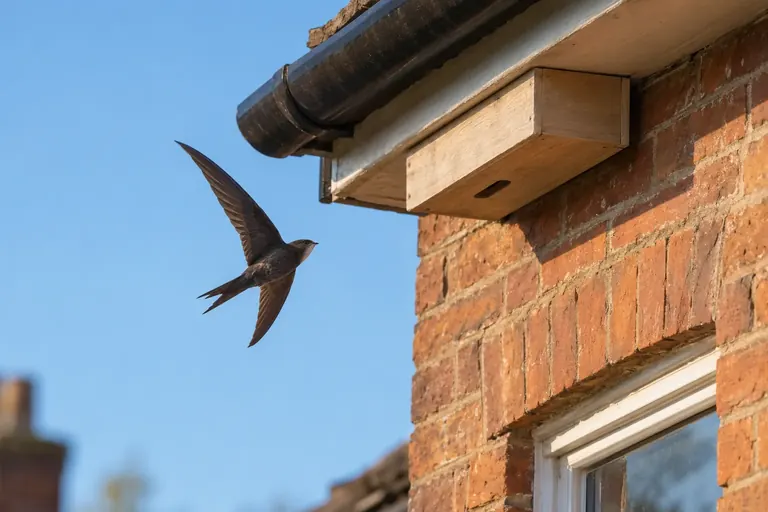
Barn Swallows now nest almost entirely on human structures. According to the Cornell Lab, the original sites were caves and cliff overhangs, and today they choose barns, stables, garages, porches, bridges and culverts.
They look for four things:
- A roof overhead. The nest must stay dry, because rain softens mud.
- A foothold. A beam top, a nail, a light fixture, a narrow ledge or a rough wall they can stick mud to.
- Headroom. A few inches between the nest rim and the ceiling so adults can land and feed chicks.
- Open access. A door, window or gap they can fly through at speed. Swallows hunt flying insects over nearby fields, lawns and water, often making many feeding trips an hour.
Smooth painted walls, vinyl siding and bare metal beams are a common reason a pair gives up; a ledge or cup fixes that. To see how the nest itself goes together, read how birds build nests.
How do you attract barn swallows to nest?
The short answer: give them a foothold, mud and a way in. If swallows already hunt over your property, one of these will often be enough.
Put up a ledge or nest cup
A plain wooden ledge works well. Mount a board roughly 5 to 6 inches (13 to 15 cm) square high on a wall or beam, with 2 to 3 inches (5 to 8 cm) of clearance below the ceiling. Schwegler recommends at least 6 cm (2.4 in) between the top of its No. 10 cup and the ceiling. A cup gives the birds a head start, since they only need to add mud to the rim and a lining.
Space cups about 3 feet (1 m) apart, as Schwegler advises for its barn swallow nest. Barn Swallows sometimes nest in loose groups, but pairs defend the area right around the nest.
Provide mud
Swallows carry mud in their bills, often hundreds of beakfuls for one nest. In a dry spring, lack of mud is a real limit. Keep a shallow puddle of clay-rich soil wet near the barn or garage from the time the birds arrive until nests are built. A low tray with garden soil and water works on a patio. Nests made from sandy, crumbly soil are more likely to fall.
Keep the building open
This is where most setups fail. A door closed at night traps birds; closed by day, adults cannot feed chicks. Leave a window or vent open all season, or use a porch or carport instead.
Keep predators out
Cats, rats, raccoons and snakes all take eggs and chicks. Avoid mounting cups above shelves, stacked boxes or rafters that give climbers a path. Our guide to cats and birds covers the cat side.
Which barn swallow nest cup or ledge should you buy?
Buy a breathable wood-concrete or concrete cup for Barn Swallows, and a closed house martin nest only if you live in Europe. Plastic or resin cups can overheat in hot sheds and give mud little to grip, based on patterns in owner feedback.
Schwegler Swallow Nest No. 10
The Schwegler No. 10 is a half-cup made from wood-concrete, a mix the maker says lets moisture escape, on a formaldehyde-free chipboard panel. It measures about 25 cm wide, 11 cm high and 14 cm deep (9.8 x 4.3 x 5.5 in) and weighs about 0.9 kg (2 lb). Schwegler lists it for use inside barns, stables, porches and other buildings, and notes that Black Redstarts sometimes use it in Europe.
Strengths: Durable material, clear headroom rule, designed for indoor sites. Drawbacks: Mostly sold through European conservation suppliers, so availability in the US varies. Skip it if you need something delivered fast in the US.
Esschert Design Swallow’s Nest NKB2
The Esschert Design NKB2 is a concrete half-cup on a plywood backboard, about 24 x 15 x 9 cm (9.4 x 5.9 x 3.5 in). It is also sold in multi-packs, handy for a barn with several possible sites.
Strengths: Simple, affordable, easy to screw to a beam or wall. Drawbacks: Plain plywood will weather over time if exposed to rain, so keep it under a roof. Skip it if you want the wood-concrete material that some conservation groups prefer.
Schwegler House Martin Nest No. 9A
This is a double house martin nest: two closed wood-concrete bowls on an angled board, 46 cm wide, 11 cm high and 14 cm deep (about 18 x 4.3 x 5.5 in), weighing about 2.9 kg (6.4 lb). Schwegler says to mount it on the outside of a building, under the eaves, at least 2 m (6.6 ft) up, on a sheltered side. Only the board, not the nest bowls, should ever be painted, to keep the bowls breathable.
Strengths: Two nests in one fitting, suits the colonial habits of house martins. Drawbacks: Heavy, and only useful where house martins breed. Skip it if you are in North America, where the right target is the Barn Swallow or Cliff Swallow.
Schwegler Droppings Board for House Martin and Swallow Nests
A wooden board on galvanized steel hangers, about 46 cm long, 26 cm deep and 17 cm high (18 x 10 x 6.7 in), made to screw to the wall below swallow or martin nests. It catches droppings before they land on windows, sills and doorsteps.
Strengths: Neat, purpose-built, fits the Schwegler nest range. Drawbacks: A plain board from a hardware store does the same job for less if you have basic tools. Skip it if the nest is over a barn floor or bare ground.
Which setup suits your building? A decision table
This table matches the setup to the structure you actually have.
| Your site | Barn Swallows likely? | Best setup | Key rule |
|---|---|---|---|
| Open barn or stable with livestock | Very likely | Two to four cups or ledges on beams, 3 ft (1 m) apart | Keep a door or high window open all season |
| Attached garage, door shut at night | Risky | Skip it, or use a porch instead | Never trap adults or chicks inside |
| Detached garage with an open window | Likely if fields or water are near | One or two cups near the window side | Cup high, away from shelves |
| Roofed porch or carport | Likely | Cup or ledge under the roof, droppings board below | Board above doors and paths |
| Bridge, boathouse or dock shed | Likely | Ledge on a sheltered beam | Check you own or may alter the structure |
| Outside wall under eaves (North America) | Cliff Swallows possible | Leave rough surface, supply mud | Barn Swallows prefer indoors |
| Outside wall under eaves (Europe) | House martins possible | Closed house martin nest | At least 2 m (6.6 ft) up |
| Suburban house, no open buildings, few insects | Unlikely | Focus on insect-rich planting | A cup alone will not bring them |
Where should you put a barn swallow nest cup?
Mount the cup high, dry and sheltered, with headroom above and no climbing route below. The table gives practical target numbers drawn from maker instructions and general nesting guidance.
| Setting | Target |
|---|---|
| Height above floor | 8 ft (2.4 m) or more; higher is better where people walk below |
| Headroom above rim | 2 to 3 in (5 to 8 cm); at least 6 cm (2.4 in) for Schwegler No. 10 |
| Ledge size (DIY) | About 5 to 6 in (13 to 15 cm) square |
| Spacing between cups | About 3 ft (1 m) |
| Distance from entrance | Inside, but within easy flight of the open door or window |
| Surroundings | Nothing below that a cat, rat or raccoon can climb |
Use stainless or galvanized screws into solid wood; a wet mud nest with chicks is heavy. For general fixing methods, see how to mount a birdhouse.

When do barn swallows return, and when should you put cups up?
Put cups and ledges up in winter, before the first birds arrive. Barn Swallows spend the winter in Central and South America, and European populations winter in Africa.
| Region | Typical first arrivals | Put cups up by |
|---|---|---|
| Gulf Coast and southern US | Late February to March | Early February |
| Mid-Atlantic, Midwest, Pacific Northwest | April | March |
| Northern US and southern Canada | Late April to May | April |
| Southern Europe | March | February |
| Northern and central Europe, UK | April | March |
Dates shift with weather; eBird records for your county give local timing. Many pairs return to the same building year after year. Barn Swallows raise one or two broods per season, and according to the Cornell Lab, clutches are usually 3 to 7 eggs. That means an active nest can be in use from spring into August, sometimes later. Our broader guide on when to put up birdhouses covers timing for other species.
How do you keep a barn swallow nest clean?
You keep the area clean, not the nest. Fit a droppings board or shelf below the nest, lay a washable mat underneath during the nestling weeks and clean up after fledging. Never scrape or move a nest with eggs or chicks.
Droppings build up most in the last week or two before the young leave. A simple DIY board works well:
- Cut a board 8 to 10 in (20 to 25 cm) deep and a little wider than the nest.
- Fix it with brackets on the wall below the nest, far enough down that it is not a step for a cat or rat.
- Angle it slightly so rain, where it can reach, drains off.
- Lay newspaper or a plastic tray on it to make cleaning easy.
- Scrape and wash it after the young have fledged, wearing gloves and a dust mask.
If a chick falls out, read what to do if you found a baby bird before touching it.
Is it illegal to remove a barn swallow nest?
Removing an active nest is illegal in the US, Canada, the UK and the EU. What counts as active, and whether empty nests are protected, depends on where you live.
United States
Barn Swallows and Cliff Swallows are protected under the Migratory Bird Treaty Act. You may not take, harm or destroy the birds, their eggs or a nest holding eggs or young without a federal permit. US Fish and Wildlife Service guidance states that destroying an inactive nest, one with no eggs or chicks, is generally not prohibited for most species, but you may not possess or keep it.
Canada
The Migratory Birds Convention Act protects Barn Swallows, their eggs and active nests. The Barn Swallow is also assessed under Canada’s species at risk process, so check with Environment and Climate Change Canada before altering sites.
European Union and UK
The EU Birds Directive requires member states to ban deliberate destruction of or damage to nests and eggs of wild birds. Many countries go further. In Germany, for example, nature protection law treats breeding sites that birds reuse each year as protected, so swallow and house martin nests can be protected even when empty. In the UK, the Wildlife and Countryside Act 1981 makes it an offense to take, damage or destroy a nest while it is in use or being built. Ask your local nature authority before removing any swallow or martin nest in Europe.
This is general information, not legal advice. When in doubt, wait and ask.
How do you remove an old swallow nest legally?
Wait until the season is over, confirm the nest is empty, check local rules, then remove it and prevent rebuilding only where you must. Where it is allowed, this is the safe order:
- Wait for the end of nesting. In most of the US that means autumn, after the birds have left.
- Confirm it is inactive. No eggs, no chicks and no adults visiting. Watch for a few days at dawn and dusk.
- Check your local law. In Germany and some other countries, you may need permission even for empty nests.
- Wear gloves and a mask. Old nests carry mites, lice and dust.
- Scrape it into a bag and dispose of it. Do not keep it; in the US possession needs a permit.
- Leave a cup or ledge elsewhere if you can. Moving the site to a less awkward spot works better than simply removing it.
- Exclude only before birds return. Netting or smooth sheeting over a problem ledge must go up in winter, not after pairs have started building.
Our explainer do birds reuse nests covers why, and our guide on when and how to clean out a birdhouse explains general winter clean-out timing.
What are the alternatives to a nest cup?
If a cup does not suit your building, you still have good options.
- A plain ledge. A small board or a wooden strip under the ceiling does most of what a cup does, and swallows build the rest.
- A rough patch. Screwing a strip of rough-sawn wood to a smooth beam or wall gives mud something to grip.
- A mud source only. Where swallows already nest nearby, a spring puddle may be the single most useful thing you add.
- Other aerial insect-eaters. If you cannot leave a building open, a Purple Martin house (east of the Rockies) or a Chimney Swift tower helps other declining insect-eaters instead.
How much does a barn swallow setup cost?
Very little. A nest cup is among the cheapest bird-nesting products you can buy, and a DIY ledge costs only a scrap board and a few screws. The real cost is commitment: leaving a door or window open for months, tolerating some mess and keeping ladders, cats and noisy work away from the nest during the season.
Common mistakes
- Shutting the garage. Closed doors trap birds and starve chicks.
- Mounting too low. Nests below head height get knocked, and they give predators easy access.
- No headroom. A cup jammed against the ceiling leaves adults no room to land.
- Plastic cups in hot sheds. Heat builds fast under metal roofs.
- Removing nests in spring. Once birds are building, leave it until autumn.
- Expecting cups to create swallows. Birds come where there are open fields, water and flying insects.
Sources
- Barn Swallow Life History, All About Birds (Cornell Lab of Ornithology)
- Cliff Swallow, All About Birds (Cornell Lab of Ornithology)
- Migratory Bird Treaty Act of 1918, US Fish and Wildlife Service
- The Birds Directive, European Commission
- House Martin, RSPB
- Swallow Nest No. 10, Schwegler
- House Martin Nest No. 9A, Schwegler
Gear mentioned in this guide
Schwegler Swallow Nest No. 10
A half-cup of breathable wood-concrete on a backing board, designed by a long-standing German nest-box maker for Barn Swallows inside barns, stables and porches.
- Best for
- Barns, stables and deep porches where swallows fly in under a roof.
- Skip it if
- You are in the US and want quick shipping; it is mostly sold by European conservation retailers.
- Size
- 25 cm W x 11 cm H x 14 cm D (about 9.8 x 4.3 x 5.5 in)
- Weight
- About 0.9 kg (2 lb)
- Material
- Wood-concrete bowl, formaldehyde-free chipboard panel
- Headroom
- At least 6 cm (2.4 in) above the nest, per the maker
Esschert Design Swallow's Nest NKB2
A simple concrete half-cup on a plywood backboard that gives swallows a ready-made base to build on, sold singly or in multi-packs.
- Best for
- Anyone who wants to try one or two cups on a porch or in a garage.
- Skip it if
- You want a nest made from breathable wood-concrete rather than plain concrete.
- Size
- 24 x 15 x 9 cm (about 9.4 x 5.9 x 3.5 in)
- Material
- Plywood and concrete
Schwegler House Martin Nest No. 9A
A double house martin nest with two closed wood-concrete bowls on an angled board, made to fix under the eaves of an outside wall.
- Best for
- European homes where house martins already feed or nest nearby.
- Skip it if
- You live in North America, where house martins do not breed.
- Size
- 46 cm W x 11 cm H x 14 cm D (about 18 x 4.3 x 5.5 in)
- Weight
- About 2.9 kg (6.4 lb)
- Nests
- Two bowls on one board
- Mounting
- Outside, under eaves, at least 2 m (6.6 ft) up
Schwegler Droppings Board for House Martin and Swallow Nests
A shelf-style board on galvanized steel hangers that screws to the wall below swallow or martin nests to catch droppings before they hit windows, doors and paths.
- Best for
- Nests above a doorway, window, walkway or parked car.
- Skip it if
- The nest sits over bare ground or a barn floor where droppings do no harm.
- Size
- 46 cm L x 26 cm D x 17 cm H (about 18 x 10 x 6.7 in)
- Material
- Formaldehyde-free chipboard, galvanized steel hangers

Frequently asked questions
Is it illegal to knock down a barn swallow nest?
In the US, destroying a Barn Swallow nest that holds eggs or young breaks the Migratory Bird Treaty Act. US Fish and Wildlife Service guidance says an inactive nest, with no eggs or chicks, can generally be removed for most species, but you may not keep it. In the EU and UK, active nests are protected too, and some countries protect reused swallow nests all year, so check local rules first.
When do barn swallows come back to their nests?
Barn Swallows winter in Central and South America. In the southern US they usually return from about late February or March, and in the northern states and Canada from about mid April to May. In Europe the first birds arrive in March and April. Many return to the same building, and often to an old nest, so have ledges and cups up before they arrive.
Do barn swallows reuse their nests?
Yes, often. Barn Swallows frequently repair and reuse an old mud nest, sometimes adding a fresh layer on top, which saves them days of mud collecting. The downside is that old nests can hold mites and other parasites. Leaving one or two sound nests in place and removing the rest after the season is a common middle path where local law allows it.
How long does it take barn swallows to build a nest?
A new mud nest usually takes a pair about one to two weeks, depending on weather and how close wet mud is. Both adults carry mud pellets in their bills, press them onto the wall or ledge, then line the cup with grass and feathers. Dry weather slows building, which is why a mud puddle nearby can make a real difference.
How do I stop swallow droppings on my porch?
Fix a droppings board or a simple shelf on the wall below the nest, far enough down that it does not give cats or rats a step up to the nest. Lay newspaper or a washable mat below it during the nestling weeks. Clean it after the young fledge. Do not block or remove an active nest to solve the mess; the droppings phase lasts only a few weeks.