Floating Duck House: How to Choose, Anchor and Protect It
A floating duck house gives pond ducks a resting and nesting spot that predators struggle to reach. How to pick one, anchor it, fill it and keep it safe.
In this article
- What is a floating duck house for?
- Which ducks will use a floating duck house?
- What types of duck house work on a pond?
- How big should a floating duck house be?
- How do you anchor a floating duck house?
- Where should you put a floating duck house?
- What should you put inside a duck house?
- When should you put out a floating duck house?
- How do you keep predators away from a duck house?
- How do you look after a floating duck house?
- Floating duck house for pet ducks: what to know
- Floating duck house vs a regular birdhouse
- Sources
- Frequently asked questions
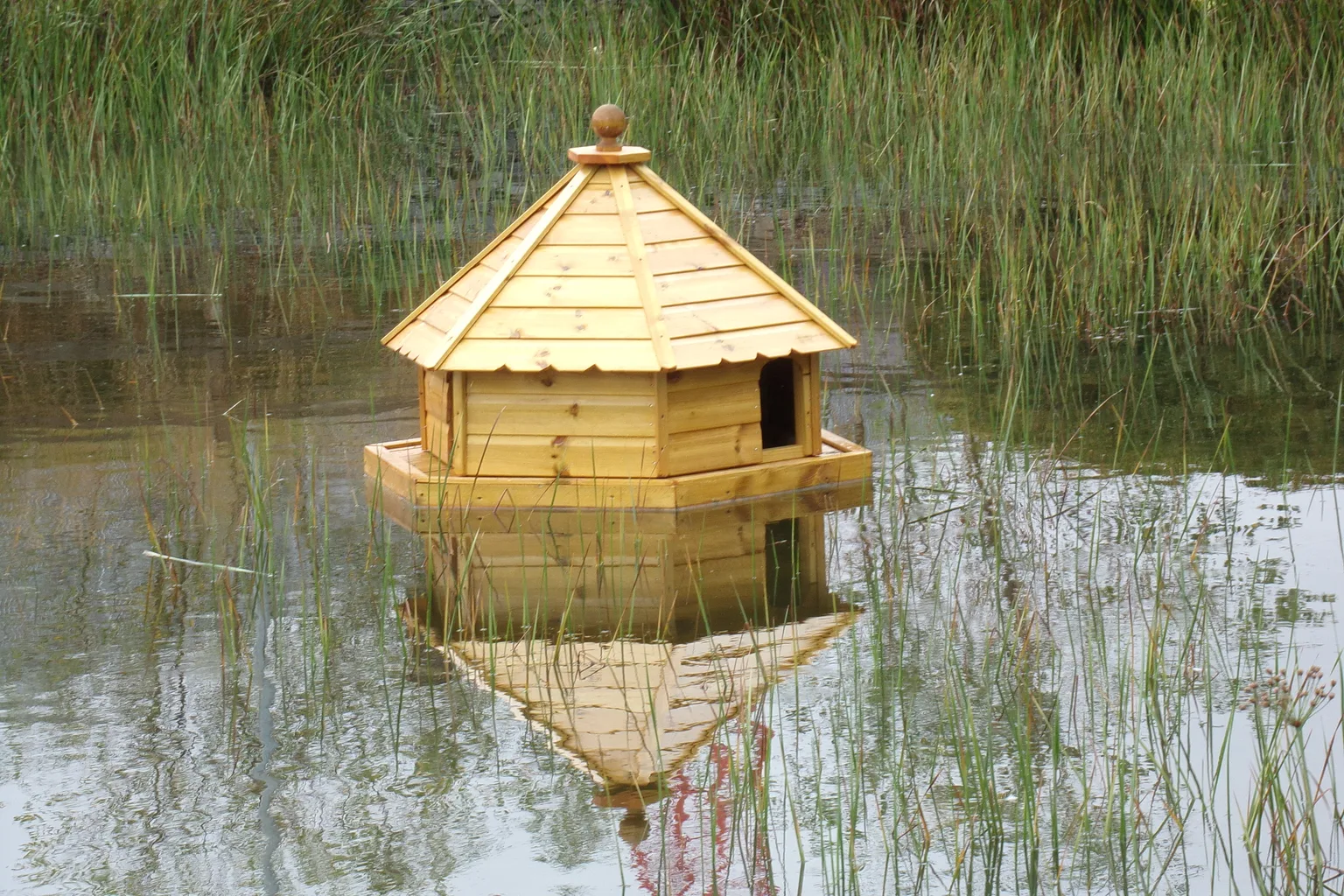
A floating duck house is a small shelter on a raft that sits out on the water of a pond or lake. It gives ducks a dry place to rest and, in spring, a nest site that foxes, cats and other land predators struggle to reach. It works best anchored in calm water near reeds, filled with dry grass, and put out by late winter.
Duck houses look like garden ornaments, but the idea behind them is serious. Ground nests of wild ducks fail often, and wildfowl groups have spent decades testing nest structures over water. This guide covers which kind of duck house suits your pond, how to anchor and fill it, how to keep predators off it, and what a floating house can and cannot do. It draws on guidance from Cornell Lab of Ornithology, Delta Waterfowl, wetland conservation handbooks and the Royal Dutch Hunting Association (KNJV), which studies Mallard nest baskets in the Netherlands.
What is a floating duck house for?
A floating duck house has two jobs: a safe loafing spot all year and a nest site in spring. Out on the water, ducks can rest without a fox or cat creeping up on them through the grass.
Nesting is where the house earns its keep. Cornell Lab explains that Mallards normally nest on the ground on dry land near water, hidden under grass or other plants. That makes eggs and sitting hens easy pickings. KNJV figures for the Netherlands say at least 60% of Mallard nests are lost, and Delta Waterfowl reports that ground-nesting Mallards in its North American study areas often succeed less than 10% of the time. A nest surrounded by water removes most of that risk.
Conservation handbooks for wetland managers make the same point about rafts in general: they are not usually visited by predatory mammals, they rise and fall with the water, and birds use them for resting as well as breeding. A floating duck house is the backyard version of that idea.
Which ducks will use a floating duck house?
The duck you are most likely to see in one is the Mallard. Cornell Lab notes that both urban and wild Mallards readily use artificial nesting structures, and they sometimes nest on floating mats of vegetation on their own.
Pet and ornamental ducks also use floating houses for shade and rest. They are not a substitute for a secure night shelter, which we come back to below.
Some ducks need something different:
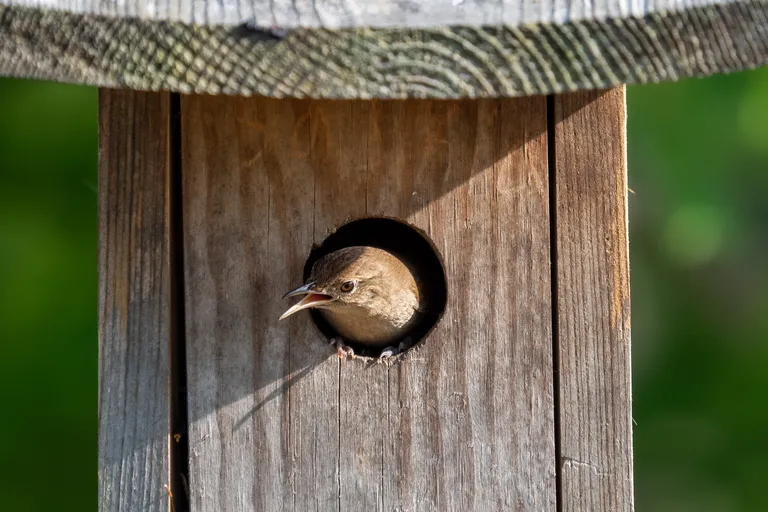
- Wood Ducks in North America, and Goldeneyes and Goosanders in Europe, nest in tree holes. They want a tall box on a pole or tree with an oval entrance, not a house on a raft. Our wood duck box guide covers sizes and placement for these cavity nesters.
- Other waterbirds use rafts too. Wetland conservation handbooks describe planted rafts with nest baskets for wildfowl and divers, bare gravel rafts for terns and waders, and rafts used by resting birds through the winter.
If you are not sure which ducks visit your pond, our guide to common winter ducks helps you tell the regulars apart.
What types of duck house work on a pond?
There are four common designs. They differ in how they stay above the water and how well they cope with changing water levels.
| Type | How it works | Best for | Watch out for |
|---|---|---|---|
| Floating raft house | Wooden house fixed to a buoyant platform, moored with anchors | Garden ponds and lakes where the level changes | Needs good flotation and anchoring; heavy timber can soak up water and sink |
| Pole-mounted cylinder (“hen house”) | Wire and straw tube on a post 2 to 4 ft (60 to 120 cm) above the water | Marshes and ponds with a stable level and a soft bottom | Damaged if the water level swings a lot or ice moves the post |
| Woven nest basket (“Dutch basket”) | Open-weave basket with a narrow entrance, on a post or raft | Mallards in Europe; traditional in the Netherlands | Needs re-lining with dry grass every year |
| Island-style house | House on a fixed island or a planted floating mat | Bigger ponds with room to create an island | Fixed islands go under in floods and can be reached by mammals in drought |
For most garden ponds, a floating raft house is the simplest choice, because it rises and falls with the water instead of flooding or ending up high and dry. In a marsh or a large natural pond with a steady level, a pole-mounted cylinder or basket can be just as good.
How big should a floating duck house be?
There is no single standard size, so think in terms of the raft rather than the house. The raft has to stay level when a duck, or two, climbs on, and it needs room around the doorway for birds to land and step out.
Wetland conservation handbooks suggest that very small rafts can float on sealed plastic containers, while rafts of about 1.2 to 1.8 m (4 to 6 ft) need closed-cell polystyrene blocks or beads in watertight containers, held in place with galvanized netting or strips. They also warn that solid timber absorbs water over time and can sink, so lighter wood such as pine plus extra floats is the safer build.
For the house itself, a few practical points:
- Doorway: large enough for a Mallard to walk in, but not a wide-open front. The Dutch nest baskets used for Mallards have an entrance narrowed to about 150 mm (6 in) to keep crows and other birds out.
- Ramp: a gentle ramp or rough edge lets ducks and ducklings climb on and off easily.
- Roof and floor: a roof that sheds rain and a floor that drains, so the nest material stays dry.
- Materials: untreated or water-based finished wood, with no fresh paint or strong-smelling preservative on the inside.
How do you anchor a floating duck house?
Anchor it to the bottom of the pond, never to the bank. A mooring line to the shore works like a bridge for rats and weasels, and it makes the raft easy for people to pull in.
Wetland conservation guidance gives a clear method:
- Use weights on the bottom. Concrete blocks or containers filled with concrete make good anchors. Join them to the raft with chain, rope or steel wire.
- Use two anchors on opposite corners. This stops the raft swinging round in the wind. A large raft in deep, open water can do better with one mooring point so it lines up with the wind.
- Leave enough slack. The raft must be able to rise to the highest flood level. Lines that are too short can make it drag its anchor in a storm, or pull it under.
- Add a small buoy to the line. If the raft breaks free, the buoy helps you find the anchor again, and birds may perch on it.
Delta Waterfowl adds advice for structures over water in general: put them in sheltered coves where you can, turn the openings side-on to the prevailing wind so nest material isn’t blown out, and avoid spots with strong currents or big swings in water level. If your water level changes by more than 3 to 5 ft (1 to 1.5 m) over the year, a pole-mounted structure will likely be damaged, and a well-anchored raft is the better choice. If you are setting up a post instead, our guide on how to mount a birdhouse covers poles and guards.
Where should you put a floating duck house?
Put it in calm, open water close to reeds or other plants growing out of the water, not in the middle of an empty pond and not against the bank.
Delta Waterfowl places its nesting structures in open water within 3 to 5 ft (1 to 1.5 m) of emergent vegetation. That gives hens cover nearby while still keeping water between the nest and the shore. Conservation handbooks say rafts can sit fairly close to the bank because mammals rarely swim out to them, but keep the house well away from overhanging branches, which give rats and climbing predators a way in.
Good spots share a few features:
- Quiet water away from paths, jetties and dogs.
- Shelter from the wind, ideally on the upwind side of the pond, so waves don’t swamp the raft.
- Plant cover nearby for ducklings once they hatch.
- Gentle banks so ducklings can get out of the water easily after they leave the nest.
On a larger pond, Delta Waterfowl suggests starting with two structures and adding more only once you see them being used. If one spot stays empty for a few seasons, try moving it.
What should you put inside a duck house?
Fill it with dry grass, hay or straw. This step is easy to skip, and it matters. Delta Waterfowl says plainly that ducks do not bring their own nesting material, and for its Hen Houses it fills about half of the inside with grass hay. Dutch nest baskets are lined with dead grass for the same reason.
The hen shapes the material into a shallow bowl. Cornell Lab describes a Mallard nest as about a foot (30 cm) across, and the female lines it with down plucked from her breast once she starts to incubate. You don’t need to add feathers or anything soft; dry grass is enough.
Avoid hay that is damp or mouldy, cut grass straight from the lawn, and anything with plastic netting or string that ducklings could tangle in.
When should you put out a floating duck house?
Have it in place, anchored and filled by late winter. In the Netherlands, the KNJV gives the Mallard breeding season as March to June. Delta Waterfowl checks and refills its structures in February so the nest material is fresh when hens arrive in March and April.
You can install a floating house at any time of year, and putting one out in autumn gives ducks a resting spot through the winter. Conservation handbooks note a trade-off: rafts used only for nesting are best taken ashore over winter to reduce storm and ice damage, while rafts left out for winter resting need the droppings cleaned off before spring.
Be patient. Delta Waterfowl notes that hens may take three to four years to start using a new structure, and success varies from site to site.
How do you keep predators away from a duck house?
Water does most of the work, but a few details close the gaps. The weak points are the mooring line, overhanging branches, the bank and the sky.
- Mammals: foxes, cats and most other ground predators rarely swim out to a raft. Mooring to the bottom and keeping the house away from branches stops rats and weasels getting across. If cats roam your garden, our guide to cats and birds has wider tips.
- Birds: crows and other egg thieves are the main risk on a raft. A roofed house with a narrow doorway, rather than an open platform, helps hide the eggs.
- Ducklings: ducklings are vulnerable once they leave the nest, whatever house they hatched in. The KNJV notes that Mallard duckling survival in the Netherlands is low, possibly because of predation and food shortage. Plants along the edge give them cover.
Don’t put food on the raft. It draws rats, crows and gulls to the nest site. If you want to feed the ducks, skip the white bread; our article on whether bread is bad for birds explains why.
How do you look after a floating duck house?
A quick check once a year keeps it working. Late winter, before the breeding season, is the best time.
- Clear out the old nest. Remove eggshells, old down and any unhatched eggs, and put in fresh dry grass.
- Check the floats and timber. Look for soft wood, cracked floats and loose fixings, and make sure the raft still sits level.
- Check the anchors and lines. Replace frayed rope and rusted chain, and check the slack still suits the water level.
- Clean off droppings if the raft was used for winter resting.
Never disturb an active nest. Do your checks and repairs outside the breeding season, and leave the house alone from early spring until the ducklings have gone. Mallard ducklings leave the nest very quickly: Cornell Lab says they can leave within about 13 to 16 hours of hatching, after an incubation of 23 to 30 days. For how this compares with songbirds, see our guide to how long baby birds stay in the nest.
Floating duck house for pet ducks: what to know
If you keep domestic or ornamental ducks, a floating house is a nice extra for shade and rest, but it is not a safe night shelter on its own. Ducks can be caught on the bank, and some predators can reach a raft close to shore.
Animal care guidance for keeping ducks says enclosures should be designed so that no dog, fox, cat or large bird can get in, with fence bases buried about 20 cm deep, mesh at least 2 m high and a fully covered top. Most keepers combine a floating house on the pond with a secure, fox-proof shelter on land that the ducks are shut into at night.
Floating duck house vs a regular birdhouse
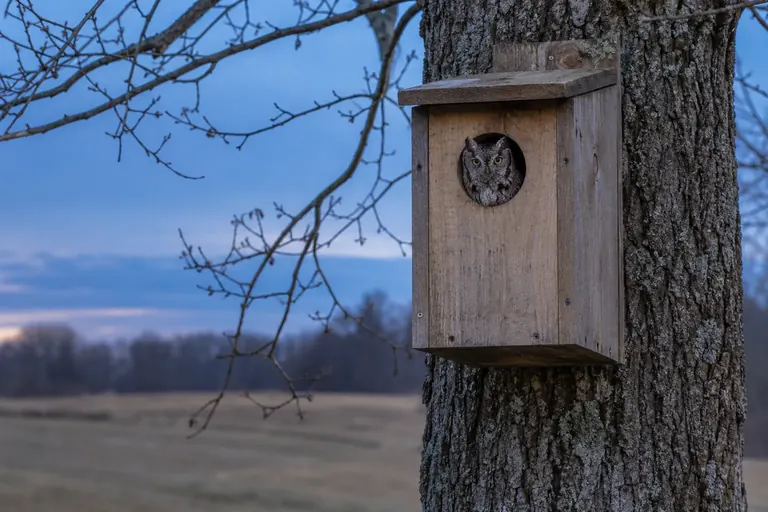
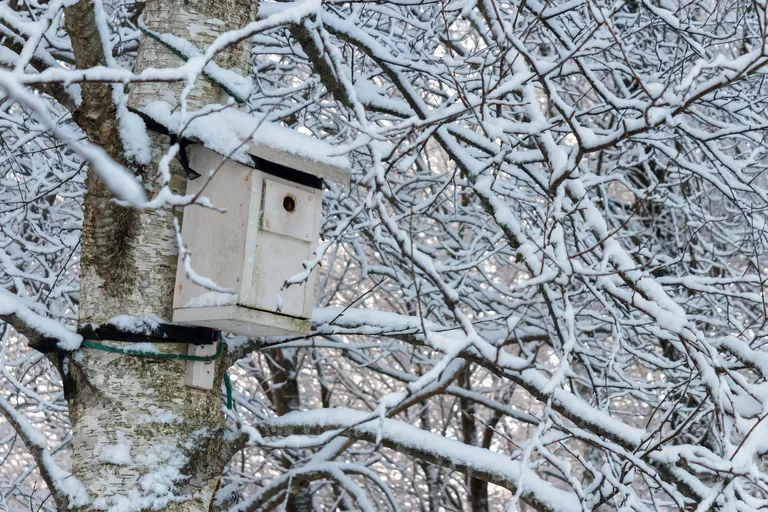
A duck house is not just a big birdhouse. Songbirds nest in small boxes with round entrance holes fixed to trees, walls or posts, while dabbling ducks such as Mallards want a ground-level style nest that is surrounded by water. If you are setting up nest sites for garden birds as well, our best birdhouses guide covers the right boxes for songbirds. And if you have wondered how ducks stay dry sitting out on a raft in the rain, our explainer on why ducks don’t get wet has the answer.
Sources
- Cornell Lab of Ornithology, All About Birds: Mallard life history
- Delta Waterfowl: What is a Delta Hen House?
- Delta Waterfowl: Tips for building and placing Hen Houses
- The Conservation Handbooks (BTCV): Waterways and wetlands, rafts
- KNJV (Royal Dutch Hunting Association): Wilde eend factsheet
- NSW Department of Education: Ducks and geese, environment


Frequently asked questions
Do ducks actually use floating duck houses?
Many do, but not right away. Cornell Lab notes that Mallards readily use artificial nesting structures, and floating rafts are also used as safe resting spots, including in winter. Delta Waterfowl warns that hens can take three to four years to start using a new structure, so placement, nesting material and patience matter more than the look of the house.
How do you anchor a floating duck house?
Anchor it to the pond bottom, not the bank. Conservation handbooks for wetland managers recommend concrete blocks or concrete-filled containers joined to the raft by chain or rope, ideally two anchors on opposite corners so it doesn't swing. Leave enough slack for the highest water level, and keep lines off the shore so rats and weasels can't climb across.
What should you put inside a duck house?
Put in dry grass, hay or straw. Delta Waterfowl points out that ducks do not bring their own nesting material, so an empty box is far less attractive. For its Hen Houses it fills about half the cylinder with grass hay. Clear out old shells, down and unhatched eggs once a year and add fresh material in late winter.
When should you put out a floating duck house?
Have it in place and filled by late winter. Mallards in the Netherlands breed from March to June, and Delta Waterfowl checks and refills its structures in February so the material is fresh when hens arrive in March and April. A raft used only for nesting can be brought ashore over winter to limit storm and ice damage.
Is a floating duck house enough to protect pet ducks at night?
Usually not on its own. A raft keeps most ground predators away from nesting wild ducks, but domestic ducks are normally shut into a predator-proof shelter at night. Animal care guidance for keeping ducks says enclosures should be built so that no dog, fox, cat or large bird can get in, with buried fence bases and a covered top.