How to Attract House Wrens With the Right Nest Box
How to attract house wrens: hang a small-hole wren box by shrubs before spring, add a brush pile, skip pesticides, and keep it clear of your bluebird boxes.
In this article
- Quick answer: how to attract house wrens
- House wren at a glance
- How to identify a house wren
- Where and when to find house wrens
- What do house wrens eat?
- Nest boxes: the key to attracting house wrens
- House wrens and bluebirds: managing competition
- Plants and habitat that attract house wrens
- Water for house wrens
- House wren seasonal calendar
- Common problems and how to fix them
- Common mistakes when trying to attract house wrens
- How long does it take house wrens to find a new box?
- Watching and recording house wrens
- Sources
- Frequently asked questions
Here is how to attract house wrens: put up a nest box with an entrance of about 1 to 1 1/4 inches, within about 100 feet of shrubs or trees, before they return in spring, and make the yard rich in insects. House wrens rarely use seed feeders but take readily to nest boxes, and a loud, bubbling male can claim a yard within days. The one catch: these tiny birds compete hard for cavities, so place wren boxes with care if you also host bluebirds, chickadees or tree swallows.
This guide is research-led. It draws on the Cornell Lab of Ornithology’s All About Birds life-history data, NestWatch nest box guidance and Audubon species accounts.
Quick answer: how to attract house wrens
- Nest box: entrance about 1 to 1 1/4 inches, placed within about 100 feet of shrubs or trees, up by early spring.
- Insects: native plants, leaf litter, a brush pile and no broad-spectrum insecticides.
- Cover: shrubs, hedges and small trees along the yard edge.
- Optional food: mealworms in a small dish near cover during nesting season.
- Placement discipline: keep wren boxes away from boxes intended for bluebirds and swallows.
House wren at a glance
| Trait | Details |
|---|---|
| Size | 4.3 to 5.1 in long; 0.3 to 0.4 oz (about the weight of two quarters) |
| Range | Breeds across most of the US and southern Canada; winters in the southern US and Mexico |
| Season in your yard | Spring through early fall in most northern states; winter in the far South |
| Natural diet | Insects and spiders; snail shells for calcium and grit |
| Feeder foods | Rarely feeds at feeders; may take mealworms |
| Nesting | Cavities and nest boxes; also cans, boots, flowerpots and gear left in sheds |
| Broods per year | 1 to 2 |
| Conservation status | Low concern; stable to slightly increasing since 1966 (Cornell Lab) |
A note on names: in 2024, ornithologists split the House Wren into two species. The bird breeding across the US and Canada is now the Northern House Wren. The Southern House Wren lives in Mexico, Central America and South America. Most backyard guides, including this one, still say “house wren” for the northern bird.
How to identify a house wren
Adults
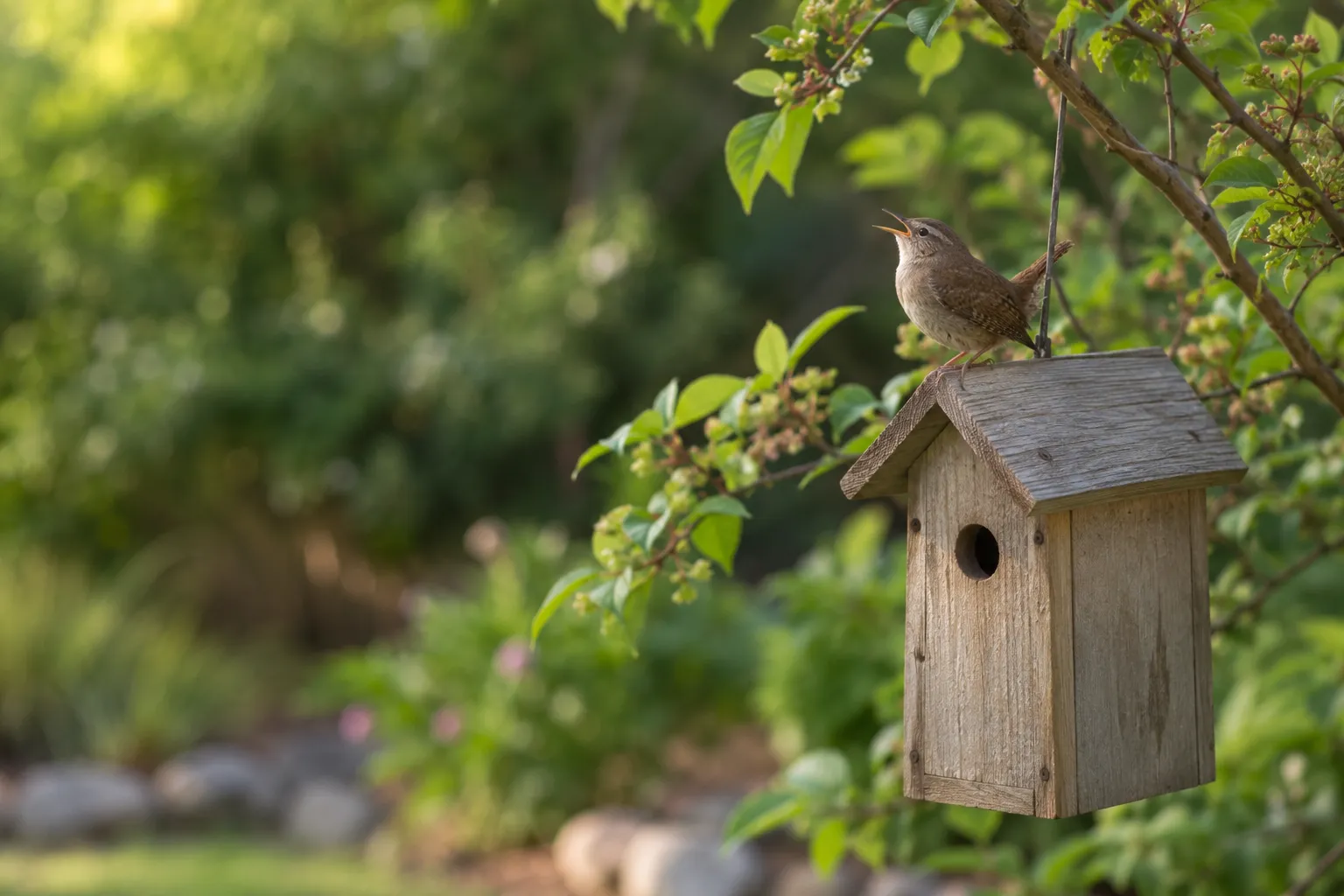
A house wren is small and compact, about chickadee-sized, with a flat head, a fairly long curved bill and a tail that is often cocked up or slightly drooped. Cornell describes it as subdued brown overall, with darker barring on the wings and tail. The pale eyebrow is faint compared with other wrens. There is nothing flashy about it; the voice is what gets your attention.
Males and females look alike. In spring, the male is the one singing constantly from a perch near his chosen boxes.
The song
The song is a fast, bubbly, tumbling cascade of notes, delivered again and again through spring and early summer. Scolds are harsh, buzzy chatters. If you are learning wren voices, our guide to Merlin Sound ID explains how to confirm what the app suggests.
Similar species
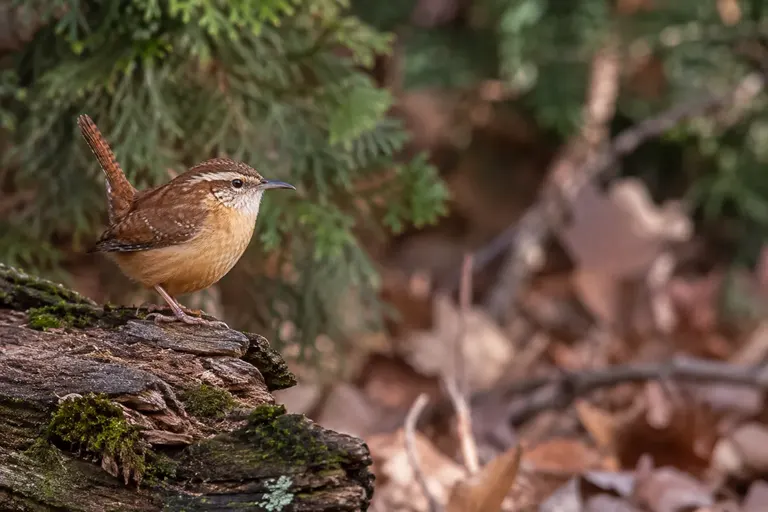
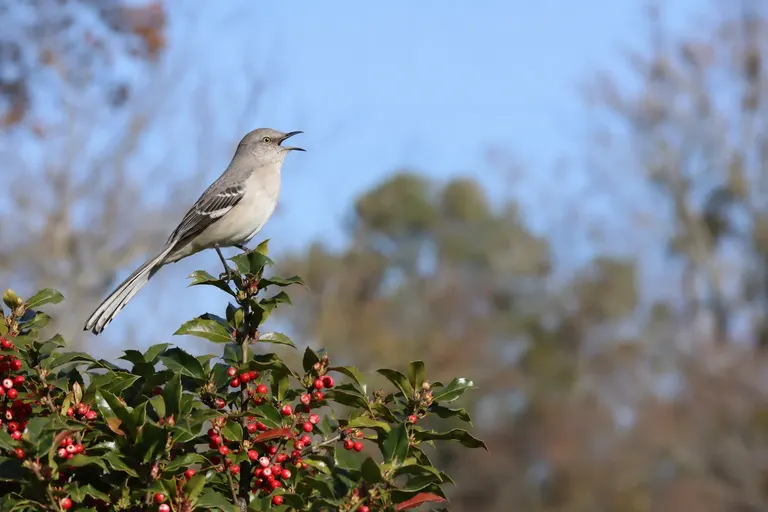
- Carolina wren: larger and warmer colored, with rich rusty upperparts, buffy-orange underparts and a bold white eyebrow. It is a year-round resident in the East. See how to attract Carolina wrens.
- Bewick’s wren: grayer above, whiter below, with a prominent white eyebrow and a longer tail it flicks side to side. Mostly western.
- Winter wren: tiny, darker and more heavily barred, with a stubby tail; a secretive forest-floor bird in winter.
For a broader method that works on any small brown bird, see how to identify birds using five clues.
Where and when to find house wrens
House wrens breed across most of the United States and southern Canada. Cornell lists habitats as varied as eastern deciduous forests, southern swamps, western conifer forests and aspen groves. They thrive in open woods, forest edges, farmyards, city parks and backyards with scattered trees and shrubs. In winter they become quieter and keep to brushy habitat in the South.
In most northern states, house wrens arrive in spring, typically from mid to late April into May, and depart by early fall. Audubon notes they probably migrate at night and that males tend to arrive a little before females. Because timing shifts with latitude and weather, recent eBird sightings for your county are the best guide to when to have boxes ready.
What do house wrens eat?
Natural diet
House wrens are insect and spider specialists. Cornell lists beetles, caterpillars, earwigs, daddy longlegs, flies, leafhoppers and springtails. Audubon adds grasshoppers, crickets, moths, millipedes and snails. They also eat snail shells for calcium and grit. They forage actively at every level, gleaning foliage, probing bark and hopping on the ground.
That means the best “feeder” for a house wren is a yard full of insects. A pair raising a brood makes constant trips with caterpillars, spiders and other prey.
Will house wrens come to feeders?
Occasionally, but do not count on it. They do not eat seed in any meaningful amount. What some owners report success with:
- Mealworms. Live or softened dried mealworms in a small dish placed close to cover. FeederWatch lists mealworms as a treat taken by wrens along with bluebirds and chickadees. Our roundup of dried mealworms for bluebirds and wrens covers how to choose and serve them.
- Suet. Wrens sometimes pick at suet in cool spring or fall weather, but it is not a dependable draw for this species.
- Crushed eggshells. Because wrens seek calcium, a small amount of baked, crushed eggshell on a platform is a low-risk addition during egg-laying season. Bake shells first to kill bacteria.
Nest boxes: the key to attracting house wrens
Why house wrens love nest boxes
House wrens are cavity nesters that will take almost any enclosed space: old woodpecker holes, natural crevices, nest boxes, and less conventional spots such as tin cans, old boots, drainpipes, flowerpots and items left in open garages. Cornell notes they prefer sites within about 100 feet of woody vegetation, but avoid deep, dense woods where predators are harder to spot. The typical suburban yard with shrubs and a few trees fits well.
House wren nest box specs
Most published house wren plans use:
| Feature | Guideline |
|---|---|
| Entrance hole | About 1 to 1 1/4 in; many builders choose 1 1/8 in because it is too small for House Sparrows |
| Location | Within about 100 ft of shrubs or trees; yard, orchard or woodland edge |
| Height | Cornell records nests from about 1 to 30 ft; eye level or a little higher is practical for monitoring |
| Mounting | Post, tree, building or hanging; wrens often accept swinging boxes |
| Ventilation and drainage | Vent gaps near the top, drain holes in the floor |
| Access | A side or front panel that opens for cleaning and monitoring |
NestWatch offers a free downloadable house wren plan with full dimensions if you want to build your own.
How to put up a house wren box, step by step
- Put it up early. Have the box in place before the first wrens arrive, typically by mid-April in the northern states.
- Choose the edge. Mount it where lawn meets shrubs or small trees, not in the middle of an open field and not deep in the woods.
- Pick a sensible height. Eye level makes cleaning and checking easy. A box hung from a sturdy branch on a short chain or wire often works.
- Add protection. A baffle below a post-mounted box helps against climbing predators. Avoid external perches; wrens do not need them and they aid predators.
- Offer more than one site if you want wrens. Males build several dummy nests, and a female chooses among them. Two or three wren-sized boxes a reasonable distance apart can raise your odds.
- Clean out between seasons. Remove old nests after the season ends, since wrens and other species will reuse a clean box.
What happens once wrens move in
The male stuffs cavities with twigs to build dummy nests, sometimes filling a box nearly to the entrance. When a female chooses, she makes a soft cup in a depression in the twig pile, lined with feathers, grass, animal hair, spider egg sacs, string and bits of plastic. NestWatch notes an interesting benefit: spiders that hatch from those egg sacs appear to eat nest parasites.
Cornell lists clutches of 3 to 10 eggs, white to grayish with reddish-brown speckles, incubated for about 9 to 16 days. Nestlings leave 15 to 17 days after hatching. Pairs raise one or two broods a year. The oldest recorded house wren was at least 9 years old.
If you find a fledgling on the ground after the young leave the box, it is usually normal. Our guide on what to do if you find a baby bird explains when to step in and when to leave it.
House wrens and bluebirds: managing competition
Why wrens take over other birds’ boxes
House wrens are fierce competitors for nest cavities. NestWatch notes they will harass and peck much larger birds and sometimes drag eggs and young out of a nest site they want. Cornell adds that males may even discard eggs and nestlings in a site they take over. Bluebirds, chickadees, tree swallows and titmice can all lose nests this way.

How to reduce conflict
House wrens are native songbirds protected under the federal Migratory Bird Treaty Act. Removing or destroying an active nest with eggs or young is not legal. The practical answer is placement:
- Put bluebird and swallow boxes in open areas, well away from shrubs, hedges and tree lines. Wrens prefer sites close to woody cover.
- Put wren boxes near shrubs, in a different part of the yard from boxes meant for other species.
- Do not cluster all your boxes together near the same shrub border.
- Monitor weekly so you know which species is using which box.
Our guide to attracting Eastern bluebirds covers bluebird box placement in more detail.
Plants and habitat that attract house wrens
Because house wrens eat insects, plantings that support caterpillars and other invertebrates matter more than berry or seed production.
Habitat features to add
- A brush pile. Cornell recommends brush piles made from pruned branches for cover, protection and insects.
- Leaf litter under shrubs. Leaves shelter spiders, beetles and larvae.
- Shrub borders and small trees. Wrens forage and sing from this layer.
- No broad-spectrum insecticides. Pesticides remove the food nestlings need.
Native plants for house wrens by region
Choose native trees and shrubs known to host many insect species, and check your state extension or native plant society for local choices.
Northeast and Midwest
- Native oaks and wild cherries (high caterpillar diversity)
- Serviceberry
- Gray dogwood and silky dogwood
- Native viburnums
Southeast
- Native oaks
- Wax myrtle
- American beautyberry
- Sweetbay magnolia in moist sites
West and Mountain West
- Quaking aspen where it grows naturally
- Native willows along water
- Chokecherry
- Native serviceberry
Water for house wrens
House wrens drink and bathe, especially in hot summer weather. A shallow bath 1 to 2 inches deep, placed near shrubs rather than in open lawn, suits them. Refresh water every few days and scrub the basin to prevent algae.
House wren seasonal calendar
| Season | What house wrens are doing | What to do |
|---|---|---|
| Late winter (Feb to Mar) | Still on wintering grounds in most areas | Clean and repair boxes; decide placement |
| Spring (Apr to May) | Males arrive, sing, build dummy nests; females choose | Boxes up; monitor weekly; separate from bluebird boxes |
| Summer (Jun to Aug) | One to two broods; heavy insect feeding | Keep pesticides out; offer water and optional mealworms |
| Fall (Sep to Oct) | Birds move south; young disperse | Clean out boxes; build a brush pile for next year |
| Winter (Nov to Jan) | Present only in the southern US and Mexico | Leave some brush and leaf litter in place |
Common problems and how to fix them
“Wrens stuffed every box with sticks”
This is dummy nest building. Only one box will usually be used for eggs. If you want other species in some boxes, the long-term fix is moving those boxes into the open, away from shrubs.
The male sings but no female arrives
Unpaired males sing persistently and keep building. Sometimes a female never picks his site. Offering another box in a slightly different spot, still near cover, gives more options next season.
Heat in the box
Cornell notes wren eggs can die if kept above about 106°F or below about 65°F for long periods. Mount boxes where they get some afternoon shade, and make sure there are ventilation gaps.
Cats and other predators
Keeping cats indoors protects wrens and their fledglings, which spend a few days near the ground. A baffle under post-mounted boxes deters snakes and raccoons.
Common mistakes when trying to attract house wrens
- Putting the box up in June. Most males claim territories in spring. Have boxes up before they arrive.
- Placing the box in wide open lawn. House wrens want woody cover within about 100 feet.
- Using a large entrance hole. Bigger holes invite House Sparrows.
- Relying on seed feeders. Wrens eat insects, not seed.
- Mounting wren boxes next to bluebird boxes. This invites egg destruction and conflict.
- Spraying the garden. Insecticides remove the food a brood needs.
How long does it take house wrens to find a new box?
If a box is up before spring arrival and sits in the right habitat, a returning or newly arrived male can find it within days, because males actively search for cavities to fill with twigs. If you put a box up in late spring, you may still get a nesting attempt, since pairs raise one or two broods and later nests are common. A box that goes unused all season usually has a placement problem rather than a design problem. Check three things:
- Distance to cover. Is there a shrub, hedge or small tree within easy reach? If the box is out in open lawn, move it closer to the edge.
- Heat and exposure. A box in full afternoon sun on a dark post can get too hot. Shift it to a spot with some shade.
- Competition. A House Sparrow pair or another wren nearby may already control the area. A 1 1/8-inch entrance keeps sparrows out, and a second box on the far side of the yard gives a new male room.
It can also simply be a quiet year. Wren numbers in any one yard vary from season to season, so keep the box clean and in place for the next spring.
Watching and recording house wrens
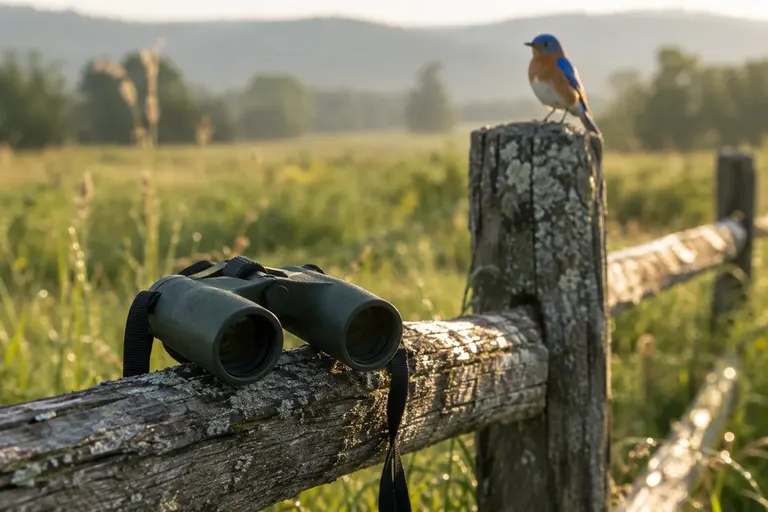
House wrens are easy to watch because they sing from exposed perches near their boxes. For close views of a small, fast bird, a pair of binoculars that focuses near is helpful; see our guide to binoculars for watching birds from your window. If you monitor a nest box, recording each check in NestWatch contributes to long-term breeding data. For more ideas on making the whole yard bird-friendly, read our guide to backyard birding.
Sources
Frequently asked questions
What attracts house wrens to a birdhouse?
House wrens look for a small cavity close to shrubs or trees, usually within about 100 feet of woody cover, in a yard, orchard or woodland edge. A box with an entrance of roughly 1 to 1 1/4 inches, put up before spring migration, is the main draw. They will even use swinging, hanging boxes that many other cavity-nesters avoid.
Do house wrens eat birdseed?
Not usually. House wrens eat insects and spiders, such as beetles, caterpillars, earwigs, flies and daddy longlegs, and they rarely use seed feeders. The best way to feed them is to grow insects: native plants, leaf litter and no pesticides. Some wrens will take mealworms from a small dish placed near cover, especially while feeding nestlings.
Why is my house wren filling birdhouses with sticks?
Male house wrens build several dummy nests of twigs in different cavities to court a female. She inspects them, picks one and adds a soft lining of grass, feathers, hair and other fine material. The stick-filled boxes she rejects may never get eggs, which is why wrens can seem to occupy every box in a yard.
Do house wrens destroy other birds' eggs?
Yes. House wrens compete fiercely for cavities and will peck eggs and drag eggs or young out of nest sites they want, including those of bluebirds, chickadees and tree swallows. They are native, protected birds, so the usual fix is placement: keep boxes meant for other species in open areas away from shrubs, where wrens are less likely to settle.
When do house wrens arrive and leave?
In most northern states, house wrens arrive in spring, typically from mid to late April into May, and are gone by fall, generally by October. Many winter in the southern United States and Mexico. Timing varies with latitude, so check recent eBird sightings for your county to decide when to have boxes up.