Robin Feeders: The Best Feeders Robins Actually Use
The best robin feeder is a domed dish or a low mesh ground tray stocked with mealworms. Compare 5 picks, caged ground feeders and where to put them.
If you buy through links on this page we may earn a commission, at no cost to you. It never decides what we recommend. How we earn
In this article
- Quick picks
- How we chose
- What makes a good robin feeder?
- Droll Yankees Seed Saver X-1: best bird feeder for robins overall
- Kingsyard Ground Bird Feeder: best robin feeder tray for the ground
- Kingsyard Squirrel Proof Caged Ground Feeder: best caged ground feeder
- Woodlink 3-in-1 Platform Feeder: best low bird table for robins
- Chubby Dried Mealworms: best food for a robin feeder
- Comparison table
- What do robins eat from a bird feeder?
- Where should you put a robin feeder?
- Is a robin feeder tray safe? What the RSPB advises now
- How do you stop starlings and pigeons eating the robin food?
- Do American Robins use bird feeders?
- When should you feed robins, and why are they linked with Christmas?
- Robin feeding calendar: what to put out each month
- Why isn’t a robin using my feeder?
- Common mistakes when feeding robins
- Sources
- Frequently asked questions
The best robin feeder for most gardens is the Droll Yankees Seed Saver X-1: a small open dish under a clear dome that you can lower until robins fit and pigeons do not. Fill it with a small daily portion of mealworms or suet pellets. If your robin only feeds on the lawn, a low mesh ground tray works better, and a caged ground feeder stops pigeons and squirrels taking everything.
Robins are ground and low-perch feeders. They hop, look and pounce, and they cannot cling to a tube feeder the way a blue tit can. So the right robin bird feeder is open, low and wide, and the food matters more than the hardware.
Quick picks
- Best robin feeder overall: Droll Yankees Seed Saver X-1. Clear 10 in dome that slides to keep big birds off, about 1 lb.
- Best ground feeder tray: Kingsyard Ground Bird Feeder. Recycled plastic, metal mesh floor, pull-out legs.
- Best caged ground feeder: Kingsyard Squirrel Proof Caged Ground Feeder. 1.5 in openings keep pigeons and squirrels out.
- Best low bird table: Woodlink 3-in-1 Platform Feeder. Cedar with a screen floor, on legs, hanging or on a pole.
- Best robin food: Chubby Dried Mealworms. The food robins take most readily.
Droll Yankees Seed Saver X-1 Domed Feeder
A clear polycarbonate dish under a 10 in dome that slides up and down, so you can let robins in and keep pigeons and crows out.
- Best for
- Serving mealworms, suet pellets or chopped fruit in a small, dry portion.
- Skip it if
- Your robin refuses to leave the ground; some never take to hanging dishes.
- Capacity
- About 1 lb
- Size
- 11 x 10 x 10 in (28 x 25 x 25 cm)
- Material
- UV-stabilized polycarbonate, brass rod
- Mounting
- Hang or pole (adapter included)
Kingsyard Ground Bird Feeder
A recycled plastic frame with a metal mesh floor on pull-out legs, so food sits just above wet grass and drains after rain.
- Best for
- Robins, dunnocks and blackbirds that feed on the ground.
- Skip it if
- Pigeons, rats or cats already patrol the ground under your feeders.
- Size
- 13.3 x 10.2 x 6.7 in (34 x 26 x 17 cm)
- Material
- Recycled plastic, metal mesh
- Mounting
- Freestanding on pull-out legs
Kingsyard Squirrel Proof Caged Ground Feeder
The same low mesh tray inside a metal cage with 1.5 in openings that small birds fly through and pigeons and squirrels cannot.
- Best for
- Gardens where pigeons, jackdaws or squirrels clear the robin food in minutes.
- Skip it if
- You want blackbirds to share the food, as many are too big for 1.5 in gaps.
- Size
- 13.5 x 10.2 x 11.9 in (34 x 26 x 30 cm)
- Cage openings
- 1.5 in (about 3.8 cm)
- Material
- Recycled plastic, rust-free metal
- Mounting
- Freestanding on pull-out legs
Woodlink 3-in-1 Platform Feeder
A cedar tray with a removable metal screen floor that sits on folding legs, hangs from a cable or goes on a pole.
- Best for
- A low feeding table you can raise later if cats are a problem.
- Skip it if
- You follow the RSPB advice to avoid flat-surfaced feeders altogether.
- Capacity
- About 3 lb mixed seed
- Size
- 16.4 x 13.25 x 2.4 in (42 x 34 x 6 cm)
- Material
- Kiln-dried cedar, powder-coated screen
- Mounting
- Ground legs, hanging cable or pole
Chubby Dried Mealworms
Whole dried mealworms in a resealable bag, the food UK and US bird charities name first for robins.
- Best for
- Anyone with a robin feeder, dish or tray who wants the food robins take most readily.
- Skip it if
- Hedgehogs visit at night and you cannot clear leftovers before dark.
- Pack
- 2 lb resealable bag (other sizes sold)
- Analysis
- Protein 53%, fat 28%, fiber 6%
- Ingredients
- Dried mealworms only
How we chose
We haven’t set these feeders out in our own garden yet. This guide is research-based. We compared manufacturer specifications for size, materials, drainage, mounting and the gap size of cages and domes, and confirmed each product is currently sold by its maker or a major retailer. We read robin and feeding guidance from the RSPB, the BTO and the Woodland Trust, and looked for consistent patterns in verified owner reviews, especially reports of cracking, wet food, legs that fold and big birds getting in. We gave extra weight to designs that keep food off soaked ground, drain well and are quick to clean, because the RSPB’s current advice puts hygiene first for any feeder with a flat surface.
What makes a good robin feeder?
A good one is low, open and easy to clean. The European Robin hunts by hopping along the ground. The RSPB describes robins following gardeners, ready to pounce on worms and grubs that are dug up. That behaviour tells you what to buy.
- Open access: robins land on a rim or flat floor. Tube perches and tiny ports suit tits and finches, not robins.
- Low height: on the ground, on short legs, or on a low table. Robins will use a hanging dish once they find it, but many visit the ground first.
- Drainage: a mesh or perforated floor stops mealworms and soft food sitting in water.
- Small portions: robins defend a territory and eat little at a time. A small dish you refill daily beats a big tray of food that goes stale.
- A way to keep big birds out: an adjustable dome or a cage with gaps about 1.5 in (3.8 cm) wide.
The Woodland Trust sums it up: robins rarely use hanging feeders unless there is a platform beside them. That is why every pick here is a dish, a tray or a table.
Droll Yankees Seed Saver X-1: best bird feeder for robins overall
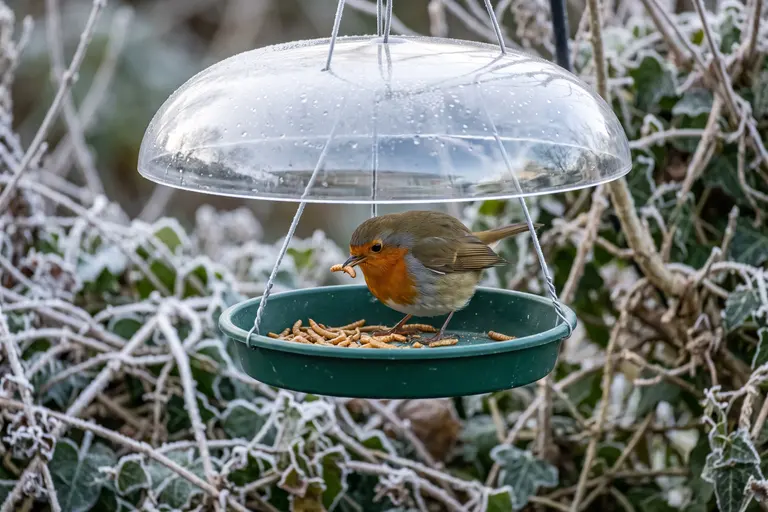
What it is: A clear polycarbonate dish under a 10 in (25 cm) dome on a brass rod. Droll Yankees lists a capacity of about 1 lb, a size of 11 x 10 x 10 in, and says it takes seed, fruit, suet or mealworms. It hangs from the rod or mounts on a pole with the included threaded adapter.
Why it stands out: The dome slides up and down. Raise it to start, so a cautious robin sees the food, then lower it step by step until robins still hop in and wood pigeons and crows cannot. The dome also keeps rain off mealworms, which turn soggy fast in an open dish. This is the same idea as the robin “pearl” feeders sold in UK garden centres: a shallow dish with an adjustable roof.
Owner patterns: Owners like how easy it is to see the food level and how the dome stops big birds. The recurring complaint is durability at the center fitting: several reviews mention the brass nut area cracking or the base coming loose after long use, so don’t overtighten it.
Key specs: About 1 lb, polycarbonate and brass, 10 in dome, hang or pole.
- Best for: A daily portion of mealworms, suet pellets or chopped apple. Read our guide to dried mealworms for birds for what to buy.
- Skip it if: Your robin only feeds on the ground and ignores anything that swings.
See available listings on Amazon
Kingsyard Ground Bird Feeder: best robin feeder tray for the ground
What it is: A ground tray made of recycled plastic with a metal mesh floor, on pull-out legs. The listing gives a size of 13.3 x 10.2 x 6.7 in (34 x 26 x 17 cm) and says the plastic is made to withstand rain, snow and sun.
Why it stands out: It lifts food a few inches off the lawn. That keeps mealworms out of puddles and mud, and the mesh lets water drain straight through. Robins, dunnocks and blackbirds all feed happily at this height. Kingsyard recommends cleaning every two weeks in summer and weekly in winter; for a robin tray, a quick daily brush-out is better.
Owner patterns: Owners like the size and the fact it works straight from the box. The main criticism is the legs: one recurring note is that they fold easily and have no lock, so set it on firm, flat ground.
Key specs: Recycled plastic, metal mesh floor, pull-out legs, about 13 x 10 in.
- Best for: Robins that feed on the lawn or patio.
- Skip it if: Rats or pigeons already feed under your seed feeders. See our guide to keeping starlings off bird feeders for the big-bird problem.
See available listings on Amazon
Kingsyard Squirrel Proof Caged Ground Feeder: best caged ground feeder
What it is: A low mesh feeding tray on pull-out legs, enclosed in a metal cage. The listing gives a size of 13.5 x 10.2 x 11.9 in (34 x 26 x 30 cm), 1.5 in (about 3.8 cm) fly-through openings, and recycled plastic with rust-free metal.
Why it stands out: This is the fix for the most common complaint about feeding robins: pigeons, jackdaws and squirrels empty the tray before the robin arrives. A robin is about 14 cm long and passes through a 1.5 in gap easily. Wood pigeons and adult squirrels cannot. UK retailers of similar cages note that young pigeons and jackdaws sometimes squeeze in, and some large birds reach in with their beaks, so no cage is perfect.
Owner patterns: Owners report fewer pigeons and squirrels on the food and more small birds. Starlings are the grey area: some get through gaps this size, so a cage reduces their share rather than ending it. Blackbirds may also be shut out, which some owners see as a drawback.
Key specs: 1.5 in openings, recycled plastic and metal, mesh floor, freestanding.
- Best for: Gardens where big birds and squirrels win every time. Our guide to keeping starlings off bird feeders covers more tactics.
- Skip it if: You want blackbirds and thrushes to share the robin’s food.
See available listings on Amazon
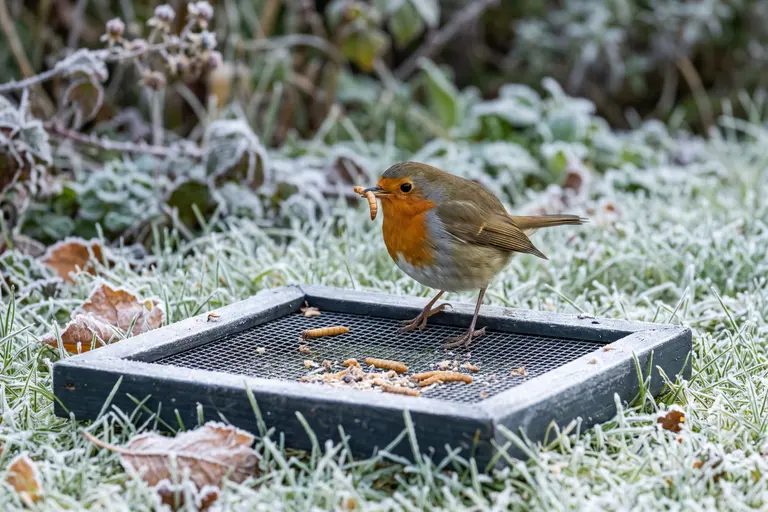
Woodlink 3-in-1 Platform Feeder: best low bird table for robins
What it is: A kiln-dried cedar tray with a removable powder-coated metal screen floor. Woodlink lists a size of about 16.4 x 13.25 x 2.4 in (42 x 34 x 6 cm), about 3 lb of mixed seed capacity, and three ways to use it: on its folding legs on the ground, hanging from the included cable, or on a pole.
Why it stands out: Flexibility. Start it on the ground where robins look for food, then hang it or pole-mount it if cats or rats become a problem. The screen floor lifts out for cleaning, which matters more than anything on a flat feeder. Rust-resistant screws hold it together, and it is made in the USA.
Owner patterns: Owners like the natural look and the drainage. The repeated trade-off with cedar is that it weathers and can split after a few seasons, and a flat tray needs more frequent cleaning than a dish.
Key specs: Cedar and metal screen, about 3 lb, legs, cable or pole.
- Best for: A low table you can adapt. Compare more options in our platform bird feeder guide and our guide to the best bird tables in the UK.
- Skip it if: You follow the RSPB’s current advice to avoid flat-surfaced feeders altogether.
See available listings on Amazon
Chubby Dried Mealworms: best food for a robin feeder
What it is: Whole dried mealworms in a resealable bag. The 2 lb bag lists protein at 53%, fat at 28%, fiber at 6% and moisture at 5%, and the only ingredient is mealworms.
Why it stands out: Mealworms are the food that matters. The Woodland Trust calls them the robin’s favourite. The BTO says live foods such as mealworms are readily taken by robins, blackbirds and wrens. The RSPB lists robins among the ground-feeding birds that love mealworms. Dried mealworms keep for months in a sealed bag, unlike live ones. Soak a portion in warm water for a few minutes before serving, as the Woodland Trust suggests, to add moisture.
Owner patterns: Buyers like the whole, unbroken worms and the resealable bag. The common complaint is dust at the bottom of the bag, and some notice their robins take soaked worms faster than dry ones.
Key specs: Dried mealworms only, 2 lb bag, 53% protein, 28% fat.
- Best for: Any dish, tray or table on this page.
- Skip it if: Hedgehogs visit at night and you can’t clear leftovers by dusk. The RSPB asks that mealworms are all eaten or cleared away the same day.
See available listings on Amazon
Comparison table
| Pick | Type | Height | Keeps big birds out | Drainage |
|---|---|---|---|---|
| Droll Yankees Seed Saver X-1 | Domed dish | Hanging or pole | Adjustable dome | Open dish under cover |
| Kingsyard Ground Feeder | Ground tray | A few inches off the ground | No | Metal mesh floor |
| Kingsyard Caged Ground Feeder | Caged ground tray | A few inches off the ground | 1.5 in cage | Metal mesh floor |
| Woodlink 3-in-1 | Low bird table | Ground, hanging or pole | No | Removable screen |
| Chubby Dried Mealworms | Food | Any | n/a | Soak before serving |
What do robins eat from a bird feeder?
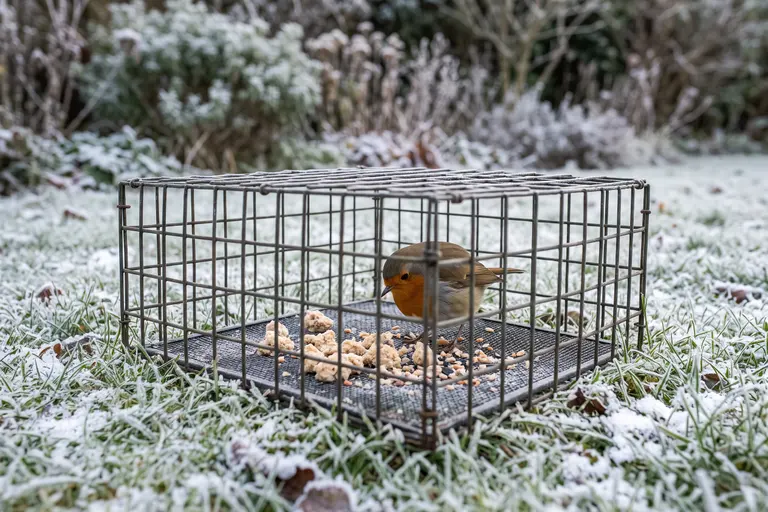
Robins eat mealworms, suet pellets and soft food from a bird feeder, not seed mixes. In the wild they take beetles, other insects and worms, plus fruit. The Woodland Trust lists what robins take in gardens: mealworms first, then suet, crushed peanuts, sunflower hearts, raisins and fruit.
A good robin menu:
- Dried mealworms, soaked: the single best food. See our guide to dried mealworms for birds.
- Suet pellets: small, soft and easy to swallow. Our guide to suet for birds explains the types.
- Crushed peanuts and sunflower hearts: small pieces only, from November to April.
- Fruit: chopped apple, pear and soaked raisins, especially in hard frost.
The Woodland Trust warns against milk, which can make birds really ill, and bread, which fills birds up without the nutrients they need in winter.
Where should you put a robin feeder?
Put it low, in the open, a short hop from cover. Robins like to dart out of a hedge or shrub, grab food and retreat. Give them that, but leave a clear gap of a few feet so a cat can’t hide right beside the dish. Our guide to keeping cats away from birds explains the risk.
Three placement rules:
- Away from the seed feeders. Robins are territorial and avoid crowds of finches and sparrows. A quieter corner works better.
- Visible from a window. Robins are bold and will often feed close to the house.
- Move it weekly. The RSPB asks people to clean and move feeders once a week and clear debris underneath, so food and droppings don’t build up in one spot.
Is a robin feeder tray safe? What the RSPB advises now
The RSPB now advises against bird tables and other flat-surfaced feeders, so any tray needs extra care. Its current guidance says flat surfaces carry the highest disease risk, because sick birds can leave contaminated food and saliva where healthy birds feed. The Woodland Trust gives the same advice. The main concern is trichomonosis, which hits finches hardest.
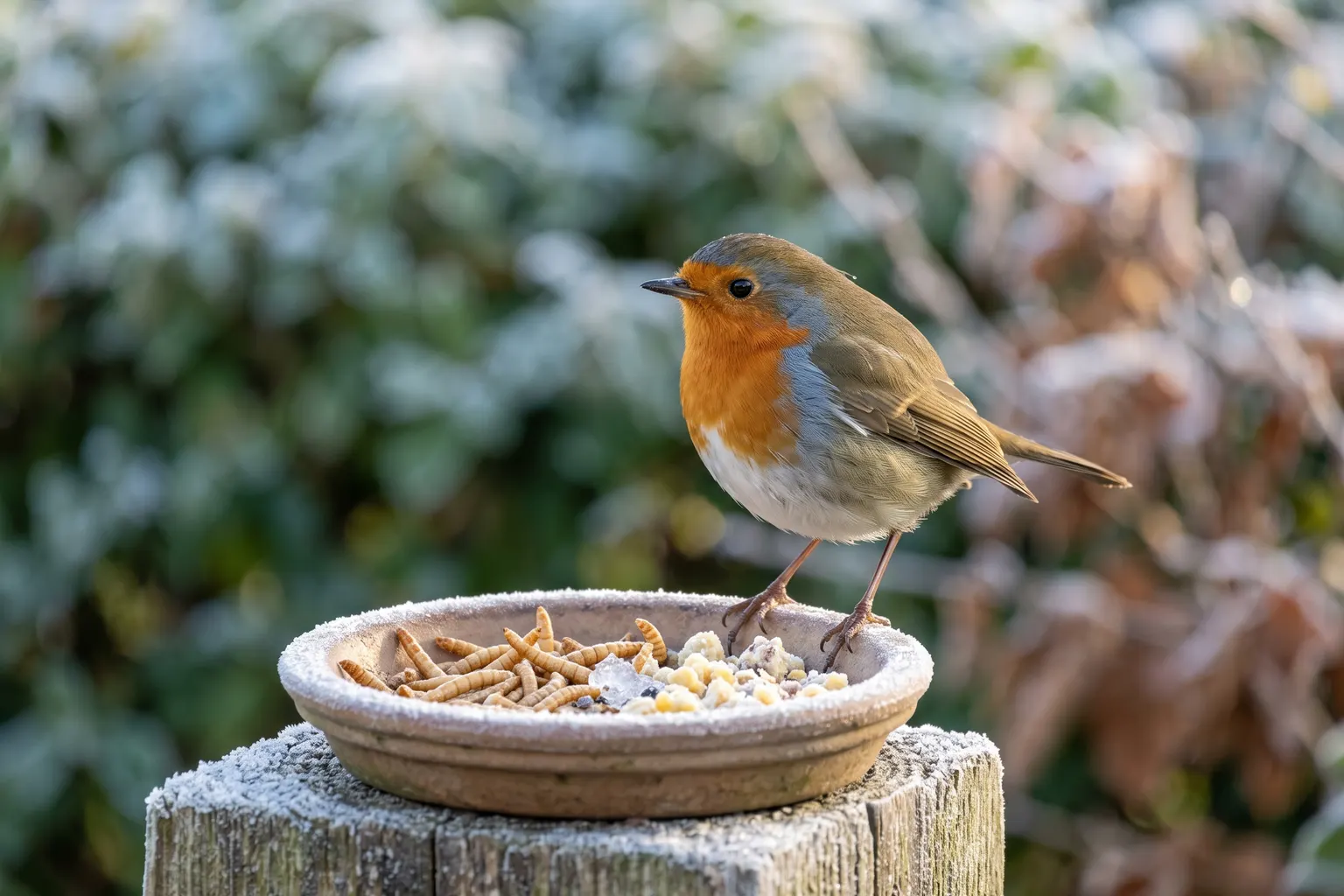
That does not mean you can’t feed robins. The RSPB says scattering mealworms is considered safe, as long as they are all eaten or cleared away by dusk. If you use a dish or tray:
- Serve small amounts that are gone within a few hours.
- Brush it out daily and wash it at least once a week in hot soapy water, as the RSPB recommends.
- Use mesh or drainage holes, never a solid floor that pools water.
- Stop for a few weeks if you see a sick or fluffed-up bird.
Our guide to how to clean bird feeders covers each step.
How do you stop starlings and pigeons eating the robin food?
Use a caged ground feeder or a domed dish set low enough to block big birds. Gaps of about 1.5 in (3.8 cm) let robins in and keep wood pigeons, jackdaws and squirrels out. A lowered dome does the same on a hanging dish.
Starlings are harder. They are smaller than pigeons and some squeeze through the same gaps. Three things help:
- Feed small amounts early in the morning, when robins are active and before starling flocks arrive.
- Put the robin dish away from the main feeders, where starlings gather.
- Skip fat on the open tray. Starlings love suet; save it for a caged feeder.
Our full guide to keeping starlings off bird feeders has more.
Do American Robins use bird feeders?
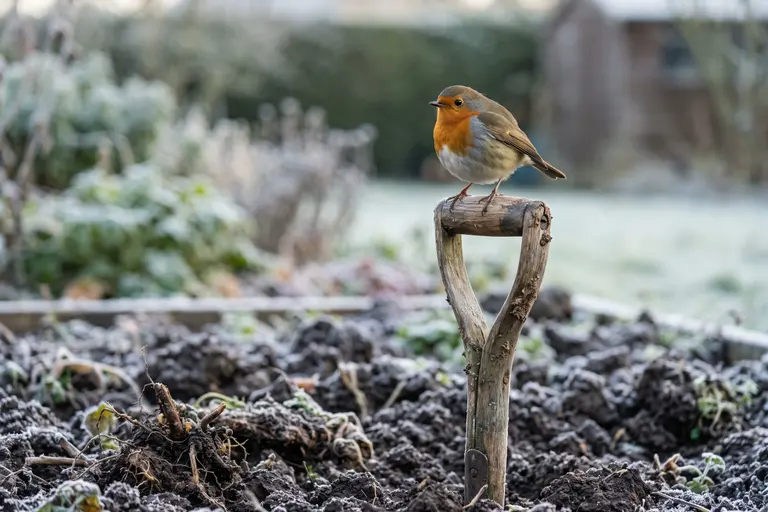
American Robins rarely eat seed, so most seed feeders do nothing for them. They are a different bird from the European Robin: a large thrush that hunts earthworms on lawns. The Cornell Lab notes they eat more earthworms in the morning and more fruit later in the day, and a lot of fruit in fall and winter.
If you want American Robins at a feeder, offer:
- Fruit: chopped apples, berries, soaked raisins on a platform or in a dish.
- Mealworms: dried and soaked, or live, in an open dish like the Seed Saver.
- Water: a shallow bird bath, which robins use for drinking and bathing.
Our guide to attracting American Robins covers plants and nesting.
When should you feed robins, and why are they linked with Christmas?
Feed robins most generously from November to April, and in small amounts the rest of the year. The RSPB says small amounts of mealworms, fat balls or suet are fine all year, while seeds and peanuts are paused from 1 May to 31 October. Winter is when robins need help most: they sing and defend territories right through the cold months, and frozen ground locks away their worms.
That winter boldness is part of why the robin became the Christmas bird. Read why robins are associated with Christmas for the history. For a wider winter setup with tits, finches and woodpeckers, see our guide to the best garden bird feeders in the UK.
Robin feeding calendar: what to put out each month
RSPB and BTO guidance now changes with the seasons: mealworms, fat balls and suet all year in small amounts, seeds and peanuts from November to April only.
| Months | What robins are doing | What to put in the feeder |
|---|---|---|
| November to February | Holding winter territories; frozen ground hides worms | Soaked mealworms, suet pellets, crushed peanuts, sunflower hearts, fruit in frost |
| March to April | Nesting begins in spring | Soaked mealworms and suet pellets; seeds and peanuts until 30 April |
| May to June | Raising two or three broods | Small portions of soaked mealworms; no seeds or peanuts |
| July to August | Moulting after breeding, so quiet and less visible | A few mealworms; natural food is at its peak |
| September to October | Back in song, natural food plentiful | Mealworms and suet in small amounts |
The RSPB notes robins go quiet in July and August while they moult, so a robin that vanishes in late summer has usually not left. The RSPB also rates mealworms as low risk year-round, which is why they sit in every row.
Why isn’t a robin using my feeder?
Usually it is the feeder, the spot or the season. Check these first.
- It hangs or swings. The Woodland Trust says robins rarely use hanging feeders unless there is a platform beside them. Lower the dish, or scatter a few mealworms below it for a week so the robin links the spot with food.
- It is too far from cover. A feeder in the middle of a bare lawn feels exposed.
- It is under the busy seed feeders. Move it to a quieter corner.
- It is July or August. Robins moult and keep a low profile, says the RSPB. Keep a few mealworms out and wait.
- The food is stale or wet. The Woodland Trust warns damp food grows mould and bacteria. Serve less and clear leftovers by dusk.
- The garden offers little natural food. The RSPB suggests planting crab apple, holly and ivy, or leaving a leaf-litter pile, to support ground-feeding birds. Our guide to winter berry shrubs for birds has more ideas.
Common mistakes when feeding robins
- Buying a tube feeder for robins. They can’t use the small perches.
- Filling a big tray. Robins eat little; leftovers go stale and attract rats.
- Leaving mealworms out overnight. Clear them by dusk, as the RSPB asks.
- Serving whole peanuts. Crush them, and stop seed and peanuts from May to October.
- Putting the dish under a busy seed feeder. Robins avoid crowds and droppings build up there.
- Never cleaning the tray. Brush daily, wash weekly.
Want robins to nest as well as feed? Our robin nest box guide covers open-fronted boxes and where to hide them.
Sources
- RSPB: Robin
- RSPB: All about bird feeding
- RSPB: How to help garden birds
- BTO: Feeding garden birds
- Woodland Trust: What do robins eat?
- Cornell Lab of Ornithology, All About Birds: American Robin
- Perky-Pet: Droll Yankees Seed Saver Platform Bird Feeder with Adjustable Dome
- Chewy: Kingsyard Ground Wild Bird Feeder
- Chewy: Kingsyard Squirrel Proof Wild Bird Feeder
- Duncraft: Chubby Dried Mealworms, 2 lb bag

Frequently asked questions
What is the best feeder for robins?
The best feeder for robins is a small open dish or a low mesh tray, not a hanging tube. The Woodland Trust notes robins rarely use hanging feeders unless there is a platform beside them. A domed dish such as the Droll Yankees Seed Saver keeps food dry and lets you lower the dome to keep large birds off, while a mesh ground tray suits robins that prefer the lawn.
What do robins eat from a bird feeder?
Robins mainly eat mealworms, suet pellets and soft food from feeders. The Woodland Trust lists mealworms as their favourite, plus suet, crushed peanuts, sunflower hearts, raisins and fruit. The BTO says live foods such as mealworms are readily taken by robins. Soak dried mealworms briefly to add moisture, and offer crushed rather than whole peanuts so pieces are small enough to swallow.
Do robins use hanging bird feeders?
Robins rarely use hanging tube feeders, because they cannot cling to small perches the way tits and finches can. The Woodland Trust says they seldom use hanging feeders unless there is a platform next to them. A hanging dish or domed tray with a wide rim works better, and many robins also feed from food scattered on the ground below.
Where should I put a robin feeder?
Put a robin feeder low, in the open, and within a short hop of a hedge or shrub. Robins like cover nearby, but leave a clear gap so a cat cannot ambush them. Place it where you can see it from a window, keep it away from the base of busy seed feeders, and move it a short distance each week, as the RSPB advises.
Should you feed robins in summer?
You can, in small amounts. The RSPB says it is fine to offer small amounts of mealworms, fat balls or suet all year round, while seeds and peanuts are paused from 1 May to 31 October. Mealworms should be eaten or cleared away by dusk the same day. In spring, soaked mealworms are easier for robins to carry to nestlings.