Sparrow Nest Box: How to Set Up a Sparrow Terrace
A sparrow nest box works best as a terrace of 2-3 chambers with 32 mm holes, high under the eaves. Sizes, height, direction and when not to put one up.
In this article
- What is a sparrow terrace?
- Why do House Sparrows need nest boxes?
- What size should a sparrow nest box be?
- How high should you put a sparrow nest box?
- Which direction should a sparrow box face?
- Where is the best place for a sparrow terrace?
- When should you put up a sparrow nest box?
- How do House Sparrows use a nest box?
- How do you clean a sparrow nest box?
- Should you buy or build a sparrow terrace?
- Can a sparrow nest box help during a renovation?
- Should you put up a sparrow nest box in North America?
- How do you protect a sparrow colony from cats and predators?
- Sparrow terrace checklist
- Common mistakes with sparrow nest boxes
- Sources
- Frequently asked questions
A sparrow nest box works best as a terrace: two or three chambers side by side, each with a 32 mm hole, fixed 4 to 5 m up under the eaves and facing between north-east and south-east. House Sparrows nest in colonies, so a group of holes beats a single box. Put it up in autumn or winter.
That advice is for Europe, the UK and the House Sparrow’s other native range, where the species has declined sharply in many towns. In North America the House Sparrow is an introduced species that harms native birds, and the right move there is the opposite. Both cases are covered below.
This guide draws on the Royal Society for the Protection of Birds (RSPB), the British Trust for Ornithology (BTO), the French bird charity LPO, the German Wildlife Foundation (Deutsche Wildtier Stiftung), the Dutch research group Sovon and Cornell Lab’s NestWatch.
What is a sparrow terrace?
A sparrow terrace is one long nest box divided into two or three separate chambers, each with its own entrance hole. It is built for House Sparrows, which like to nest close to their neighbours.
The RSPB describes terrace boxes as having 2 to 3 separate chambers side by side, and notes that sparrows “do best when given several nesting opportunities together”. Each chamber works like a normal small hole-fronted nest box. The birds can’t get from one chamber into the next, so each pair has its own nest, but the colony sits on one wall.
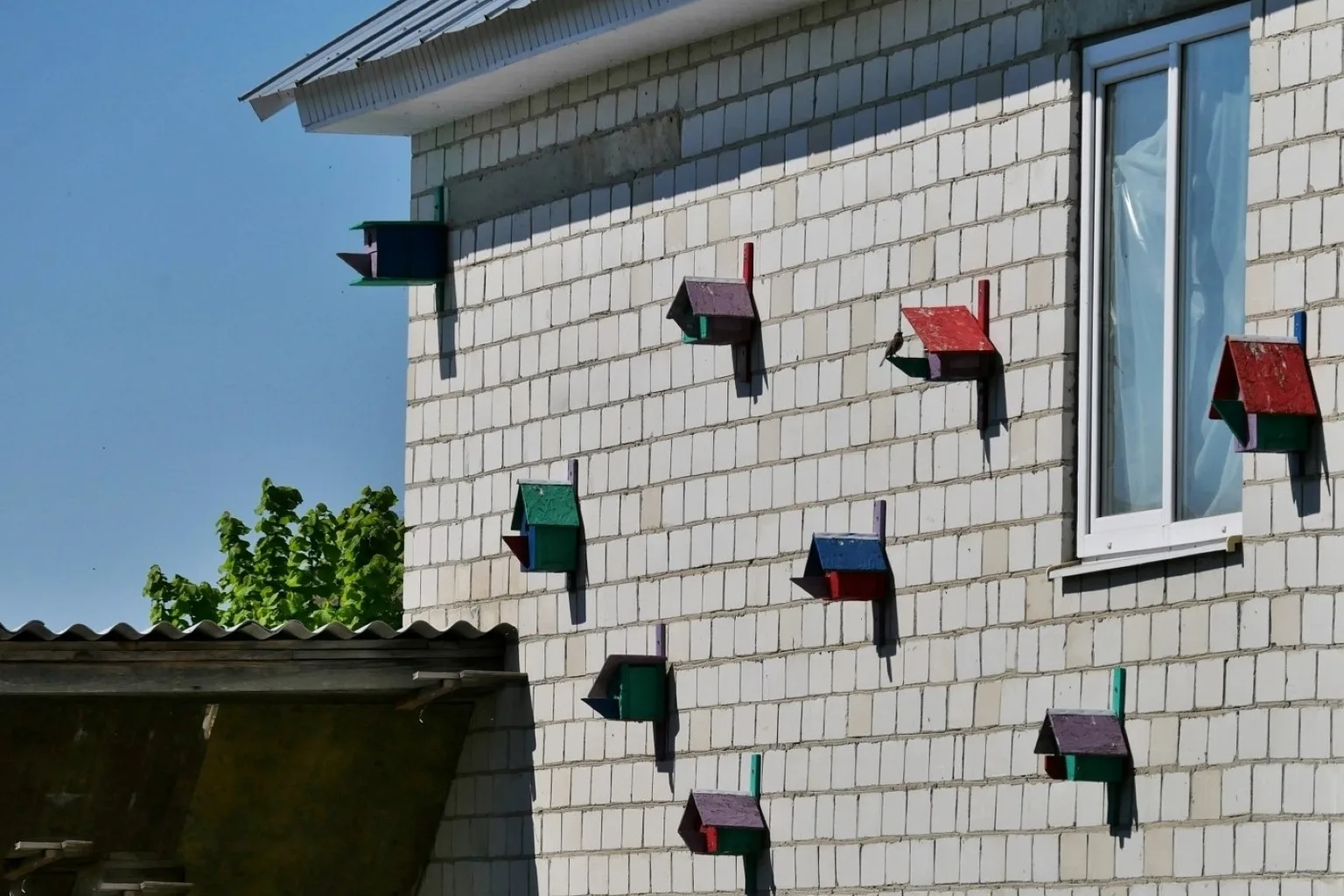
You can get the same effect with single boxes. The RSPB suggests putting two or three boxes on the same side of a building as an alternative to a terrace. The photo at the top of this page shows a looser version of the idea: nine small boxes spread over one house wall.
Why do House Sparrows need nest boxes?
Because the gaps they used to nest in are disappearing. House Sparrows are building nesters. Their traditional sites are holes under roof tiles, gaps in eaves and soffits, and cracks in old walls, and modern renovation tends to seal all of these.
The numbers show the problem in several countries:
| Country or city | What happened | Source |
|---|---|---|
| United Kingdom | Red listed as a bird of conservation concern; breeding population down 18% between 1995 and 2024 | BTO |
| Germany | About 6 million pairs left; numbers in Hamburg and Berlin nearly halved recently; on the warning list in Bavaria, Hesse and Lower Saxony | Deutsche Wildtier Stiftung |
| Netherlands | Down by as much as 50% from the late 20th century; rising again but not back to 1980s levels | Sovon |
| Paris, France | About 73% of House Sparrows lost between 2003 and 2016 | LPO and CORIF survey |
Nest sites are not the only cause. A 2025 review by Sovon in the Netherlands put habitat fragmentation at the top of the list, followed by the loss of shrubs, hedges and ivy, paved-over gardens, building insulation, pesticides and exotic garden plants that support few insects. Most of these pressures hit young birds, which depend on insects in their first weeks. A box gives a colony somewhere to breed, and the garden around it decides whether the chicks survive.
What size should a sparrow nest box be?
Use an entrance hole of 32 to 35 mm and a floor of roughly 11 to 14 cm square per chamber, with 15 cm or more between the bottom of the hole and the floor. The plans below come from three national bird organisations.
| Measurement | RSPB (UK) | LPO (France) | Vroege Vogels (Netherlands) |
|---|---|---|---|
| Entrance hole | 32 mm | 32 to 40 mm | 35 mm |
| Floor per chamber | Not stated | 14 x 14 cm | 11 x 12 cm |
| Inside height | Not stated | 23 cm | About 21 cm at the back, 19 cm at the front |
| Hole to floor | Not stated | 17 cm | Not stated |
| Mounting height | 4 to 5 m under eaves, or 2 to 4 m on a wall or tree | 3 to 8 m | At least 2 m |
| Hole direction | North-east to south-east | East to south-east | North-east to south-east |
A 32 mm hole lets in House Sparrows and Great Tits. The RSPB points out that it is larger than the 25 mm hole used for Blue Tits, so a sparrow box will not keep out larger tits, and a tit box will not take sparrows. The German Wildlife Foundation suggests a slightly larger 4 cm hole for boxes high on buildings. For a full chart by species, see our birdhouse hole sizes by species guide.
The deep space between the hole and the floor matters more than the exact floor size. Sparrows build a bulky, untidy nest of grass, straw and feathers, and the depth keeps chicks out of reach of a cat’s paw or a magpie’s bill at the hole.
How high should you put a sparrow nest box?
As high as you can safely reach, ideally 4 to 5 m under the eaves. That is the RSPB’s first choice, and the German Wildlife Foundation gives the same 4 to 5 m minimum for boxes on buildings.
If the eaves are out of reach, the RSPB accepts 2 to 4 m on a wall or a mature tree. The LPO plans give 3 to 8 m, and Dutch guidance sets a floor of 2 m. Lower than 2 m is a bad idea: cats can reach the box, and people walking past disturb the birds.
Height helps in three ways:
- Predators. Cats, rats and squirrels find it harder to reach a box high on a smooth wall.
- Flight path. Sparrows like to drop out of the hole and fly straight off. The RSPB notes that higher sites give a clear flight path in and out.
- It copies the real thing. Wild colonies sit under roof tiles and in the eaves, so a box at that height looks like the sites sparrows already know.
Fix the box firmly to the wall with screws or brackets so it can’t swing in the wind. Our guide on how to mount a birdhouse on a pole, tree or wall covers wall plugs, spacers and safe ladder work.
Which direction should a sparrow box face?
Point the holes somewhere between north-east and south-east. The RSPB, the LPO and Dutch guidance all land in that range.
The reasons are the same everywhere in north-west Europe. Most rain and wind come from the west and south-west, so an east-facing hole stays drier. Full afternoon sun from the south and west can heat a thin box on a brick wall enough to stress chicks in summer. A north-east to south-east wall gets gentle morning sun and shade later in the day.
If your only usable wall faces south or west, put the box under deep eaves where it is shaded for most of the day, or choose a thick wooden or woodcrete box that holds a steadier temperature. Dutch guidance recommends wood at least 1.5 cm thick for that reason.
Where is the best place for a sparrow terrace?
On a house or garage wall, close to dense cover and close to food. House Sparrows live near people and rarely travel far while feeding chicks. The German Wildlife Foundation notes that they seldom go more than about 100 m from the nest while raising young.
Look for a wall that has:
- Cover nearby. Ivy on a wall, a thick hedge or dense shrubs within a short flight. Sparrows gather and chatter in cover between trips to the nest.
- Insects close by. Native shrubs such as hawthorn and blackthorn attract the insects that chicks need. A patch of long grass or a pile of leaves helps too; see why you should leave the leaves in autumn.
- Other sparrows. The best sign of all is sparrows already nesting or calling nearby. A new box near an existing colony is far more likely to be used than one in a garden with no sparrows for miles.
- Peace and quiet. Avoid placing the box right above a door, a window you open often or a busy path.
Keep it well away from bird feeders on the same wall. Feeders draw in predators and squabbling birds, which can disturb a nest.
When should you put up a sparrow nest box?
Autumn and winter are the best time. The LPO advises putting boxes up from autumn or early winter, because some species start looking for sites very early, and Dutch guidance from Vroege Vogels gives the same advice.
House Sparrows are resident birds. They don’t migrate, and the German Wildlife Foundation notes that males start choosing sites and displaying as soon as the snow and frost have gone. A box that is already on the wall in winter can also be used as a night roost, and birds that know a box are more likely to nest in it in spring. Our guide on when to put up birdhouses covers timing for other species.
How do House Sparrows use a nest box?
They use it a lot. House Sparrows have a long breeding season and often raise several families from the same box.
According to the BTO:
| Fact | House Sparrow |
|---|---|
| Typical clutch | 4 to 5 eggs |
| Broods per year | 2 to 3, sometimes 4 |
| Incubation | 12 to 15 days, by the female |
| Time in the nest | About 14.5 to 17 days |
| Typical lifespan | 3 years for a bird that reaches breeding age |
| Nesting habit | Colonial |
Because of the repeated broods, a busy box fills with old nest material during the season. Don’t try to clean it between broods. Leave the birds alone from spring to the end of summer and clean once a year, after the last chicks have left.

How do you clean a sparrow nest box?
Once a year, after the breeding season. The LPO recommends September to October as the ideal window, early enough to avoid disturbing animals that move in for winter.
- Check the box is empty. Watch for a few minutes to make sure no birds go in and out.
- Open the box and remove the old nest with gloves on.
- Brush out the chambers and pour boiling water inside to kill parasites, as Dutch guidance suggests. Let the box dry before closing it.
- Don’t use insecticide or flea powder. Don’t add straw or bedding; the birds bring their own material.
If you find unhatched eggs, check your local law before you remove them. Our guide on when and how to clean out a birdhouse has the details.
Should you buy or build a sparrow terrace?
Either works if the measurements are right. A built box lets you match the RSPB and LPO sizes exactly, while a bought box is quicker and often comes in woodcrete or another long-lasting material.
| Option | Good for | Watch out for |
|---|---|---|
| Wooden terrace, 3 chambers | Most houses, easy to fit under eaves | Wood at least 1.5 cm thick; hinged or removable front for cleaning |
| Woodcrete or concrete terrace | Long life, steadier inside temperature | Heavy; needs strong wall fixings |
| Two or three single boxes | Flexible spacing on one wall | Keep them on the same side of the building |
| Built-in sparrow box or brick | New builds and renovations | Plan it with the builder; it sits inside the wall |
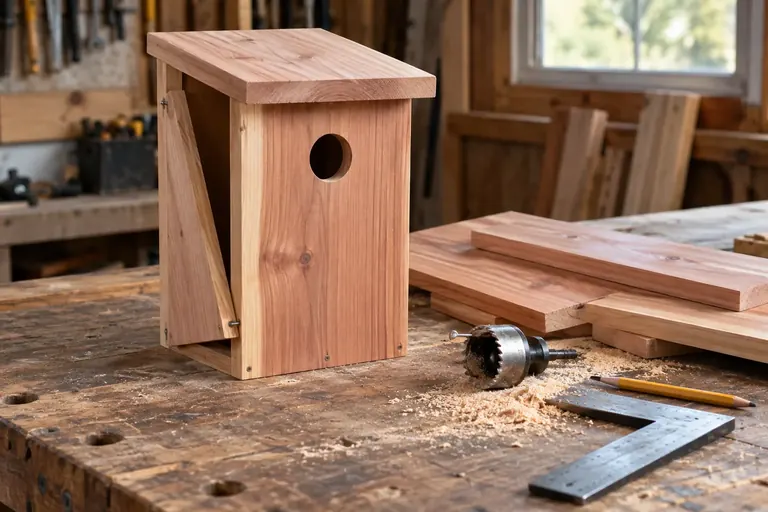
If you want to build one, our birdhouse building guide gives a one-board cutting list. Make the chambers about 12 to 14 cm wide, divide them with full-height partitions, and drill a 32 mm hole high in each front. Our roundup of the best birdhouses includes hole-fronted boxes that suit sparrows.
Can a sparrow nest box help during a renovation?
Yes, and in parts of Europe it may be required. When a roof or facade is renovated, gaps used by House Sparrows, swifts and bats are often sealed for good.
The German Wildlife Foundation notes that facade nests have to be checked before renovation work and that lost nesting sites have to be replaced with special boxes for building-nesting birds. Many towns in France have run similar projects. In Paris, the LPO and the City of Paris set up “Quartiers moineaux” (sparrow neighbourhoods) in the 13th, 14th and 18th arrondissements with new nest boxes to support local colonies.
If you are re-roofing or insulating, ask your builder about built-in sparrow boxes or nest bricks. They sit flush with the wall and last as long as the building.
Should you put up a sparrow nest box in North America?
No. In the United States and Canada, the House Sparrow is an introduced species, brought over in the 19th century, and it competes hard with native birds for nest holes.
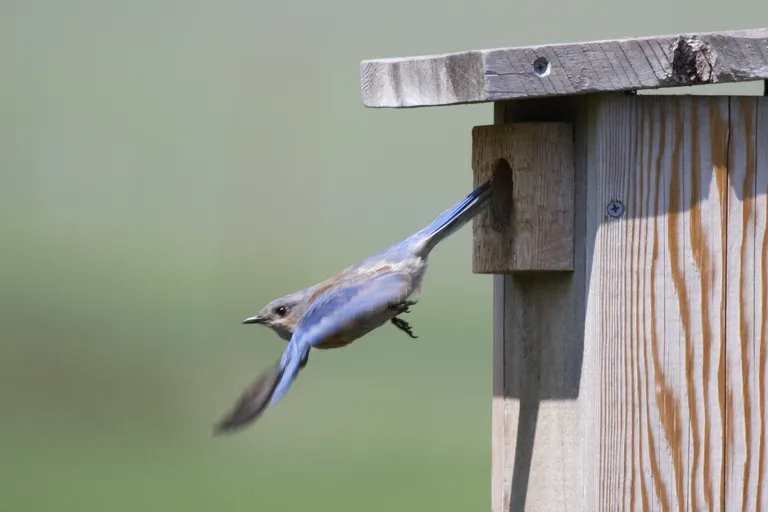
Cornell Lab’s NestWatch explains that House Sparrows take over nest boxes used by native birds, destroy eggs and kill nestlings and even adults. They often target bluebird and swallow nests. Because the species is not native, it is not protected by the Migratory Bird Treaty Act, while every native bird and its nest is.
If you live in North America:
- Don’t put up a sparrow terrace or boxes sized for House Sparrows.
- Place boxes for native birds away from buildings and grain farms, where sparrows are fewer.
- Watch your boxes closely. NestWatch suggests removing House Sparrow nest material every few days if they move in.
- Don’t rely on hole size. NestWatch notes that House Sparrows can get through a 1 1/4 inch hole, so no hole size reliably keeps them out.
- Feed carefully. Millet, cracked corn and milo draw in sparrows.
Our guide to the best bluebird houses covers designs and monitoring for the native birds that suffer most, and the Eastern Bluebird profile explains their nesting needs.
How do you protect a sparrow colony from cats and predators?
Height is the main defence. A box 4 m or more up a smooth wall is out of reach for cats and most climbing predators.
- Keep the wall clear below the box. Don’t fix it above a shed roof, a water butt or a trellis a cat can climb.
- Use the deep chamber. A floor 15 cm or more below the hole keeps chicks out of reach of a paw or bill.
- No perch. Sparrows don’t need one, and a perch helps predators.
- Watch cats in the garden. Our guide on cats and birds covers fences, bells and timing.
Sparrow terrace checklist
Run through this list before you climb the ladder. Every line comes from the guidance above.
| Check | Target |
|---|---|
| Number of holes | 2 to 3 chambers, or 2 to 3 boxes on one wall |
| Hole size | 32 to 35 mm |
| Depth below hole | About 15 to 17 cm |
| Height | 4 to 5 m under eaves; never below 2 m |
| Direction | North-east to south-east |
| Wall | Firm fixings, no climbable objects below |
| Surroundings | Hedge, ivy or dense shrubs within a short flight |
| Timing | Up by late winter, ideally in autumn |
| Cleaning | Once a year, in September or October |
| Location | Europe or another native range, not North America |
If you can tick every line, the box has the best chance of being found. Sparrows are faithful to their sites, so a colony that settles in may return to the same wall for years.
Common mistakes with sparrow nest boxes
- One lone box. Sparrows want neighbours. Put up a terrace or two to three boxes together.
- Too low. Below 2 m invites cats and disturbance. Aim for 4 to 5 m.
- Wrong hole size. A 25 mm tit hole keeps sparrows out. Use 32 to 35 mm.
- South or west facing in full sun. The box can overheat. Face it north-east to south-east.
- No cover nearby. A box on a bare wall with no hedge, ivy or shrubs nearby is less likely to be used.
- Cleaning in spring. Sparrows breed into late summer. Clean in September or October.
- Putting one up in North America. There it helps an introduced species at the cost of native birds.
A sparrow box is one of the simplest ways to help a declining bird in Europe. Pair it with native shrubs, a strip of long grass and maybe an insect hotel, and the colony has both a home and the insects its chicks need.
Sources
- House Sparrow nest boxes, RSPB
- House Sparrow BirdFacts, British Trust for Ornithology
- Fiche Refuges LPO: Les nichoirs, LPO Auvergne-Rhone-Alpes
- Nistkasten fur Spatzen (press release, 20 Feb 2026), Deutsche Wildtier Stiftung
- Waar knelt het voor de Huismus?, Sovon Vogelonderzoek Nederland (2025)
- Pourquoi les moineaux disparaissent-ils a Paris ?, L’info durable
- Managing House Sparrows and European Starlings, NestWatch (Cornell Lab)


Frequently asked questions
What size hole does a sparrow nest box need?
The RSPB uses a 32 mm entrance hole for House Sparrow boxes, the same size a Great Tit needs and larger than the 25 mm hole used for Blue Tits. French LPO plans allow 32 to 40 mm, and Dutch guidance from Vroege Vogels uses 35 mm. Anything in the 32 to 35 mm range suits House Sparrows.
How high should a sparrow terrace be?
High. The RSPB suggests 4 to 5 m under the eaves of a house, or 2 to 4 m on a wall or mature tree if you can't reach the eaves. The German Wildlife Foundation recommends at least 4 to 5 m on a building. Height keeps the box away from cats and gives the birds a clear flight path in and out.
Which direction should a sparrow nest box face?
Face the holes somewhere between north-east and south-east. The RSPB gives that range, and Dutch and French guidance agree: it keeps the box out of driving rain from the west and out of the hottest afternoon sun from the south and west, which can overheat chicks in a thin box on a sunny wall.
Why do sparrows need a terrace instead of a single box?
House Sparrows are colonial. They nest in small groups close to each other and close to people, and the RSPB notes they are drawn to sites where several families can nest together. A terrace with two or three chambers, or two or three single boxes on the same side of a building, matches that habit better than one lone box.
Should I put up a sparrow nest box in North America?
No. House Sparrows were introduced to North America in the 19th century and compete with native cavity nesters. NestWatch reports that they take over bluebird and swallow nests and kill the occupants, and the species is not protected by the Migratory Bird Treaty Act. In North America, put up boxes for native birds and manage sparrows instead.