How Do Hummingbirds Hover?
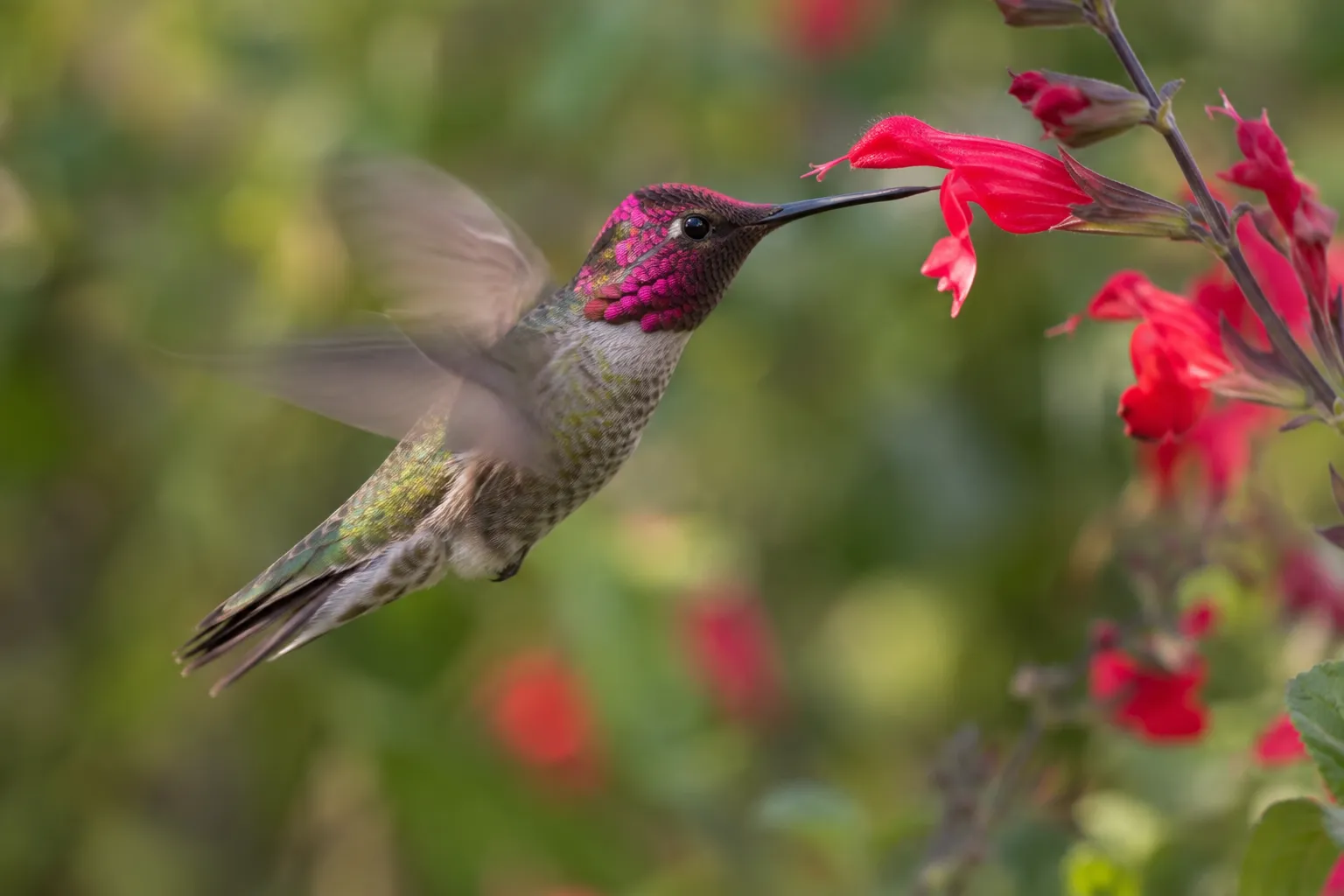
How do hummingbirds hover? They sweep their wings in a flat figure-eight, twisting them to make lift on both strokes, powered by huge muscles and sugar fuel.
In this article
- Quick answer: how hummingbirds hover
- How does a hummingbird’s wing move when it hovers?
- What is special about a hummingbird’s wing bones?
- How strong are hummingbird flight muscles?
- Where does the energy for hovering come from?
- How do hummingbirds stay perfectly still in the air?
- Do all hummingbirds hover the same way?
- Why can’t bigger birds hover like hummingbirds?
- Can hummingbirds hover in wind and rain?
- How do hummingbirds take off and land?
- Can other birds hover?
- Myths vs facts about hummingbird flight
- What does this mean for backyard birders?
- Quick facts
- Sources
- Frequently asked questions
Hummingbirds hover by sweeping their wings forward and back in a nearly horizontal figure-eight pattern, twisting them at the end of each stroke so that both the forward and the backward sweep push air downward. Wind-tunnel studies suggest about 75% of their lift comes from the downstroke and about 25% from the upstroke. They power this with unusually large flight muscles and a metabolism that burns nectar sugar almost as fast as they can drink it.
No other group of birds can hold still in midair for so long. Understanding how they do it means looking at their bones, their muscles, the air around their wings and the fuel that keeps it all going.
Quick answer: how hummingbirds hover
- Wing path: a flat figure-eight, forward and back, not up and down.
- Wing twist: the wing flips over at each end of the stroke, so the upstroke also makes lift.
- Lift split: roughly 75% from the downstroke and 25% from the upstroke, according to wind-tunnel studies.
- Shoulder power: a highly mobile shoulder joint lets the wing rotate almost 180 degrees.
- Big muscles: flight muscles make up roughly a quarter or more of body weight.
- Fast fuel: they burn freshly eaten sugar directly to power flight.
- Speed: small species beat their wings around 50 times per second while hovering.
How does a hummingbird’s wing move when it hovers?
Most birds flap their wings up and down. The downstroke pushes air backward and downward to create lift and thrust, and the upstroke is mainly a recovery stroke. The bird folds or tilts its wing to reduce drag on the way up, and very little lift is made.
A hovering hummingbird does something different. Its body tilts upright, so the wings sweep forward and back in a roughly horizontal plane. If you could slow the motion down, the wingtip would trace a flattened figure-eight or an oval.
At the end of each forward sweep, the wing rotates sharply so its underside now faces up. It then sweeps backward with the leading edge still in front. The same edge leads in both directions, which means the wing meets the air at a useful angle on both strokes. It is somewhat like a swimmer sculling with a flat hand, turning the palm to push water on each sweep.
Why do hummingbirds make more lift on the downstroke?
For a long time, hummingbird hovering was described as insect-like, with equal lift on both strokes. A 2005 study that used particle-tracking in a wind tunnel on Rufous Hummingbirds changed that view. The researchers found about 75% of the weight support came from the downstroke and about 25% from the upstroke.
The reason seems to be that bird wings are built differently from insect wings. The hummingbird wing is not a flat, rigid plate. It has bones, joints and feathers, and it cannot invert quite as fully on the upstroke. The result is a hovering style that sits between typical birds, which get almost all their lift on the downstroke, and insects such as hawk-moths, which get roughly equal lift from both strokes.
What is special about a hummingbird’s wing bones?
The key is in the shoulder and the proportions of the arm. In most birds, the wing has a long upper arm, a long forearm and a relatively short hand, with joints at the shoulder, elbow and wrist that flex during flight.
In hummingbirds:
- The upper arm bone (humerus) is very short and stout.
- The elbow and wrist move relatively little during flight; the wing is held fairly rigid.
- The hand bones are long, and the primary flight feathers attached to them make up most of the wing surface.
- The shoulder joint has an unusual shape that allows the wing to rotate through a very wide angle, close to 180 degrees.
Because most of the wing’s movement comes from the shoulder, the whole wing acts like a single blade that the bird can swing and rotate. This is what allows the sharp flip at each end of the stroke.
Why are the flight feathers so important?
The primaries form a stiff, streamlined surface. Their shape and the way they overlap help the wing hold its form under the high forces of rapid strokes. Male hummingbirds of many species also have specially shaped outer feathers that make trilling or buzzing sounds in flight or during courtship dives, which is why you can often hear a hummingbird before you see it.
How strong are hummingbird flight muscles?
Remarkably strong for their size. In most flying birds, the large breast muscle that pulls the wing down, the pectoralis, is much bigger than the muscle that raises it, the supracoracoideus. The upstroke muscle is often only a small fraction of the size of the downstroke muscle.
In hummingbirds, the upstroke muscle is relatively large, often around half the size of the downstroke muscle. That fits with the upstroke doing real work. Together, the flight muscles can account for roughly 25 to 30% of a hummingbird’s body mass, among the highest proportions of any bird.
These muscles are packed with mitochondria, the cell’s energy factories, and are richly supplied with blood. The heart is large for the body, and during activity it can beat well over 1,000 times per minute. Breathing rates are also very high.
Where does the energy for hovering come from?
Hovering is extremely expensive. For its size, a hummingbird uses energy at one of the highest rates measured in any vertebrate. It meets that demand with sugar.
Research has shown that hovering hummingbirds can fuel most of their flight directly from sugar they have just eaten, switching quickly between recently consumed nectar and stored reserves. Most animals, including humans, can use only a modest share of freshly eaten sugar to power hard exercise. Hummingbirds are unusually good at moving sugar from the gut into the blood and into the muscles.
That is why nectar matters so much. A Ruby-throated Hummingbird may feed every 10 to 15 minutes during the day, visiting many flowers and feeders. They also eat small insects and spiders for protein, fat and other nutrients, especially when feeding young. Our guide to hummingbird nectar explains why the classic 4:1 water-to-sugar ratio is close to what many flowers provide.
At night they can save energy by entering torpor, a deep, sleep-like state, as explained in do hummingbirds sleep.
How do hummingbirds stay perfectly still in the air?
Holding position is not just about power. It needs constant, precise control.
- Vision: hummingbirds use visual motion cues to detect drift. Experiments in flight tunnels suggest they are especially sensitive to changes in the apparent size and position of patterns around them, and they correct quickly.
- Wing adjustments: tiny changes in stroke angle, amplitude and timing let them nudge left, right, forward or back.
- Tail: the tail fans and tilts to help steer and brake, particularly during sudden turns.
- Head stabilization: like many birds, they hold the head remarkably steady even while the body adjusts, which keeps the eyes and bill on target at a flower.
This control allows feats that look almost impossible. Hummingbirds can hover in gusty wind, feed from a swaying flower, back out of a blossom and dart sideways to chase a rival.
Do all hummingbirds hover the same way?
The basic method is the same, but size changes the details. There are more than 360 hummingbird species, all found in the Americas, from Alaska to Tierra del Fuego.
| Species | Approximate weight | Typical hovering wingbeat | Where found |
|---|---|---|---|
| Bee Hummingbird | About 2 g (under 0.1 oz) | Very fast | Cuba |
| Ruby-throated Hummingbird | About 3 to 4 g | Around 50 per second | Eastern North America, winters in Central America |
| Anna’s Hummingbird | About 4 to 5 g | Roughly 40 to 50 per second | Pacific coast of North America |
| Rufous Hummingbird | About 3 to 4 g | Around 50 per second | Western North America |
| Giant Hummingbird | About 18 to 24 g | Around 10 to 15 per second | Andes of South America |
Smaller species generally beat their wings faster. The Giant Hummingbird, roughly the size of a starling, has a much slower, deeper wingbeat and at times glides between flowers, something small hummingbirds rarely do. High-altitude species in the Andes face thin air, which makes hovering harder; studies suggest they compensate with larger wings relative to body size and bigger stroke angles.
For species you might see in the United States, see our guides to the Ruby-throated Hummingbird and Anna’s Hummingbird.
Why can’t bigger birds hover like hummingbirds?
It comes down to how power and weight scale with size. When an animal gets bigger, its weight rises faster than the area of its wings and faster than the power its muscles can deliver in proportion to that weight. The power needed to hold a body still in the air, by pushing enough air downward, climbs steeply with body mass.
For a very small bird, the numbers work: muscles can just about supply the power needed to support the body in still air. For a pigeon, a gull or an eagle, they do not. Larger birds would need impossibly large flight muscles or impossibly fast wingbeats to hover for more than a moment. Instead they rely on forward speed, where moving air over the wings produces lift far more cheaply, or on wind, as kestrels do.
This helps explain why sustained hovering evolved in tiny animals: hummingbirds, many insects and a few nectar-feeding bats. It also explains why the Giant Hummingbird, at around 20 g, sits near the upper limit of hummingbird size.
Can hummingbirds hover in wind and rain?
They can, within limits. Studies in wind tunnels and rain simulators suggest that hummingbirds adjust their body angle, tail position and wing strokes to cope with turbulence, and that hovering becomes more costly in gusty conditions. In heavy rain, researchers have observed hummingbirds increasing their wingbeat rate and shifting posture to stay aloft, and shaking water from their heads and bodies with rapid twists, even in midair.
In practice, hummingbirds often wait out heavy storms perched in sheltered spots and then feed intensively once the rain eases. That is a good reason to keep feeders topped up and clean during wet spells, since the birds may arrive hungry.
How do hummingbirds take off and land?
Most birds jump into the air using powerful legs before their wings take over. Hummingbirds have tiny legs and feet, and studies suggest they generate much of their takeoff force with their wings, beginning to flap before they leave the perch. That is why a hummingbird seems to lift straight off a twig rather than leaping.
Landing is equally precise. The bird slows by tilting its body upright, increasing wing stroke angle and fanning the tail, then settles its feet on the perch with almost no bounce. The same control that makes hovering possible makes these transitions smooth.
Can other birds hover?
Yes, but briefly and with more effort. Only hummingbirds can sustain true hovering in still air for long periods. Other birds hover in two main ways.
Wind-hovering
Common Kestrels in Europe, Asia and Africa and American Kestrels in the Americas often face into the wind and flap or hang in place while scanning the ground for prey. The wind does much of the work, so their airspeed matches the wind speed and their ground speed is near zero. Rough-legged Hawks and some buzzards do the same. This is sometimes called kiting.
Short bouts of powered hovering
Pied Kingfishers in Africa and Asia hover over water before plunging for fish, and are among the largest birds to hover without relying on wind. Terns hover briefly before diving. Sunbirds in Africa and Asia, which fill a similar niche to hummingbirds, usually perch to feed but sometimes hover for a moment at a flower. Some flycatchers, vireos and warblers hover briefly to pick insects off leaves.
What looks like a hummingbird in Europe?
Visitors to gardens in Europe, Turkey and much of Asia sometimes report “hummingbirds” at flowers. These are almost always Hummingbird Hawk-moths, day-flying moths that hover at flowers with a long tongue and a blur of wings. The resemblance is a textbook example of convergent evolution: unrelated animals arriving at the same solution to the same problem.
Myths vs facts about hummingbird flight
Myth: Hummingbirds hover exactly like insects. Fact: They twist their wings on both strokes like insects, but studies suggest they make much more lift on the downstroke.
Myth: Hummingbirds never stop flying. Fact: They perch often, sometimes for long periods, to rest, digest and watch their territory. Perching saves a lot of energy.
Myth: Hummingbirds cannot walk. Fact: Their legs are tiny, and they cannot walk or hop in the usual sense, but they can shuffle sideways along a perch.
Myth: Hummingbirds hitch rides on geese during migration. Fact: This old tale has no basis. Ruby-throated Hummingbirds fly on their own, and many cross the Gulf of Mexico nonstop.
Myth: Hovering is only for feeding. Fact: Hummingbirds also hover while chasing rivals, catching insects, inspecting nest sites and during courtship displays.

What does this mean for backyard birders?
Knowing how costly hovering is can help you support hummingbirds in your yard.
- Keep nectar fresh and clean. A bird burning energy this fast relies on reliable, safe food. Change nectar every few days in hot weather, and see our guide to hummingbird feeders that are easy to clean.
- Plant tubular native flowers. Salvias, penstemons, bee balm, trumpet honeysuckle and cardinal flower in North America provide nectar the birds evolved with. Native plants also support the small insects hummingbirds need.
- Add perches nearby. Hummingbirds rest between feeding bouts. A few bare twigs near feeders let them sit, digest and guard their patch.
- Avoid pesticides. Insects are an essential part of the diet, particularly for growing chicks.
- Watch closely. Try watching a hovering hummingbird in good light. You may see the tail steering, the body tilting and the head staying perfectly still while the wings blur.
Quick facts
- Hummingbirds hover by sweeping their wings forward and back in a flat figure-eight.
- The wing flips over at each end of the stroke, so the upstroke also produces lift.
- Wind-tunnel research suggests about 75% of lift comes from the downstroke.
- Most wing movement comes from a highly mobile shoulder joint.
- Flight muscles make up roughly a quarter or more of body mass.
- Small species beat their wings around 50 times per second while hovering.
- Heart rate can exceed 1,000 beats per minute during activity.
- They can power flight largely from sugar they have just eaten.
- All hummingbirds live in the Americas; the Hummingbird Hawk-moth fills a similar role in Europe and Asia.
Sources
- Warrick, D. R., Tobalske, B. W. and Powers, D. R. (2005). Aerodynamics of the hovering hummingbird. Nature
- Anna’s Hummingbird overview - Cornell Lab of Ornithology, All About Birds
Frequently asked questions
How fast do hummingbird wings beat when hovering?
It depends on size. Small species such as the Ruby-throated Hummingbird beat their wings roughly 50 times per second while hovering, and some very small hummingbirds go faster. The Giant Hummingbird of the Andes, the largest species, beats its wings only around 10 to 15 times per second. Wingbeat rates rise during courtship dives and fast maneuvers.
Can hummingbirds fly backwards?
Yes. Hummingbirds can fly backward for short distances, as well as hover, fly sideways and even briefly upside down. They do it by tilting the plane of their wingbeat and adjusting the angle of the wings on each stroke, which redirects the force they produce. Backward flight is useful for backing out of flowers.
Are hummingbirds the only birds that can hover?
They are the only birds that can hover for long periods in still air. Others hover briefly or with the help of wind, including kestrels, kingfishers, sunbirds, terns and some flycatchers. These birds usually hover for seconds rather than minutes and use much more effort per gram than a hummingbird does.
How much energy does hovering take?
A great deal. Hovering is among the most energy-demanding forms of movement in any vertebrate. Hummingbirds power it by burning sugar from nectar almost as fast as they drink it. A hummingbird may need to feed every 10 to 15 minutes during the day and visit hundreds or even thousands of flowers.
Do hummingbirds hover like insects?
Partly. Both sweep their wings back and forth and twist them to make lift on both strokes. The difference is balance: insects such as moths produce about equal lift on each stroke, while studies suggest hummingbirds make roughly three quarters of their lift on the downstroke and one quarter on the upstroke. Their method sits between typical birds and insects.