How to Attract Ruby-throated Hummingbirds to Your Yard
How to attract Ruby-throated Hummingbirds: hang a clean feeder with 1:4 sugar water a week before they arrive, plant red tubular natives and skip pesticides.
If you buy through links on this page we may earn a commission, at no cost to you. It never decides what we recommend. How we earn
In this article
- Ruby-throated Hummingbird at a glance
- How to identify a Ruby-throated Hummingbird
- When Ruby-throated Hummingbirds arrive and leave
- What Ruby-throated Hummingbirds eat
- Hummingbird nectar: the recipe and the rules
- Choosing a hummingbird feeder
- The best native plants for Ruby-throated Hummingbirds
- Water, perches and insects
- Nesting: what to expect
- How to attract hummingbirds to a small yard, patio or balcony
- Do hummingbirds come back to the same yard every year?
- A year of Ruby-throated Hummingbirds
- Common mistakes when attracting Ruby-throated Hummingbirds
- Sources
- Gear mentioned in this guide
- Frequently asked questions
Here is how to attract Ruby-throated Hummingbirds: hang a clean feeder filled with fresh 1:4 sugar water about a week before they usually arrive, plant red and orange tubular native flowers nearby, and avoid pesticides so there are insects for them to eat. Put up at least two feeders out of sight of each other once a male starts guarding one. That combination works in almost any eastern yard, from a big garden to a small patio.
Ruby-throated Hummingbird at a glance
| Trait | Details |
|---|---|
| Size | 2.8 to 3.5 in long, wingspan 3.1 to 4.3 in, 0.1 to 0.2 oz |
| Range | Breeds across eastern North America and the Canadian prairies, the only breeding hummingbird in the East |
| Season | Spring and summer breeder, winters in Mexico and Central America |
| Diet | Flower nectar, tree sap, small insects and spiders |
| Feeder food | 1:4 sugar water, no dye |
| Feeder type | Saucer or bottle nectar feeder with an ant moat |
| Nesting | Tiny cup nest on a slender branch, usually 10 to 40 ft up, 1 to 3 eggs |
| Plants | Red and orange tubular flowers: cardinal flower, trumpet honeysuckle, bee balm, columbine |
How to identify a Ruby-throated Hummingbird
The Cornell Lab calls this species eastern North America’s sole breeding hummingbird, with the largest breeding range of any North American hummingbird. East of the Great Plains, a hummingbird in summer is almost certainly a Ruby-throat. Wings beat about 53 times a second, according to the Lab, and the legs are so short that the bird cannot walk or hop.
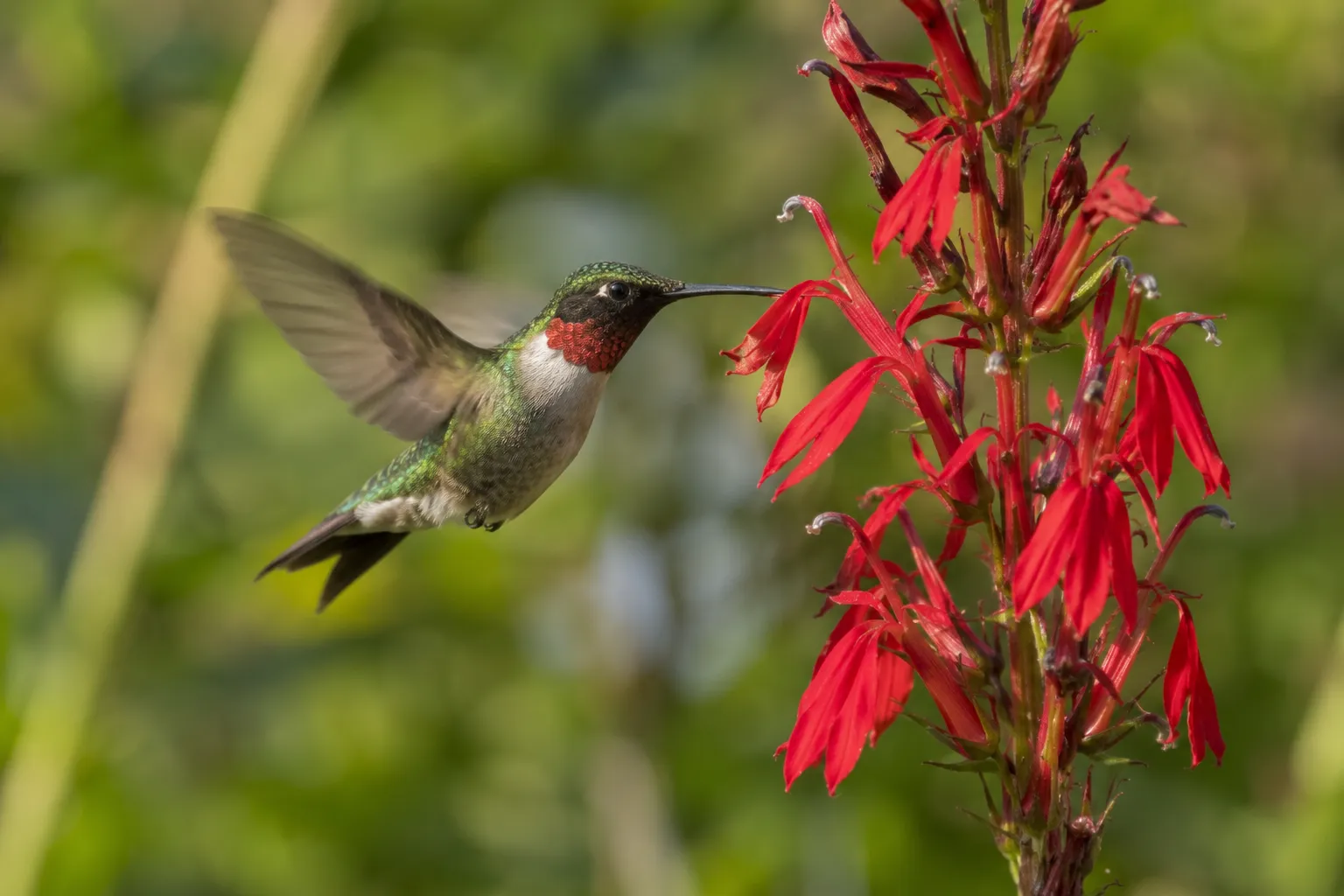
Adult male
- Brilliant iridescent red throat (the gorget), which looks black when the light is wrong
- Emerald green back and crown
- Grayish-white underparts with greenish sides
- Black, forked tail with no white
Female
- No red throat, white or lightly marked throat instead
- Golden-green above, whitish below, with buffy flanks and a dusky mask
- Tail mostly black with white tips on the outer feathers
Immature male
Young males in late summer and fall look like females but may show a few scattered red throat feathers as they develop.
Similar species
- Black-chinned Hummingbird: a close relative of the West and Texas. Males have a black chin with a thin purple band below. Females are very hard to separate from female Ruby-throats. Where ranges meet, careful photos help.
- Rufous Hummingbird: a western species that turns up in the East and Southeast in fall and winter. Rufous and orange tones on the sides and tail are the clue.
- Anna’s, Broad-tailed and Calliope Hummingbirds: western birds, rare in the East.
A hummingbird at an eastern feeder after most Ruby-throats have left, especially from November onward, is worth photographing and reporting on eBird. See our guide on how to use eBird.
When Ruby-throated Hummingbirds arrive and leave
Ruby-throats are long-distance migrants. Audubon notes that nearly all leave North America in fall and winter from Mexico to Costa Rica and Panama, that males move north in spring before females, and that some cross the Gulf of Mexico while many travel along the Texas coast.
General timing, which varies by year and latitude:
| Region | Typical spring arrival | Typical fall departure |
|---|---|---|
| Gulf Coast and Florida | Late winter to March | Into October, a few later |
| Mid-Atlantic, Ohio Valley, central states | April | September, stragglers into October |
| Northern states, New England, southern Canada | Late April to May | Late August to September |
Treat this table as a starting point. The most reliable way to time your feeder is to check eBird sightings for your county or the migration maps many hummingbird groups publish each spring.
When to put your feeder out
Audubon suggests putting the feeder out about a week before hummingbirds normally arrive in your yard. Early males scout for food, and a ready feeder can be one reason a bird settles nearby.
When to take it down
Audubon states that hummingbirds are genetically programmed to head south in fall, and that departure depends on day length and sun angle, not food. A feeder will not trap a bird that should be leaving. Keep feeders up until you have gone about two weeks without seeing a hummingbird. In the Southeast, some people leave one feeder up all winter for western vagrants such as Rufous Hummingbirds.
What Ruby-throated Hummingbirds eat
Nectar is only part of the diet. According to the Cornell Lab, Ruby-throats feed on nectar from red and orange tubular flowers such as trumpet creeper and cardinal flower, visit feeders and drink tree sap. They also eat mosquitoes, gnats, fruit flies, small bees and spiders, pick insects out of spider webs and glean small caterpillars and aphids from leaves.
That protein is essential, especially for nestlings. A yard with feeders but no insects is a weak yard for hummingbirds. This is also why pesticide use matters so much: spraying for mosquitoes or garden pests removes food the birds and their young depend on.
Sap wells
Ruby-throats also feed at sap wells drilled by Yellow-bellied Sapsuckers, which helps early spring migrants before many flowers open. Leaving trees with sapsucker rows in place is a quiet way to help them. For a broader plan that serves hummingbirds alongside seed eaters, see backyard birding: turn your yard into a bird magnet.
Hummingbird nectar: the recipe and the rules
The 1:4 recipe
The Cornell Lab and Audubon both recommend one part refined white sugar to four parts water. In practice that is one-quarter cup of sugar per cup of water. Stir until dissolved, let it cool, then fill. Boiling is optional for dissolving sugar faster, but it does not keep nectar fresh once it is outside. Our full hummingbird nectar recipe walks through it step by step.
The Cornell Lab notes that during cold, rainy weather some people use a slightly stronger mix, about one-third cup of sugar per cup of water. For normal spring and summer feeding, stick with 1:4.
What never to use
- Red dye: unnecessary, since flower nectar is clear and the feeder’s red parts attract the birds. Audubon warns it could prove harmful.
- Honey: Audubon says it can promote dangerous fungal growth.
- Brown sugar, raw sugar, organic sugars or artificial sweeteners: stick with plain white table sugar.
- Store-bought red nectar: it costs more than sugar and water and adds nothing birds need.
How often to change nectar
This matters more than any feeder feature. Audubon recommends emptying and cleaning the feeder every day or every other day in hot weather, every three days in temperate weather, and twice a week in cooler weather. The Cornell Lab says sugar water should never sit out more than two or three days and should be changed daily in very hot weather. Cloudy nectar, black specks or white strings mean it has spoiled. Dump it, scrub and refill.
Choosing a hummingbird feeder
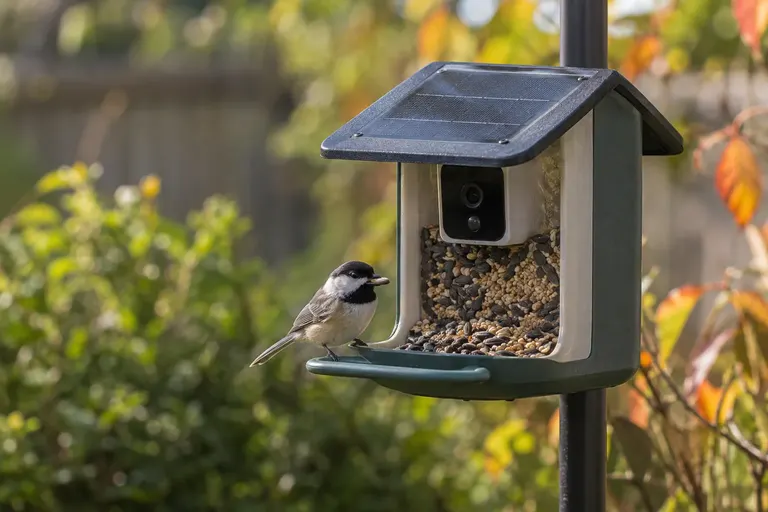
A good feeder is one you will actually clean. Features that matter, based on manufacturer designs and patterns in owner feedback:
- Easy disassembly. Saucer feeders that pull apart into two or three pieces are the easiest to scrub.
- Wide openings. If a bottle brush cannot reach every surface, mold will grow where you cannot see it.
- Built-in ant moat. A small cup of water above the feeder stops ants. The Cornell Lab recommends moats filled with plain water.
- Right size. Buy capacity to match the number of birds. A small yard with one or two Ruby-throats may only drink a few ounces in two or three days, so a 32 oz feeder mostly means wasted nectar.
- Red parts, no yellow. The Cornell Lab notes yellow bee guards can actually attract bees.
Our roundup of hummingbird feeders that are easy to clean and do not leak compares designs in detail, and there is a separate guide on how to clean a bird feeder.
Where to hang it
- In partial shade. The Cornell Lab warns that direct sun makes sugar water spoil quickly.
- Near flowers. Audubon notes that red or orange tubular flowers near a feeder may help birds find it.
- Near a perch. Males like a small bare twig or wire with a view of the feeder.
- Either very close to a window or well away from it. A window feeder or decals help reduce collisions; see how to stop birds hitting windows.
- Out of reach of cats. The Cornell Lab notes some cats learn to wait for visiting hummingbirds. Hang feeders well above the ground and away from low shrubs a cat could hide in.
Beat the bully male
Male Ruby-throats aggressively defend flowers and feeders, according to the Cornell Lab. One male can keep every other bird away from a single feeder. The fix is more feeding stations placed so they cannot all be seen from one perch: one in front of the house, one around the side or back. A cheap second feeder often doubles the number of birds you see.
The best native plants for Ruby-throated Hummingbirds
Plants give nectar across a longer season than any feeder and also bring in the small insects hummingbirds need. Choose a sequence of bloom from spring to fall.
| Plant | Type | Bloom (typical) | Notes |
|---|---|---|---|
| Red buckeye (Aesculus pavia) | Shrub or small tree | Early spring | Key food for arriving migrants in the Southeast |
| Wild columbine (Aquilegia canadensis) | Perennial | Spring | Nodding red and yellow flowers, part shade |
| Trumpet honeysuckle (Lonicera sempervirens) | Vine | Spring into summer | Native, not the invasive Japanese honeysuckle |
| Bee balm (Monarda didyma) | Perennial | Summer | Red forms are a hummingbird favorite |
| Trumpet creeper (Campsis radicans) | Vine | Summer | Named by the Cornell Lab; vigorous, needs space |
| Cardinal flower (Lobelia cardinalis) | Perennial | Late summer | Named by the Cornell Lab; likes moist soil |
| Jewelweed (Impatiens capensis) | Annual | Late summer | Grows in damp shade, heavily used by migrants |
| Coral bells and native salvias | Perennials | Varies by region | Check local native lists |
Plant in clusters rather than single stems, so a bird finds many flowers in one spot. A local native plant society or extension office can confirm which species suit your county.
Water, perches and insects
- Misters and shallow moving water. Hummingbirds rarely use deep baths, but many fly through a fine mist or bathe on wet leaves. A mister or bubbler in a shallow bath can help.
- Small bare branches. Leave a few dead twigs on shrubs near feeders for perching and guarding.
- No pesticides. Mosquitoes, gnats and aphids are hummingbird food.
- Spider webs and plant down. Females build nests from thistle or dandelion down held together with spider silk. A slightly messy garden helps.
Nesting: what to expect
Hummingbirds do not use nest boxes. The Cornell Lab says females build on slender branches of deciduous trees, usually 10 to 40 feet up. The nest is made of plant down bound with spider silk and decorated with lichen and moss, about 2 inches across and 1 inch deep, with an inner cup about the size of a large thimble.
| Nesting detail | Ruby-throated Hummingbird |
|---|---|
| Eggs | 1 to 3, white, about 0.5 in long |
| Incubation | 12 to 14 days |
| Nestling period | 18 to 22 days |
| Broods per year | 1 to 2 |
| Who raises young | Female only |
The Cornell Lab notes pairs are together only long enough for courtship and mating, a matter of days to weeks. Males perform U-shaped courtship dives from as high as 50 feet. If you see a male swinging back and forth in a big U in spring, a female is likely nearby.
Nests are hard to find because they look like a knot on a branch. If you find one, watch from a distance and do not touch it.
How to attract hummingbirds to a small yard, patio or balcony
You do not need a big garden. Ruby-throats regularly visit apartment balconies and townhouse patios if the basics are right.
- Start with one small feeder. An 8 to 12 oz feeder is plenty. Smaller volumes mean less waste when you change nectar every few days. Our guide to bird feeders for balconies and small spaces covers mounting options.
- Add container plants. A few pots of red salvia, native bee balm or cardinal flower (kept well watered) give birds a reason to stop. A trumpet honeysuckle vine on a railing trellis adds height.
- Use height to your advantage. Upper-floor balconies can work, since hummingbirds forage at many heights. Hang the feeder where it is visible from open air, not tucked under an overhang.
- Keep it clean and consistent. In a small space, the feeder is often the only draw, so fresh nectar matters even more.
- Be patient. A feeder in a spot with little greenery around it may take longer to be found than one in a garden.
Do hummingbirds come back to the same yard every year?
Many do. Bird banders have recaptured Ruby-throats in the same area in later years, and the Cornell Lab records one individual recaptured at an age of at least 9 years, 2 months. Returning birds often appear at the same time each spring, sometimes hovering where a feeder hung the previous year. That is one more reason to have feeders ready before the usual arrival date: a returning bird that finds food right away has every reason to stay. It also means the habitat you build pays off over many seasons, not just one.
A year of Ruby-throated Hummingbirds
| Month (mid-latitudes) | What is happening | What to do |
|---|---|---|
| March to April | First males arrive | Feeder out a week early, fresh nectar |
| May to June | Courtship, nesting, females feed on insects | Plant, avoid spraying, keep one feeder clean |
| July | Midsummer lull at feeders is common | Change nectar on schedule anyway |
| August to September | Young birds and migrants, peak feeder traffic | Add feeders, refill often |
| October | Last migrants | Keep one feeder up until two weeks after the last bird |
Common mistakes when attracting Ruby-throated Hummingbirds
- Letting nectar spoil. A dirty feeder does more harm than no feeder.
- Using red dye or honey. Neither is needed; honey promotes fungus.
- One feeder in full sun. It spoils fast and one male will own it.
- Taking feeders down too early. Late migrants rely on them.
- Spraying the yard. Insecticides remove food for adults and chicks.
- Planting non-native, nectar-poor flowers. Many bedding plants look bright but offer little. Favor native tubular flowers.
- Giving up after a week. New feeders can take time to be found. Our guide on why birds are not coming to a new feeder covers the patience part.
Sources
Gear mentioned in this guide
Aspects HummZinger HighView 12 oz
A saucer-style feeder that comes apart for scrubbing, with a built-in ant moat and raised ports that keep nectar out of reach of bees.
- Best for
- Most yards with one to a few Ruby-throats, where nectar needs changing every few days anyway.
- Skip it if
- You host dozens of birds in late summer and want to refill less often; a larger feeder or a second feeder suits that better.
- Capacity
- 12 oz
- Ports
- 4
- Ant moat
- Built in
Perky-Pet 203CPBN Pinch-Waist Glass Hummingbird Feeder
A small wide-mouth glass bottle feeder with bee guards and a top ant moat, holding 8 oz, a sensible amount for a yard with one or two birds.
- Best for
- A first feeder, or a second feeder placed out of sight of the first to beat a bully male.
- Skip it if
- You want the fewest parts to scrub; a two-piece saucer feeder is simpler to clean than a bottle and base.
- Capacity
- 8 oz
- Ports
- 4
Frequently asked questions
What is the fastest way to attract Ruby-throated Hummingbirds?
Hang a clean feeder with fresh 1:4 sugar water about a week before birds usually arrive in your area, placed where you can see it and near red or orange tubular flowers. Audubon notes that planting such flowers near a feeder may help birds discover it. Add a second feeder out of sight of the first once a territorial male claims the first one.
What is the right sugar water ratio for Ruby-throated Hummingbirds?
Use one part plain white table sugar to four parts water, which is one-quarter cup of sugar per cup of water. The Cornell Lab and Audubon both recommend this ratio. Do not use honey, brown sugar, artificial sweeteners or red dye. Change the nectar every two to three days, and daily in very hot weather.
When do Ruby-throated Hummingbirds arrive and leave?
Timing varies by latitude. Birds typically reach the Gulf Coast states in late winter or early spring and the northern states and southern Canada by about May, with males arriving before females. Most leave North America by early fall for Mexico and Central America. Local eBird records show typical dates for your county.
Will leaving my feeder up in fall stop hummingbirds from migrating?
No. Audubon explains that hummingbirds are genetically programmed to migrate and that departure is driven by day length, not food supply. Leaving a feeder up into fall helps late migrants and stragglers refuel. A good rule is to keep it up for about two weeks after you see your last hummingbird.
How can I tell a female Ruby-throated Hummingbird from a male?
The adult male has an iridescent ruby-red throat that can look black in poor light, and a forked black tail. The female has no red throat, is golden-green above and whitish below, and has white tips on the outer tail feathers. Immature males look like females but may show a few red throat feathers.
Why did hummingbirds stop coming to my feeder in summer?
Midsummer lulls are common. Females are busy nesting and feed heavily on insects for their young, and many flowers are in bloom. Feeder visits often jump again in late summer when young birds fledge and migrants start moving south. Keep the nectar fresh through the lull so the feeder is ready.