Why Do Birds Fly in a V? The Energy-Saving Science
Why do birds fly in a V? Each bird rides rising air off the wingtip of the bird ahead, saving energy, and the shape keeps sightlines clear. Here is the science.
In this article
- Quick answer: the two main reasons for a V
- How does a bird’s wing make “free” lift for the bird behind it?
- What did scientists learn from the ibis experiment?
- Do birds really save energy in formation?
- Is energy saving the only reason?
- Which birds fly in a V, and which don’t?
- Why are some V formations lopsided?
- Have engineers copied the V formation?
- Myths vs facts about V formations
- What does this mean for backyard birders?
- Quick facts
- Sources
- Frequently asked questions
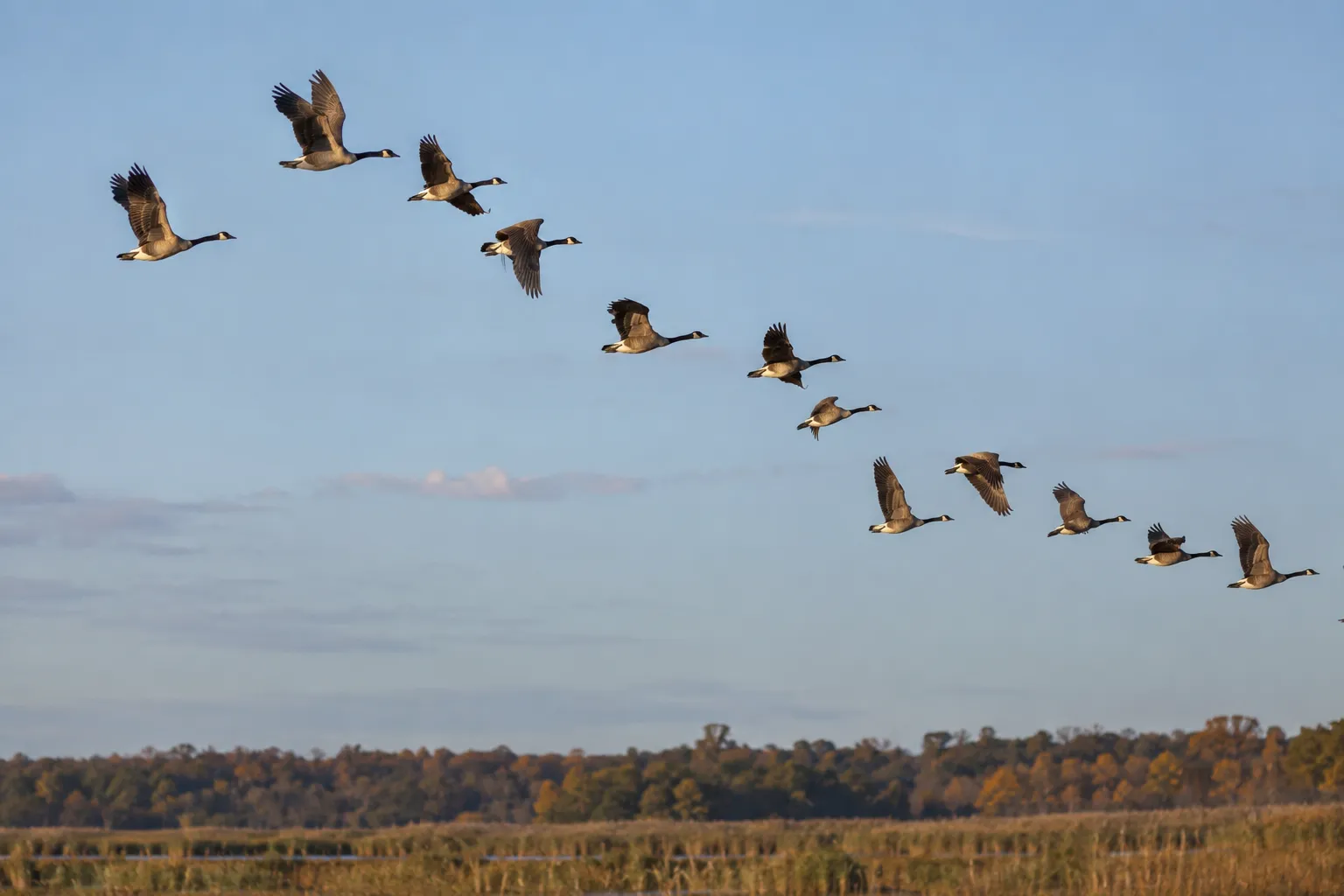
Why do birds fly in a V? Mainly to save energy. Every flapping wing leaves a spinning vortex of air behind its tip, and just outside that vortex the air moves upward. A bird flying just behind and beside the one ahead can ride that rising air, called upwash, and spend less effort staying aloft; a 2014 Nature study showed Northern Bald Ibises doing exactly this. The V shape also lets every bird see the one in front, which helps the flock keep spacing and avoid midair collisions.
That is the short answer. The longer one is more interesting, because for decades the energy-saving idea was mostly theory. It was not until the 2000s and 2010s that researchers managed to measure formation flight in real birds in the air, using heart rate monitors and tiny data loggers, and found that the birds are doing something remarkably precise.
Quick answer: the two main reasons for a V
- Aerodynamics. Birds position themselves in the rising air off the wingtip of the bird ahead, which lowers the energy cost of flight.
- Visibility and coordination. Flying on a diagonal lets each bird see the bird in front clearly, keep a safe distance and follow changes in direction.
- Who does it: mostly large birds on long flights, such as geese, cranes, swans, pelicans, cormorants and ibises.
- Real shapes are messy: lopsided Vs, J-shapes and single diagonal lines (echelons) are more common than perfect chevrons.
How does a bird’s wing make “free” lift for the bird behind it?
To see why a V helps, it is useful to know what a wing does to the air around it.
Wingtip vortices, downwash and upwash
A bird’s wing produces lift by creating lower pressure above the wing and higher pressure below it. At the wingtip, higher-pressure air from below curls around toward the lower-pressure air on top. As the bird moves forward, that curling motion trails behind it as a spinning tube of air, called a wingtip vortex.
Behind the wing itself, the air is pushed downward. That is downwash, and flying directly behind another bird would put a follower in sinking air, which makes flight harder. But just outside each wingtip, the spinning vortex pushes air upward. That is upwash. A follower whose wing sits in that rising air gets a little extra lift, so it can flap less hard for the same result.
The V shape is simply what you get when every bird in a line tries to put its wing in the upwash of the bird ahead: each one sits back and to the side of the next, forming a diagonal. Two diagonals meeting at a leader make a V.
Aircraft produce the same kind of vortices, which is why air traffic controllers space planes carefully during takeoff and landing. The vortices behind a large jet can be strong enough to upset a smaller plane that flies into them.
Why flapping makes it tricky
For a fixed-wing aircraft, the vortex behind each wingtip is fairly steady. A flapping bird is different. Its wingtip moves up and down with every stroke, so the trail of upwash it leaves is wavy, not straight. To benefit, a following bird needs to be in the right place and ideally flap in a way that matches the wavy pattern of rising air it is flying through.
For a long time, many scientists doubted birds could do this precisely enough to matter. Then came the ibis study.
What did scientists learn from the ibis experiment?
In 2014, a team led by Steven Portugal published a study in Nature on Northern Bald Ibises, an endangered species also called the Waldrapp. The birds had been raised by people in Austria as part of a conservation project to re-establish a migration route, and they flew behind a microlight aircraft that guided them south toward Italy. That setup allowed researchers to fit the birds with small data loggers that recorded position via GPS and wing movements via accelerometers, many times per second.
The results showed two striking things:
- Birds positioned themselves in the predicted sweet spot. Following ibises tended to fly at about the angle and distance where aerodynamic models predicted upwash would be strongest.
- Birds matched their wingbeats to the air. When flying in the V, birds timed their flapping so that their wingtips followed the same path through the air as the wingtip of the bird ahead, a pattern that makes the most of the rising air. When a bird flew directly behind another, in the downwash, it switched to flapping in the opposite phase, apparently to reduce the effect of the sinking air.
That level of coordination surprised many researchers. It suggests birds can sense the airflow created by their neighbors, or at least learn where flying feels easiest, and adjust their position and timing to match.
Do the birds take turns at the front?
A follow-up study on the same ibis population, published in PNAS in 2015, looked at who was leading. It found that birds frequently swapped places, and that pairs of birds tended to take turns flying in front of each other. Individuals roughly balanced the time they spent in the harder leading position against the time they spent following. The researchers described it as a form of cooperation based on reciprocity.
This supports a long-standing idea that birds in formation share the burden of leading. It is often said of geese too, and it seems likely, but the direct evidence is strongest for the ibises.
How do birds find the right spot?
Nobody knows exactly, and it is one of the open questions in the field. The ibis results suggest birds may sense subtle changes in airflow over their wings and body, adjusting position until flight feels easiest, much as a cyclist learns where the draft behind another rider is strongest. Feathers are connected to sensitive receptors in the skin, so birds are well equipped to feel air movement. Experience probably matters too. The ibises in the study were young birds on their first migration, which suggests that finding the sweet spot does not require years of practice, though it may improve with it. For now, the mechanism by which birds detect upwash remains a hypothesis rather than a settled fact.
Do birds really save energy in formation?
Yes, according to field evidence, though probably less than early theories claimed.
The pelican heart rate study
In 2001, a team led by Henri Weimerskirch published a study in Nature on Great White Pelicans in Senegal, trained to fly behind a boat and a microlight aircraft. The researchers fitted the birds with heart rate monitors. Pelicans flying in formation had lower heart rates than pelicans flying alone, and they spent more time gliding rather than flapping. Lower heart rate is a reasonable indicator of lower effort. The birds at the front, with no bird ahead to provide upwash, had to work hardest.
What about the famous “71 percent” figure?
A theoretical study published in Science in 1970 calculated that a flock of 25 birds in an ideal V could fly about 70 percent farther than a single bird on the same energy. The figure has been widely repeated ever since. Later researchers have pointed out that the calculation assumed idealized fixed wings and perfect positioning, which real, flapping birds cannot achieve all the time. Wind gusts, turns, flock members joining and leaving, and the variation of flapping all reduce the savings.
So the best current summary is this: formation flight does save energy, and the evidence from both pelicans and ibises supports it, but the real gain in a wild flock is likely to be more modest than the textbook number, and it varies from moment to moment.
Is energy saving the only reason?
Probably not. A second, compatible explanation is about seeing and staying together.
The visibility hypothesis
Many birds have eyes set on the sides of the head. Flying at an angle behind the bird ahead gives each bird a clear view of its neighbor without having to look directly forward past another body. That makes it easier to:
- Keep a safe distance and avoid collisions.
- Follow the leader’s changes in speed and direction.
- Keep the flock together over long distances, in fog, and at night.
Some researchers have argued that for certain species the coordination benefit may matter as much as the aerodynamic one. The two explanations are not rivals: a formation that keeps everyone in view and also saves energy is doubly useful. Our explainer on why birds flock together covers the social and safety benefits of flying as a group in general.
Why do geese honk in flight?
Geese call frequently in flight, and those calls are widely thought to help flock members stay in contact, especially in poor visibility and at night. Family groups of geese migrate together, and calls probably help parents and young keep track of each other. Whether honking specifically coordinates positions in the V is less clear.
Which birds fly in a V, and which don’t?
| Group | Typical formation | Notes |
|---|---|---|
| Geese (Canada, Greylag, Snow, Brant and others) | V, J or echelon | The classic example, often in family groups |
| Cranes (Sandhill, Common and others) | V or long lines | Long migrations over land |
| Swans | V or diagonal lines | Large, heavy birds with long flights |
| Pelicans | Lines and V shapes, often close to water | Heart rate studies showed energy savings |
| Cormorants | V or long lines | Often low over water |
| Ibises | V and echelon | Studied in detail with data loggers |
| Ducks | Loose lines or V shapes in some species | Varies by species |
| Small songbirds | Loose or dense clusters, not a V | Fast, irregular flapping reduces the benefit |
| Starlings | Dense flocks and murmurations | Coordinate by responding to near neighbors |
Why don’t small birds fly in a V?
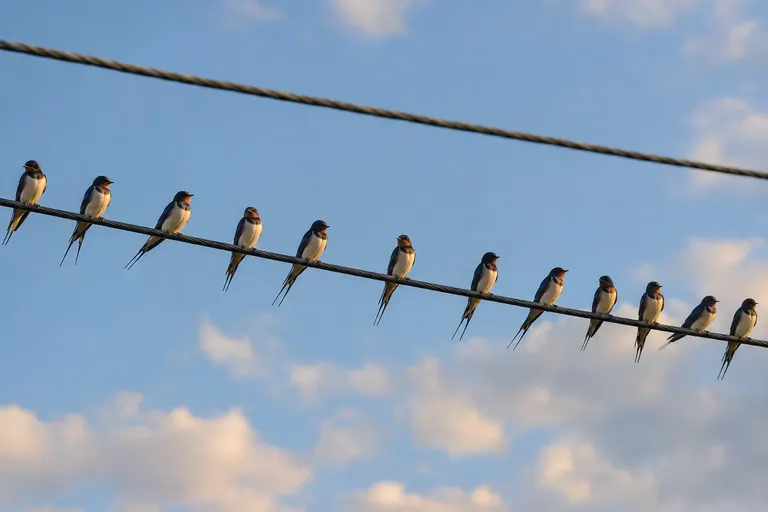
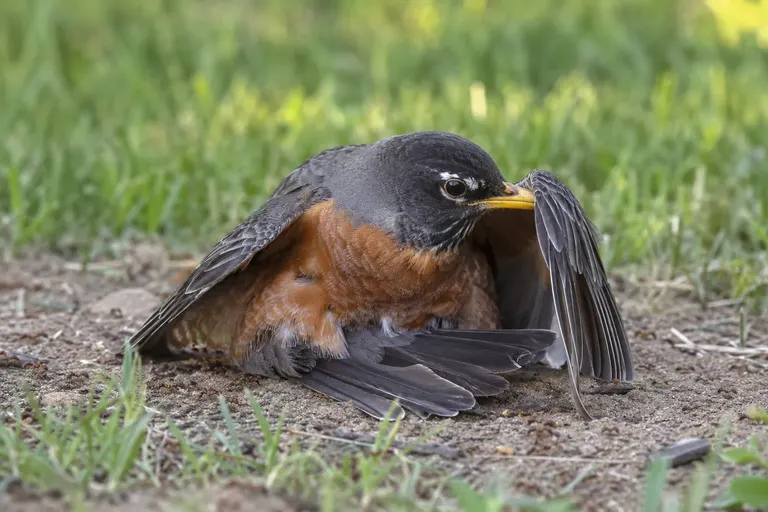
Small birds such as finches, sparrows and warblers flap fast and fly with frequent short glides or bounding flight, and they produce weaker, more irregular wingtip vortices. It would be very hard for them to hold the precise positions needed to exploit upwash. Many small songbirds also migrate at night, often alone or in loose groups spread out across the sky. Their flocking strategy is about safety in numbers rather than aerodynamics.
European Starlings take a completely different approach, with huge, fluid flocks in which each bird tracks a handful of close neighbors. Our explainer on what a murmuration is explains how that works.
Do all long-distance migrants fly in a V?
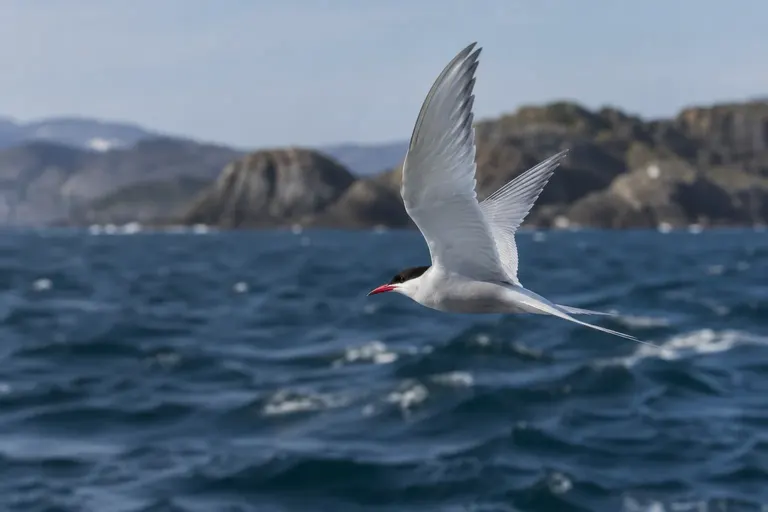
No. Many of the longest-distance migrants, such as Arctic Terns, shorebirds and small songbirds, do not fly in tight V formations. Some shorebirds fly in fast, compact flocks. Birds of prey such as hawks and storks often soar on rising thermals rather than flapping, which is another way to save energy. Our articles on how far birds migrate and which bird migrates the farthest look at the champions.
Why are some V formations lopsided?
Look closely at a passing skein of geese and you will often see a V with one arm much longer than the other, a J-shape, or simply a single diagonal line. That is normal. Birds shift position constantly, drop back for a rest, move forward or change sides. Late joiners attach to one arm. Crosswinds and turns can also distort the shape.
The old joke asks why one side of the V is longer, with the punchline “because there are more birds on that side.” It is not wrong.
Is the leader always the strongest or oldest bird?
This is often claimed but not well supported. In the ibis studies, leading was shared. In goose family groups, adults may lead more often, which seems plausible since they know the route, but the details vary and have not been studied as closely as people sometimes suggest.
Have engineers copied the V formation?
Yes. Aerospace engineers have tested formation flight with aircraft to take advantage of the same wake upwash. Research programs by NASA and others have explored it, and in 2021 Airbus reported flight tests in which an aircraft flying in the wake of another saved fuel on the order of 5 percent. Commercial use still faces practical challenges, including safety spacing and air traffic control, but the principle is the same one geese discovered long ago.
Myths vs facts about V formations
Myth: Birds in a V save around 70 percent of their energy. Fact: that figure comes from a 1970 theoretical model. Real savings appear smaller, though measurable.
Myth: The lead goose leads the whole way. Fact: evidence from ibises shows birds swap the lead often, and the same is widely thought to happen in geese.
Myth: Every migrating bird flies in a V. Fact: V formations are mostly found in large birds with long, steady flights. Most small birds migrate in loose groups, many at night.
Myth: Birds in a V are following a single navigator. Fact: experienced birds may guide the route, but position in the V shifts constantly and navigation is a group process. Our article on how birds know where to migrate covers how they find their way.
What does this mean for backyard birders?
- Use flight shape as an identification clue. A long, orderly V of large birds high overhead in spring or autumn is most likely geese or cranes. Lines low over water suggest cormorants or pelicans. Loose, bounding flocks are usually small songbirds. Our guide on how to identify birds explains how to combine shape and behavior with other clues.
- Listen as well as look. Geese and cranes call constantly in flight, and you often hear a skein before you see it.
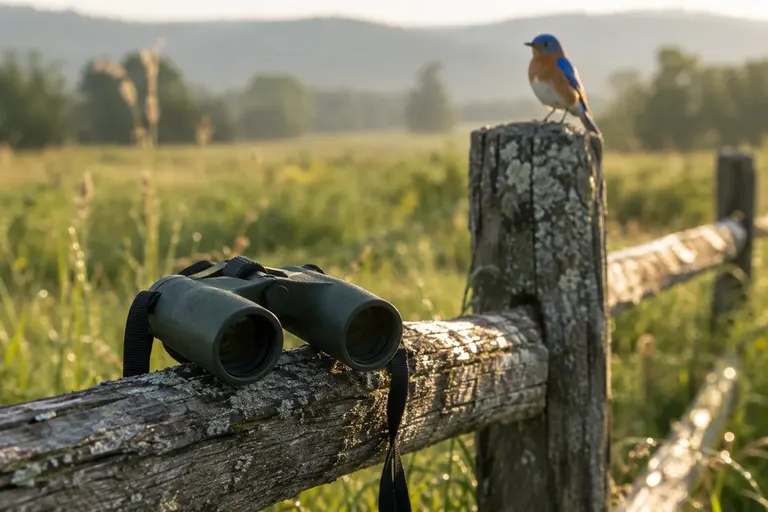
- Watch the V change. Through binoculars, you can often see birds trade places, drop back or move to the other arm.
- Record what you see. Counting passing flocks and logging them in eBird, as our guide on how to use eBird explains, helps researchers track migration timing.
Common mistakes
- Assuming any V of dark birds is geese. Cormorants and ibises fly in similar shapes.
- Expecting a perfect V. Uneven formations are the norm.
- Forgetting sound. Calls are often the fastest route to an ID for high flocks.
Quick facts
- A flapping wing leaves a spinning vortex behind each wingtip, with rising air (upwash) just outside it.
- Birds in a V fly back and to the side of the bird ahead to use that upwash.
- A 2014 Nature study showed Northern Bald Ibises positioned themselves in the upwash and timed their wingbeats to match.
- A 2015 study found ibises took turns leading and following.
- Great White Pelicans flying in formation had lower heart rates than those flying alone.
- The often quoted 70 percent range increase comes from a 1970 theoretical model and is considered optimistic.
- The V also helps birds see each other and avoid collisions.
- Mostly large birds fly in V formations: geese, cranes, swans, pelicans, cormorants and ibises.
Sources
- Portugal, S. J., et al. (2014). Upwash exploitation and downwash avoidance by flap phasing in ibis formation flight. Nature
- Voelkl, B., et al. (2015). Matching times of leading and following suggest cooperation through direct reciprocity during V-formation flight in ibis. PNAS
- Canada Goose overview - Cornell Lab of Ornithology, All About Birds
Frequently asked questions
Why do geese fly in a V formation?
The main reason is energy saving. A flying bird leaves swirling air behind each wingtip, and just outside that swirl the air rises. A goose flying slightly behind and to the side of the bird ahead rides that rising air and needs less effort to stay aloft. The V shape also lets every bird see the one in front, which helps the flock keep spacing and avoid collisions.
Do birds take turns leading the V?
At least some do. A 2015 study of Northern Bald Ibises tracked with data loggers found that birds swapped between leading and following, and that individuals roughly matched the time they spent in front with the time they got to follow. Rotation is often said to happen in geese as well, but it has been studied less directly.
How much energy do birds save by flying in a V?
Real-world savings are smaller than early theory suggested but still meaningful. A 2001 study found Great White Pelicans flying in formation had lower heart rates and glided more than pelicans flying alone. An often quoted theoretical estimate from 1970 claimed a large increase in range, but later researchers regard it as optimistic for real flocks.
Why don't small birds fly in a V?
Small birds such as sparrows, finches and starlings fly with fast, irregular wingbeats and relatively weak wingtip vortices, and they often fly in dense, shifting flocks where the benefit of a precise V is hard to capture. Formation flight is mostly seen in larger, heavier birds with long, steady flights, such as geese, cranes, pelicans, swans and ibises.
Why is one side of the V longer than the other?
There is no special reason beyond numbers. Birds join, drop back or change position as they fly, and one arm of the V often ends up with more birds than the other. Real formations are frequently lopsided, J-shaped or single diagonal lines called echelons rather than perfect, symmetrical Vs.