Why Do Birds Molt?
Why do birds molt? Feathers are dead keratin that wears out and cannot be repaired, so birds replace them on a schedule. How molt works, when and why.
In this article
- Quick facts about molt
- Why can’t birds just repair their feathers?
- How does a bird actually molt?
- What are the different types of molt?
- Can a bird change color without molting?
- What triggers molt, and why is timing so important?
- Why do birds look bald or scruffy in late summer?
- Do birds act differently while they molt?
- Myths and facts about molt
- Why does molt matter for bird identification?
- How can backyard birders help molting birds?
- Common mistakes birders make about molt
- The bottom line
- Sources
- Frequently asked questions
Birds molt because feathers wear out and cannot be repaired. A feather is a dead structure made of keratin, the same protein family as your fingernails, and once it is fully grown it receives no blood or nutrients. Sunlight, abrasion, bacteria and feather lice slowly break it down, so birds replace their feathers on a regular schedule, usually at least once a year, to keep flying, staying warm, shedding water and signaling to other birds. A complete molt takes a small songbird around 1 to 3 months.
That simple answer hides a remarkably organized process. This guide explains how molt works, why different birds molt in such different ways, how molt changes the colors you see at your feeder, and what it means for backyard birders.
Quick facts about molt
- What it is: the planned, regular replacement of feathers, one follicle at a time.
- How often: most birds have at least one complete molt a year, and many add a partial molt.
- When: in North America and Europe, most songbirds molt in late summer and early fall, after nesting.
- Order matters: flight feathers are usually replaced a few at a time, symmetrically on both wings.
- The exceptions: ducks, geese, swans, loons and grebes drop all flight feathers at once and are flightless for weeks. Penguins replace almost everything at once and fast on land.
- Cost: feathers are nearly pure protein, so molt is expensive, and birds rarely overlap it with breeding or long migration.
- Color changes: molt, wear, or both explain why many birds look different in spring and fall.
Why can’t birds just repair their feathers?
A growing feather sits in a follicle in the skin and is fed by blood vessels in its core. You can sometimes see this on a “pin feather”: a new feather still wrapped in a waxy sheath with a dark, blood-filled shaft. Once the feather finishes growing, the blood supply withdraws, the sheath flakes away and what remains is inert keratin.
From that moment the feather can only get worse. Several forces wear it down:
- Ultraviolet light breaks down keratin, especially in pale feathers.
- Abrasion from vegetation, nest cavities, sand and wind frays feather tips.
- Feather-degrading bacteria and feather lice chew and digest keratin.
- Everyday wear from flight and preening slowly unhooks and breaks the tiny barbules that zip a feather vane together.
Birds fight this constantly. Preening realigns barbs and spreads oil from the uropygial (preen) gland. Behaviors like dust bathing, sunbathing and anting are thought to help control parasites. But maintenance only slows the decline. Eventually the only fix is a new feather.
Melanin, the pigment that makes feathers black and brown, makes keratin tougher. That is one reason many white seabirds, such as gulls and gannets, have black wingtips: the dark pigment protects the outer flight feathers that take the most wear.
How does a bird actually molt?
A molting bird does not simply drop feathers and wait. A new feather begins growing in the same follicle, and as it grows it pushes the old feather out. So in most cases the old feather falls out only when its replacement is already on the way, which keeps gaps small.
Why flight feathers are replaced in order
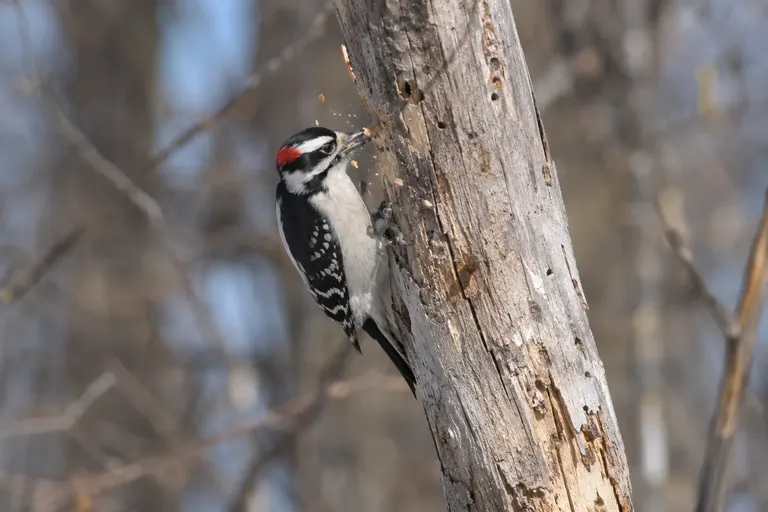
For a bird that depends on flight to escape predators, losing too many wing feathers at once could be fatal. Most birds solve this by replacing flight feathers in a set sequence, a few at a time, with the same feathers dropping on both wings together so the bird stays balanced.
In many songbirds, the primaries (the long outer wing feathers) are replaced starting from the innermost and moving outward toward the wingtip, while the secondaries and tail feathers follow their own sequences. A careful observer can sometimes see a small gap moving through a bird’s wing over several weeks. A complete molt in a small songbird commonly takes somewhere around one to three months, depending on the species.
Why ducks and geese become flightless
Ducks, geese and swans do things differently. They shed all their flight feathers at once, replace them together and are unable to fly for several weeks. Loons, grebes and many auks do the same.
This strategy makes sense for birds that can escape danger by swimming or diving. Getting the whole job done in one burst shortens the total time with damaged wings. Many waterfowl move to large lakes, marshes or coastal bays before this flightless period, and some make special “molt migrations” to traditional safe sites. If you want to know how their feathers stay waterproof in the meantime, see our guide on why ducks don’t get wet.
Why penguins molt all at once
Penguins take the all-at-once approach even further. In a “catastrophic molt,” a penguin replaces nearly its entire coat of feathers over a few weeks. Because its insulation and waterproofing are compromised, it cannot go to sea to feed. Penguins fatten up beforehand and then stand ashore, fasting, while the new plumage pushes the old one out in clumps.
Why eagles and albatrosses take years
Very large birds face the opposite problem. Their flight feathers are so long that growing a full set takes more time and protein than a single season allows. Many large raptors and albatrosses replace their flight feathers in overlapping waves, so any given wing may contain feathers of several ages. Bald Eagles, for example, take several years to reach full adult plumage, passing through a series of mottled brown immature stages along the way.
What are the different types of molt?
Ornithologists in North America use a naming system developed by Philip Humphrey and Kenneth Parkes in 1959 and refined since. It describes plumages by their place in the life cycle rather than by season.
| Term | What it means | Backyard example |
|---|---|---|
| Juvenal plumage | The first true feathers a young bird grows in the nest | Speckled young American Robins in early summer |
| Preformative molt | The first molt after leaving the nest, often partial | Young songbirds replacing loose juvenile body feathers in their first fall |
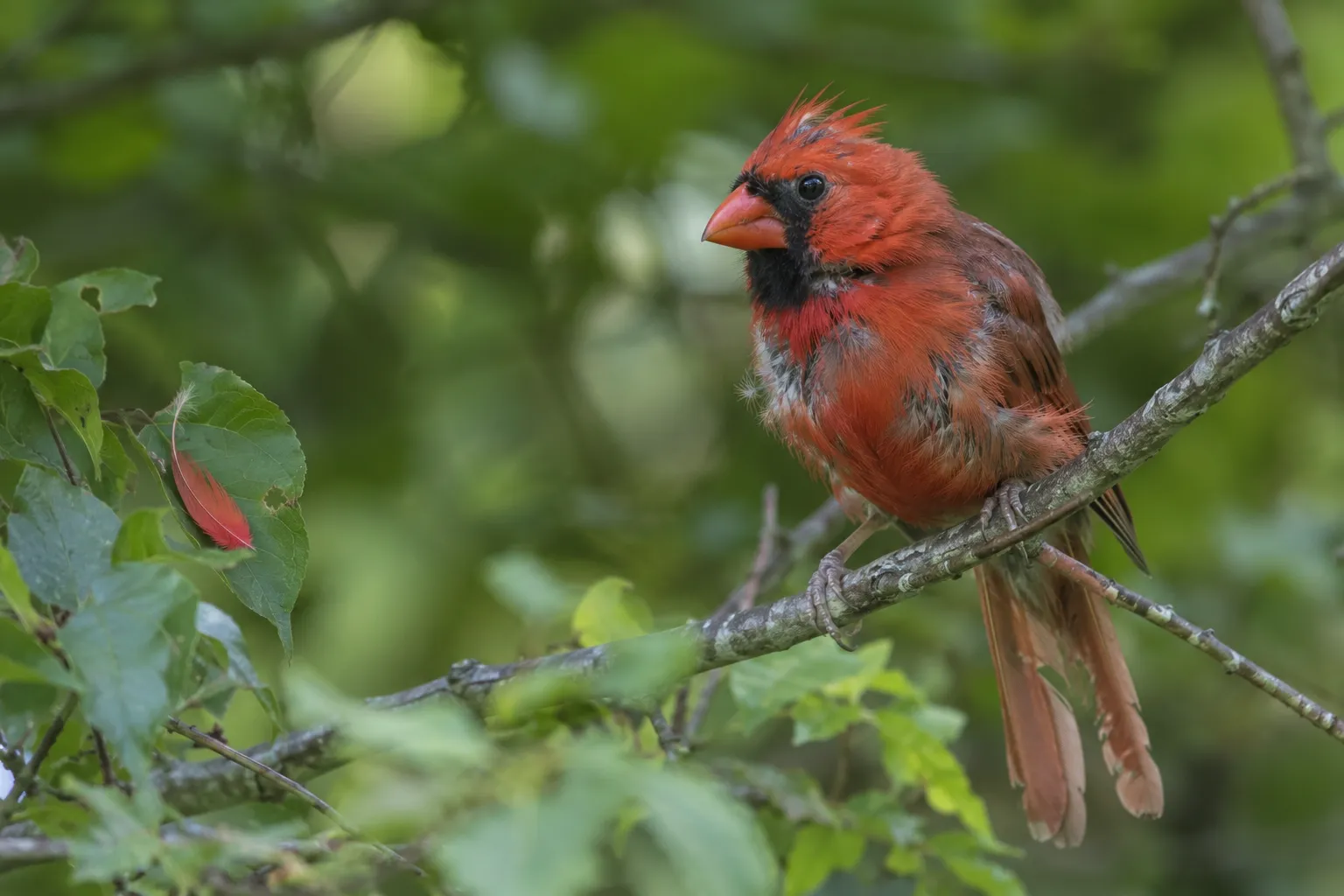
| Prebasic molt | The main, usually complete molt, repeated every year | Adult cardinals looking ragged in August |
| Basic plumage | The plumage produced by the prebasic molt | A male goldfinch’s olive-brown winter look |
| Prealternate molt | An extra, usually partial molt before breeding | Male goldfinches turning bright yellow in spring |
| Alternate plumage | The plumage produced by the prealternate molt | A breeding-plumage Scarlet Tanager |
The key idea: every bird has a prebasic molt, but only some species have a prealternate molt. Many familiar birds, such as the Northern Cardinal, keep essentially the same look all year and have no significant prealternate molt.
Why do some birds molt twice a year?
A second molt costs extra energy, so it has to pay for itself. It tends to evolve in species where plumage takes heavy wear, such as birds living in grassland or bright sun, or where males need a distinct breeding look.
The American Goldfinch is a classic example. It has a complete molt in fall that produces a dull olive or brownish winter plumage, then a partial molt in late winter and spring that gives males their brilliant yellow body and black cap. Many warblers, tanagers and buntings do something similar, which is why fall migrants can look so confusing.
Which birds molt three times a year?
Ptarmigan are the famous case. Species such as the Rock Ptarmigan and Willow Ptarmigan, which live across the Arctic of North America, Europe and Asia, change between white winter plumage and mottled brown summer plumage, with additional partial molts in between. The changes keep them camouflaged against snow in winter and tundra in summer.
Can a bird change color without molting?
Yes, and this surprises many birders. Some color changes come from wear rather than new feathers.
The European Starling is the best example. In fall, fresh starling feathers have pale tips that cover the bird in white and buff spots. Through winter those tips wear off, and by spring the same feathers look glossy black with purple and green iridescence. The bird did not molt; its “breeding plumage” was hidden under the spots all along.
The male House Sparrow works the same way. His black bib grows in partly concealed by pale feather edges in fall, and it becomes larger and blacker as those edges wear away toward spring. Snow Buntings show a similar change, with brownish fall edges wearing off to reveal crisp black and white.
Color can also shift through diet. The red, orange and yellow in many feathers comes from carotenoid pigments that birds get from food and deposit into feathers as they grow. A House Finch that grows its new feathers on a poor diet may come out orange or yellow instead of red. That link between molt, diet and color is part of the story in our guide on why male birds have brighter colors.
What triggers molt, and why is timing so important?
Molt is controlled by hormones, and the main external cue is day length. As the breeding season winds down and sex hormones fall, other hormonal signals, including thyroid hormones, help start feather growth. Food supply, age, health and the bird’s migration schedule can all shift the timing.
The timing is critical because molt is expensive. Feathers are almost entirely protein, and in many birds the full set of feathers is often said to outweigh the skeleton. Growing new feathers raises a bird’s metabolic rate, and flying with gaps in its wings takes more effort. Most birds therefore avoid stacking molt on top of their other two big costs: breeding and long-distance migration.
The typical annual cycle for a North American or European songbird looks like this:
- Spring: migrate and arrive on breeding grounds, sometimes after a partial prealternate molt.
- Late spring and summer: build nests, lay eggs and raise young.
- Late summer to early fall: complete the prebasic molt, often while becoming quiet and secretive.
- Fall: migrate south, or settle in for winter if the species is a resident.
- Winter: survive on the fresh plumage, which provides the best insulation of the year.
There are many variations. Some long-distance migrants postpone part or all of their molt until they reach their wintering grounds. Others stop partway, molting at a productive stopover site. Several western North American songbirds are known to pause in the monsoon region of northwestern Mexico and the southwestern United States to molt before continuing south, taking advantage of the late-summer rains and insect boom there.
Winter timing matters too. Birds in cold climates enter winter with their freshest plumage, which fits with how feathers help them stay warm through cold nights.
Why do birds look bald or scruffy in late summer?
If you feed birds, August is often the month you notice molt most. Adults look faded and ragged. Tails are short or missing. Young birds look like they are wearing a mix of two outfits.
The most startling sight is a bald Northern Cardinal or Blue Jay. Sometimes these birds lose all their head feathers at once, exposing dark gray skin and ear openings. Researchers and bird-watchers have suggested several explanations, including an unusual but normal molt pattern in some individuals and heavy infestations of feather mites or lice. The Cornell Lab has noted that the cause is not settled. The good news is that the feathers generally grow back within a few weeks.
A bald bird at your feeder is usually not sick. If it also looks lethargic, fluffed up for long periods, or has crusty eyes, see our guide to sick birds at the feeder.
Do birds act differently while they molt?
Often, yes. With gaps in the wings, flight is less efficient and escape is slower. Many songbirds become less conspicuous, sing less and spend more time in dense cover during heavy molt. This is one reason backyards can seem strangely quiet in late summer, even though the birds have not left.
Waterfowl in their flightless period are especially wary. Male ducks of many species also go into an “eclipse” plumage in summer: a Mallard drake, for example, loses his glossy green head and looks much like a female for a time. The dull look likely helps him stay inconspicuous while he cannot fly.
Molting birds also bathe and preen a great deal. New feathers emerge from waxy sheaths that must be picked away, and bathing seems to help. A clean bird bath can get very busy in August.
Myths and facts about molt
Myth: Birds lose all their feathers at once every year. Fact: Most birds replace feathers gradually over weeks or months. Only a few groups, like penguins and waterfowl, replace large sets at once.
Myth: A bald cardinal is always sick. Fact: Head-feather loss in cardinals and jays is a well-known late-summer event, and the feathers usually return.
Myth: Birds change color in spring because the old feathers are dyed. Fact: Feathers cannot change pigment once grown. Spring changes come from a new partial molt, from wear revealing hidden colors, or both.
Myth: Molt happens only in spring and fall. Fact: Most molt in temperate songbirds happens after breeding, in late summer and early fall. Timing is very different in the tropics, in seabirds and in long-distance migrants.
Myth: A shed feather means a bird was attacked. Fact: Single feathers under a perch are normal in molt season. A tight cluster of many feathers in one spot is more likely a sign of a predator.
Why does molt matter for bird identification?
Molt and wear explain a large share of the confusion in bird identification. Knowing the basics helps you avoid common mistakes:
- Expect different fall and spring looks. Goldfinches, buntings, many warblers and tanagers look very different after the fall molt. Indigo Buntings are one of the most dramatic examples.
- Age birds by their plumage. Young birds in their first year often look different from adults, and some species take two or more years to reach adult plumage.
- Watch feather edges. Fresh fall feathers often have pale or buffy edges that wear away by spring.
- Look for mixed plumages. A bird caught midway through molt can show patches of old and new feathers that do not match any field guide image.
For a structured approach, see how to identify birds using shape, behavior and habitat, which do not change with molt.
How can backyard birders help molting birds?
You cannot speed up molt, but you can make it easier for the birds around you.
- Offer high-protein and high-fat foods. Feathers are built from protein. Black oil sunflower, suet, peanuts and mealworms are good late-summer options. Our guide on whether to feed birds in summer covers the pros and cons.
- Keep water fresh and clean. Molting birds bathe often to help with feather care.
- Provide dense cover. Shrubs, hedges and brush piles give molting birds a safe retreat while their flight is weaker.
- Keep cats indoors. A bird with gaps in its wings is easier to catch.
- Leave shed feathers where they fall. In the United States, the Migratory Bird Treaty Act generally prohibits collecting feathers of native wild birds without a permit, even if they were naturally molted. Rules differ by country, so check locally before keeping any feather.
- Do not worry about bald birds. Watch, enjoy and let them grow back.
Common mistakes birders make about molt
- Assuming a scruffy bird is a different species. Check the bill, shape and behavior first.
- Thinking a quiet yard means birds have left. In late summer, many are simply molting in cover.
- Mistaking eclipse ducks for females. In summer, look at bill color and wing patterns, which often still separate the sexes.
- Believing bright spring colors come from new pigment. Wear and partial molts explain most spring changes.
The bottom line
Birds molt because feathers are dead, hardworking structures that wear out and cannot be repaired. Replacing them keeps a bird able to fly, stay warm, stay dry and send the right visual signals. Each group of birds has evolved a molt strategy that fits its life: gradual and symmetrical in songbirds, all at once in waterfowl and penguins, and spread over years in eagles and albatrosses. The next time your feeder birds look tattered in August, you are watching one of the most carefully timed events in a bird’s year.
Sources
Frequently asked questions
How often do birds molt?
Most birds replace every feather at least once a year, usually in a complete molt after the breeding season. Many songbirds add a second, partial molt in late winter or spring that swaps some body feathers for breeding colors. A few species, such as ptarmigan, molt parts of their plumage three times a year, while large eagles and albatrosses need more than a year to replace all their flight feathers.
Does molting hurt birds?
There is no evidence that normal molt is painful in the way we imagine. A new feather grows in the same follicle and pushes the old one out, much like a new tooth. Growing feathers do have a blood supply, so they are sensitive while they develop, and molt is energetically costly. Birds often behave more quietly and secretively during heavy molt.
Why do birds at my feeder look bald or scruffy in late summer?
Late summer is peak molt season for many backyard birds, so worn feathers and half-grown replacements give a ragged look. Northern Cardinals and Blue Jays sometimes drop all their head feathers at once and look completely bald for a week or two. The cause of that pattern is still debated, but the feathers usually grow back normally.
Can birds fly while molting?
Most birds can, because they replace flight feathers a few at a time in a set order on both wings. Ducks, geese, swans, loons, grebes and many auks are the big exception. They shed all their flight feathers at once and are flightless for several weeks, so they hide on large, safe bodies of water until the new feathers grow in.
What triggers molt in birds?
Molt is timed mainly by hormones that respond to day length. As breeding hormones fall after the nesting season, thyroid hormones and other signals help start feather replacement. Birds usually avoid overlapping molt with nesting and long migrations because each is costly. Food supply, age and health can shift the exact timing.
Should I feed birds differently during molt?
Feathers are almost pure protein, so molting birds need protein and fat. Black oil sunflower, suet, peanuts and mealworms are all useful in late summer. Clean water for bathing also helps birds keep new and old feathers in good condition. Dense shrubs give molting birds a safer place to hide while they fly less efficiently.