What Is a Murmuration?
What is a murmuration? It is a huge, shifting flock of starlings wheeling at dusk before roosting. Here is how it works, why they do it and where to see it.
In this article
- Quick answer: what is a murmuration?
- Which birds form murmurations?
- When and where can you see a murmuration?
- How do thousands of starlings move as one?
- Why do starlings form murmurations?
- Myths and facts about murmurations
- What does a murmuration sound like?
- Are starling murmurations declining?
- What does this mean for backyard birders?
- How to watch a murmuration well
- How is a murmuration different from a V formation?
- Quick facts
- Sources
- Frequently asked questions
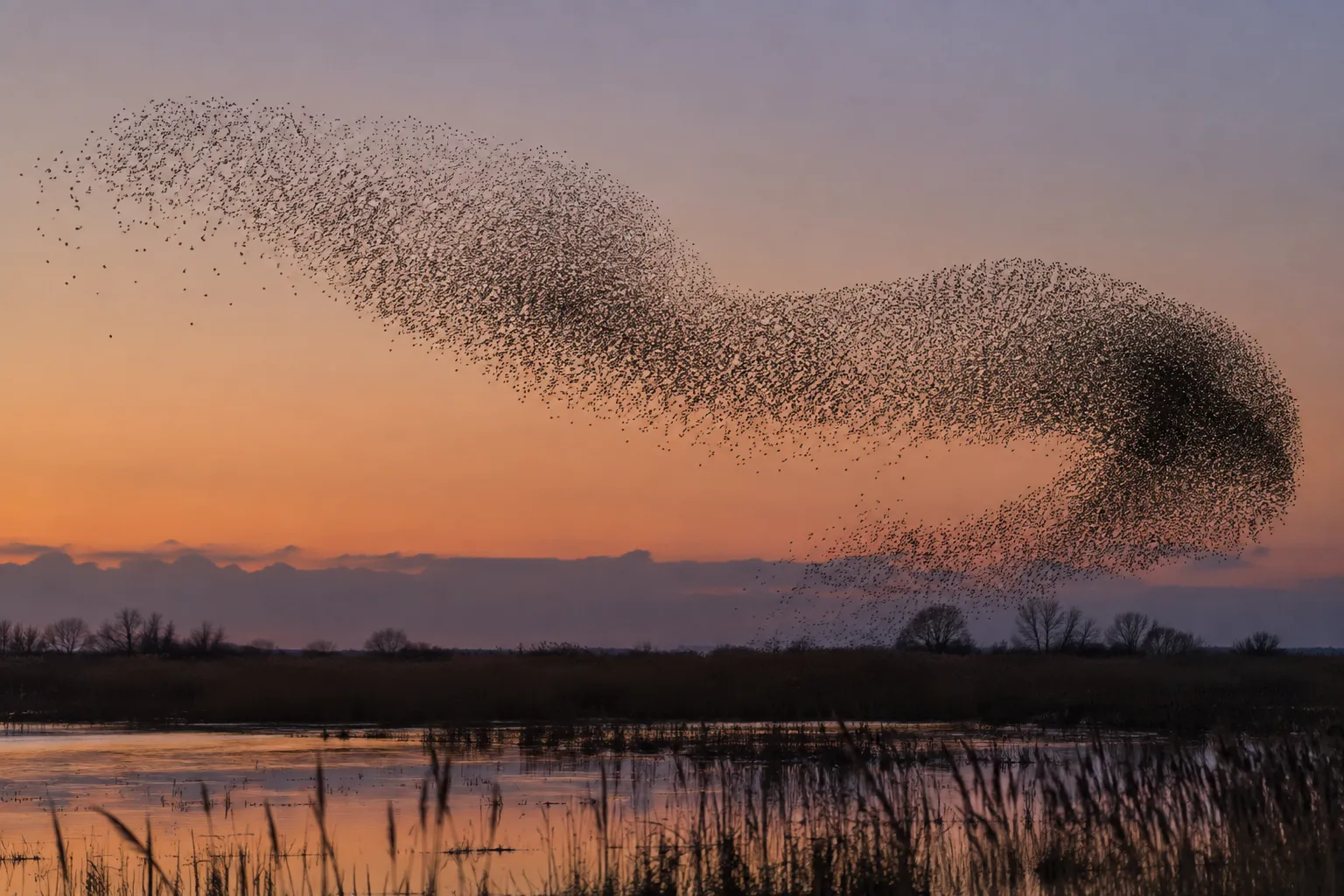
What is a murmuration? It is a huge flock of starlings flying together in tight, shifting, cloud-like shapes, over their night roost just before dusk. Thousands or even hundreds of thousands of birds twist, fold and pulse as if they were one animal, then pour down into reeds, trees or buildings to sleep. The display appears to be driven mainly by safety from predators, and it works because each bird tracks only about six or seven close neighbors, as a 2008 study of flocks over Rome showed.
The word itself is old and literal. “Murmuration” comes from the soft, rushing murmur of countless wingbeats, and it has been used as a collective noun for starlings since at least late medieval lists of animal group names. Today it also refers to the display itself.
Quick answer: what is a murmuration?
- Who does it: mainly the Common or European Starling (Sturnus vulgaris). Some shorebirds, such as Dunlin and Red Knot, perform similar synchronized flights.
- When: mostly late autumn and winter in Europe, at dusk, in the minutes before birds settle into a communal roost.
- Where: over reedbeds, marshes, woodland, piers and city buildings that serve as roosts.
- Why: the leading explanation is protection from predators such as falcons and hawks, with information sharing and roost gathering as supporting ideas.
- How: each bird reacts to about six or seven nearest neighbors, and those local reactions spread across the flock very quickly.
Which birds form murmurations?
The classic murmuration belongs to the Common Starling, a stocky, short-tailed songbird that looks black from a distance but glosses purple and green in good light. Native to Europe, western Asia and North Africa, it has been introduced to North America, southern Africa, Australia, New Zealand and parts of South America. In North America it is usually called the European Starling. After roughly 100 birds were released in New York’s Central Park in 1890 and 1891, the species spread across the continent.
Starlings are unusually social. They feed in loose groups on lawns and pasture, probing the soil for larvae and insects, and in the non-breeding season many of them gather each evening at shared roosts. The murmuration is the aerial prelude to that roost.
Other birds produce similar spectacles:
- Shorebirds. Flocks of Dunlin, Red Knot and other sandpipers wheel over estuaries in tight formations, flashing pale bellies and dark backs in unison as they turn. At high-tide roosts on large estuaries, these flights can look strikingly like starling murmurations.
- Red-billed Quelea. This small African weaver forms some of the largest bird flocks on Earth, moving across savanna in dense, rolling clouds.
- Blackbirds and grackles. In North America, mixed winter roosts of Red-winged Blackbirds, grackles, cowbirds and starlings can produce long streams and swirling flocks at dusk, though usually less choreographed than a classic starling display.
Pigeons, parakeets and waterfowl also fly in coordinated groups, but they rarely match the density and fluid shape changes of starlings.
When and where can you see a murmuration?
What time of year is best?
In Britain and much of northwestern Europe, murmurations are a cold-season event. Resident starlings are joined in autumn by migrants from Scandinavia, the Baltic region and farther east, which swell roost numbers. Displays typically build from October, are often most impressive in the depth of winter and fade as birds disperse to breed in spring. Exact timing varies with weather, food and the fortunes of individual roosts.
Denmark offers a well-known variation. In the marshes of the Wadden Sea region in southwest Jutland, spring and autumn flocks of migrating starlings produce displays known locally as “sort sol,” or “black sun,” because the massed birds can seem to darken the evening sky.
What time of day?
Murmurations happen at dusk. Starlings feed during the day, sometimes many miles from the roost, then travel back in small parties that merge over the roost site. The aerial display usually lasts from a few minutes to around half an hour. Then, often abruptly, the flock funnels down into cover. If you want to watch one, arrive about 45 minutes before sunset and stay until the birds are down.
Where do murmurations form?
Roosts need shelter and safety. Common choices include:
- Large reedbeds and marshes, which are hard for ground predators to reach.
- Conifer plantations and dense woodland.
- Seaside piers and bridges, which offer warm, sheltered ledges over water.
- City buildings and street trees, where urban heat may help on cold nights.
Well-known European sites have included reedbeds in the Somerset Levels, piers on the English south coast, the Solway area near Gretna on the England and Scotland border, and city roosts in Rome. Roosts shift over time, so check recent local reports rather than relying on a site’s reputation from years ago.
How do thousands of starlings move as one?
This is the question that has drawn physicists, mathematicians and biologists to starlings. There is no leader. No single bird knows the shape of the whole flock. The pattern emerges from simple local rules followed by every individual.
What rules does each starling follow?
In 1987, computer graphics researcher Craig Reynolds showed that realistic flocks could be simulated with three rules applied to each virtual bird, which he called “boids”:
- Separation: do not get too close to your neighbors.
- Alignment: steer toward the average heading of nearby birds.
- Cohesion: move toward the average position of nearby birds.
Real starlings are more complex, but these rules capture the core idea. Coordination is local, yet order appears at the scale of the whole flock.
How many neighbors does each starling watch?
A landmark study published in 2008 in the Proceedings of the National Academy of Sciences used synchronized cameras to reconstruct the three-dimensional positions of individual starlings in flocks over Rome. The team, part of the European STARFLAG project led by Italian physicists, found that each bird interacts with a fixed number of neighbors, on average about six or seven, rather than with every bird within a fixed distance.
That distinction matters. A rule based on distance, sometimes called “metric,” would break down when a flock stretches thin, because some birds would suddenly have no neighbors within range. A rule based on a count of neighbors, called “topological,” keeps working whether the flock is packed tight or spread out. The researchers argued this helps flocks stay cohesive when predators force them to expand and contract.
Why does the whole flock react at once?
A follow-up study in 2010, also in PNAS, found that changes in one bird’s speed and heading are correlated with changes in other birds across the entire flock, whatever its size. Physicists call this “scale-free” correlation. In plain terms, information about a turn is not lost as it passes from bird to bird. A disturbance at one edge can propagate across tens of thousands of birds in about a second or less.
The dark bands that seem to ripple across a murmuration are part of this picture. Researchers studying starlings under attack by Peregrine Falcons in Rome described “agitation waves,” where birds briefly bank or dodge and the change passes outward like a wave through a stadium crowd. As birds tilt, more of their dark wing surface faces the viewer, so the wave shows up as a moving band of darker color.
Is the flock close to a tipping point?
Some physicists have suggested that starling flocks behave like systems poised near a “critical” state, where small inputs can trigger large, fast collective responses. This remains an active research area, and not every researcher accepts the framing. What is well established is that flocks respond far faster than any individual could if it had to see a predator for itself.
Why do starlings form murmurations?
No one has interviewed a starling, so explanations rest on evidence from behavior, predator observations and modeling. Several ideas probably work together.
Is it about avoiding predators?
This is the leading explanation. Falcons, hawks and harriers often hunt at starling roosts, and a predator needs to single out one target. A dense, shifting flock makes that very hard, a problem biologists call the confusion effect. Each starling also benefits from dilution: in a flock of 50,000, the chance that any one bird is caught on a given pass is tiny. Birds on the inside of the flock are safer than those on the edge, which helps explain why flocks are so tight.
A 2017 citizen science study published in PLOS ONE, based on thousands of public reports of murmurations mostly in the UK, found that displays were more likely to be larger and longer when predators were present. The authors interpreted this as support for the predator hypothesis, while noting the limits of observational data.
Do starlings use the display to gather at the roost?
Probably, at least partly. Birds arrive from many directions in small groups, and a large, visible swirling flock may act as a beacon, drawing latecomers to the roost. Some researchers have suggested that the display helps birds assess how many others are present, but this is harder to test.
Is the roost an information center?
A long-standing idea, known as the “information center” hypothesis, suggests that communal roosts help birds learn where good feeding areas are by following successful birds in the morning. Evidence for this is mixed across species. It may explain part of the value of roosting together, even if it does not explain the aerial display itself.
Does it help them keep warm?
Murmurations are a winter phenomenon, and roosting in large groups in sheltered sites likely reduces heat loss overnight. That is a benefit of roosting, though, not of the swirling flight that comes before it. For the broader picture, see our guide on how birds stay warm in winter.
Myths and facts about murmurations
| Claim | What the evidence says |
|---|---|
| A leader bird steers the flock. | False. There is no leader. The pattern emerges from local rules followed by every bird. |
| Starlings watch every bird in the flock. | False. Studies in Rome found each bird tracks about six or seven neighbors. |
| Murmurations happen all year. | Mostly false. Big displays are a non-breeding season event, largely autumn and winter in Europe. |
| The dark waves are birds bunching up. | Partly true. Density changes play a role, but much of the darkening comes from birds banking and showing more wing surface. |
| Murmurations are just for fun. | Unknown and unlikely as a main driver. Predator protection has the strongest support. |
| Only starlings murmurate. | False. Shorebirds and some other species perform similar synchronized flights. |
What does a murmuration sound like?
Stand close to a big roost and you will hear why the name stuck. The flock produces a soft, surging roar of wings as it passes overhead, rising and falling as the birds turn. Once they settle, the reeds or trees erupt into a loud chatter of whistles, clicks and squeaks that can continue well after dark. Starlings are gifted mimics, and the roost chorus can include fragments of other birds’ calls and even mechanical sounds.
Are starling murmurations declining?
In parts of Europe, the likely answer is yes, though individual roosts rise and fall for local reasons. The Common Starling has declined sharply in the UK since the 1970s and is on the UK Red List of Birds of Conservation Concern. Suggested causes include changes in farming, loss of permanent pasture where starlings feed on soil invertebrates, and reduced survival of young birds, though the relative importance of each is still debated. Similar declines have been reported in other parts of northern Europe.
In North America the picture is different. The European Starling is a widespread introduced species, and while its numbers have also declined from their peak, it remains abundant. For context on declines in native birds, read why bird populations are declining.
What does this mean for backyard birders?
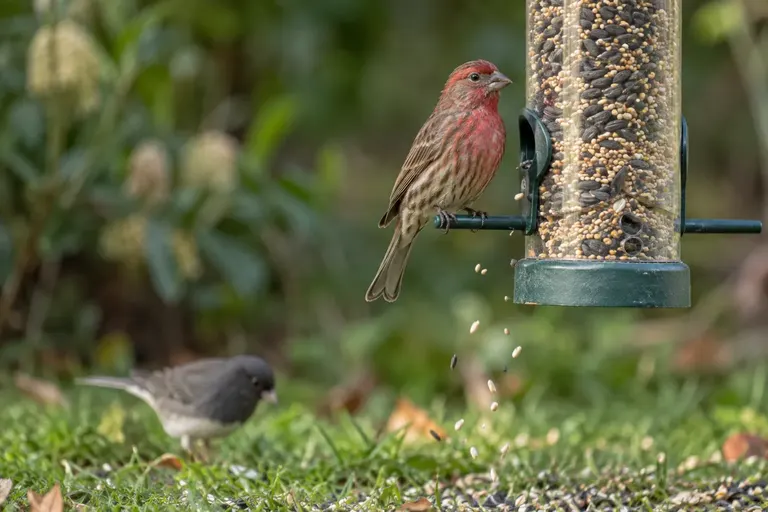
Most backyard birders meet starlings at the feeder rather than in a swirling cloud. They arrive in groups, eat quickly and can empty a suet cake in an afternoon, which is the same social behavior that powers a murmuration. If they overwhelm your feeders, see how to keep starlings and grackles off feeders for practical fixes.
A few ways to connect the backyard to the big spectacle:
- Watch the evening commute. On winter afternoons, look for small flocks of starlings flying purposefully in one direction around sunset. They are often heading for a roost, and following their line can lead you to a murmuration.
- Log what you see. Recording roost sizes and dates on eBird helps researchers track where roosts form and how they change. Our guide to using eBird explains how.
- Keep an eye on predators. If a Cooper’s Hawk or Sharp-shinned Hawk hunts your feeders, you are seeing a small version of the same pressure that drives flocking. Here is what to do about hawks at feeders.
- Understand the flock. Murmurations are an extreme example of a broader habit. For the full science of why birds group up, read why birds flock together.
How to watch a murmuration well
Murmurations are free, but a little planning makes the difference between a great evening and cold feet in an empty marsh.
- Check recent reports. Roosts move. Look for sightings from the past week from local wildlife groups or bird reporting sites.
- Arrive early. Aim for 45 minutes to an hour before sunset.
- Pick a vantage point. Stand where you can see open sky above the roost, ideally with the sunset behind the birds for strong silhouettes.
- Dress for standing still. Winter dusk is cold, and you will be motionless. Our guide on what to wear birding covers layering.
- Stay quiet and keep your distance. Do not approach the roost or use lights and drones near it. Disturbance can scatter birds that need a safe night.
- Watch the edges. Scan for a falcon or hawk near the flock. When a predator makes a pass, you will often see the flock split, compress or send a dark wave across its body.
- Stay until the drop. The final descent into the roost, sometimes a sudden pour of birds, is often the most dramatic moment.
How is a murmuration different from a V formation?
Both are coordinated flight, but they solve different problems. Geese, cranes and ibises flying in a V are thought to save energy by positioning themselves to catch rising air from the wingtip vortices of the bird ahead. Starlings in a murmuration are not saving energy that way. They are packed densely in three dimensions and changing direction constantly, which suits predator evasion rather than efficient long-distance travel. Read more in why birds fly in a V.
Quick facts
- A murmuration is a pre-roost aerial display, mainly by Common (European) Starlings.
- The name comes from the murmuring sound of massed wings.
- Displays happen at dusk, mainly in late autumn and winter in Europe.
- Each starling tracks roughly six or seven nearest neighbors, not a fixed distance.
- Changes in heading spread across the whole flock almost instantly, a property called scale-free correlation.
- The strongest explanation is protection from predators through confusion and dilution.
- Shorebirds such as Dunlin and Red Knot perform similar flights over estuaries.
- The Common Starling is red-listed in the UK after steep declines since the 1970s.
Sources
- Ballerini et al. (2008), Interaction ruling animal collective behavior depends on topological rather than metric distance, PNAS
- Cavagna et al. (2010), Scale-free correlations in starling flocks, PNAS
- Goodenough et al. (2017), Birds of a feather flock together: insights into starling murmuration behaviour revealed using citizen science, PLOS ONE
- Reynolds (1987), Flocks, herds and schools: a distributed behavioral model
Frequently asked questions
What time of year do starling murmurations happen?
In Europe, murmurations are mostly a late autumn and winter event, building from about October and often peaking in the colder months before thinning out by early spring, when birds disperse to breed. Timing shifts with location and weather. In Denmark's Wadden Sea marshes the famous 'black sun' displays are best known in spring and autumn migration periods.
What time of day do murmurations start?
Murmurations happen around dusk. Starlings spend the day feeding in fields and towns, then gather in the last hour or so before sunset over the roost site. The aerial display usually lasts from a few minutes to around half an hour, then the flock drops into reeds, trees or structures to spend the night. Arriving 45 minutes before sunset is a sensible plan.
How many birds are in a murmuration?
It varies enormously. Small murmurations may hold a few hundred starlings, while large winter roosts in Europe are often estimated in the tens or hundreds of thousands, and some historic roosts have been reported in the millions. Counts are rough estimates, because moving flocks are very hard to census, so treat any single headline number with caution.
Do murmurations happen in North America?
Yes. European Starlings were introduced to North America in the 1890s and now roost communally across much of the continent, so murmurations do occur, especially in fall and winter. They tend to be less celebrated than the classic European displays, and North American winter roosts often mix starlings with blackbirds and grackles.
Why don't starlings crash into each other in a murmuration?
Each starling responds to a small number of nearby birds, roughly six or seven neighbors according to 3D studies of flocks in Rome, adjusting its speed and direction to theirs while keeping a minimum spacing. Fast reactions and excellent motion vision let those local adjustments ripple across the flock without collisions, even at high density.
Are murmurations getting smaller?
In parts of Europe, likely yes. The Common Starling has declined sharply in the UK and several other countries since the 1970s and is red-listed as a species of high conservation concern in the UK. Individual roosts also move from year to year, so a site that seems quieter may simply have lost its birds to a nearby roost.