Why Don't Woodpeckers Get Headaches? The Brain Science
Why don't woodpeckers get headaches? A small, tightly packed brain, brief impacts, straight-line strikes and a stiff skull protect them. Here is the science.
In this article
- Quick answer: how woodpeckers protect their brains
- How hard does a woodpecker hit?
- Why does a small brain make such a big difference?
- Why do straight-line strikes protect the brain?
- Is a woodpecker’s skull a shock absorber?
- What does the woodpecker’s tongue bone do?
- Do woodpeckers ever get brain damage?
- Is drumming harder on the head than feeding?
- Why doesn’t the woodpecker’s bill break?
- Woodpeckers around the world
- Myths vs facts about woodpecker heads
- Can woodpecker science help people?
- What does this mean for backyard birders?
- Quick facts
- Sources
- Frequently asked questions
Why don’t woodpeckers get headaches or concussions from pecking? Mainly because their brains are very small and tightly packed, which lets them withstand decelerations of roughly 1,000 g or more per strike, far beyond what a human brain tolerates. Each strike also lasts only about a thousandth of a second and lands in a straight line along the bill. Contrary to a popular idea, recent research suggests the skull is not a shock absorber at all: it works more like a stiff hammer.
That last finding overturned years of assumptions, including the idea that spongy bone and a looping tongue bone cushion every blow. Here is what scientists now think actually protects a woodpecker’s head, and what is still unknown.
Quick answer: how woodpeckers protect their brains
- Small brain: tolerance to impact rises sharply as brain size falls. A woodpecker brain weighs only a few grams.
- Snug fit: little fluid space around the brain limits sloshing and bruising.
- Brief impacts: each strike lasts roughly half to one millisecond.
- Straight-line strikes: the head moves in a line with little twisting, which is what causes the worst brain injuries in people.
- Stiff, not springy, head: the skull and bill pass force into the wood rather than absorbing it.
- Strong neck and body: muscles, tail and feet brace the bird and control each blow.
- Unknowns remain: one study found a protein linked to brain injury in some woodpecker brains, and its meaning is not settled.
How hard does a woodpecker hit?
Very hard for its size. Classic measurements suggested woodpecker heads decelerate at around 1,000 times the force of gravity (1,000 g) or more when the bill strikes wood. More recent high-speed filming puts peak decelerations in the hundreds to over a thousand g depending on species and the type of pecking. For comparison, human concussions are often associated with head accelerations somewhere around 60 to 100 g or more, although the exact threshold varies a lot.
Woodpeckers also strike often. Drumming, the rapid-fire signal birds use to claim territory and attract mates, can run at roughly 10 to 25 strikes per second depending on species. Excavating a nest cavity in solid wood can take days to weeks of work. Over a day, estimates reach thousands of pecks.
Those numbers are why the question fascinates engineers and doctors. If a person hit their head that hard, that often, the damage would be severe. For background on why woodpeckers do it in the first place, see our guide on why woodpeckers peck wood.
Why does a small brain make such a big difference?
This is the core of the answer, and it comes from basic physics. When a moving head stops suddenly, the brain inside keeps moving for a moment and presses against the skull. The stress this creates in brain tissue depends heavily on the size of the brain.
Scaling rules suggest that the acceleration a brain can tolerate rises roughly as brain mass falls, in proportion to brain mass to the power of about minus one third. In practical terms, a brain of only a few grams can withstand accelerations many times higher than a human brain of around 1,300 to 1,400 g in weight. Researchers who compared the numbers found that even a hard woodpecker strike stays within the range a brain that small should tolerate.
Put simply, a woodpecker is not a tiny human with extra padding. It is a small animal whose brain is naturally robust to jolts that would hurt a large one.
Does the fit of the brain matter?
Yes. In humans, cerebrospinal fluid surrounds the brain and cushions everyday movements, but in a violent impact the brain can shift inside that fluid layer and hit the skull. A woodpecker’s brain sits snugly in the skull with relatively little fluid space around it, so there is less room to build up speed before it meets bone.
The brain’s shape and orientation also help. The woodpecker brain is oriented so that its broad surface faces the direction of impact, spreading force over a larger area rather than concentrating it.
Why do straight-line strikes protect the brain?
Many serious human brain injuries come not from straight blows but from rotation, when the head twists or whips around. Rotation creates shearing forces that stretch and tear nerve fibers deep in the brain.
Woodpeckers strike in a largely straight line. Their bill, head and neck align with the direction of travel, and the strong neck muscles keep the head on course. High-speed video shows remarkably little twisting at impact, which avoids the kind of rotational stress that is most damaging to brains.
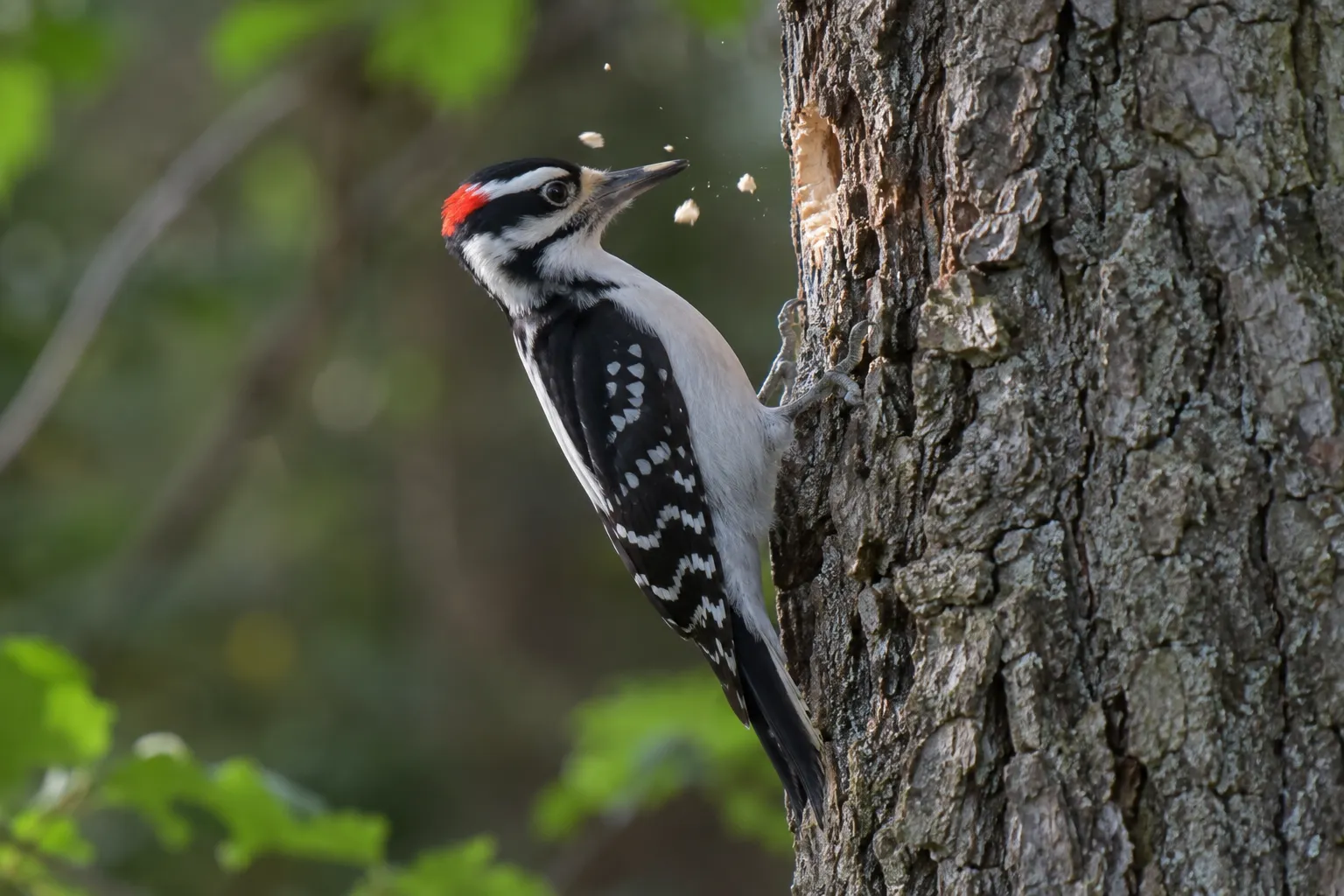
Their bodies help too. A woodpecker clings to the trunk with strong, often zygodactyl feet, which in many species have two toes pointing forward and two back. The stiff tail feathers brace against the bark. This tripod stance turns the bird into a stable platform so each strike is controlled and accurate. Species like the Hairy Woodpecker and the much larger Pileated Woodpecker show this posture clearly.
Is a woodpecker’s skull a shock absorber?
For years, articles, museum signs and even some engineering papers described the woodpecker skull as a natural shock absorber. The story went that spongy bone behind the bill, a flexible tongue bone and cushioned tissues soaked up the energy of each blow.
A 2022 study led by researchers at the University of Antwerp challenged this. The team filmed Black Woodpeckers, Great Spotted Woodpeckers and Pileated Woodpeckers pecking at high speed and tracked the movement of the bill and eye. They found that the head decelerated almost as quickly as the bill tip. In other words, very little of the impact was absorbed on its way from bill to brain.
Their modeling showed why this makes sense. If the head were a good shock absorber, it would soften each strike and the bird would have to hit harder or more often to chip the wood. Evolution seems to favor a stiff hammer that delivers force efficiently. The brain is protected mainly by its small size, not by cushioning.
What about the spongy bone?
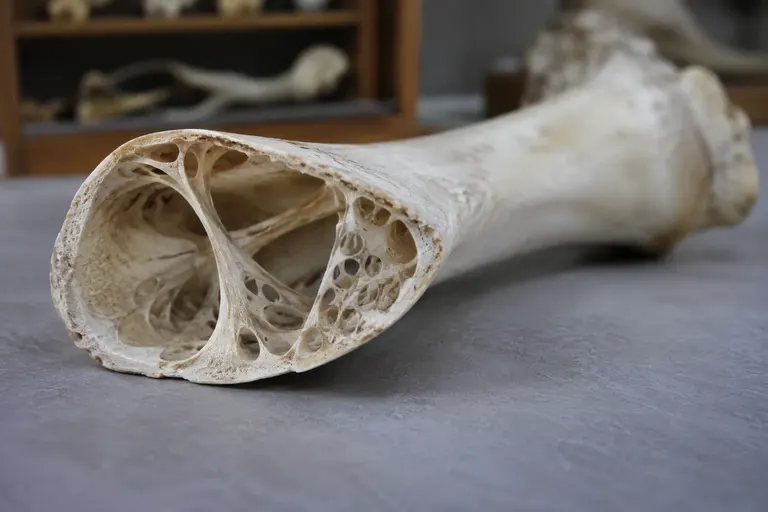
Woodpecker skulls do have areas of plate-like spongy bone, particularly at the back and top of the skull, and the bill has a layered structure of bone and keratin. These features probably help the skull resist cracking and fatigue over millions of strikes, a bit like a well-built hammer handle. But based on the recent evidence, their main job is likely structural strength rather than absorbing shock before it reaches the brain.

What does the woodpecker’s tongue bone do?
The hyoid apparatus is one of the most remarkable features of a woodpecker. It is a flexible structure of slender bones and cartilage wrapped in muscle that supports the tongue. In many woodpeckers it starts near the throat, splits into two long horns, curves around the back of the skull, runs over the top of the head and anchors near the eye socket or even into the nostril area in some species.
This design lets woodpeckers push their tongue far out of the bill to probe insect tunnels, ant nests and bark crevices. Northern Flickers, which feed heavily on ants, and wrynecks in Europe and Asia have especially long tongues.
Some researchers proposed that the hyoid acts like a seat belt or safety sling around the brain, damping vibration. That idea is still discussed, but it has not been clearly demonstrated. The tongue’s main, proven role is feeding.
Do sapsuckers work differently?
Sapsuckers peck many shallow holes to make sap flow and then lick up sap and trapped insects. Their tongues are shorter with brush-like tips, and their pecking is typically less forceful than excavating. They show the same general head design as other woodpeckers but put it to lighter use.
Do woodpeckers ever get brain damage?
This is where the science is honestly unsettled. A 2018 study examined preserved brains of woodpeckers from museum collections and compared them with brains of non-pecking birds. It found accumulations of the protein tau in some woodpecker brains. In people, tau build-up is associated with repeated head trauma and conditions such as chronic traumatic encephalopathy.
The authors were careful not to conclude that woodpeckers have brain injury. Tau might play a different role in birds, possibly even a protective one, and the sample was small. Behaviorally, woodpeckers show no clear signs of impairment. They forage, nest and survive in the wild like other birds of similar size.
So the most accurate statement is that woodpeckers appear well protected from the kind of acute injury pecking would cause in people, but researchers are still learning whether there is any long-term cost.
What about the eyes?
Rapid deceleration could in theory strain the eyes. Woodpeckers blink a thick third eyelid, the nictitating membrane, just before each impact. This probably protects the eyes from flying wood chips and may help hold them steady. Stiff bristle-like feathers over the nostrils also keep sawdust out of the airway.
Is drumming harder on the head than feeding?
Not necessarily, but it is different. Woodpeckers use three main kinds of pecking, and each loads the head in its own way.
- Foraging taps: light, exploratory strikes on bark to find insects or flake off loose bark. Force is modest and rhythm is irregular.
- Excavating: slow, powerful blows to chisel out nest or roost cavities or reach wood-boring larvae. These produce the highest impact forces.
- Drumming: very fast bursts of strikes on a resonant surface, such as a hollow limb, a utility pole or a metal chimney cap. Each strike is usually lighter than an excavating blow, but the rate is extreme.
Drumming is a signal, much like song in other birds. Each species has a characteristic rhythm, speed and length, and experienced birders can often tell species apart by drumming alone. The Black Woodpecker in Europe produces long, loud rolls that carry far through forests, while the Yellow-bellied Sapsucker in North America drums in an irregular, stuttering pattern that sounds like Morse code.
Because drumming aims for loudness rather than damage to the wood, birds choose surfaces that ring. That is why a woodpecker may hammer on a gutter or satellite dish in spring. The metal is a loudspeaker, not a food source.

Why doesn’t the woodpecker’s bill break?
A woodpecker’s bill takes the first hit every time, so it needs to be strong and to wear evenly. The bill is a bony core covered by a sheath of keratin, the same protein found in fingernails. In woodpeckers this sheath is thick and hard, and it grows continuously, which replaces tissue worn away at the chisel-shaped tip.
Studies of the bill’s microstructure suggest the keratin scales are arranged in layers that help stop tiny cracks from spreading. In some species, the upper and lower halves of the bill differ slightly in length or structure, which may help distribute stress. Researchers are still working out how much each of these details contributes, but together they help explain why woodpecker bills rarely fracture despite a lifetime of heavy use.
Woodpeckers around the world
There are more than 200 woodpecker species on every continent except Australia and Antarctica, and all share the same basic head design, adjusted to their lifestyle.
| Species | Region | Notable pecking habit |
|---|---|---|
| Downy Woodpecker | North America | Small; forages on thin twigs and weed stems |
| Pileated Woodpecker | North America | Large; excavates big rectangular holes for carpenter ants |
| Great Spotted Woodpecker | Europe and Asia | Loud drumming in spring; also raids nest boxes |
| Black Woodpecker | Europe and Asia | Crow-sized; digs large cavities later used by owls and ducks |
| Campo Flicker | South America | Often feeds on the ground on ants and termites |
| Syrian Woodpecker | Turkey, Middle East, southeast Europe | Common in orchards, gardens and towns |
| Eurasian Wryneck | Europe, Asia, Africa | Rarely excavates; feeds mostly on ants with a long tongue |
The variety is a reminder that “woodpecker” covers heavy excavators, gentle bark probers and ground-feeding ant eaters. Heavy excavators such as the Black and Pileated Woodpeckers strike the hardest and have the strongest skulls and neck muscles.
Myths vs facts about woodpecker heads
Myth: Woodpeckers have built-in shock absorbers. Fact: Recent high-speed filming suggests the head acts as a stiff hammer. The brain is protected mainly by its small size.
Myth: The tongue wraps around the brain like a cushion. Fact: The hyoid apparatus loops around the skull, not directly around the brain, and its main proven job is feeding. A protective role is uncertain.
Myth: Woodpeckers never suffer any brain effects. Fact: One study found tau protein build-ups in some woodpecker brains. What that means is still unknown.
Myth: Woodpeckers peck only to find food. Fact: They also peck to excavate nest and roost holes and drum to communicate.
Myth: Pecking kills healthy trees. Fact: Most excavation happens in dead or decaying wood. Sapsuckers can damage some trees, but woodpeckers generally signal insect problems rather than cause them.
Can woodpecker science help people?
Engineers have long been inspired by woodpeckers when designing protective gear, including helmets and shock-resistant electronics. The newer findings add a twist: the woodpecker’s protection is mostly about scale, so simply copying its head shape will not make a human helmet safer. Some ideas do transfer, such as reducing rotation and spreading force over a wider area, which are already central to modern helmet design.
Researchers also study the woodpecker’s bill, which is made of layers of keratin, bone and connective tissue, for insights into materials that resist repeated impact without cracking.

What does this mean for backyard birders?
Understanding woodpecker heads can help you appreciate what you see at the feeder and in your trees.
- Listen in late winter and spring. Drumming peaks as birds establish territories. Loud hammering on a gutter or chimney cap is usually a male advertising, not feeding.
- Offer suet. Suet and peanut feeders attract woodpeckers across much of the world, from Downy Woodpeckers in the United States to Great Spotted Woodpeckers in Britain. Our guide to suet feeders covers styles that let woodpeckers brace with their tails.
- Leave dead wood where safe. A standing dead tree or large dead limb, away from paths and buildings, gives woodpeckers feeding and nesting sites. Their old holes later shelter chickadees, tits, nuthatches and bluebirds.
- Watch the posture. Notice how the tail braces against the bark and the head moves straight in and out. That tripod stance is part of what keeps each strike safe.
- Know your locals. Our species guides to the Downy Woodpecker and Red-bellied Woodpecker show what they eat and how to attract them.
If a woodpecker is drumming on your house, the behavior is usually seasonal and fades once territories are settled. Covering the spot temporarily or adding visual deterrents is usually enough. There is no need to worry about the bird hurting itself.
Quick facts
- A woodpecker’s head can decelerate at roughly 1,000 g or more when it strikes.
- Each impact lasts only about half to one millisecond.
- A woodpecker brain weighs only a few grams, which makes it far more tolerant of impacts than a human brain.
- Straight-line strikes avoid the rotational forces that cause the worst brain injuries.
- High-speed video suggests the head works like a stiff hammer, not a shock absorber.
- The hyoid bones loop around the skull and let the tongue extend far beyond the bill.
- A thick third eyelid closes just before impact.
- Some woodpecker brains show tau protein build-up; its meaning is not yet known.
- Woodpeckers live on every continent except Australia and Antarctica.
Sources
- Van Wassenbergh, S., et al. (2022). Woodpeckers minimize cranial absorption of shocks. Current Biology
- Farah, G., et al. (2018). Tau accumulations in the brains of woodpeckers. PLOS ONE
- Hairy Woodpecker overview - Cornell Lab of Ornithology, All About Birds
- Pileated Woodpecker overview - Cornell Lab of Ornithology, All About Birds



Frequently asked questions
How do woodpeckers not get brain damage?
Mostly through size and physics. A woodpecker's brain is tiny and packed tightly in the skull with little room to slosh, so the forces it can tolerate are far higher than for a human brain. Each impact lasts only about a thousandth of a second, strikes are straight in line with the bill, and the thick neck muscles hold the head on course.
Does a woodpecker's tongue wrap around its brain?
Not exactly. The tongue is supported by the hyoid apparatus, a set of long, slender bones and muscle that in many woodpeckers loops from the base of the bill around the back of the skull and over the top of the head. It lets the bird extend its tongue far out of the bill. Whether it also protects the brain is still debated.
How many times a day does a woodpecker peck?
Estimates vary by species and activity, but active woodpeckers can strike thousands of times a day while feeding, excavating or drumming. Drumming bursts often run at roughly 10 to 25 strikes per second. Pecking rates are highest during excavation and territorial drumming in spring, and lower during relaxed foraging on bark.
Do woodpeckers get concussions?
There is no clear evidence that healthy woodpeckers suffer concussions from normal pecking. One study found build-ups of the protein tau in some woodpecker brains, which in people is associated with brain injury, but the authors noted it might be harmless or even protective in birds. The question remains open.
Is a woodpecker's skull a shock absorber?
Recent research suggests not. High-speed video analysis of several woodpecker species found their heads behave mostly like stiff hammers, transferring force into the wood rather than cushioning it. Shock absorption would actually weaken each blow. The brain appears to be safe mainly because it is small, not because the skull soaks up the impact.