Can You Get Sick From Bird Feeders?
Can you get sick from bird feeders? Yes, but rarely. Salmonella is the main risk, and simple hygiene prevents it. Germs, droppings and bird flu explained.
In this article
- Quick answer: what are the risks?
- How can bird feeders make people sick?
- Salmonella: the main risk from bird feeders
- What other diseases can you catch from birds at feeders?
- Can you get bird flu from a bird feeder?
- Can birdbaths, hummingbird feeders and nest boxes make you sick?
- How do diseases spread between birds at feeders?
- What should you do if you get sick after handling a feeder?
- Who is most at risk?
- How do you feed birds safely?
- What should you do if you see sick birds at your feeder?
- Common mistakes
- Myths and facts
- Quick facts
- Sources
- Frequently asked questions
Yes, you can get sick from bird feeders, but it is uncommon, and simple hygiene, such as washing your hands and soaking feeders in 1 part bleach to 9 parts water, prevents nearly all of the risk. The main concern is Salmonella, a bacterium that wild birds can shed in their droppings onto feeders, trays and the ground. People usually catch it by touching a contaminated feeder and then touching their mouth or food without washing their hands.
For most healthy adults who wear gloves or wash up after handling feeders, the risk is very small. It is worth taking more seriously if young children, older adults, pregnant people or anyone with a weakened immune system live in the household, and it matters for the birds as well, because the same germs spread disease between them.
Quick answer: what are the risks?
- Main risk: Salmonella from bird droppings on feeders, birdbaths and spilled seed.
- Less common risks: psittacosis (from certain birds, mostly pet parrots and pigeons), and fungal infections from long-term accumulations of droppings.
- Bird flu: very low risk from backyard songbird feeders, according to health agencies.
- Who is most vulnerable: children under 5, adults over 65, pregnant people and anyone with a weakened immune system.
- How to prevent it: gloves, cleaning outdoors, regular feeder cleaning and washing hands with soap and water.
How can bird feeders make people sick?
Feeders bring many birds to one spot, often day after day. Birds perch, eat and defecate in the same small area. That is good for viewing and bad for hygiene. Anything shed in droppings can build up on perches, ports, trays and the ground beneath.
People are exposed in a few predictable ways:
- Hand to mouth. Filling or cleaning a feeder, then eating, smoking or touching your face before washing your hands.
- Cross-contamination indoors. Cleaning feeders in the kitchen sink, or setting them on food counters.
- Children and pets. Kids playing under feeders, or dogs and cats eating spilled seed and droppings, then licking hands and faces.
- Dust. Sweeping or blowing dried droppings can raise particles, which matters for some fungal and bacterial infections.
Salmonella: the main risk from bird feeders
Salmonella bacteria live in the intestines of many animals, including some wild birds. Certain strains circulate among songbirds and can cause outbreaks at feeders, especially in winter, when birds crowd together.
What happens in birds
Finches and siskins are particularly affected. In North America, Pine Siskins, American Goldfinches and House Finches are among the species most often reported in Salmonella outbreaks at feeders. In Britain and Europe, greenfinches, chaffinches and house sparrows have been affected. Sick birds often look fluffed up and lethargic, sit on the feeder or ground for long periods and can be approached closely. Our guide to sick birds at the feeder explains how to recognize them.
What happens in people
Salmonella infection in people usually causes diarrhea, fever and stomach cramps, starting roughly half a day to a few days after exposure and lasting several days. Most people recover without treatment, but severe cases can require hospital care, especially in vulnerable groups.
Has this actually happened?
Yes. In 2021, a large Salmonella outbreak spread through Pine Siskins and other finches in parts of the United States. Public health investigators linked a strain found in sick birds to a group of human illnesses in several states. Some of those people had handled bird feeders or sick birds, and some had pets that had contact with wild birds. Wildlife agencies in several states asked people to take feeders down for a period to let the outbreak die down.
Cases like this are uncommon, but they show the link is real. Most people who feed birds never get sick. The ones who do usually skipped a basic step such as handwashing.
What other diseases can you catch from birds at feeders?
Psittacosis
Psittacosis is a bacterial infection caused by Chlamydia psittaci. It most often comes from pet parrots, parakeets and cockatiels, and from pigeons and doves. Infection usually happens by breathing in dust from dried droppings or feather dust. Cases linked to backyard songbird feeders are rare. Symptoms resemble the flu or pneumonia, so anyone who becomes ill after close contact with birds should mention it to their doctor. Pigeons and doves are regular feeder visitors in many parts of the world, which is one more reason to keep feeding areas clean and avoid raising dust.
Histoplasmosis and cryptococcosis
These are fungal infections. The fungus behind histoplasmosis grows in soil rich in bird or bat droppings, especially in parts of the central and eastern United States, around the Ohio and Mississippi River valleys, and in parts of Central and South America. Infection happens when disturbed soil releases spores into the air. The fungus behind cryptococcosis is associated with pigeon droppings.
These risks are mostly linked to large roosts, old barns, attics and heavily used pigeon sites rather than a typical backyard feeder. Still, if droppings build up in one spot for years, the same principles apply: dampen the area before cleaning, avoid sweeping dust into the air and consider a mask.
E. coli and Campylobacter
Wild birds can carry other intestinal bacteria, including Campylobacter and some strains of E. coli. These are more often associated with poultry, gulls and water contaminated by large flocks than with songbird feeders, but the same handwashing habits protect against them.
West Nile virus
You cannot catch West Nile virus directly from birds at a feeder. It spreads through mosquito bites. Birds are part of the virus’s natural cycle, but the risk to people comes from mosquitoes. Changing birdbath water every few days prevents mosquitoes from breeding in it.
Can you get bird flu from a bird feeder?
Highly pathogenic avian influenza, often called bird flu or H5N1, has spread widely among wild birds and poultry since 2021. It has infected mammals and a small number of people who had close contact with infected poultry or dairy cattle.
Health and wildlife agencies generally consider the risk from backyard songbird feeders to be very low. The virus mainly affects waterfowl, gulls, seabirds, poultry and birds of prey, and typical feeder birds such as chickadees, finches, sparrows and cardinals are rarely infected. Most agencies do not recommend taking feeders down because of bird flu, unless you keep backyard poultry or local authorities issue specific advice.
If you keep chickens or ducks, keep wild bird feeders well away from them and stop wild birds from reaching poultry feed and water. For the latest recommendations, see our page on bird flu and backyard feeders. Guidance can change quickly during outbreaks, so check with your state wildlife agency or national authority.
Can birdbaths, hummingbird feeders and nest boxes make you sick?
Feeders are not the only places where germs collect. Any spot that many birds share, or where droppings and old material build up, deserves the same care.
Birdbaths
Birds drink and bathe in the same shallow water, and they often defecate while standing in it. Within a few days in warm weather, a birdbath can hold droppings, feathers, algae and bacteria. Change the water every two to three days, scrub the basin with a stiff brush when you see a film, and wear gloves if you reach into dirty water. Keep birdbaths away from outdoor dining areas and children’s play spaces.
Hummingbird feeders
Sugar water spoils quickly, especially in hot weather, and grows mold, yeast and bacteria. This is mainly a risk to the birds rather than to people, but it is still good practice to wash your hands after cleaning nectar feeders. Change nectar every one to two days in hot weather and every few days when it is cool, and scrub the ports with a small brush.
Nest boxes
Old nests can contain droppings, parasites such as mites and fleas, and sometimes mouse nests. When you clean out a birdhouse after the breeding season, wear gloves, consider a dust mask if the material is dry and dusty, and avoid shaking debris near your face. Our guide on when and how to clean out a birdhouse explains timing and the rules that protect active nests.
How do diseases spread between birds at feeders?
Protecting yourself and protecting the birds go hand in hand. Several diseases spread mainly or partly at feeding stations, and some have had large effects on bird populations.
- Salmonellosis. Spread through droppings contaminating food and water. Outbreaks tend to peak in late winter, when birds concentrate at feeders.
- Trichomonosis. Caused by a single-celled parasite spread in saliva, contaminated food and water. It devastated European Greenfinch and Common Chaffinch populations in Britain after it emerged in finches in the mid 2000s, and it affects doves and pigeons worldwide. It is not considered a risk to people.
- House Finch eye disease. A bacterial infection (Mycoplasma) that causes swollen, crusty eyes in House Finches and some other finches in North America. It spreads when infected birds touch feeder ports. It does not infect people.
- Avian pox. A virus that causes warty growths on the feet, legs and face. It spreads through direct contact, contaminated surfaces and biting insects. It is not a risk to people.
The pattern is the same for all of them: crowding and dirty surfaces help disease spread. That is why regular cleaning, several spread-out feeders and taking feeders down during outbreaks are recommended by bird conservation groups on both sides of the Atlantic, including the Cornell Lab of Ornithology and the RSPB.
What should you do if you get sick after handling a feeder?
Most cases of mild stomach illness have nothing to do with birds. But if you develop diarrhea, fever and stomach cramps within a few days of cleaning feeders or handling a sick bird, or flu-like symptoms after close contact with pigeons or pet birds, mention the bird contact when you see a doctor. It can change which tests they order. Drink plenty of fluids, and seek care promptly if symptoms are severe, if you see blood in the stool or if the person who is ill is very young, elderly, pregnant or has a weakened immune system.
Who is most at risk?
Most healthy adults face little risk. The groups who should be most careful are:
- Children under 5, who put their hands in their mouths often and have developing immune systems.
- Adults over 65, who are more likely to have severe Salmonella illness.
- Pregnant people.
- People with weakened immune systems, including those undergoing cancer treatment, living with HIV, taking immune-suppressing drugs or managing some chronic illnesses.
If someone in these groups lives in your home, it is sensible to have another household member handle feeder cleaning, or to be especially strict about gloves and handwashing.
How do you feed birds safely?
Good hygiene protects both you and the birds. The same habits that reduce your risk also slow the spread of Salmonella, trichomonosis, avian pox and House Finch eye disease between birds.
Step-by-step hygiene routine
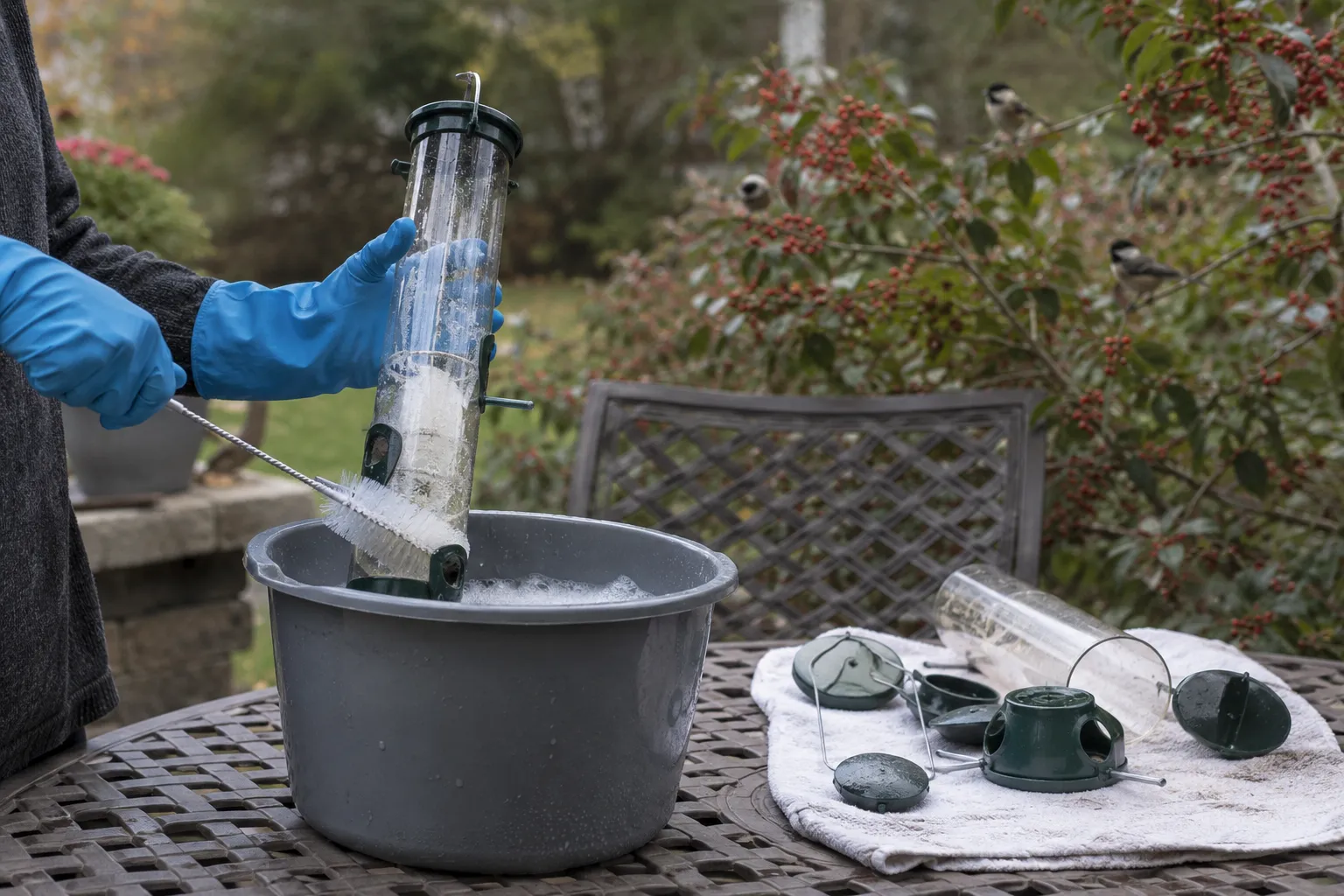
- Wear gloves when filling or cleaning feeders and birdbaths. Disposable or dedicated rubber gloves both work.
- Clean feeders regularly. Every two weeks is a reasonable baseline, and more often in wet weather, during outbreaks or when many birds visit.
- Clean outdoors. Use a bucket, a dedicated brush and hot soapy water. Keep feeder brushes away from kitchen items.
- Disinfect. Many wildlife organizations recommend soaking cleaned feeders in a dilute bleach solution of roughly 1 part household bleach to 9 parts water for about 10 minutes, then rinsing thoroughly.
- Dry completely before refilling. Damp seed molds quickly.
- Rake up the ground. Remove spilled seed, hulls and droppings under feeders regularly.
- Wash your hands with soap and water afterward, even if you wore gloves.
Our step-by-step guide on how to clean bird feeders goes into detail for tube, hopper, tray and hummingbird feeders, and our guide on cleaning a bird bath covers water features.
Other smart habits
- Space feeders out. Several feeders spread across the yard reduce crowding, which lowers disease transmission between birds.
- Use feeders that keep seed dry. Wet, clumped seed grows mold and bacteria.
- Buy fresh seed and store it well. Our guides on storing bird seed and whether bird seed goes bad explain how to avoid moldy seed, which can make birds sick.
- Place feeders thoughtfully. Avoid hanging them over patios, play areas, vegetable beds or outdoor dining tables. Our guide to where to put a bird feeder covers placement.
- Discourage rodents. Spilled seed attracts rats and mice, which carry their own diseases. Picking up spilled seed each evening helps.
What should you do if you see sick birds at your feeder?
If you notice several fluffed-up, lethargic birds, birds with swollen or crusty eyes or birds dying near your feeders:
- Take feeders and birdbaths down for at least one to two weeks. This disperses birds and slows transmission.
- Clean and disinfect everything before putting it back up.
- Rake and remove seed and droppings from the ground.
- Do not handle sick or dead birds with bare hands. Use gloves or an inverted plastic bag, and wash your hands afterward.
- Report unusual deaths. In the United States, contact your state wildlife agency. In the United Kingdom, the Garden Wildlife Health project collects reports. Many countries have similar schemes.
Common mistakes
- Cleaning feeders in the kitchen sink or on food preparation surfaces.
- Skipping handwashing because the feeder “looked clean.”
- Letting children play under feeders where seed and droppings collect.
- Topping up without cleaning for months, so old seed and droppings pile up inside.
- Using only water instead of soap and a disinfectant rinse.
- Leaving birdbath water for a week or more, which grows bacteria and mosquito larvae.
Myths and facts
Myth: “Feeding birds is a health hazard”
Fact: The risk to people is small and easily managed. Millions of households feed birds safely. The benefit to wellbeing, and the enjoyment, are real. Hygiene is what keeps the risk low.
Myth: “Hand sanitizer is enough”
Fact: Alcohol-based sanitizer helps when soap is not available, but soap and running water are better at removing dirt and organic material, which is exactly what you get from feeders.
Myth: “Birds carry bird flu to every feeder”
Fact: The songbirds that use most feeders are rarely infected with highly pathogenic avian influenza. Waterfowl, poultry and scavenging birds carry most of the risk.
Myth: “If birds look healthy, the feeder is clean”
Fact: Birds can carry and shed Salmonella without looking sick. Cleaning on a schedule matters more than waiting for visible signs.
Quick facts
- Yes, you can get sick from bird feeders, but it is uncommon.
- Salmonella from bird droppings is the main risk.
- Psittacosis and fungal infections are rare and linked mostly to pigeons, pet parrots and large accumulations of droppings.
- The risk of bird flu from songbird feeders is considered very low.
- Clean feeders every two weeks, outdoors, and disinfect with dilute bleach.
- Always wash your hands with soap and water afterward.
- Take feeders down for one to two weeks if you see sick birds.
Sources
- Centers for Disease Control and Prevention, Salmonella. https://www.cdc.gov/salmonella/index.html
- Centers for Disease Control and Prevention, Bird flu. https://www.cdc.gov/bird-flu/
- Cornell Lab of Ornithology, Pine Siskin species account. https://www.allaboutbirds.org/guide/Pine_Siskin/overview
- Cornell Lab of Ornithology, House Finch species account. https://www.allaboutbirds.org/guide/House_Finch/overview
- Project FeederWatch, Cornell Lab of Ornithology and Birds Canada. https://feederwatch.org
Frequently asked questions
Can you catch salmonella from a bird feeder?
Yes, though it is uncommon. Wild songbirds can carry Salmonella bacteria and shed them in droppings, which end up on feeders, trays and the ground below. People are infected by touching contaminated surfaces and then touching their mouth or food. Wearing gloves, cleaning feeders outdoors and washing hands afterward prevents almost all risk.
Should I wash my hands after filling a bird feeder?
Yes. Wash with soap and water after filling, cleaning or handling any feeder, birdbath or seed tray, even if the feeder looks clean. Droppings can be invisible. This is especially important before eating, cooking or touching young children, and for anyone who is pregnant, elderly or has a weakened immune system.
Can you get bird flu from a backyard bird feeder?
The risk is considered very low. Highly pathogenic avian influenza mainly affects waterfowl, poultry, gulls and birds of prey, and songbirds that visit feeders are rarely infected. Health agencies still advise basic hygiene. If you keep backyard poultry, keep them away from wild bird feeders and follow local guidance during outbreaks.
Is it safe to clean a bird feeder in the kitchen sink?
It is best not to. Cleaning a feeder where you prepare food risks spreading bacteria from bird droppings onto dishes and counters. Clean feeders outdoors with a dedicated brush and bucket, or in a utility sink, and disinfect the area afterward. Wear gloves and wash your hands when you are done.
Can bird droppings under a feeder make you sick?
Fresh droppings can carry bacteria such as Salmonella. Large, long-term accumulations of droppings in soil can also support fungi such as the one that causes histoplasmosis, though this is linked more to roosts and old buildings than to typical feeders. Rake up spilled seed and droppings regularly and avoid raising dust.