Hummingbird Nectar: The 4:1 Recipe (and Why Not Red Dye)
The hummingbird nectar recipe experts agree on: 1 part plain white sugar to 4 parts water, no red dye, no honey. Ratios, storage and how often to change it.
In this article
- Quick answer: the 4:1 hummingbird nectar recipe
- How to make hummingbird nectar, step by step
- Why 4:1? What the ratio does
- Why not red dye in hummingbird nectar?
- What sugar should you use (and what to avoid)?
- How often should you change hummingbird nectar?
- How to clean a hummingbird feeder
- Ants and bees at the nectar feeder
- When to put hummingbird feeders out and take them down
- Common hummingbird nectar mistakes
- Why aren’t hummingbirds drinking my nectar?
- Beyond the feeder: flowers and insects
- How we put this guide together
- Sources
- Frequently asked questions
The best hummingbird nectar recipe is also the simplest: 1 part plain refined white sugar to 4 parts water. No red dye, no honey, no brown or raw sugar, no sweeteners. Audubon, the Cornell Lab of Ornithology, the Smithsonian’s National Zoo and Penn State Extension all give the same 4:1 ratio, and they agree that dye is unnecessary.
The part people get wrong is not the recipe. It is freshness. Sugar water spoils quickly in warm weather, so the real skill is changing it on time and keeping the feeder clean.
Quick answer: the 4:1 hummingbird nectar recipe
- Ratio: 1 part refined white sugar to 4 parts water.
- Small batch: 1/4 cup sugar + 1 cup water.
- Large batch: 1 cup sugar + 4 cups water.
- Mix: stir until the sugar fully dissolves. Hot water speeds this up.
- Cool: let it reach room temperature before filling the feeder.
- Skip: red dye, honey, corn syrup, brown, raw or organic unrefined sugar, and artificial sweeteners.
- Change: every 2 to 3 days in mild weather, daily when it is very hot.
- Store extra: in the refrigerator for up to one week.
How to make hummingbird nectar, step by step
What you need
- Plain white granulated table sugar (cane or beet sugar are both refined sucrose)
- Water that is safe for you to drink
- A measuring cup
- A clean pot or heat-safe jug
- A clean spoon
- A lidded jar if you are storing extra
Steps
- Measure the water. For one small feeder, 1 cup is plenty. For several feeders, use 4 cups.
- Heat the water if you like. Hot water dissolves sugar faster. Audubon’s version pours boiling water over the sugar; Penn State Extension boils the water first, then pours it over the sugar. The Cornell Lab notes that boiling is not required if you mix small batches every day or two.
- Add sugar at a 1:4 ratio. 1/4 cup sugar for every 1 cup of water.
- Stir until clear. There should be no grains left at the bottom.
- Cool completely. Warm nectar spoils faster, and hot nectar can damage plastic feeders.
- Fill only what the birds will drink. The Cornell Lab recommends choosing feeder sizes that your hummingbirds empty every day or two. A half-filled feeder that you change often beats a full feeder that sours.
- Refrigerate the rest in a clean, covered container, and use it within one week.
Nectar batch sizes
| Sugar | Water | Makes about | Good for |
|---|---|---|---|
| 1/4 cup | 1 cup | 1 1/4 cups | One small feeder, early or late season |
| 1/2 cup | 2 cups | 2 1/2 cups | One or two feeders |
| 1 cup | 4 cups | 5 cups | Several feeders, or a busy summer week (refrigerate extra) |
| 2 cups | 8 cups | about 10 cups | Peak season with many birds |
Because sugar takes up volume as it dissolves, the finished amount is a little less than the two numbers added together. That does not change the ratio.
Why 4:1? What the ratio does
A hummingbird runs on sugar. Audubon notes that hummingbirds eat about half their body weight in bugs and nectar each day and feed every 10 to 15 minutes. The 4:1 mix gives them a steady, easily digested energy source, close to the sweetness of many flowers they visit.
Going weaker makes the feeder less rewarding, so birds may spend their limited time elsewhere. Going much stronger is not better either. Penn State Extension warns against both weak solutions, which are less attractive, and strong solutions, which may be harmful. The Cornell Lab’s one exception is a modest bump to 1/3 cup sugar per cup of water during cold, rainy spells when birds need extra energy. Go back to 1/4 cup when the weather improves.
Why not red dye in hummingbird nectar?
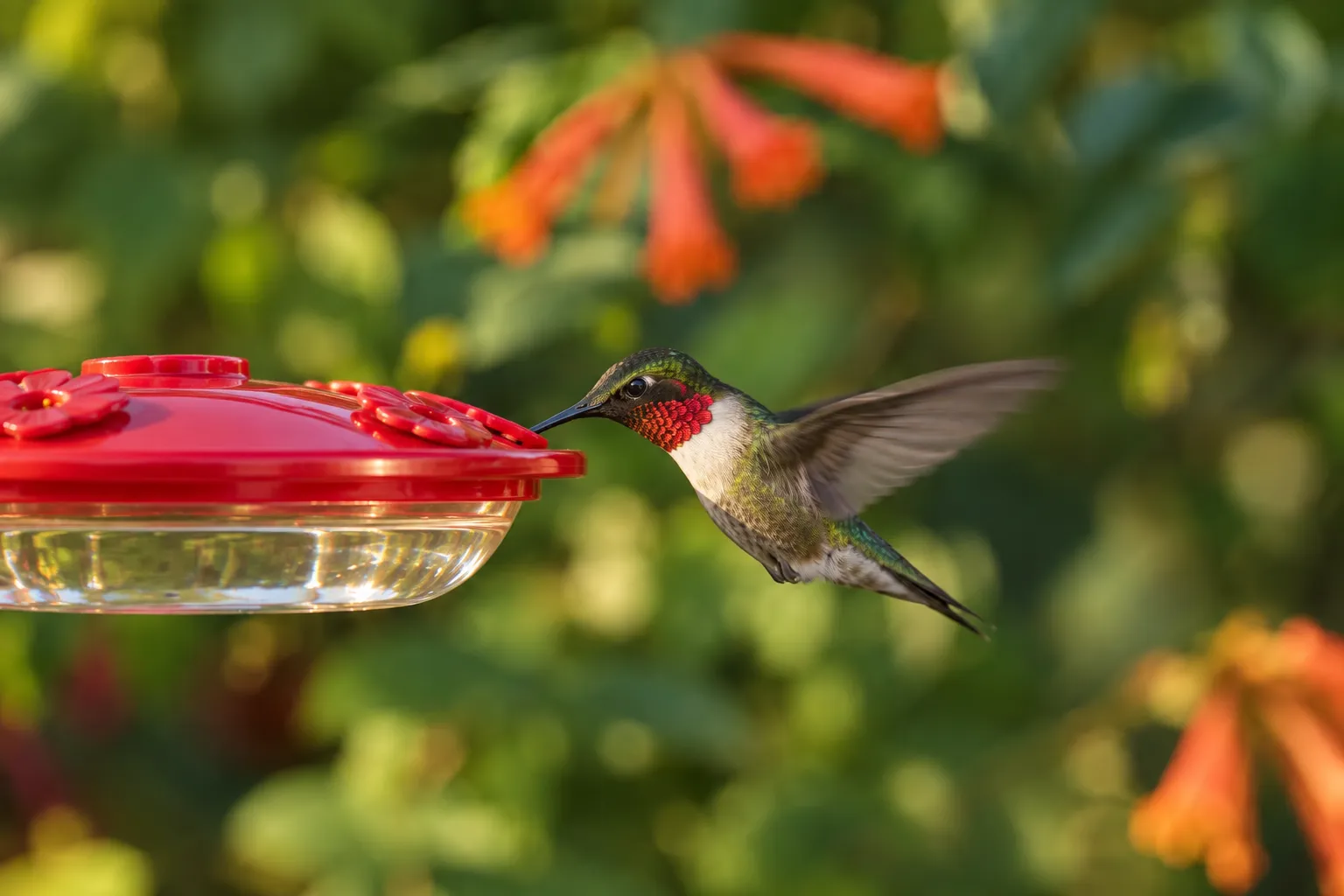
Hummingbirds are drawn to the color red, which is why dyed nectar became popular. But the red on the feeder itself does the attracting. Nearly every commercial hummingbird feeder has red ports, a red base or a red top.
Every major bird organization advises leaving dye out:
- The Cornell Lab of Ornithology says there is no need to add red food coloring to sugar water and that it may be harmful to hummingbirds.
- Audubon calls red food coloring not necessary and says it could prove harmful.
- Project FeederWatch says not to add red food coloring because it is harmful to birds.
- The Smithsonian’s National Zoo says red dye is not necessary to attract hummingbirds and could be harmful.
Is red dye proven to hurt hummingbirds?
Here the honest answer is: not directly. Hummingbird biologist Sheri L. Williamson, author of a Peterson field guide to hummingbirds, has pointed out that no one has tested the dyes on hummingbirds themselves. Wild hummingbirds are protected under the Migratory Bird Treaty Act, are hard to keep in captivity, and a meaningful study would need many birds. What does exist is a large body of research on the dyes themselves, such as FD&C Red No. 40, in other animals and contexts.
So the case against dye is a risk-versus-benefit case. A hummingbird drinks a very large amount of nectar relative to its body size, many times a day, for months. Dye adds a chemical exposure at that scale and delivers no benefit, because the feeder already provides the color. With zero upside, there is no reason to take the chance.
What if my feeder has no red on it?
Add color to the feeder, not the food. Penn State Extension suggests red nail polish near the feeding openings. Red ribbon, a red saucer base, or hanging the feeder near red or orange flowers also works. Once hummingbirds find a feeder, they remember it, and color matters much less.
What sugar should you use (and what to avoid)?
Use plain refined white granulated sugar. It is the cheapest option and the right one.
| Ingredient | Use it? | Why |
|---|---|---|
| Refined white table sugar | Yes | Pure sucrose, what the recipe is built on |
| Red food coloring | No | Unnecessary; advised against by Cornell, Audubon, FeederWatch and the Smithsonian |
| Honey | No | Promotes dangerous fungal growth when diluted |
| Corn syrup | No | Listed by the Smithsonian’s National Zoo as a never-use ingredient |
| Raw, turbinado, brown or unrefined sugar | No | Smithsonian advises against raw and unprocessed sugars |
| Powdered sugar | No | Often contains cornstarch as an anti-caking agent |
| Artificial or zero-calorie sweeteners | No | No usable energy for a bird that needs calories constantly |
| Fruit juice, sports drinks, soda | No | Additives and acids with no benefit, and they spoil fast |
Is organic sugar OK for hummingbirds?
Only if it is fully refined white sugar. Many organic sugars are less refined and tan in color. Since the Smithsonian’s National Zoo specifically warns against raw and unprocessed sugars, the simplest rule is: if it is not plain white table sugar, do not use it.
What about tap water?
If your tap water is safe for you to drink, it is fine for nectar. If you would not drink it, use filtered or bottled water. You do not need distilled water.
How often should you change hummingbird nectar?
This is where most feeders fail. Sugar water is an ideal growth medium for yeast, bacteria and mold, and warmth speeds that up.
The Cornell Lab’s rule is that nectar should never be left out for more than two or three days, and should be changed daily in very hot weather. The Smithsonian’s National Zoo recommends changing and cleaning feeders every other day where possible, and at the very least twice a week in hot weather and once a week in cool spring and fall weather. Taken together, the safe practice looks like this:
| Conditions | Change nectar |
|---|---|
| Cool spring or fall days | Every 2 to 3 days, and at least weekly |
| Warm summer days | Every 2 days |
| Very hot days, or a feeder in sun | Daily |
Signs your hummingbird nectar has spoiled
Throw it out and clean the feeder if you see any of these:
- Cloudy or milky nectar
- Stringy strands or slime
- Black specks or fuzzy growth on the ports or inside the reservoir
- A sour or fermented smell
- Bubbles or foam that you did not create when filling
Keep nectar fresh longer
- Hang the feeder in shade. The Cornell Lab notes that direct sun causes sugar water to spoil rapidly.
- Use a smaller feeder or fill it partway.
- Use several small feeders instead of one big one. Hummingbirds are territorial, and spreading feeders out lets more birds feed.
How to clean a hummingbird feeder
Refilling old nectar on top of old nectar defeats the purpose. Empty the feeder every time you change it and clean it before refilling.
- Pour out old nectar. Never top it up.
- Take the feeder apart. Choose feeders that come fully apart; the Cornell Lab advises that every crevice should be easy to scrub.
- Scrub with hot water and a bottle brush and small port brush.
- Deal with mold. For visible mold, soak in a dilute vinegar or dilute bleach solution, then scrub.
- Rinse thoroughly so no soap, vinegar or bleach remains.
- Dry and refill with fresh, cool nectar.
Our full walkthrough on how to clean a bird feeder, and how often covers solutions and schedules for every feeder type. If you are shopping, our roundup of the best hummingbird feeders focuses on models that are easy to clean and do not leak.
Ants and bees at the nectar feeder
Sugar water attracts insects as well as birds.
- Ants: use a feeder with a built-in ant moat, or hang a separate moat above it. The Cornell Lab describes saucer feeders with a small moat in the center that you fill with plain tap water. Never put oil, grease or insecticide on the hanger; it can end up on the birds.
- Bees and wasps: saucer-style feeders keep the nectar level well below the port, out of reach of insects’ shorter tongues. The Cornell Lab calls saucer feeders fairly bee and wasp proof. Some feeders have bee guards, but the Cornell Lab notes that yellow guards can actually attract bees.
- Leaks draw insects. A feeder that drips puts sugar on the outside where insects can reach it. Upright bottle feeders can leak as the air inside warms, so saucer designs are often simpler in hot climates.
When to put hummingbird feeders out and take them down
Timing depends on where you live and which species you host.
- East of the Great Plains, most backyard hummingbirds are Ruby-throated Hummingbirds, which arrive in spring and leave in fall. Put feeders up a little before your usual first arrival date. Our guide on how to attract Ruby-throated Hummingbirds covers their seasonal pattern.
- Along the Pacific Coast and parts of the Southwest, Anna’s Hummingbirds stay year-round in many areas, so feeders can stay up all year. See how to attract Anna’s Hummingbirds.
- eBird range maps and local sightings show when hummingbirds typically arrive and depart where you live. Our guide to using eBird explains how to check.
Will leaving my feeder up stop hummingbirds from migrating?
No. Hummingbird migration is driven mainly by internal cues and changing day length, not by whether a feeder is available. Leaving a feeder up into fall can help late migrants and stragglers refuel on their way south. A common approach is to keep a clean feeder up for a week or two after you see your last hummingbird.
Winter feeding where hummingbirds stay
Where Anna’s Hummingbirds overwinter, nectar can freeze on cold nights. Bring the feeder in overnight and rehang it at first light, or rotate two feeders so a thawed one is always ready. Keep to the 4:1 ratio or the modest 1/3 cup per cup option; do not make syrup-strength nectar to stop freezing.
Common hummingbird nectar mistakes
- Adding red dye. It adds risk with no benefit. The feeder’s red parts do the job.
- Using honey or “healthier” sugars. Honey feeds fungus, and raw or brown sugars are on the Smithsonian’s avoid list.
- Making it too strong. A stronger mix is not a treat. Stick to 4:1, with 1/3 cup per cup only in cold, wet weather.
- Topping up instead of replacing. Fresh nectar on old nectar spoils immediately.
- Leaving nectar out too long. Two to three days maximum in mild weather; daily in heat.
- Hanging the feeder in full sun. Sun warms and spoils nectar fast.
- Filling a big feeder for a few birds. Most of it will spoil before it is drunk.
- Skipping the brush. Mold hides in ports and seams, so scrub every port.
- Using oil or insecticide against ants. Use a water moat instead.
Why aren’t hummingbirds drinking my nectar?
If the level barely drops, the recipe is rarely the cause. Work through these checks in order.
- Is the nectar fresh? Birds that sample spoiled nectar may stop visiting. Dump it, clean the feeder and refill.
- Is it the right strength? Weak mixes are less rewarding. Measure rather than eyeballing the sugar.
- Can they see it? Hang the feeder in the open where a passing bird can spot the red, ideally near flowers they already use. Once birds find it, you can move it gradually to a better viewing spot.
- Is one bird guarding it? A single dominant hummingbird can chase every other bird away. Add a second feeder out of sight of the first.
- Is the timing right? Early in spring and after nesting starts, birds may rely heavily on flowers and insects. Visits often pick up again in late summer as young birds and migrants arrive.
- Are insects blocking the ports? Bees or ants crowding the feeder deter hummingbirds. Fix leaks, add a moat and consider a saucer design.
- Is the feeder too exposed? Hummingbirds like a nearby perch in cover where they can rest and watch their feeder.
Patience matters too. A new feeder can take days or weeks to be discovered, especially where natural nectar is plentiful.
Beyond the feeder: flowers and insects
Nectar feeders are a supplement. Hummingbirds also eat large numbers of small insects and spiders, which supply protein, especially for growing chicks. Audubon recommends planting nectar-rich plants to support them naturally. Native tubular flowers such as trumpet honeysuckle, bee balm, cardinal flower and native salvias are widely recommended, and a yard without pesticides keeps insects on the menu.
For a whole-yard approach, see backyard birding: turn your yard into a bird magnet.
How we put this guide together
We have not run feeding trials ourselves. This guide is based on the published recommendations of the Cornell Lab of Ornithology, National Audubon Society, the Smithsonian’s National Zoo and Conservation Biology Institute, Project FeederWatch and Penn State Extension, plus the published writing of hummingbird researchers on the red dye question. Where these sources differ slightly, such as how often to change nectar, we show the range and lean toward the more cautious advice.
Sources
Frequently asked questions
What is the correct sugar to water ratio for hummingbird nectar?
Use 1 part refined white sugar to 4 parts water, for example 1/4 cup of sugar in 1 cup of water, or 1 cup of sugar in 4 cups of water. Audubon, the Smithsonian's National Zoo, the Cornell Lab of Ornithology and Penn State Extension all give this 4:1 ratio. Cornell notes you can go to 1/3 cup per cup during cold, rainy spells.
Do you need to boil water for hummingbird nectar?
Not for small batches. The Cornell Lab says there is no need to boil the water if you mix small amounts every day or two. Boiling helps sugar dissolve and is worth doing if you make a larger batch to keep in the refrigerator. Always let the nectar cool completely before you fill the feeder.
Is red dye bad for hummingbirds?
It is unnecessary and may be harmful. The Cornell Lab, Audubon, Project FeederWatch and the Smithsonian all advise against it. No study has tested the dyes directly on hummingbirds, so harm is not proven, but the red parts of the feeder already attract the birds, so dye adds risk with no benefit.
How long does homemade hummingbird nectar last?
In the feeder, change it every two to three days in mild weather and daily in very hot weather, per the Cornell Lab. Unused nectar keeps in the refrigerator for up to one week, according to the Smithsonian's National Zoo. Discard any nectar that looks cloudy, stringy or has black specks.
Can I use honey, brown sugar or sweetener instead of white sugar?
No. Honey can promote dangerous fungal growth when diluted, and the Smithsonian's National Zoo also says never to use corn syrup or raw, unprocessed sugars. Artificial sweeteners provide no usable energy, which a hummingbird needs constantly. Plain refined white table sugar, the cheapest kind, is the right choice.
Is store-bought hummingbird nectar better than homemade?
Not in any way that matters to the birds. Commercial nectar is mostly sugar and water. Clear, dye-free products are fine if you value convenience, but homemade 4:1 sugar water made with refined white sugar is what bird organizations recommend, and it is easy to make fresh.