Do Hummingbirds Sleep?
Do hummingbirds sleep? Yes, every night, and often in torpor, a deep energy-saving state where body temperature and heart rate plunge. Here is how it works.
In this article
- Quick answer: how hummingbirds sleep
- Why do hummingbirds need to sleep so deeply?
- What is torpor, and how is it different from sleep?
- How long do hummingbirds sleep?
- Is torpor risky for hummingbirds?
- Where do hummingbirds sleep?
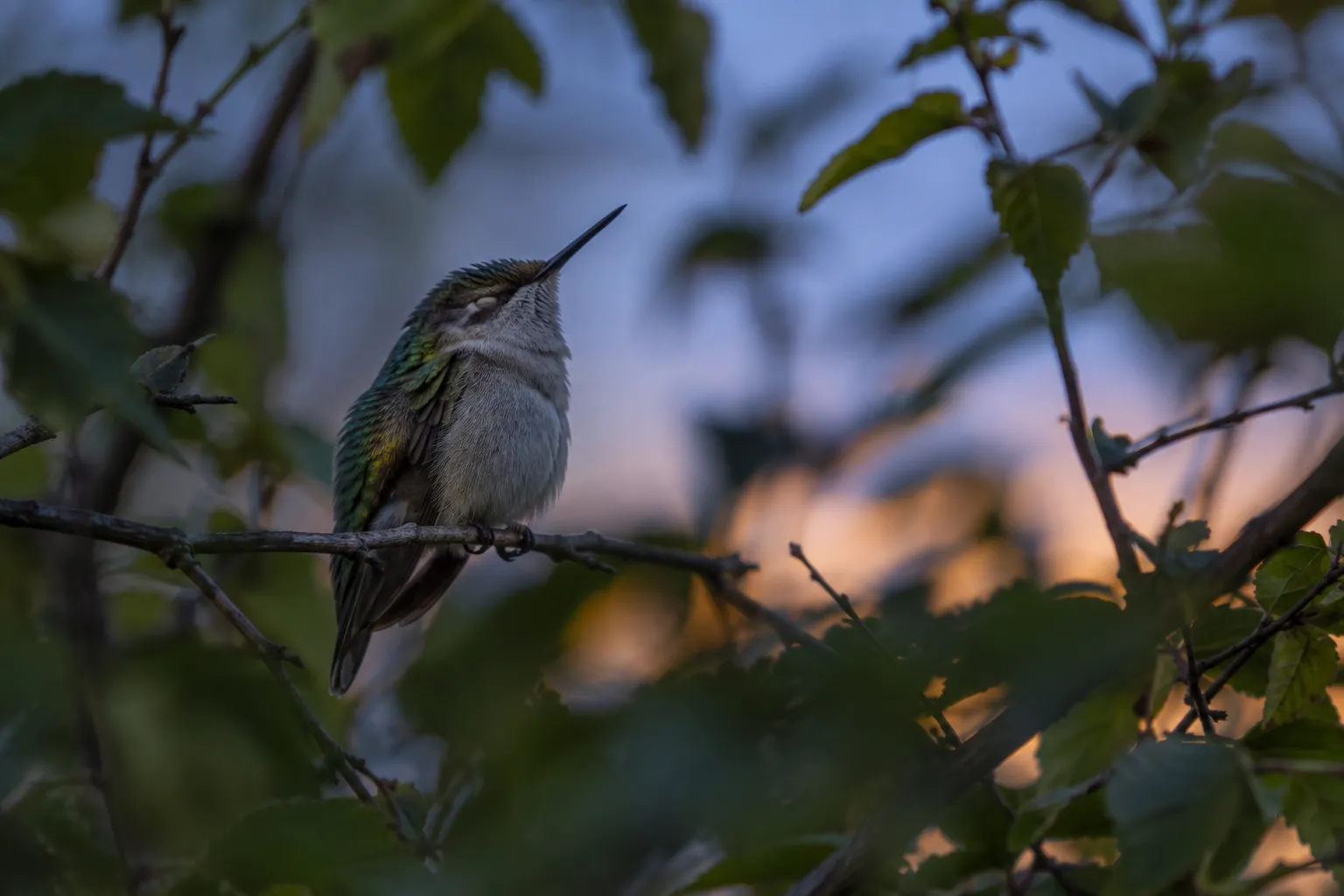
- What does a sleeping hummingbird look like?
- Do all hummingbirds use torpor?
- Do hummingbirds sleep during the day?
- Myths vs facts about hummingbird sleep
- What does this mean for backyard birders?
- Quick facts
- Sources
- Frequently asked questions
Yes, hummingbirds sleep every night. They are active in daylight and rest after dark, usually perched alone on a thin, sheltered twig. On many nights they also drop into torpor, a deep energy-saving state in which body temperature can fall by tens of degrees from its normal 104 F and the heart slows dramatically. It looks alarming, since a torpid hummingbird can seem dead, but it is a normal survival tool for a bird that burns energy faster than almost any other animal.
To understand why hummingbirds sleep so deeply, you need to understand how close to the edge they live. Their size, flight style and diet leave them with very little margin between a full tank and an empty one.
Quick answer: how hummingbirds sleep
- When: at night, from roughly dusk to dawn.
- Where: usually on a small, sheltered branch in a shrub or tree, not in a nest.
- How deeply: anything from ordinary sleep to deep torpor, depending on temperature and energy reserves.
- Torpor: body temperature drops far below the normal daytime level of about 104 F, and heart rate and breathing slow sharply.
- Waking up: the bird rewarms by shivering its flight muscles, which can take tens of minutes.
- What to do if you find one: usually nothing. A motionless or upside-down hummingbird at dawn is most likely in torpor and will recover on its own.
Why do hummingbirds need to sleep so deeply?
Hummingbirds have the highest metabolic rate, relative to body size, of any warm-blooded vertebrate that has been studied. Several features combine to make that so.
They are tiny
The Ruby-throated Hummingbird, the only breeding hummingbird across most of eastern North America, weighs roughly 0.1 ounce, about the same as a penny. Small animals lose heat quickly, because they have a lot of surface area compared with their volume. A hummingbird has very little body to hold warmth.
They hover
Hovering is one of the most energy-demanding ways to move. A hummingbird’s wings beat many dozens of times per second, and its flight muscles make up a large share of its body weight. Our explainer on how hummingbirds hover shows why it is so costly.
Their fuel runs low fast
Hummingbirds mainly drink flower nectar, a sugar solution, and eat small insects and spiders for protein. Sugar is burned quickly. A hummingbird feeding during the day may visit hundreds or even more than a thousand flowers, and it cannot eat at night because it cannot see well enough to feed, and most flowers produce less nectar in the dark.
That creates a problem every evening. A hummingbird has to get through the night on the fat and sugar it has stored in its body since its last meal at dusk. On a mild night with good reserves, ordinary sleep may be enough. On a cold night, or when it has not fed well, staying at normal body temperature all night could burn through its reserves before dawn. Torpor is the solution.
What is torpor, and how is it different from sleep?
Sleep is a state of reduced awareness and activity, with changes in brain activity, that all birds and mammals share. In ordinary sleep, a hummingbird’s body temperature and metabolism dip only a little.
Torpor is a far deeper, controlled shutdown of the body’s energy use. It is related to hibernation but is much shorter, typically lasting a single night. In torpor:
- Body temperature falls sharply. Instead of holding around 104 F, the bird lets its temperature drift down toward the surrounding air temperature, stopping at a lower limit it defends.
- Heart rate drops dramatically. An active hummingbird’s heart can beat more than 1,000 times per minute. In torpor, it slows to a small fraction of that.
- Breathing slows, sometimes with pauses between breaths.
- Energy use plunges. Studies have found that torpor can cut a hummingbird’s overnight energy use substantially, with figures of well over half commonly reported and much higher savings on cold nights.
- Responsiveness is almost gone. A torpid hummingbird reacts slowly or not at all to being touched, which is why it can seem dead.
How cold can a hummingbird get?
Remarkably cold. Research on hummingbirds living high in the Andes of Peru, published in 2020, recorded one species, the Black Metaltail, letting its body temperature fall to about 38 F (around 3 C) overnight. That is among the lowest body temperatures recorded in any bird. Most hummingbirds in temperate North America probably do not go that low, but drops of tens of degrees are normal.
The same study found that different species, and even individuals, used torpor differently. Some entered it almost every night, others more selectively, and birds in good condition sometimes spent less time in torpor. That supports the idea that hummingbirds use torpor flexibly, as a way to manage an energy budget rather than as an automatic nightly shutdown.
How do hummingbirds wake up from torpor?
Rewarming takes work. Before dawn, a torpid hummingbird starts shivering its large flight muscles. Muscle activity produces heat, and body temperature rises steadily. The whole process can take from about 20 minutes to around an hour, depending on how cold the bird got and the air temperature. It is one reason hummingbirds often appear at feeders very soon after first light: they have used energy both overnight and during rewarming, and they need to refuel.
Researchers believe hummingbirds time their rewarming using an internal body clock, so they are ready to feed at first light rather than waking only when the sun hits them.
How long do hummingbirds sleep?
Roughly as long as it is dark. Hummingbirds are strictly daytime feeders, so their sleep period tracks the length of the night. That means they sleep much longer in early spring and late autumn than in midsummer, when northern nights are short. A hummingbird in the far north of its range in June may have only a few hours of darkness, while one wintering in the tropics has close to 12 hours each night.
Longer nights are also harder nights. The longer the bird goes without feeding, the more stored energy it needs. That is one reason torpor matters so much in cool seasons: a long, cold night is the most dangerous combination for a bird this small.
How much weight does a hummingbird lose overnight?
Researchers weighing hummingbirds at dusk and dawn have found that they can lose a noticeable share of their body weight overnight, mostly from burned fat and sugar and some water loss. The exact amount varies with temperature, species and whether the bird used torpor. Torpid birds lose less. That is the whole point of torpor: it protects the reserves the bird needs to survive until the first flowers open in the morning.
Is torpor risky for hummingbirds?
Yes, it comes with trade-offs, which is probably why hummingbirds do not use it every night regardless of conditions.
- Predators. A torpid bird cannot flee quickly. Choosing a hidden perch on a thin twig reduces the risk, but does not remove it.
- Rewarming costs. Waking from deep torpor takes energy and time. A bird that is too low on reserves may struggle to rewarm.
- Lost time. A bird still warming up at first light is not feeding or defending its flowers, while rivals may be.
- Possible physiological costs. Some researchers have suggested that very deep, frequent torpor may carry hidden costs, for example to sleep quality or immune function. This is still being studied.
The balance between saving energy and these risks helps explain why hummingbirds seem to use torpor as needed, going deeper on cold nights or when they have fed poorly, and staying shallower or skipping it when conditions are kind.
Where do hummingbirds sleep?
Most hummingbirds sleep alone, perched on a small, thin twig. They tend to choose spots in dense shrubs or trees that are sheltered from wind, rain and, where possible, predators. The branch is usually thin enough that a larger animal would struggle to reach it without shaking it first.
They do not sleep in nests, with one exception. A female incubating eggs or brooding young chicks stays on the nest overnight to keep them warm. Interestingly, females with eggs or young seem to use torpor less, or more shallowly, probably because they need to keep eggs and chicks warm. Our explainer on whether birds sleep in nests covers what other species do.
How do hummingbirds stay on the branch while asleep?
Like other perching birds, hummingbirds have feet that grip tightly with minimal effort, helped by the arrangement of tendons and a ratchet-like texture on the tendon sheaths in many species. Our article on how birds perch without falling when asleep explains the mechanism in more detail. In deep torpor, the grip holds even though the body goes limp, which is why hummingbirds sometimes end up hanging upside down.
What does a sleeping hummingbird look like?
| Clue | Ordinary sleep | Torpor |
|---|---|---|
| Posture | Upright, feathers slightly fluffed, head tucked or bill forward | Often very still, bill pointed up, may hang upside down |
| Response to disturbance | Wakes quickly and flies | Very slow or no response |
| Breathing | Normal, if hard to see | Slow, may seem to stop |
| Body temperature | Close to normal | Far below normal, feels cool |
| When seen | Night | Night and early morning, especially on cold nights |
Do all hummingbirds use torpor?
Torpor has been documented in many hummingbird species across the Americas, from tropical and mountain species to the migrants that breed in North America, and it is thought to be widespread in the family. How often an individual uses it depends on temperature, altitude, food supply and the bird’s condition.
- Mountain species in the Andes and other high ranges face cold nights year-round and appear to rely on torpor heavily.
- Winter residents such as Anna’s Hummingbirds, which stay through the winter along the Pacific Coast of North America as far north as British Columbia, are thought to use torpor on freezing nights. Our species guide to Anna’s Hummingbirds covers their winter habits.
- Migrants such as the Ruby-throated and Rufous Hummingbirds build up fat before migration. Some research suggests they may use torpor during migration to conserve those fat reserves, although this is less well studied. Our guide to Ruby-throated Hummingbirds covers their migration timing.
Do other birds use torpor?
Yes, though hummingbirds are the most famous example. Several nightjars, swifts, mousebirds and some small songbirds can enter torpor. The Common Poorwill of western North America goes further and can remain torpid for extended periods in winter, which comes close to true hibernation, something almost unknown in other birds.
Is torpor the same as hibernation?
They are closely related, and both are forms of what physiologists call heterothermy, where an animal lets its body temperature drop instead of holding it steady. The main difference is timing. Hibernation, as in ground squirrels, woodchucks or dormice, lasts for days or weeks at a stretch, often through a whole winter with only brief arousals. Hummingbird torpor is a daily event that lasts part of one night and ends every morning. A hummingbird cannot store enough fat to survive for weeks without eating, so it uses torpor as a nightly bridge from one day’s feeding to the next.
Do hummingbirds sleep during the day?
Not really. They spend most of the day perched between short feeding bouts, often sitting quietly for long stretches and guarding flowers or feeders. That resting is not the same as sleep, and they stay alert. Normal sleep and torpor happen at night.
Do hummingbirds sleep with half their brain?
Some birds, including ducks and frigatebirds, can sleep with one half of the brain while the other half stays alert, called unihemispheric sleep. It helps them watch for predators or keep flying. Whether hummingbirds do this has not been well studied, so it is best to treat it as unknown.
Myths vs facts about hummingbird sleep
Myth: A motionless hummingbird at dawn must be dead or dying. Fact: it is very likely in torpor and will usually recover within an hour.
Myth: Hummingbirds sleep in their nests. Fact: only females incubating eggs or brooding young do. Other hummingbirds sleep on branches.
Myth: Hummingbirds never stop moving. Fact: they spend a large share of the day perched, and they sleep every night.
Myth: Hummingbirds migrate on the backs of geese. Fact: this old story is false. Hummingbirds migrate under their own power, with no help from larger birds.
Myth: Leaving a feeder up in autumn keeps hummingbirds from migrating. Fact: migration is triggered mainly by day length and internal rhythms, not by food availability. Feeders can help late migrants refuel.
What does this mean for backyard birders?
What should I do if I find a torpid hummingbird?
In most cases, nothing. Here is a practical approach:
- Watch from a distance. If the bird is on a perch or feeder and not in immediate danger, leave it alone. Most will warm up and fly off within an hour of dawn.
- Do not try to feed it or force it awake. Handling can stress it and interfere with rewarming.
- If it is on the ground or in danger (from cats, for example), and still unresponsive later in the morning, contact a licensed wildlife rehabilitator for advice. Our guide on what to do with an injured bird explains the steps.
Help hummingbirds refuel at dawn and dusk
- Keep feeders clean and fresh. Hummingbirds often feed heavily just before dark and soon after first light. Our guide to the hummingbird nectar recipe explains the standard 4 parts water to 1 part white sugar mix.
- Choose feeders that are easy to clean, since nectar spoils quickly in warm weather. See our roundup of hummingbird feeders.
- In mild-winter regions with resident hummingbirds, some people keep a feeder from freezing on cold mornings by bringing it in overnight and putting it back out before dawn.
Give them places to rest
Dense native shrubs and small trees provide sheltered sleeping perches and insect food. A garden with layers of vegetation is more useful to hummingbirds than an open lawn. Our explainer on where birds go at night covers night shelter for other backyard species too.
Common mistakes
- Picking up a torpid hummingbird and bringing it indoors when it would have recovered in place.
- Letting feeders go empty or stale in late summer, when hummingbirds are building fat for migration.
- Clearing dense shrubs that provide overnight shelter.
Quick facts
- Hummingbirds sleep every night and often enter torpor.
- Normal daytime body temperature is about 104 F.
- In torpor, body temperature can fall by tens of degrees; one Andean species has been recorded at about 38 F.
- An active hummingbird’s heart can beat more than 1,000 times per minute and slows sharply in torpor.
- Rewarming from torpor by shivering can take roughly 20 minutes to an hour.
- Hummingbirds sleep on thin, sheltered branches, not in nests, except incubating or brooding females.
- A hummingbird hanging upside down at dawn is usually in torpor, not dead.
- Torpor is found widely among hummingbirds and in some other birds, such as nightjars and swifts.
Sources
- Anna’s Hummingbird overview - Cornell Lab of Ornithology, All About Birds
- Wolf, B. O., McKechnie, A. E., et al. (2020). Extreme and variable torpor among high-elevation Andean hummingbird species. Biology Letters
Frequently asked questions
Do hummingbirds sleep at night?
Yes. Hummingbirds are active by day and sleep at night, usually perched on a thin, sheltered twig in dense vegetation. On many nights, especially cold ones or when their energy reserves are low, they go a step further and enter torpor, a deep, sleep-like state in which body temperature, heart rate and breathing drop sharply to save energy.
What is hummingbird torpor?
Torpor is a controlled drop in metabolism. A torpid hummingbird lets its body temperature fall far below its normal daytime level of around 104 F, and its heart rate and breathing slow dramatically. This can cut its overnight energy use by a large margin. In the morning it rewarms itself, mostly by shivering its flight muscles, which can take tens of minutes.
Why is a hummingbird hanging upside down?
A hummingbird hanging upside down from a perch or feeder at night or early morning is most likely in torpor. Its feet keep gripping while its body relaxes, so it can tip over. It usually is not dead or injured. Leave it alone and it will normally warm up and fly off once its body temperature rises.
Where do hummingbirds sleep?
Most hummingbirds sleep alone on a small, sheltered branch in trees or shrubs, often somewhere protected from wind and rain. They do not use nests as beds. The exception is a female incubating eggs or brooding small young, which stays on the nest overnight to keep them warm.
Should I leave my hummingbird feeder out at night?
Yes, it is fine to leave it up. Hummingbirds do not feed in the dark, but they often feed heavily just before dusk and again soon after first light, when their reserves are lowest. A clean feeder with fresh nectar that is available at dawn can be useful, especially on cold mornings.