Bird Buddy Review: Camera, AI ID, Premium and Solar
Bird Buddy review: tough weatherproof hardware and the most polished app, but automatic species ID needs Premium. Specs, sizes, battery, solar and alternatives.
If you buy through links on this page we may earn a commission, at no cost to you. It never decides what we recommend. How we earn
In this article
- Quick verdict
- Bird Buddy specs at a glance
- How we chose and researched
- What is Bird Buddy, and how does it work?
- Is Bird Buddy worth it?
- How good is the Bird Buddy camera?
- Does Bird Buddy identify birds for free?
- How long does the battery last, and does the solar roof work?
- Which Bird Buddy size should you buy?
- Where should you put a Bird Buddy?
- How do you keep a Bird Buddy clean?
- Which birds will a Bird Buddy attract?
- Bird Buddy strengths
- Bird Buddy drawbacks
- What are the best Bird Buddy alternatives?
- Bird Buddy vs alternatives: comparison table
- Bird Buddy buyer’s checklist
- The bottom line
- Sources
- Alternatives worth a look
- Frequently asked questions
This Bird Buddy review comes down to one trade-off. Birdbuddy’s current feeders are the most weatherproof and most polished of the major smart feeders, with IP67 ratings, a -5°F (-21°C) operating floor and a genuinely enjoyable app. The catch is that automatic species identification needs the paid Premium membership. If that fee does not bother you, buy the Birdbuddy Home. If it does, a Birdfy version with lifetime AI is the better value.
A quick naming note: the product is widely searched as “Bird Buddy,” but the company spells it Birdbuddy. We use the company spelling for model names below.
Quick verdict
- Best Bird Buddy for most people: Birdbuddy Home (sold as the Birdbuddy 2), for its 135-degree view, dual solar roof and 5 GHz Wi-Fi.
- Best for small spaces: Birdbuddy Nook, with the same IP67 rating in a smaller 3.8-cup body.
- Best value if you find it discounted: Birdbuddy Pro Solar, the previous flagship.
- Best alternative with no ID fees: Birdfy Feeder 2 in an AI Lifetime Free version.
- Skip Bird Buddy if: you want automatic species labels without a membership, or you need local microSD recording.
Bird Buddy specs at a glance
These figures come from Birdbuddy’s product and support pages. Where Birdbuddy does not publish a number, we leave it out.
| Spec | Birdbuddy Home (Birdbuddy 2) | Birdbuddy Nook | Birdbuddy Pro Solar |
|---|---|---|---|
| Photos | 5MP HDR | 5MP HDR | 5MP |
| Video | 2K HDR capability | Full HD HDR | 2K |
| Field of view | 135° | Not published | 122° |
| Camera orientation | Rotates, portrait or landscape | Fixed | Fixed |
| Seed capacity | 6 cups (1.4 L) | 3.8 cups (0.9 L) | 3.8 cups |
| Battery | 3,900 mAh | 3,900 mAh | Built-in, with solar roof |
| Solar | Integrated dual-panel roof | Optional single-panel roof | Solar roof included |
| Wi-Fi | 2.4 and 5 GHz | 2.4 GHz | 2.4 GHz |
| Weather rating | IP67 | IP67 | IP67 |
| Operating range | -5°F to 120°F (-21°C to 49°C) | -5°F to 120°F (-21°C to 49°C) | Not published |
| Audio | Microphone and speaker | Microphone, no speaker | Microphone |
| Local storage | No | No | No |
How we chose and researched
We have not physically tested a Birdbuddy feeder yet, so nothing here is a hands-on claim. This review is research-led. We worked from Birdbuddy’s product pages, support articles and membership documents; independent expert reviews from established camera and home publications; and recurring patterns in verified owner feedback on retailer and community sites. For the alternatives, we used Birdfy’s own spec pages. When a spec was not published or could not be confirmed, we left it out rather than estimate.
What is Bird Buddy, and how does it work?
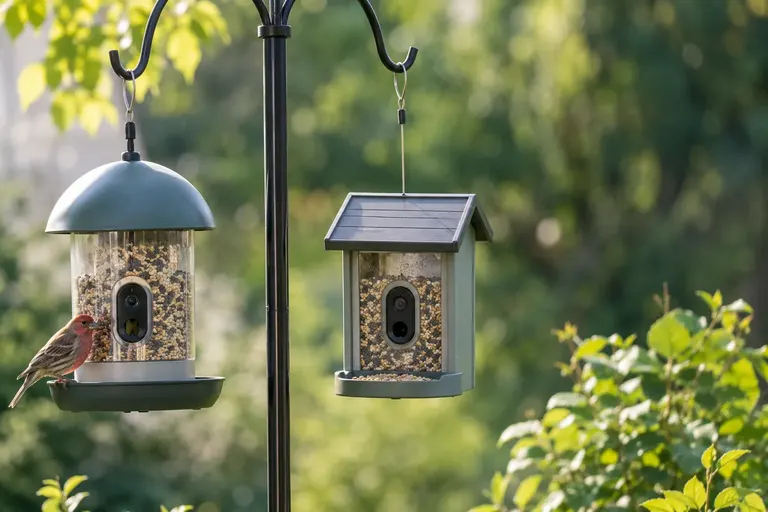
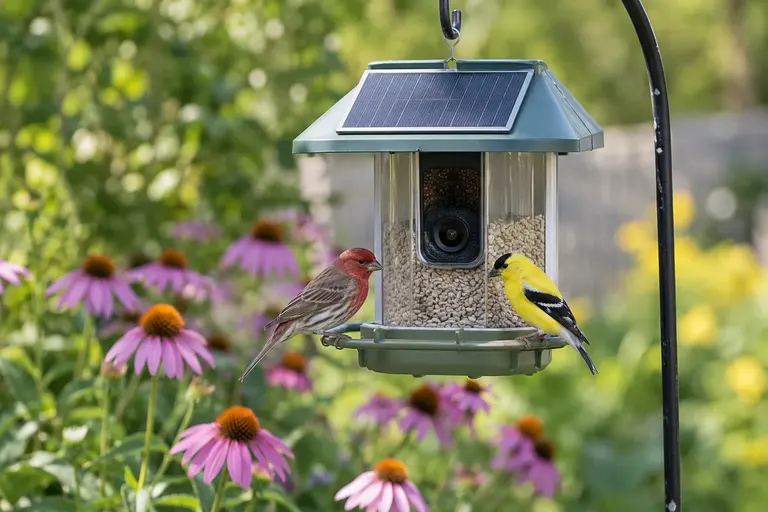
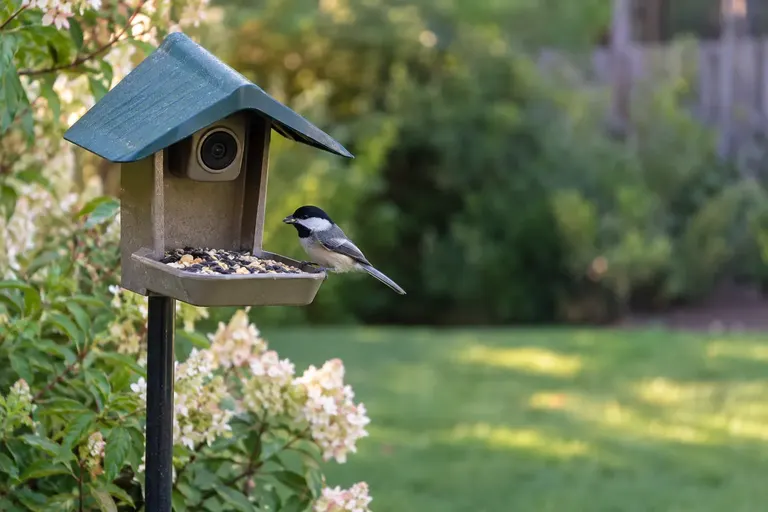
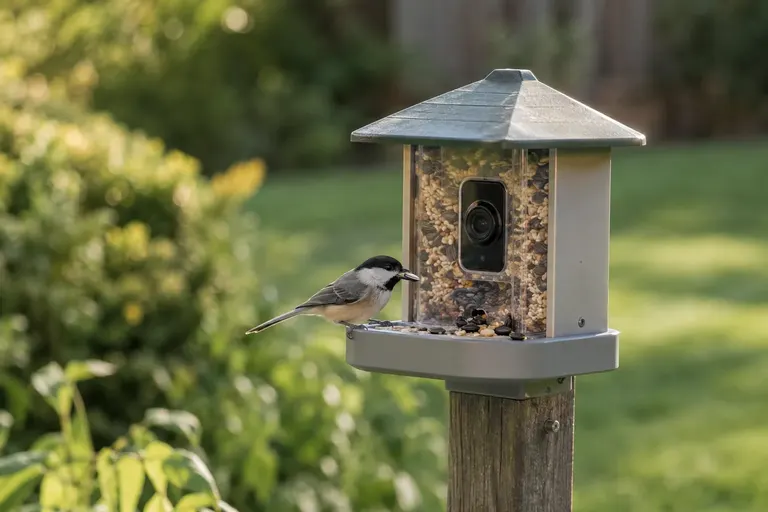
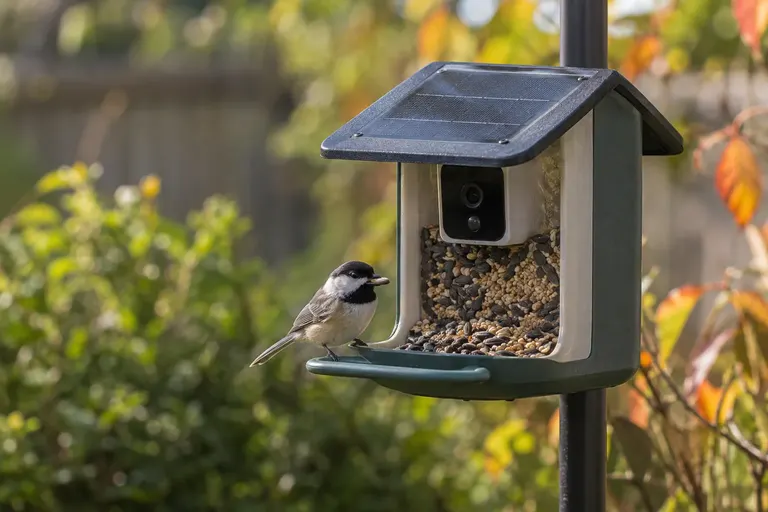
Bird Buddy is a bird feeder with a battery-powered camera built into the front, connected to your Wi-Fi and a phone app. When a bird lands on the perch, a motion sensor wakes the camera, which takes photos and short videos and sends them to the app as a “postcard.”
It has three parts: the feeder body with a perch in front of the lens, a removable camera module Birdbuddy calls the Nature Cam (battery, sensor, microphone and Wi-Fi), and the app, which holds your postcards, a collection of every species recorded, live view and a public feed called Birdbuddy TV.
The core promise is simple: you see birds you would otherwise miss, at a distance of a few inches, without sitting at the window.
Is Bird Buddy worth it?
Yes, for most people who already feed birds and want close-up photos of their regulars, especially in cold or wet climates. No, if your main goal is a species list with no recurring cost, or if you want footage stored on a card at home.
Independent reviewers consistently describe Birdbuddy’s app as the most polished and playful in the category, and its current hardware carries tougher weather ratings than its main rival. Owner feedback is more mixed on software: the most common complaints are slow livestream loading, missed or duplicate postcards on busy days, and firmware hiccups after launches. One independent review of the Birdbuddy 2 at release found that 2K video and slow motion were not yet unlocked in firmware, so treat headline video modes as software-dependent rather than guaranteed on day one.
If you are still deciding whether any smart feeder makes sense for your yard, read our honest take on whether smart bird feeders are worth it before buying.
How good is the Bird Buddy camera?
For feeder-distance portraits, it is very good on paper. Birdbuddy’s current generation shoots 5MP HDR stills, and the Home uses a 1/2.8-inch sensor behind Gorilla Glass with a 135-degree field of view.
What that means in practice:
- HDR helps on bright days. Feeder cameras often face harsh contrast, such as a dark bird against bright sky. HDR balances those tones better than a standard exposure.
- The wide view catches groups. At 135 degrees, the Home frames several birds on the perch and tray. Birdbuddy’s older Pro models show 122 degrees.
- The rotating module is unusual. On the Home, you can turn the camera for a tall portrait frame (good for phone sharing) or a wide landscape frame.
- Close focus matters most. Birdbuddy lists close-focus of roughly 2.6 to 5.9 inches (7 to 15 cm) on its Nature Cam Pro module. Birds on the perch sit in that zone; birds hanging off the side may not.
Owners commonly report that image quality depends heavily on placement. A camera facing into the sun produces silhouettes; a feeder that swings in the wind produces blur. Our feeder camera setup guide covers angle, framing and mounting in detail.
Does Bird Buddy identify birds for free?
Partly. Free users get manual AI recognition; automatic recognition requires Premium. This is the single most important thing to understand before buying.
What the free tier includes
According to Birdbuddy’s membership documents, the free plan includes automatic photos and videos, live streaming, HD and 2K videos, sensitivity controls, up to 10 guest members, Birdbuddy TV, downloads and pet alerts. When the AI does not automatically identify a visitor, the postcard arrives unlabeled and you tap to analyze it.
What Premium adds
Premium turns on automatic AI+ recognition, reanalyzes earlier unrecognized visitors, and adds Name That Bird (for tagging and tracking individual regulars), 2K Ultra Resolution, Nature Chat, Alexa integration, photo styling and lists for species you want to ignore. A Family Premium tier extends features to guest members. Birdbuddy sells monthly and annual plans; we do not list prices because they change.
Our take on the subscription
Tapping to identify is fine if you get a handful of visits a day. AI suggestions are a starting point, so confirm tricky birds with a bird identification app. On a busy winter feeder with dozens of postcards, it becomes a chore, and that is when Premium starts to feel necessary.
If a recurring fee is a deal-breaker, see our list of bird feeder cameras without a subscription.
How long does the battery last, and does the solar roof work?
Both current models use a 3,900 mAh battery. Real runtime depends on how often the camera wakes, how strong the Wi-Fi signal is and how cold it gets, so no single number fits every yard.
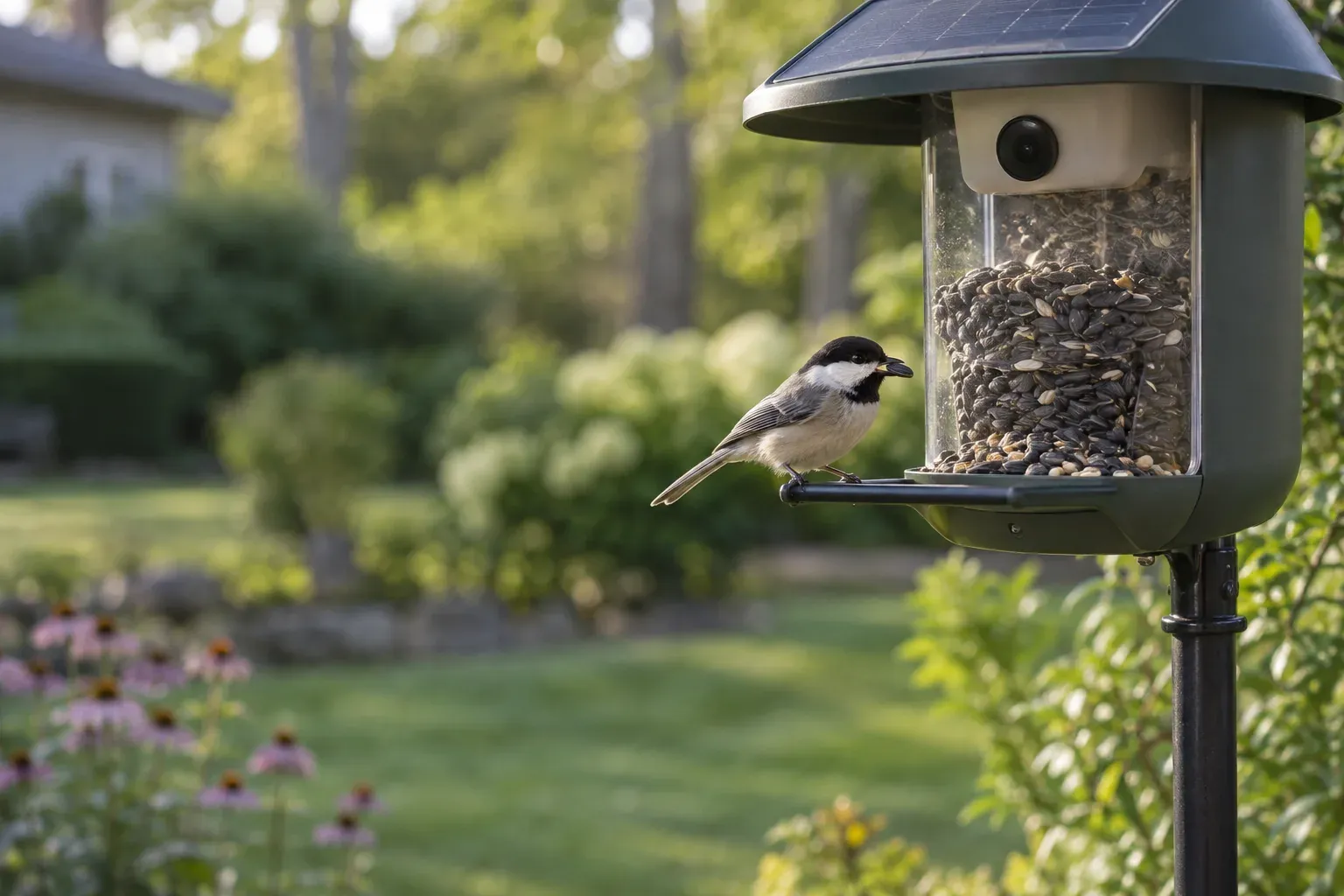
- Birdbuddy Home: has an integrated dual-panel solar roof. In a spot with a few hours of direct sun, it is designed to stay topped up. One independent Birdbuddy 2 review praised its solar efficiency in standard power mode.
- Birdbuddy Nook: runs on battery alone unless you add the optional single-panel solar roof.
- Charging by cable: one independent review noted that cable charging the Birdbuddy 2 means removing the unit or its roof assembly, which is awkward on a high pole.
Owners across smart-feeder brands commonly report that busy winter feeders drain batteries far faster than quiet summer ones, and lithium batteries lose capacity in hard cold. A solar roof plus a sheltered, sunny mounting spot is the most reliable fix.
Which Bird Buddy size should you buy?
Buy the Home if you have a sunny yard, cold winters or 5 GHz-only Wi-Fi. Buy the Nook for balconies, small yards or a lower budget. Consider a discounted Pro Solar only if you have solid 2.4 GHz coverage.
Which model fits your yard: a decision table
This is our own decision aid, built from the published specs. Find the row that matches your situation.
| Your situation | Best choice | Why |
|---|---|---|
| Winters below 14°F (-10°C) | Birdbuddy Home or Nook | Both rated to -5°F; Birdfy is rated to 14°F |
| Router broadcasts 5 GHz only | Birdbuddy Home | Only model here with dual-band Wi-Fi |
| Balcony or railing mount | Birdbuddy Nook | Smaller 3.8-cup body |
| Busy feeder, dislike refilling | Birdbuddy Home | 6-cup hopper, nearly double the Nook |
| Shady yard, no solar | Birdfy Feeder 2 | Larger 9,000 mAh battery |
| No recurring fees for ID | Birdfy (AI Lifetime Free version) | Species labels included with the device |
| Want tight portrait shots | Birdfy Feeder 2 Duo | Dedicated 2K tracking lens |
| Tight budget, first feeder | Birdfy Feeder Rookie or Nook | Lower-cost entry models |
| Need local SD recording | Neither brand | Current feeders are cloud only |
Where should you put a Bird Buddy?
Put it on a solid pole or bracket, with the camera facing away from direct sun (ideally north), within reach of your Wi-Fi, and either within 3 feet (1 m) of a window or more than 30 feet (9 m) away.
Follow these steps:
- Check the signal first. Stand at the spot with your phone. If Wi-Fi is weak there, clips will lag and battery drain rises.
- Face the camera north if you can. A north-facing lens avoids the backlit, silhouetted birds that owners most often complain about.
- Use a solid mount. One independent Birdbuddy 2 review flagged that its standard mount let the feeder swing and tip backward. A pole or wall bracket gives sharper clips.
- Mind the window distance. Bird-collision guidance generally recommends feeders within about 3 feet of glass or well beyond 30 feet, so birds either cannot build up speed or are far from the reflection.
Our general guide to where to put a bird feeder covers height, distance and cover in more depth.
How do you keep a Bird Buddy clean?
Remove the camera module, empty the seed, wash the feeder with hot soapy water or a dilute bleach solution, rinse well and dry fully before refilling. Most guidance suggests cleaning feeders roughly every two weeks, and more often in wet weather or during disease outbreaks.
A few Bird Buddy specifics:
- Never submerge the camera module. Wipe the lens glass gently with a soft, damp cloth.
- Clean the lens often. Seed dust, droppings and pecking marks soften images. Owners commonly report a noticeable jump in sharpness after a simple lens wipe.
- Dry the hopper completely. Damp seed molds quickly and can clump in the feed opening.
For the full routine and safe cleaning ratios, see how to clean a bird feeder.
Which birds will a Bird Buddy attract?
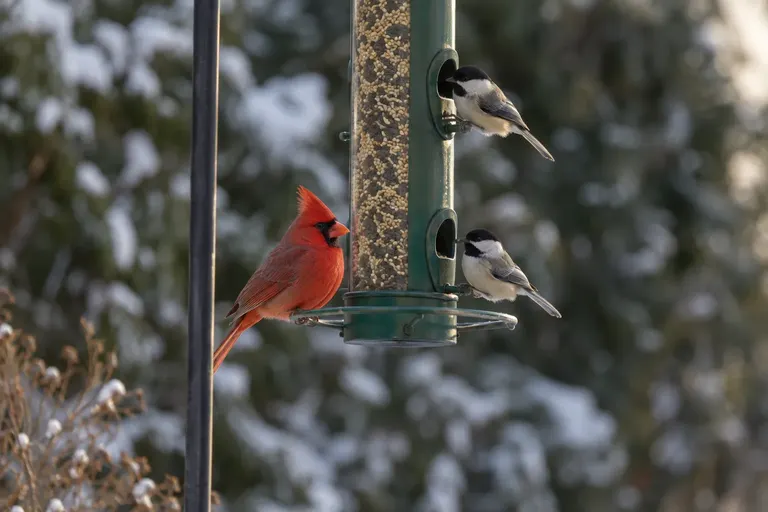
It attracts the same perching birds as any hopper feeder: chickadees, titmice, nuthatches, finches, cardinals, sparrows, jays and some woodpeckers. The camera does not attract birds; the seed and placement do.
Seed choice shapes your visitor list:
- Black oil sunflower draws the widest range of feeder birds and is the best default.
- Shelled sunflower cuts mess under the feeder.
- Safflower is favored by cardinals and less loved by squirrels and grackles.
- Mixes heavy in millet or milo attract ground-feeding birds and more mess.
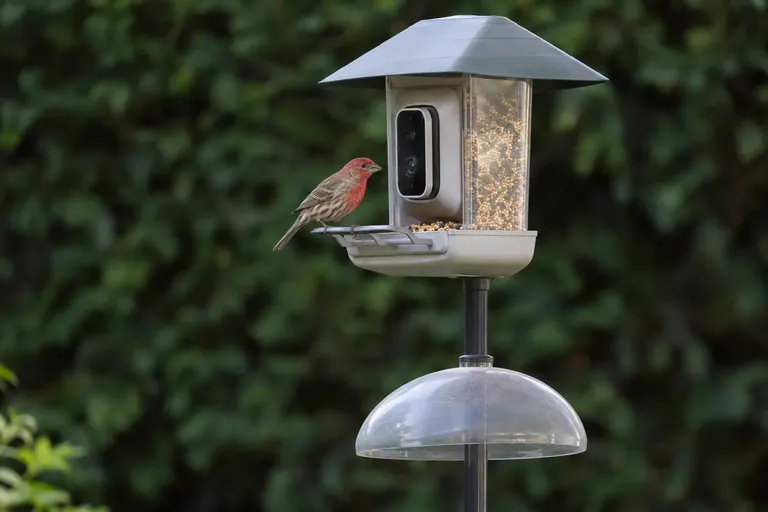
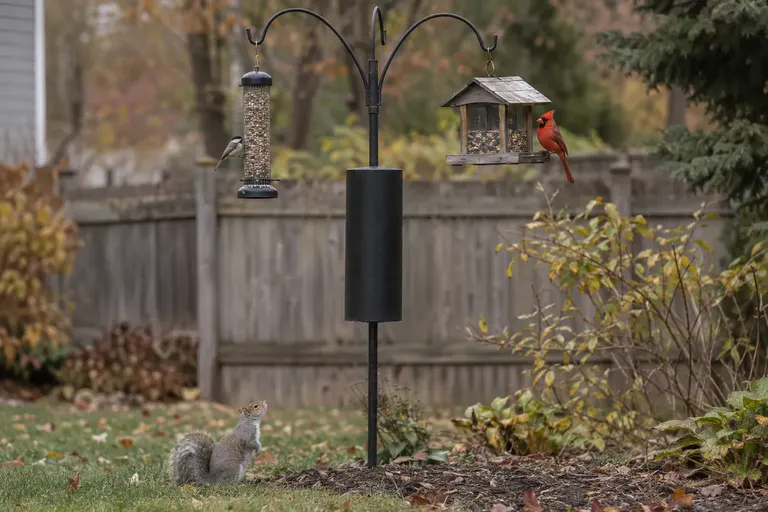
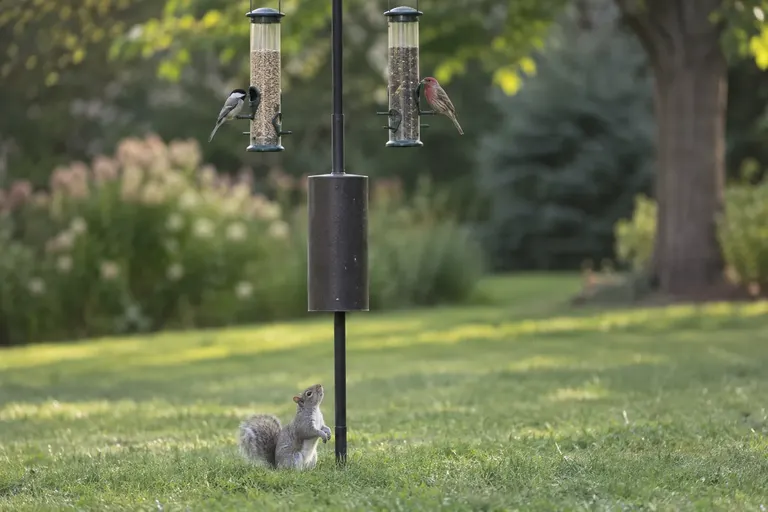
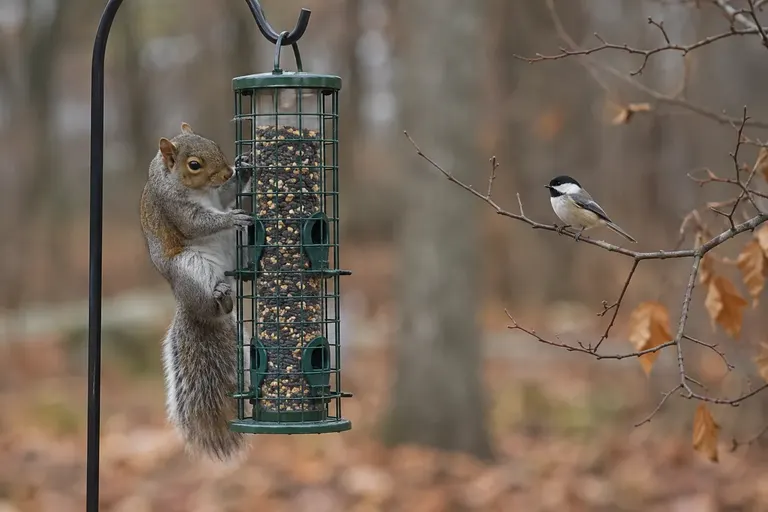
Larger birds such as jays, doves and grackles can crowd the perch, and squirrels will raid any feeder they can reach. Birdbuddy’s feeders are plastic, so a pole with a proper baffle is the best protection. Our guide to keeping squirrels off feeders explains baffle size and placement.
Bird Buddy strengths
Based on the published specs, expert reviews and owner-review patterns, these are the clear positives:
- The toughest weather specs in the category. IP67 and a -5°F to 120°F (-21°C to 49°C) rating on the Home and Nook.
- Integrated solar on the Home. No add-on panel to wire up.
- Dual-band Wi-Fi on the Home. Useful in homes with 5 GHz-only mesh networks, and Birdbuddy says pairing takes about 10 seconds versus roughly 5 minutes on the older Pro.
- A polished, social app. Postcards, a species collection and Birdbuddy TV make it enjoyable for families and grandchildren.
Bird Buddy drawbacks
- Automatic ID needs Premium. The most common frustration in owner feedback.
- No local storage. All media lives in Birdbuddy’s cloud. Download the clips you love.
- Software can lag the hardware. Owners and reviewers have reported slow livestreams, missed visits and features arriving after launch through firmware.
- Plastic body. Persistent squirrels can chew it; baffles are close to mandatory.
- The Nook is 2.4 GHz only. A hard stop if your router cannot broadcast that band.
What are the best Bird Buddy alternatives?
The main alternative is Birdfy, the bird feeder camera brand of Netvue. You will see listings titled “Netvue Birdfy”; they are the same product family.
Birdfy Feeder 2
Birdfy’s second-generation feeder fits a 9,000 mAh battery, more than double Birdbuddy’s, carries an IP66 rating and is rated from 14°F to 113°F (-10°C to 45°C). The standard version uses a 1080p wide lens. The key difference is identification: Birdfy sells versions labeled AI Lifetime Free, with species ID included, alongside AI by Subscription versions. Birdfy also includes 30-day rolling cloud storage and 5 GB of permanent storage for bookmarked clips at no cost.
Skip it if: your winters regularly fall below 14°F, or your router is 5 GHz only.
Birdfy Feeder 2 Duo
The Duo adds a 3 MP 2K auto-tracking portrait lens to a 2 MP 1080p wide lens, keeps the 9,000 mAh battery and includes a 5W solar panel. Birdfy says it includes lifetime AI by default. It is the closest thing to a close-up portrait camera in the smart-feeder category.
Skip it if: you need Birdbuddy’s colder operating range.
Birdfy Feeder Rookie
The Rookie is Birdfy’s light entry model, with 1080p video, a 60 fps mode, a 44 oz (1.3 L) hopper and a 5,200 mAh battery rated up to four months. It is a sensible first smart feeder if budget matters more than weather ratings.
Skip it if: you want 2K clips or two-way audio.
For a head-to-head breakdown, read our full Bird Buddy vs Birdfy comparison.
Bird Buddy vs alternatives: comparison table
| Feature | Birdbuddy Home | Birdbuddy Nook | Birdfy Feeder 2 | Birdfy Feeder 2 Duo | Birdfy Feeder Rookie |
|---|---|---|---|---|---|
| Weather rating | IP67 | IP67 | IP66 | IP66 | IP66 |
| Operating floor | -5°F | -5°F | 14°F | 14°F | 14°F |
| Battery | 3,900 mAh | 3,900 mAh | 9,000 mAh | 9,000 mAh | 5,200 mAh |
| Solar | Built in | Optional | Optional | Included | Optional |
| Wi-Fi | 2.4 and 5 GHz | 2.4 GHz | 2.4 GHz | 2.4 GHz | 2.4 GHz |
| Auto species ID | Premium | Premium | Lifetime or subscription, by version | Lifetime included | Varies by listing |
| Local storage | No | No | No | No | No |
Bird Buddy buyer’s checklist
Run through this before you order:
- I have checked Wi-Fi strength at the exact mounting spot.
- I know which band my router uses (2.4 GHz, 5 GHz or both).
- I have a solid pole or bracket, plus a squirrel baffle.
- The spot gets some direct sun for solar, but the lens can face away from it.
- I am comfortable tapping to identify, or I have budgeted for Premium.
- I accept cloud-only storage and will download favorite clips.
- I will remove the camera and clean the feeder every couple of weeks.
The bottom line
Bird Buddy earns its reputation. The current Birdbuddy Home pairs the toughest weather ratings in the category with built-in solar, dual-band Wi-Fi and the most enjoyable app. The Premium membership is the real cost of ownership if you want automatic identification, so decide up front whether you will pay it. If you will, buy the Home. If you will not, a Birdfy version with lifetime AI gives you species labels with no recurring bill.
Sources
- The Birdbuddy Membership (Birdbuddy Support)
- Advanced AI+ Recognition (Birdbuddy Support)
- Name That Bird (Birdbuddy Support)
- Bird Buddy 2 review (Digital Camera World)
- Birdfy Feeder 2 (Birdfy)
- Birdfy Feeder 2 Duo (Birdfy)
- Birdfy Feeder Rookie (Birdfy)
- Feeding Birds (Cornell Lab of Ornithology, FeederWatch)
Alternatives worth a look
Birdbuddy Home (Birdbuddy 2)
The current full-size Birdbuddy, with a rotating 135-degree camera, built-in dual solar roof, 6-cup hopper, IP67 rating and dual-band Wi-Fi.
- Best for
- Cold climates, 5 GHz-only homes and buyers who want to forget about charging.
- Skip it if
- You will not pay for Premium but want automatic species labels.
- Field of view
- 135°
- Seed capacity
- 6 cups (1.4 L)
- Battery
- 3,900 mAh + integrated solar
- Weather rating
- IP67
Birdbuddy Nook
The smaller Birdbuddy, with the same IP67 rating and 5MP HDR photos in a 3.8-cup body, plus an optional solar roof.
- Best for
- Balconies, small yards and smaller budgets.
- Skip it if
- Your router only broadcasts 5 GHz, or you want a speaker for two-way audio.
- Seed capacity
- 3.8 cups (0.9 L)
- Wi-Fi
- 2.4 GHz only
- Weather rating
- IP67
Birdbuddy Pro Solar
The previous-generation flagship with the Nature Cam Pro module, still sold while stock lasts and often discounted.
- Best for
- Buyers with strong 2.4 GHz coverage who find it on clearance.
- Skip it if
- You want the wider 135-degree view and faster pairing of the Home.
- Camera
- 2K video, 5 MP photos
- Field of view
- 122°
- Seed capacity
- 3.8 cups
- Weather rating
- IP67
Birdfy Feeder 2
Birdfy's second-generation feeder with a 9,000 mAh battery, IP66 rating and versions sold with lifetime AI identification.
- Best for
- Buyers who want species ID without a membership.
- Skip it if
- Winters regularly drop below 14°F, the bottom of its rated range.
- Camera
- 1080p wide lens
- Battery
- 9,000 mAh
- Weather rating
- IP66
Birdfy Feeder 2 Duo
A multi-lens Birdfy with a 2K auto-tracking portrait camera, a wide lens, a 9,000 mAh battery and a solar panel in the box.
- Best for
- Photo-minded buyers who want tight portraits without paying for AI.
- Skip it if
- You live where January nights sit well below 14°F.
- Cameras
- 3 MP 2K tracking + 2 MP 1080p wide
- Battery
- 9,000 mAh
- Solar
- 5W panel included
Birdfy Feeder Rookie
A light, simple Birdfy with 1080p video, a 60 fps mode and a battery rated for up to four months.
- Best for
- First-time buyers who want the smart-feeder experience for less.
- Skip it if
- You want 2K clips, two-way audio or cold-weather ratings below 14°F.
- Seed capacity
- 44 oz (1.3 L)
- Battery
- 5,200 mAh, rated up to 4 months
- Weather rating
- IP66
Frequently asked questions
Is Bird Buddy worth it?
For most backyard birders who want photos and clips of their regulars, yes. Birdbuddy's current feeders have the toughest weather specs in the category and the most polished app. The catch is identification: the free tier makes you tap to identify each unrecognized visitor, while automatic recognition needs Premium. If a recurring fee bothers you, a Birdfy version with lifetime AI is the better value.
Does Bird Buddy work without a subscription?
Yes. The free tier includes automatic photos and videos, live streaming, HD and 2K videos, sensitivity controls, up to 10 guest members, Birdbuddy TV and downloads. It also includes manual AI recognition, where you tap a postcard to identify a visitor. Premium adds automatic AI+ recognition, Name That Bird, 2K Ultra Resolution, Nature Chat and Alexa integration.
How long does the Bird Buddy battery last?
Birdbuddy uses a 3,900 mAh battery in both the Home and the Nook, and runtime depends mostly on traffic, Wi-Fi strength and temperature. A busy winter feeder wakes the camera far more often than a quiet summer one. The Home's built-in dual solar roof is designed to keep it topped up in a sunny spot, and the Nook accepts an optional solar roof.
Can Bird Buddy record to an SD card?
No. Birdbuddy stores photos and videos in its cloud and delivers them through the app, where you can download and share them. There is no memory-card recording on the current feeders. If local recording matters to you, a plug-in camera with microSD support, such as the Wyze Cam v4 aimed at an ordinary feeder, is the practical workaround.
Is Birdfy made by Netvue?
Yes. Birdfy is the bird feeder camera brand of Netvue, a smart-camera company, and you will often see listings titled Netvue Birdfy. The two names refer to the same product family. When comparing with Bird Buddy, look at the specific Birdfy model and whether the listing says AI Lifetime Free or AI by Subscription, since that changes the long-term cost.