Heated Hummingbird Feeder: Keep Nectar Liquid in Winter
A heated hummingbird feeder keeps 1:4 nectar from freezing near 29 F. Heater types, safe outdoor wiring, which hummingbirds stay and how to clean it.
In this article
- When does hummingbird nectar freeze?
- Which hummingbirds overwinter in North America?
- Can hummingbirds survive freezing weather?
- What types of heated hummingbird feeders are there?
- How do you use a heated hummingbird feeder safely?
- Should you make nectar stronger in winter?
- How do you clean a hummingbird feeder in winter?
- Do you need a heated feeder at all?
- Common mistakes with winter hummingbird feeders
- Sources
- Frequently asked questions
A heated hummingbird feeder is a nectar feeder with a small electric heater, or a heat source added to it, that keeps sugar water liquid when the temperature drops below freezing. Standard 1:4 nectar starts to freeze at around 29 F (about -2 C), so if hummingbirds visit your yard in winter, gentle heat or a feeder swap keeps their food available.
Most people never need one. The exception is the Pacific Coast, where Anna’s Hummingbirds stay all year, and parts of the Gulf Coast and Southeast, where western hummingbirds now spend the winter. This guide covers when nectar freezes, which hummingbirds stay, the heater types worth knowing about, how to wire them safely and how to keep a winter feeder clean.
When does hummingbird nectar freeze?
Standard nectar of 1 part white sugar to 4 parts water begins to freeze at around 29 F (about -2 C), according to Birds Connect Seattle. Sugar lowers the freezing point a little, but only by a few degrees.
That small margin is why winter feeders freeze so often. A clear night that dips just below freezing can leave a feeder full of slush at dawn, which is exactly when hummingbirds need food most. Bird Alliance of Oregon puts it simply: a frozen feeder is an empty feeder.
| Overnight low | What usually happens to 1:4 nectar | What to do |
|---|---|---|
| Above 32 F (0 C) | Stays liquid | Nothing extra |
| About 29 to 32 F (-2 to 0 C) | Starts to turn slushy in exposed spots | Move the feeder to shelter, wrap it or bring it in overnight |
| Below 29 F (-2 C) for a few hours | Ports and reservoir can freeze | Add gentle heat or rotate two feeders |
| Well below freezing all day | Freezes even in daytime without heat | Use a heater and swap feeders as a backup |
The table is a rule of thumb, not a lab chart. Wind, sun and feeder material all change how fast nectar cools.
Which hummingbirds overwinter in North America?
Hummingbirds live only in the Americas. The University of California’s extension service counts more than 340 species, of which only 17 occur north of Mexico, and only a few of those stay north in winter. Where you live decides whether a heated feeder makes sense.
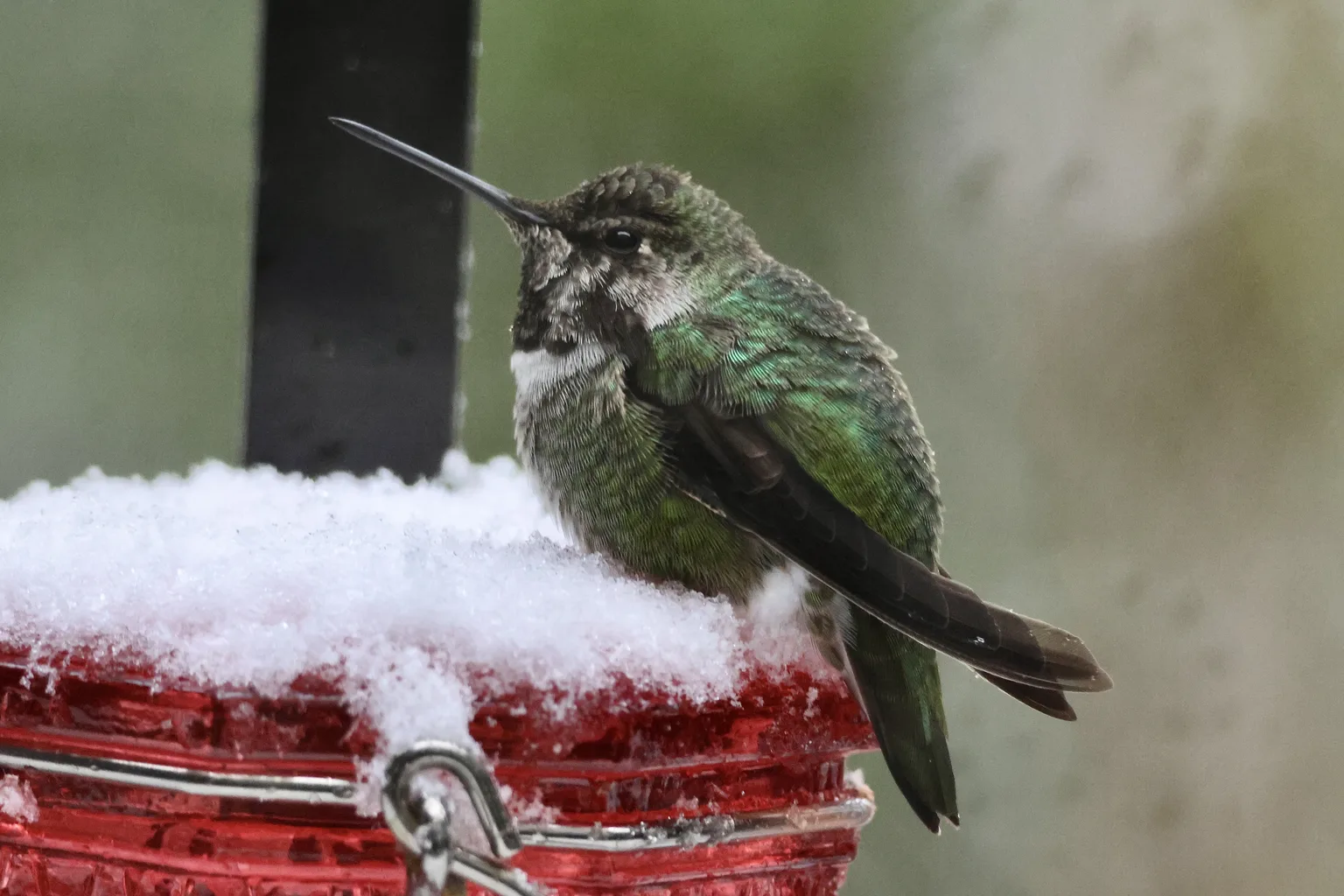
- Anna’s Hummingbird (Pacific Coast). Anna’s don’t migrate much. The Cornell Lab notes they regularly winter as far north as British Columbia and have even been seen in Alaska. Birds Connect Seattle says they’re present year-round in the Seattle area, winter included. Our Anna’s Hummingbird guide covers their year-round habits.
- Rufous Hummingbird (Gulf Coast and Southeast). Audubon says Rufous winter mostly in pine-oak woods in Mexico, but many now winter regularly in the Gulf Coast states. The Cornell Lab adds that Rufous is the species most often seen wintering farther north, with records from Michigan, upstate New York, Wisconsin, Massachusetts and Indiana.
- Other strays. The Cornell Lab mentions Allen’s Hummingbirds and others turning up in winter in recent years too.
East of the Great Plains, the summer hummingbird is the Ruby-throated Hummingbird, which leaves for Mexico and Central America in fall. If you’re there and see a hummingbird after your usual birds have gone, it’s worth a careful look: it may be a western stray. Our guide on when to take down hummingbird feeders explains why leaving a feeder up never stops migration.
Can hummingbirds survive freezing weather?
Yes, as long as they can keep finding food. The Cornell Lab says a winter hummingbird is likely to be fine if it can continue to find food, and some birds have returned to the same feeders winter after winter.
Hummingbirds get through cold nights by going into torpor, a deep energy-saving state in which heart rate and metabolism slow down. Bird Alliance of Oregon notes that Anna’s keep a body temperature well above 100 F by day and rely on torpor to get through the coldest nights. Our article on whether hummingbirds sleep explains torpor in more detail. If you find a hummingbird that seems frozen still on a perch on a cold morning, leave it alone: waking it forces it to burn reserves it needs.
At first light, a bird coming out of torpor needs nectar quickly. That’s when a heated or freshly swapped feeder does its real work.
What types of heated hummingbird feeders are there?
There are five main ways to keep nectar liquid, from plug-in heaters to simple feeder swaps. Most people combine two of them.
| Method | How it works | Best for | Watch out for |
|---|---|---|---|
| Purpose-made feeder heater | A small electric unit that attaches to or sits under the nectar reservoir and warms it | Regular hard frosts, feeders you can’t reach easily | Needs an outdoor outlet; nectar stays warm, so clean more often |
| Feeder with a built-in heating element | Heater and feeder sold as one unit | People who want one tidy setup | Same wiring and cleaning rules as above |
| Incandescent bulb or string lights | A low-watt incandescent bulb hung below the feeder, or old-style lights wrapped around it | Occasional cold snaps | LED lights give off too little heat; keep bulbs from touching plastic |
| Plumber’s heat tape | Low-wattage heat tape with a built-in thermostat wrapped around the reservoir | Bottle feeders, longer cold spells | Must be outdoor-rated; keep the plug dry |
| Hand warmers | A disposable chemical hand warmer taped or clipped to the feeder | Short frosts, no outlet nearby | Lasts about 7 hours, so replace it |
| Swapping two feeders | One feeder outside, one warming indoors, switched as needed | Anyone, no electricity | Someone has to be home at dawn |
All of these come from the advice of Birds Connect Seattle and Bird Alliance of Oregon, which both list feeder heaters, lights, hand warmers and feeder rotation as options. Bird Alliance of Oregon calls a feeder heater a reliable solution, and Birds Connect Seattle points out that LED lights do not give off enough heat to work.
Purpose-made heaters
A dedicated heater is the most hands-off choice. You plug it in, attach it to the feeder as the maker describes, and the nectar stays liquid through the night. Look for a design that fits the feeder you already use, or buy a feeder and heater designed together. A saucer feeder, with its wide, shallow reservoir, is easy to warm from below; see our hummingbird feeder guide for the main feeder styles.
Heat lamps and lights
A low-watt incandescent bulb under the feeder, or a string of old-style incandescent holiday lights around it, warms the nectar enough on most nights. Bird Alliance of Oregon warns not to put lights so close that they damage the feeder. Only use lights rated for outdoor use.
Swapping feeders
If you’d rather avoid electricity, keep two feeders. Bring one in at dusk to thaw, and hang the warm one back out at first light, or rotate them during a freezing day. Birds Connect Seattle notes that rotating feeders through the day keeps the nectar moving and available.
How do you use a heated hummingbird feeder safely?
Treat it like any outdoor electrical appliance. The Electrical Safety Foundation (ESFI) gives the same rules for outdoor lights and decorations, and they apply here:
- Use outdoor-rated gear. Extension cords and anything electrical should be marked for outdoor use.
- Plug into GFCI protection. Outdoor devices should run from circuits protected by ground fault circuit interrupters. If your outlet doesn’t have one, ESFI notes you can buy a portable outdoor GFCI.
- Keep connections dry. Keep cords and plugs clear of snow and standing water.
- Protect the cord. Don’t pinch cords in doors or windows, and match the cord’s rating to the device it powers.
- Remove tangle hazards. Bird Alliance of Oregon warns that loose twine, wire, tape or ribbon near a feeder can trap a hummingbird. Check around and below the feeder after every change.
- Replace leaky feeders. A cracked or dripping feeder can soak a bird, and a wet hummingbird in freezing weather is in real trouble.
Hang the feeder in a sheltered spot, such as under a covered porch or an eave. Bird Alliance of Oregon suggests avoiding north and east exposures.
Should you make nectar stronger in winter?
No. Keep the same 1 part white sugar to 4 parts water you use all year, as in our hummingbird nectar recipe.
It’s tempting to add sugar, because a richer mix freezes at a slightly lower temperature. But Birds Connect Seattle says higher-sugar mixes aren’t beneficial and may damage the birds’ kidneys and liver, and Bird Alliance of Oregon also recommends four parts water to one part white sugar. Use plain white sugar only. Bird Alliance of Oregon lists honey, brown sugar, raw sugar and molasses as unsafe. And skip red dye.
The fix for freezing is heat or a feeder swap, not a sweeter recipe.
How do you clean a hummingbird feeder in winter?
Clean it every few days, even when it’s cold. Nectar ferments more slowly in winter, so you don’t need the summer pace, but a heated feeder keeps nectar warmer than the air around it.
- How often: Bird Alliance of Oregon suggests every three to four days in winter, and notes that heated feeders need cleaning more often. Birds Connect Seattle says at least once a week in cold weather. With a heater, stick to the shorter interval.
- How: Empty the nectar, rinse with hot water and scrub ports and the reservoir with a bottle brush. Throw out old nectar at every cleaning.
- Timing: Clean in the middle of the day, then refill and rehang quickly, so the feeder isn’t empty at dawn.
For a full cleaning routine, see our guide on how to clean bird feeders.
Do you need a heated feeder at all?
Only if hummingbirds actually visit in winter. If none have shown up by late fall, take your feeder down about two weeks after the last one, clean it and store it.
If you do have winter visitors, commit to the whole season. Hummingbirds that build their winter routine around your feeder may depend on it during a cold snap. Ask a neighbor to swap feeders if you travel.
It’s also worth thinking beyond nectar. Birds Connect Seattle recommends offering fresh, unfrozen water in winter too, which a heated bird bath makes easy.
Common mistakes with winter hummingbird feeders
- Making the mix stronger. Keep 1:4, as above.
- Using LED lights for warmth. They don’t give off enough heat.
- Indoor cords outdoors. Only outdoor-rated cords, on a GFCI-protected outlet.
- Letting the feeder freeze at dawn. Hang a thawed feeder before first light on frosty mornings.
- Skipping cleaning because it’s cold. Warm nectar in a heated feeder still spoils.
- Waking a bird in torpor. Let it warm up on its own.
Sources
- Cornell Lab of Ornithology: There’s a hummingbird at my feeder in the dead of winter. Will he be okay?
- Audubon Guide to North American Birds: Rufous Hummingbird
- Birds Connect Seattle: Hummingbirds in winter
- Bird Alliance of Oregon: Tips for assisting Anna’s Hummingbirds in cold weather
- University of California ANR: Hummingbirds
- Electrical Safety Foundation: Outdoor decoration safety tips

Frequently asked questions
At what temperature does hummingbird nectar freeze?
Standard nectar, 1 part white sugar to 4 parts water, begins to freeze at around 29 F (about -2 C), according to Birds Connect Seattle. That's only a few degrees below the freezing point of plain water, so a feeder can turn to slush on any frosty night. Wind and an exposed spot make it freeze sooner, and a sheltered spot under an eave buys a little time.
Should I add more sugar so the nectar won't freeze?
No. A stronger mix freezes at a slightly lower temperature, but Birds Connect Seattle and Bird Alliance of Oregon both advise keeping to 1 part white sugar to 4 parts water all year. Birds Connect Seattle says richer mixes don't help the birds and may damage their kidneys and liver. Keep the recipe the same and use heat or a feeder swap instead.
Are heated hummingbird feeders safe?
They can be, if the electrical side is treated like any outdoor appliance. Use products and extension cords marked for outdoor use, plug them into a circuit with ground fault (GFCI) protection, and keep cords and plugs clear of snow and standing water, as the Electrical Safety Foundation advises. Check that no wire, tape or string near the feeder could tangle a hummingbird.
Which hummingbirds stay north in winter?
Anna's Hummingbirds live year-round along the Pacific Coast and regularly winter as far north as British Columbia, the Cornell Lab says. Rufous Hummingbirds winter mostly in Mexico, but Audubon notes many now winter regularly in the Gulf Coast states. Rufous is also the species most often found wintering farther north and east, with records from states such as Michigan and New York.
How often should I clean a hummingbird feeder in winter?
Nectar ferments more slowly in the cold, so winter cleaning can be less frequent than in summer, but it still matters. Bird Alliance of Oregon suggests every three to four days, and Birds Connect Seattle says at least once a week in cold weather. A heated feeder keeps nectar warmer, so clean it at the shorter interval. Empty it, rinse with hot water and scrub with a bottle brush.