Found a Baby Bird? What to Do (and Not Do)
Found a baby bird? What to do depends on its age: return a nestling to its nest, leave a feathered fledgling alone, and call a rehabilitator if it's hurt.
In this article
- Quick answer: what to do with a baby bird
- Step 1: Is the baby bird hurt?
- Step 2: Is it a fledgling or a nestling?
- Common backyard fledglings and what they look like
- Step 3: What to do with a fledgling
- Step 4: What to do with a nestling
- What NOT to do when you find a baby bird
- How to contain a baby bird safely while you get help
- How to find a licensed wildlife rehabilitator
- When are you most likely to find a baby bird?
- How to prevent baby bird emergencies in your yard
- Common mistakes
- Sources
- Frequently asked questions
If you found a baby bird, first decide whether it is a fledgling or a nestling. A feathered youngster that hops and grips your finger is a fledgling: it left the nest on purpose, its parents are nearby, and it should be left alone. A mostly bare or fuzzy nestling belongs in its nest, so put it back if you can find it; the parents will not reject it because you touched it. Call a licensed wildlife rehabilitator only if the bird is injured, was caught by a pet, or is truly orphaned.
The Cornell Lab of Ornithology puts it clearly: the vast majority of “abandoned” baby birds are healthy fledglings whose parents are nearby and watching over them. Well-meaning rescues of healthy fledglings are one of the most common ways people accidentally harm young birds.
Quick answer: what to do with a baby bird
| What you see | What it means | What to do |
|---|---|---|
| Feathered, hopping, grips tightly, short tail | Fledgling, normal stage | Leave it. Keep pets and kids away. Move it to a nearby shrub only if it is in danger |
| Bare, fuzzy or pin-feathered, can’t hop or grip | Nestling, out of nest too early | Put it back in the nest if you can find it |
| Nestling, nest destroyed or unreachable | Needs a substitute nest | Make a replacement nest near the original spot and watch from far away |
| Bleeding, wing drooping, can’t stand | Injured | Contain it and call a rehabilitator now |
| Caught by a cat or dog, even with no visible wound | Emergency | Call a rehabilitator now |
| Cold, weak, eyes closed, covered in insects | Sick or failing | Contain it, keep warm, call a rehabilitator |
| Both parents confirmed dead | Orphaned | Call a rehabilitator |
| Fuzzy chick running on the ground (for example, Killdeer) | Ground-nesting species | Leave it. Parents usually nearby |
Step 1: Is the baby bird hurt?
Before anything else, check for signs that the bird needs professional help right away:
- Blood, wounds or a visibly broken limb.
- A wing that droops or hangs lower than the other.
- Inability to stand or to hold its head up.
- It was in a cat’s or dog’s mouth. Even without visible wounds, this counts as an emergency. Wildlife rehabilitators commonly treat cat-caught birds urgently, because bacteria from a cat’s mouth can cause a fast-spreading infection.
- It is cold, lethargic, has its eyes closed or is covered in flies or ants.
- You found both parents dead.
If any of these apply, skip ahead to how to contain a baby bird safely and call a rehabilitator. The Cornell Lab recommends contacting a rehabilitator when both parents are dead, the young bird is injured, you cannot find the nest, or you are certain the bird is orphaned.
If none of these apply, the bird is probably fine. Next, work out its age.
Step 2: Is it a fledgling or a nestling?
Fledglings: feathered and hopping
The Cornell Lab describes fledglings as feathered and able to hop or flit, with toes that grip your finger or a twig tightly. They often have:
- A short, stubby tail that has not grown out yet.
- Fluffy tufts of down poking out between feathers.
- Yellow or pale corners at the base of the bill (the gape).
- Awkward, fluttering flight over short distances, or none at all.
Fledglings have left the nest as part of normal development. Many songbirds leave before they can fly well, because a nest full of large, noisy young attracts predators. Once out, the young spread out in the shrubs and on the ground, and the parents keep feeding them. This stage often lasts several days to a couple of weeks, depending on species.
A fledgling on your lawn is not lost. The parents are usually close, often out of sight, and they return to feed it every so often. You may hear the young bird calling to them.
Nestlings: bare, fuzzy or pin-feathered
Nestlings are sparsely feathered and, in the Cornell Lab’s words, not capable of hopping, walking, flitting or gripping tightly to your finger. Very young nestlings may have closed eyes and bare pink skin. Older ones show pin feathers, which look like tiny sheathed quills.
A nestling on the ground is out of place. It may have fallen, been pushed out by a sibling, or been dislodged by wind or a predator. The nest is usually nearby.
Special cases: babies that belong on the ground
Some birds hatch covered in down with their eyes open and leave the nest within a day or so. These precocial species include Killdeer, ducks, geese, quail and turkeys. A fuzzy Killdeer chick running across a gravel lot or lawn is exactly where it should be. Leave it, and do not chase it.
If you find a single duckling with no mother anywhere in sight after watching for a while, call a rehabilitator. Ducklings depend on their mother for warmth and protection, and rehabilitators often have specific advice for reuniting them.
Common backyard fledglings and what they look like
Young birds often look different from their parents, which is part of why people assume they are lost. A few you are likely to meet:
| Species | What the fledgling looks like | What to expect |
|---|---|---|
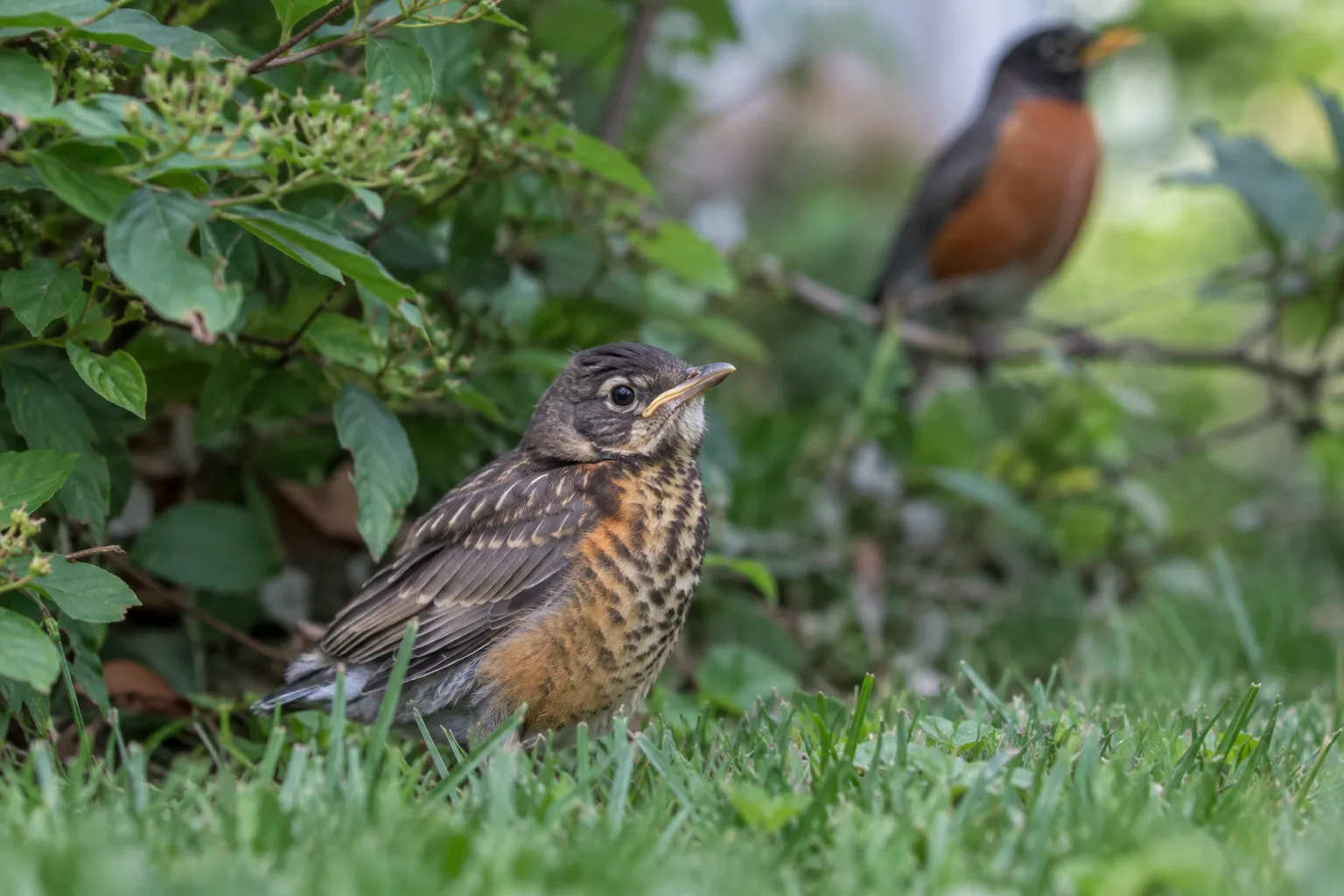
| American Robin | Spotted, speckled breast; short tail; pale gape | Often sits quietly on lawns and low branches while adults feed it |
| Northern Cardinal | Brownish overall, crest shorter, bill dark instead of red-orange | Hides in dense shrubs; parents give sharp chip calls nearby |
| Blue Jay | Grayer and fluffier than adults, short crest and tail | Loud and conspicuous; adults may dive at people and pets |
| Mourning Dove | Looks like a small, scaly-feathered adult | Leaves the nest looking nearly grown; often sits on the ground |
| House Finch and sparrows | Streaky brown, stubby tail, fluffy | Hop through low cover while begging for food |
Adults that dive, scold or chip loudly at you are a good sign: the parents are present and defending their young. Give them space. If you want help naming the bird, our guide on how to identify birds explains the size, shape and behavior clues that work even on young birds.
Step 3: What to do with a fledgling
Usually, nothing. The Cornell Lab says there is typically no reason to intervene beyond putting the bird on a nearby perch out of harm’s way and keeping pets indoors.
- Leave the bird where it is unless it is in immediate danger, such as on a road, a driveway or in open lawn with a cat nearby.
- If you need to move it, place it on a low branch or in a dense shrub within a few feet of where you found it. Parents find young birds by sound and sight, so keep the move short.
- Keep cats and dogs indoors, or on a leash, for a few days. This is the single most helpful thing you can do.
- Keep children and people away so the parents feel safe coming down to feed.
- Watch from a distance, if you want to. Watch from a window or from well away, since parents are cautious when people are close. Feeding visits can be quick and easy to miss.
Do not take a healthy fledgling indoors “just to be safe.” Fledglings learn to forage, recognize predators and fly by spending this time with their parents. Removing one takes away that learning.
Step 4: What to do with a nestling
If you can find the nest
The Cornell Lab’s advice is to put the bird back as quickly as possible. Parent birds will not abandon it because you touched it. Most songbirds have a poor sense of smell and do not identify their young by scent.
- Look up. Nests are usually in the nearest shrub, tree, eave, porch light or hanging planter.
- Warm your hands, then gently pick up the nestling, cupping it so it feels secure.
- Place it in the nest, then leave the area right away.
- Watch from a distance, preferably from inside, to see if adults return.
If the nest is destroyed or out of reach
The Cornell Lab suggests you can make a new nest, place the chick inside, and watch to see whether the parents return.
- Choose a small container such as a plastic berry basket or a small wicker basket. It needs drainage, so poke holes in the bottom of any solid container.
- Line it with the old nest material if you can recover it, or with dry grass or leaves.
- Fasten it securely in the same tree or shrub, as close as possible to the original nest site and out of direct sun.
- Put the nestling or nestlings inside, then leave the area.
- Watch from a distance for parents coming to feed. If you see no adults visit after a reasonable time, or the nestling looks weak, call a rehabilitator for advice.
Cornell’s guidance on nests near houses adds a related point: moving an active nest can cause parents to abandon it, and any replacement must stay very close to the original spot, within a few feet.
What NOT to do when you find a baby bird
These are the mistakes that most often turn a healthy baby bird into a rescue case.
Don’t feed it
No worms, bread, milk, seeds or pet food. Baby birds have species-specific diets, and the wrong food can kill them. Nestlings also need precise feeding technique; food can end up in the airway.
Don’t give it water
Never drip water into a baby bird’s mouth. Young birds can inhale water into their lungs. The Cornell Lab’s guidance for injured birds is the same: no food and no water. A rehabilitator will provide what it needs.
Don’t take a healthy fledgling home
This is the most common mistake. The Cornell Lab stresses that fledglings on the ground are normal and usually well cared for. Taking one inside removes it from its parents at the point when it most needs them.
Don’t try to raise it yourself
Native wild birds are protected under the federal Migratory Bird Treaty Act, which the U.S. Fish and Wildlife Service enforces. Keeping one, even temporarily and with good intentions, is illegal without the proper permits. Beyond the law, hand-raised birds often fail to survive in the wild because they miss critical learning, or become habituated to people.
Don’t keep checking on it
Every visit you make can delay a feeding. Parents avoid coming down while people are close. Watch from a window or a long distance.
Don’t wait for the bird to “look better”
If a bird is injured, cold or was caught by a pet, time matters. Call a rehabilitator promptly.
How to contain a baby bird safely while you get help
If the bird is injured, sick, or a rehabilitator has told you to bring it in, the Cornell Lab’s advice for injured birds applies:
- Prepare a container first. A small cardboard box with air holes, lined with a soft cloth or paper towel, works well. An unwaxed paper bag is fine for a small bird.
- Wear gloves if you have them, or wash your hands well afterward.
- Pick the bird up gently and place it in the container. Close the lid loosely.
- Keep it dark, quiet and warm, away from children, pets and noise. Darkness calms birds.
- Do not handle it again and do not open the box to check on it.
- Do not give food or water.
- Call a rehabilitator right away and follow their instructions on warmth and transport.
Call before you drive. The Cornell Lab notes that some clinics lack facilities for certain birds, and calling ahead lets them prepare or send you to the right place.
How to find a licensed wildlife rehabilitator
Wildlife rehabilitators hold state and, for most birds, federal permits to care for injured and orphaned wildlife. To find one:
- Search online for your state name plus “wildlife rehabilitation,” as the Cornell Lab suggests.
- Use Animal Help Now (ahnow.org), a U.S. wildlife emergency locator that points you to nearby help.
- Call your state wildlife agency (often called the Department of Natural Resources, Fish and Game or Fish and Wildlife).
- Ask a local veterinarian, nature center or animal control office for a referral.
Save a rehabilitator’s number in your phone now, before you need it. Spring and early summer are the busiest times for wildlife centers, and knowing whom to call saves time.
When are you most likely to find a baby bird?
Most songbirds in the United States nest from spring through summer, so the peak season for baby birds on the ground runs roughly from April through August, with regional differences. The Cornell Lab notes that for most songbirds the full nesting cycle, from incubation to fledging, lasts about four weeks. American Robins, Northern Cardinals, House Finches, Blue Jays, sparrows and wrens are among the backyard species whose fledglings people find most often. Our guide to attracting American Robins covers their nesting season in more detail.
How to prevent baby bird emergencies in your yard
You can reduce the number of baby birds that end up in trouble:
- Keep cats indoors, especially from spring through summer. Outdoor cats are a leading cause of harm to fledglings.
- Delay pruning and hedge trimming until after nesting season, and check shrubs carefully before any cutting.
- Check before mowing long grass or clearing brush, where ground-nesting birds and fledglings hide.
- Leave active nests alone. The Cornell Lab advises against moving nests, since parents often abandon them.
- Make windows visible to birds. Fledglings and inexperienced young birds are especially prone to window strikes. See our guide on how to stop birds hitting windows.
- Keep feeders and baths clean so young birds are not exposed to disease. Our guide on how to clean a bird feeder covers the routine.
For a broader look at making your yard safer for nesting birds, see our guide to backyard birding.
Common mistakes
- “Rescuing” a healthy fledgling. Most baby birds on the ground are fledglings in the care of their parents.
- Believing the touch myth. Parents will not reject a nestling because a person touched it.
- Giving water with a dropper. Young birds can inhale it.
- Offering bread, milk or worms. The wrong food harms young birds.
- Moving a fledgling far away. Keep any move within a few feet so parents can find it.
- Leaving the cat outside. Pets are the biggest immediate danger to a fledgling.
- Waiting too long with an injured bird. Call a rehabilitator promptly.
If you also see adult birds at your feeders that look sick, read our guide to sick birds at the feeder for signs and next steps.
Sources
Frequently asked questions
Will the mother bird reject a baby bird if I touch it?
No. The Cornell Lab of Ornithology says parent birds will not abandon a nestling because a person touched it. Most songbirds rely little on smell to recognize their young. If you find a nestling and can see its nest, put it back quickly and gently. Then leave the area so the parents feel safe returning.
How do I know if a baby bird is a fledgling or a nestling?
Fledglings are feathered, can hop or flutter, and grip your finger or a twig tightly with their toes. Nestlings are sparsely feathered or bare, cannot hop or grip well, and belong in the nest. The Cornell Lab notes that fledglings are the young birds people find most often, and they usually need no help.
Should I give a baby bird water or food?
No. The Cornell Lab and other wildlife authorities advise against feeding or watering baby birds. Young birds can inhale water into their lungs, and the wrong food, such as bread, milk or worms from the yard, can make them sick. Keep the bird warm, dark and quiet, and let a licensed wildlife rehabilitator decide what it needs.
Can I raise a baby bird myself?
No. Native wild birds are protected by the federal Migratory Bird Treaty Act, and keeping or raising one without a permit is illegal. Licensed wildlife rehabilitators have the training, diets and permits to raise young birds so they can survive in the wild. Your role is to get the bird to one quickly.
How do I find a wildlife rehabilitator near me?
The Cornell Lab suggests searching your state name plus wildlife rehabilitation. Animal Help Now (ahnow.org) offers a wildlife emergency locator for the United States. Your state wildlife agency, local nature centers, animal control and many veterinary clinics can also refer you. Call before you drive, so they can tell you how to transport the bird.