How to Use Merlin Sound ID Without Getting Fooled
How to use Merlin Sound ID: record close and still, then confirm every suggestion by range, repetition and a look at the bird. How to spot mimics and false IDs.
In this article
- Quick answer: a five-step check for every Sound ID suggestion
- How Merlin Sound ID works
- Where Merlin Sound ID gets fooled most often
- How to record better with Merlin Sound ID
- How to confirm a Merlin Sound ID suggestion
- Using Merlin Sound ID to learn birdsong
- Merlin Sound ID in different seasons and settings
- Managing your saved Sound ID recordings
- Common mistakes with Merlin Sound ID
- Merlin Sound ID vs your own ears
- Should you report Sound ID birds to eBird?
- Sources
- Frequently asked questions
Merlin Sound ID is very good at telling you which birds are probably singing around you, and it is sometimes confidently wrong. Knowing how to use Merlin Sound ID without getting fooled is simple: record close and still in sessions under 10 minutes, then confirm each suggestion by checking that the bird fits your place and season, that Merlin detected it more than once, and that the song matches the example recordings or, better, that you saw the bird sing.
The Cornell Lab says as much itself. Its help center describes Sound ID as suggesting possibilities, and says you confirm the identification. This guide explains how the tool works, where it tends to go wrong, and a repeatable routine for checking its answers.
Quick answer: a five-step check for every Sound ID suggestion
| Check | What to ask | If the answer is no |
|---|---|---|
| 1. Range and season | Is this species normal here at this time of year? | Treat as unconfirmed; look for a look-alike |
| 2. Repetition | Did Merlin flag it several times, or once? | One brief detection is weak evidence |
| 3. Match the sample | Does the song in Merlin’s examples sound like what you heard? | Play similar species and compare |
| 4. Mimic risk | Is a mockingbird, catbird, thrasher, starling or jay nearby? | Find the singer before you count it |
| 5. Eyes on the bird | Did you see it singing? | Keep it as “heard, probable” in your notes |
How Merlin Sound ID works
Knowing what happens inside the app explains most of its mistakes.
Sound ID turns your phone’s audio into a spectrogram, a picture of sound with time running left to right and pitch running bottom to top. A deep neural network, the same broad kind of model used to recognize objects in photos, reads that picture and recognizes the shapes that particular species make. The Cornell Lab’s project lead described it as identifying “a picture of a bird’s sound.”
According to the Macaulay Library, the original model was trained on sound recordings in which experts had marked the exact moments each species vocalized, along with many hours of background noise such as whistling and car sounds. That precise labeling is what lets Merlin pick out several species singing over each other. Later versions were trained on far more audio, and the help center notes that a species needs a minimum number of training recordings before it can be added.
Three consequences matter for you:
- Merlin knows only what it was trained on. A species missing from the supported list will never be suggested, and the model may put the closest match it knows in its place.
- Location and date weight the results. Merlin uses your location to favor birds that are likely where you are. The help center says Sound ID works offline but needs location services on.
- Clean, loud input gives better output. A faint, distant song buried under traffic is a small smudge on the spectrogram.
How many species does Sound ID cover?
When Sound ID launched in 2021, the Macaulay Library reported it could identify 458 species in the United States and Canada. The Cornell Lab’s supported-species page now lists more than 2,000 species worldwide, including more than 600 for the United States and Canada, with comprehensive coverage there and in Europe, and growing coverage in Latin America and India. The model is updated roughly twice a year.
Where Merlin Sound ID gets fooled most often
Mimics
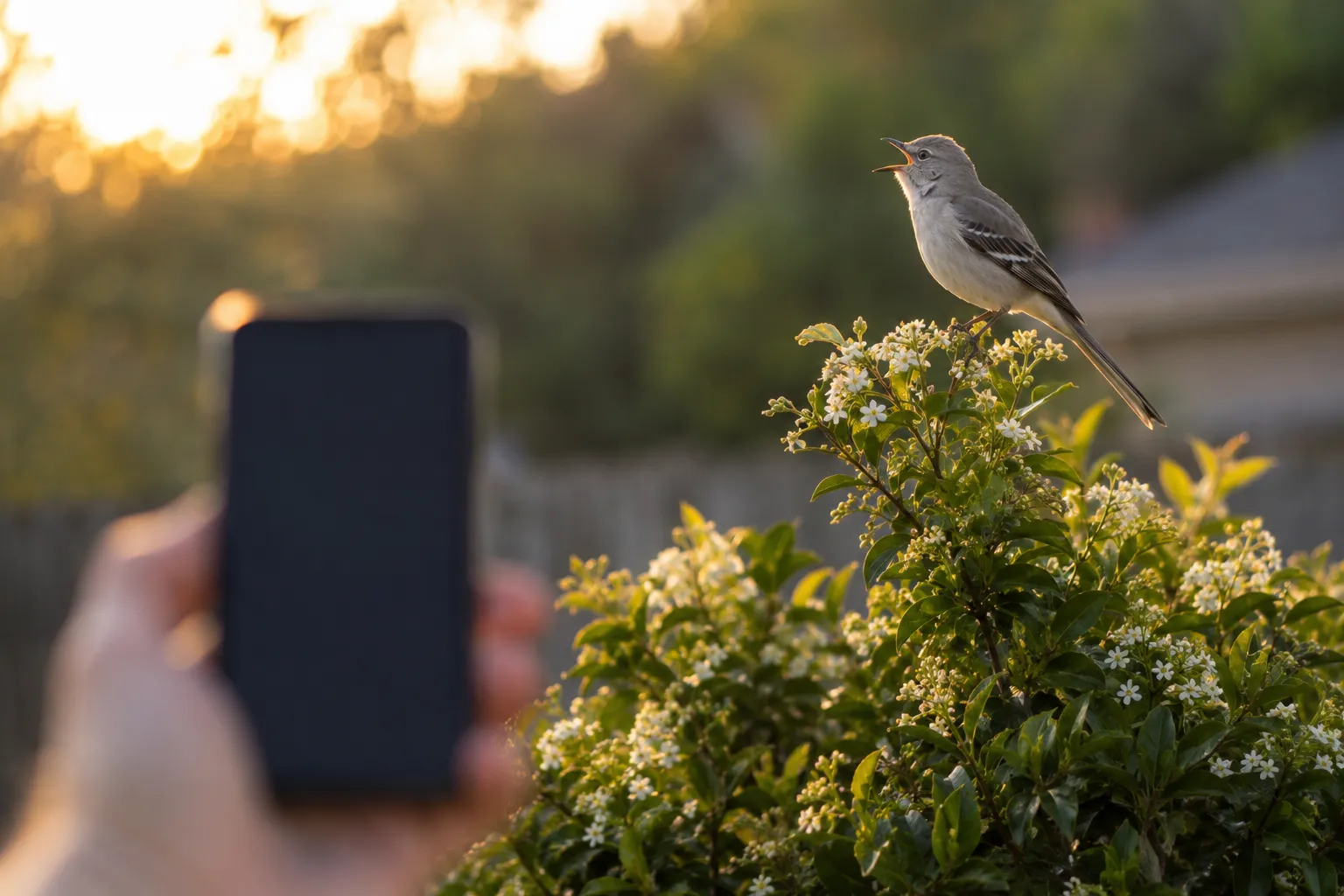
Several common yard birds copy other species. Northern Mockingbirds, Gray Catbirds and Brown Thrashers string together phrases of other birds’ songs. European Starlings imitate many sounds, and Blue Jays often give calls that closely resemble Red-shouldered and Red-tailed Hawks.
A mockingbird working through its repertoire can produce a list of cardinal, Carolina Wren, Northern Flicker and more, all from one bird on your chimney. How to tell:
- Mockingbirds usually repeat each phrase several times, often three or more, before switching.
- Brown Thrashers tend to sing phrases in pairs.
- Gray Catbirds run phrases together in a long, jumbled stream with mews and squeaks, mostly without repeating.
If Merlin lists a surprising bird and one of these mimics is singing nearby, find the singer before you trust the list. Our guide to attracting Northern Mockingbirds covers their song habits in more detail.
Look-alike songs from related species
Some species simply sound alike, and even experienced birders need care. Common backyard pairs and groups:
- Chipping Sparrow, Dark-eyed Junco and Pine Warbler all give dry or musical trills. Speed, tone and habitat help, but a quick trill can go any of three ways.
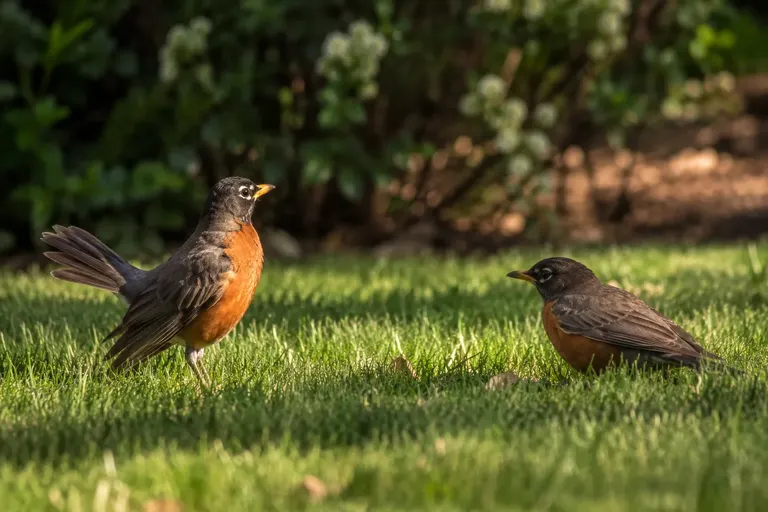
- American Robin, Scarlet Tanager and Rose-breasted Grosbeak all sing caroling, robin-like phrases. The tanager sounds hoarse, like a robin with a sore throat; the grosbeak sounds sweeter and more fluid.
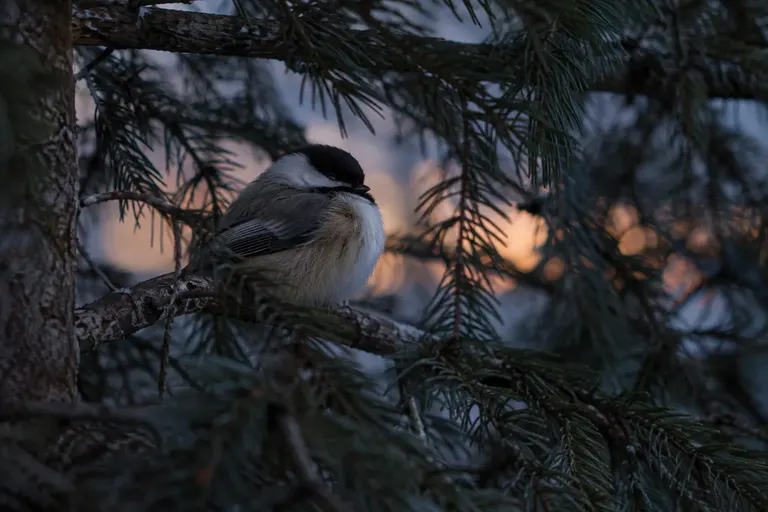
- Black-capped and Carolina Chickadees overlap in a narrow zone, and where they meet, individuals may sing the other species’ song. Range matters more than song there. Our Black-capped Chickadee guide explains the range split.
- House Finch and Purple Finch both sing long, warbling songs. Purple Finch songs are usually described as richer and lacking House Finch’s harsh ending notes.
- Downy and Hairy Woodpecker give similar sharp calls, and the Hairy’s is typically louder and sharper.
Species that vary from bird to bird
The Cornell Lab notes that species with consistent songs across their range, such as Willow Flycatcher, are easier for Sound ID, while species where individuals vary a lot, such as Baltimore Oriole, are harder. Song Sparrows, with many song types per bird, fall into the same challenging category.
Short calls and chip notes
Chips, tseets and contact calls are short and often similar across species. Merlin can help here. The Cornell Lab highlights its ability to identify the chip notes of common birds like Northern Cardinal. But a single chip is a small amount of information, so give chip-note suggestions extra scrutiny.

Sounds that are not birds
Insects (crickets, katydids and cicadas), frogs such as spring peepers, chipmunks and squirrels, squeaky gates and pulleys, car alarms, backing trucks and people whistling can all produce bird-like marks on a spectrogram. The training included background noise specifically to reduce this, but it still happens. Summer evenings full of insects and spring nights full of frogs are the usual culprits.
Faint and distant birds
Merlin can hear things you cannot, which the Cornell Lab describes as a kind of “super ears” for distant or very high-pitched singers like Blackpoll Warbler and Cedar Waxwing. That same sensitivity means it may register a faint sound too weak to identify reliably. When a species appears only for a moment at the edge of hearing, it is a lead, not a record.
How to record better with Merlin Sound ID
Most bad suggestions start with a poor recording. These tips come from the Merlin and Macaulay Library help guidance and common experience:
- Get closer, slowly. Approach without changing the bird’s behavior. Distance is the biggest enemy.
- Stand still. Footsteps, rustling jackets and a moving phone all add noise. Brace your elbow against your body.
- Point the phone’s microphone toward the bird. On most phones it is on the bottom edge.
- Do not be the loudest thing near the microphone. Stop talking, and ask others to pause.
- Step outside. Recording through a closed window cuts much of the high-pitched detail.
- Mute your phone. Notification sounds, keyboard clicks and ringtones end up in the recording.
- Keep sessions shorter. The help center says results are best for recordings under 10 minutes.
- Save the recording. Nothing saves automatically. Tap Save when you finish, so you can review it later.
- Consider a directional microphone. The help center notes a shotgun microphone gives better results than a small external mic, but technique matters more than equipment.
How to confirm a Merlin Sound ID suggestion
Step 1: Check the range and season
Open the species page in Merlin and look at the range map, or check eBird’s species map for your county. Is it a year-round resident, a summer breeder, a migrant or a winter visitor here? A Wood Thrush suggested in January in Ohio should set off alarms. A White-throated Sparrow in July in Georgia deserves a second look. Merlin already weights suggestions by location, so anything unusual that still gets through needs strong support.
Step 2: Look for repeated detections
A bird that sings for five minutes will be detected many times. Merlin highlights species as it hears them, and in a saved recording you can scroll through the spectrogram and see where each suggestion was heard. A species flagged once, for a split second, is much weaker evidence than one flagged throughout.
Step 3: Compare with the example recordings
Tap the suggested species and play its songs and calls. Then play the similar species listed in its account. Listen for rhythm, pitch, tone quality (clear, buzzy, harsh) and pattern. If your recording’s spectrogram shape does not resemble the examples, be skeptical.

Step 4: Find the singer
This is the single most reliable check. Use the direction and volume of the sound to find the bird, then get binoculars on it and watch it sing. The Cornell Lab recommends verifying identifications by observing the bird singing. If you need help finding a bird quickly, our guide to finding a bird in your binoculars fast walks through the technique.
Step 5: Decide what to record
If you confirmed the bird by sight, or you know its song well and the recording matches, count it. If not, note it as “possible” in your own notes but leave it off formal lists. When a rare species is involved, keep the saved recording. Rare reports on eBird are reviewed by regional experts, and good audio helps them evaluate it.
Using Merlin Sound ID to learn birdsong
The best long-term use of Sound ID is as a tutor. Many birders report that after a season of running it in the yard, they start recognizing the common singers on their own.
- Pick three birds a week. Focus on the most frequent voices in your yard, such as cardinal, robin and chickadee. When Merlin flags one, find the bird and watch it sing.
- Guess first, then check. Before looking at the screen, say what you think is singing.
- Learn songs and calls separately. A Northern Cardinal’s whistled song and its sharp metallic chip are both worth knowing. See our Northern Cardinal guide.
- Use the dawn chorus. Spring mornings bring the most singers, and Merlin can help separate overlapping voices. Our guide to the best time of day to see birds explains why early morning is the peak.
- Revisit saved recordings. Replay a morning session later and try to identify each voice before reading the list.
Merlin Sound ID in different seasons and settings
Sound ID behaves differently depending on when and where you use it. Adjust your expectations accordingly.
Spring and early summer
This is when Sound ID shines and when it is busiest. Many birds sing hard at dawn to defend territories and attract mates, so a single recording can hold a dozen species. Expect more true detections and, because there is more going on, more chances for a brief false one. Spring migration also brings birds that pass through for only a few days, so an unfamiliar warbler suggestion in May is more plausible than the same suggestion in July.
Late summer and fall
Singing drops off sharply after nesting season. Many birds switch to short calls and chips, and young birds give begging calls and imperfect practice songs that do not match adult recordings well. Fall migrants move through largely silent, and their flight calls are brief and hard to pin down. Take fall suggestions with more caution.
Winter
Fewer species are present and fewer are singing, so lists are shorter. Chickadees, titmice, nuthatches, jays, cardinals and woodpeckers are often the main voices. Winter is a good season to learn calls rather than songs, because the soundscape is simpler. Our guide to winter bird feeding covers which birds tend to stay.

At night
Owls, nightjars and some migrants call after dark. Sound ID can help with common owls such as Great Horned, Barred and Eastern Screech-Owl, but night also brings frogs and insects that can produce false marks. Recording at night from a quiet spot, and listening back later, gives you time to compare carefully.
At the feeder
Feeders concentrate birds, which helps. But feeders also concentrate mimics and loud, common species. A Blue Jay giving its hawk-like call at the feeder can produce a “Red-shouldered Hawk” suggestion. Look up before you log a hawk.
Managing your saved Sound ID recordings
The Merlin help center explains how saved sessions work, which is useful once you start collecting recordings:
- Recordings stay private on your device in the Sound ID sessions list.
- You can export and share a recording using the share button, for example to send an unknown song to a birding friend.
- You can import mp3, m4a and wav files from other apps and run Sound ID on them.
- Delete what you do not need. Recordings take storage space, so clear out routine sessions and keep the interesting ones.
If you record something unusual, keep the file. It is your best evidence if you later want to submit the observation or ask others to help confirm it.
Common mistakes with Merlin Sound ID
- Counting every name on the list. The list is suggestions, not a checklist.
- Running it all day in the background. More listening time means more chances for brief false detections.
- Ignoring the season. Out-of-season species are the most likely errors.
- Forgetting mimics. One mockingbird can create half a dozen phantom species.
- Recording from inside the house. Glass filters out much of the detail the model needs.
- Trusting it for a rarity without evidence. Unusual birds need a sighting, a photo or a clean recording.
- Deleting recordings too soon. Keep anything unusual until you have checked it.
Merlin Sound ID vs your own ears
Sound ID has clear advantages. It can pick out high, distant and overlapping songs that many people, especially those with some age-related hearing loss in high frequencies, cannot hear. It never gets tired, and it teaches through repetition.
Your ears and eyes still win in context. You can tell a bird is moving, see which tree the song comes from, notice that a “cardinal” and a mockingbird are singing from exactly the same perch, and weigh behavior. The strongest approach combines both: let Merlin point you toward a voice, then use your own observation to confirm it.
Should you report Sound ID birds to eBird?
eBird asks birders to report species they confidently identified by sight or sound. An app suggestion on its own does not meet that bar. If you confirmed the bird yourself, report it. If you are building your own familiarity, many birders add a short comment such as “heard, confirmed with Merlin and seen singing” to record how they identified it. Our guide to how to use eBird explains checklists in detail, and our comparison of the best bird identification apps covers Merlin alongside the alternatives.
Sources
Frequently asked questions
How accurate is Merlin Sound ID?
It is often right for common, vocal birds recorded clearly and close, but accuracy drops with distant singers, noisy recordings, mimics and species whose songs vary between individuals. The Cornell Lab itself says Merlin suggests possibilities and you confirm the identification by comparing the audio and species details, ideally by seeing the bird sing.
Why does Merlin Sound ID suggest birds that are not there?
Common causes are mimics such as Northern Mockingbirds and Blue Jays, look-alike songs from related species, non-bird sounds like insects, frogs, squeaky hinges and whistling people, and very short or faint detections. A suggestion that appears only once, briefly, for a species that is unusual in your area deserves the most skepticism.
Does Merlin Sound ID work offline?
Yes. The Cornell Lab says Sound ID runs on your device and works completely offline once the Bird Pack for your region is downloaded. Keep location services on so Merlin can use your location and the date to weight its suggestions toward birds that are actually likely where you are.
How many birds can Merlin Sound ID identify?
The Cornell Lab's supported-species list shows more than 2,000 species worldwide, including more than 600 in the United States and Canada, with comprehensive coverage there and in Europe. Coverage is updated about twice a year. When Sound ID launched in 2021, it covered roughly 450 US and Canadian species.
Can I use Merlin Sound ID on a recording I already made?
Yes. The eBird and Merlin help center says Merlin can import mp3, m4a and wav files from other apps and run Sound ID on them. It also notes results are best for recordings under 10 minutes, since longer ones load slowly. Location and date still matter, so use recordings from your own area.
Should I report Merlin Sound ID results to eBird?
Only report species you confidently identified yourself. eBird asks for birds you can identify by sight or sound, and an app suggestion alone does not meet that bar. If you confirmed a bird by seeing it or by carefully matching its song, include it. If you are unsure, leave it off or note the uncertainty.