Woodpecker Feeder Guide: Suet Cages, Peanuts and Logs
A woodpecker feeder works best as a suet cage or rigid peanut mesh feeder hung near a tree trunk. Which feeder types, foods and spots suit each woodpecker.
In this article
- What is the best woodpecker feeder?
- Do woodpeckers need a tail prop feeder?
- What is a peanut feeder, and do woodpeckers use it?
- Are log feeders good for woodpeckers?
- What food should you put in a woodpecker feeder?
- Which woodpeckers visit feeders?
- Will a woodpecker feeder attract chickadees and tits?
- Where should you hang a woodpecker feeder?
- How do you keep starlings and squirrels off a woodpecker feeder?
- When should you feed woodpeckers?
- How do you clean a woodpecker feeder?
- Common mistakes with woodpecker feeders
- Sources
- Frequently asked questions
The best woodpecker feeder is a suet cage or a rigid wire peanut feeder hung on or near a tree trunk. Woodpeckers cling to feed, so they prefer feeders they can grip from the side or below. Fill it with plain suet or shelled, unsalted peanuts, keep it clean and feed mainly in the colder months.
The same feeders also draw chickadees, nuthatches and titmice in North America, and tits and nuthatches in Europe. This guide covers feeder types, foods, species and placement, drawing on the Cornell Lab, Audubon, the RSPB, the BTO and national bird groups in France, Germany and the Netherlands.
What is the best woodpecker feeder?
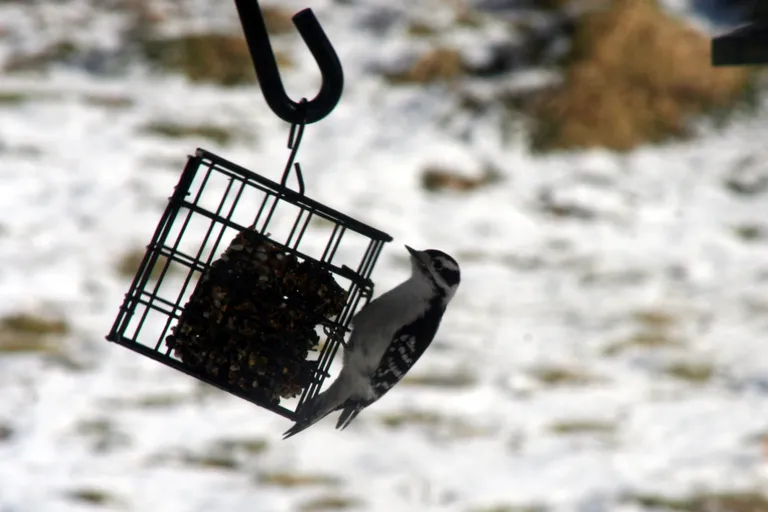
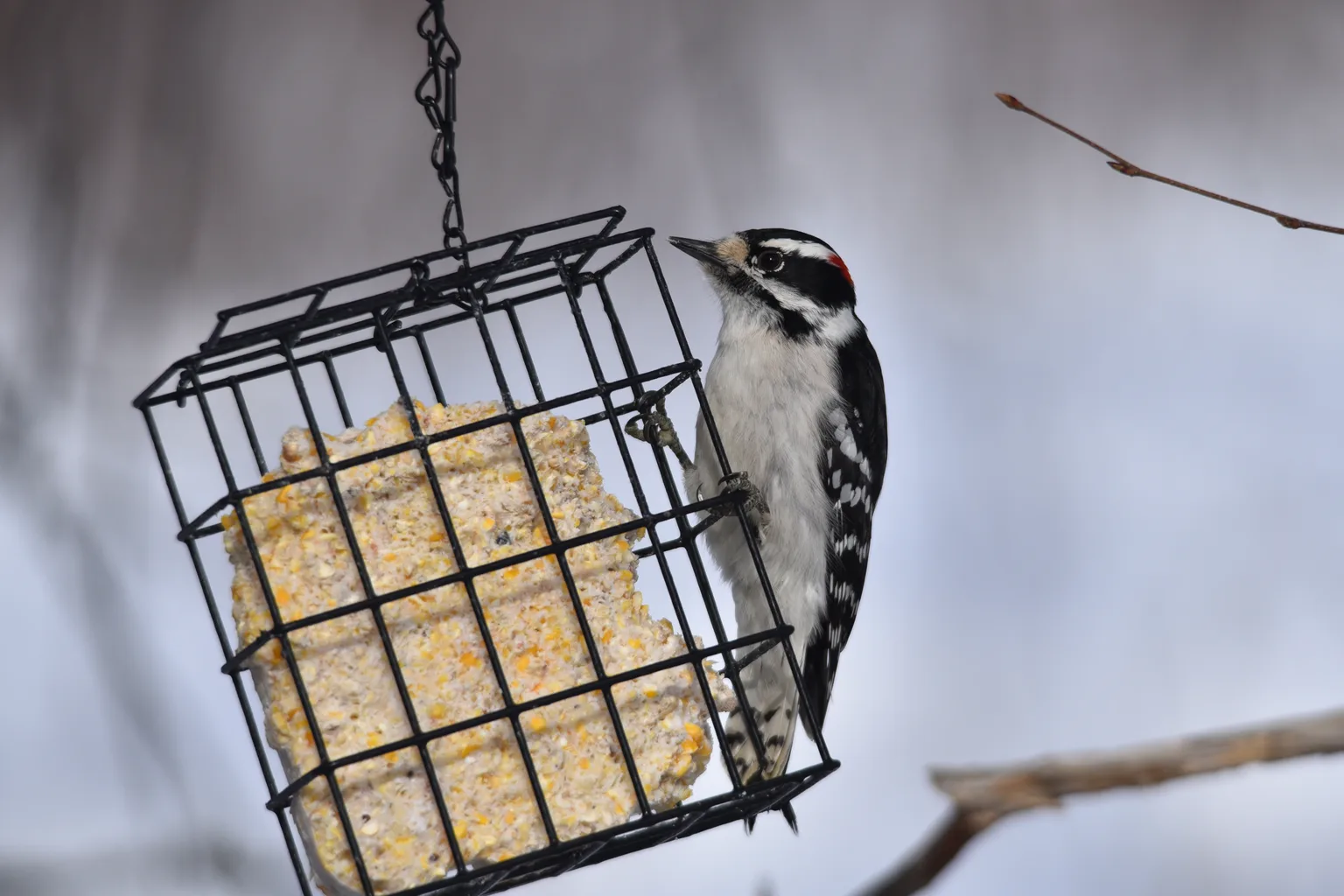
For most yards, it’s a suet cage. Woodpeckers feed by clinging to bark, and a wire cage lets them do exactly that. Peanut mesh feeders and log feeders are good second options.
| Feeder type | Best food | Main visitors | Strengths | Watch out for |
|---|---|---|---|---|
| Single suet cage | Suet cakes | Downy and Hairy Woodpeckers, nuthatches, chickadees | Simple, easy to refill | Starlings and squirrels also use open cages |
| Upside-down suet feeder | Suet cakes | Woodpeckers, nuthatches, chickadees | FeederWatch says bottom-only cages tend to resist starlings | Some birds take a few days to learn it |
| Tail prop suet feeder | Suet cakes | Red-bellied and Pileated Woodpeckers, flickers | Support for larger woodpeckers | Bigger and heavier to hang |
| Rigid peanut mesh feeder | Shelled, unsalted peanuts | Woodpeckers, nuthatches, tits, chickadees | Birds take small pieces, not whole nuts | Squirrels love peanuts |
| Log feeder | Suet plugs or suet pressed into holes | Small woodpeckers, nuthatches, chickadees | Looks and works like a tree trunk | Holes need regular scrubbing |
| Caged feeder | Suet or peanuts | Small woodpeckers and small songbirds | Keeps out squirrels and large birds | Larger woodpeckers can’t fit through |
For specific models, see our roundup of the best suet feeders.
Do woodpeckers need a tail prop feeder?
Small woodpeckers don’t, but larger ones benefit. Woodpeckers brace against trunks with stiff tail feathers; as Texas Parks and Wildlife puts it, the tail acts “as a prop to brace and steady the bird as it works.”
On a small cage there’s nothing below the bird to lean on. A Downy Woodpecker, which Audubon describes as the smallest North American woodpecker, is about the length of a classic suet cage and feeds without trouble. Red-bellied Woodpeckers, Northern Flickers and Pileated Woodpeckers are much bigger, and a tail prop panel lets them settle and feed for longer. If you live in the range of these larger birds, a tail prop design is worth the extra size.
What is a peanut feeder, and do woodpeckers use it?
A peanut feeder is a tube or cylinder of rigid steel mesh filled with shelled peanuts. Birds peck through the mesh and take small pieces. Woodpeckers use them readily: the RSPB calls Great Spotted Woodpeckers “bold, regular visitors” to peanut and suet feeders, especially in winter.
The mesh does an important job. The BTO says peanuts are best supplied behind wire mesh “so that a bird cannot take a whole peanut away.” That matters most in spring, when whole nuts carried to the nest can choke chicks. The mesh must be rigid metal. The RSPB warns never to put food out in mesh bags, which can trap birds’ feet, and adds that birds with a barbed tongue, like woodpeckers, can become trapped by their beaks.
In North America, the Cornell Lab lists peanuts as a draw for Downy, Hairy and Red-bellied Woodpeckers. FeederWatch notes that chickadees, nuthatches and titmice do better with shelled peanuts than whole ones in the shell. For safe types, storage and aflatoxin, see our guide to peanuts for birds.
Are log feeders good for woodpeckers?
Yes. A log feeder is a short length of wood with holes drilled into it, filled with suet plugs or a firm suet mix. It imitates a tree trunk, so clinging birds use it naturally.
Bird groups describe the same idea in simpler forms. FeederWatch says suet can be tied to trees or smeared into knotholes, and the BTO notes that fat smeared into cracks in bark will be found by treecreepers and woodpeckers. Vogelbescherming Nederland calls a homemade woodpecker block easy to make. A firm homemade suet mix pressed into the holes works as well as bought plugs.
What food should you put in a woodpecker feeder?
Suet first, peanuts second, sunflower as an extra. That order reflects what the Cornell Lab and Audubon say woodpeckers take at feeders.
| Food | How useful for woodpeckers | Best feeder | Notes |
|---|---|---|---|
| Suet cakes or plugs | Excellent | Suet cage, tail prop, log | Cornell Lab: Downy Woodpeckers prefer suet feeders |
| Shelled peanuts, unsalted | Very good | Rigid steel mesh feeder | Buy from a supplier that checks for aflatoxin, as the RSPB advises |
| Black-oil sunflower | Occasional | Tube or hopper | FeederWatch says woodpeckers eat it “on occasion” |
| Peanut butter mixes | Good | Log or cage | Use a chunky, unsalted type |
| Millet, cracked corn | Poor | Ground or tray | Little interest from most woodpeckers |
The Cornell Lab says Downy Woodpeckers prefer suet but also take black-oil sunflower, millet, peanuts and chunky peanut butter. For Hairy Woodpeckers it suggests suet, peanut and black-oil sunflower feeders, especially in winter. Red-bellied Woodpeckers come to suet in winter, peanuts, and sometimes sunflower. Our guide to suet for birds explains which blends to choose.
Avoid salted or coated peanuts, which FeederWatch rules out. In France, the LPO recommends unroasted, unsalted peanuts and plant-based fats, ideally made with rapeseed oil rather than palm oil.
Which woodpeckers visit feeders?
It depends on where you live. North America has several regular feeder woodpeckers; most European gardens have one main species.
| Region | Species | How often at feeders | Favorite feeder foods |
|---|---|---|---|
| North America | Downy Woodpecker | The most likely woodpecker at a backyard feeder (Cornell Lab) | Suet, sunflower, peanuts |
| North America | Hairy Woodpecker | Probably the second most common at feeders (Audubon) | Suet, peanuts, sunflower |
| North America | Red-bellied Woodpecker | Common in the eastern US | Suet in winter, peanuts |
| North America | Northern Flicker | Often visits suet feeders (Audubon) | Suet |
| North America | Pileated Woodpecker | Sometimes, especially for suet (Cornell Lab) | Suet |
| Europe | Great Spotted Woodpecker | Bold, regular visitor in winter (RSPB) | Peanuts, suet |
In Britain, the BTO reports that Great Spotted Woodpeckers have significantly increased their use of garden feeders. The RSPB describes them as roughly Blackbird-sized but slimmer, and resident all year. Vogelbescherming Nederland notes they wander in winter and increasingly turn up at garden feeding stations.
Telling a Downy from a Hairy at the cage takes a second look. Audubon suggests judging size against the feeder: a Downy is about the length of a classic suet cage or smaller, while a Hairy is a bit longer with a thicker bill. Bill length is the best clue: the Cornell Lab says a Hairy’s bill is nearly the same length as its head, while a Downy’s is short and almost thornlike.
Will a woodpecker feeder attract chickadees and tits?
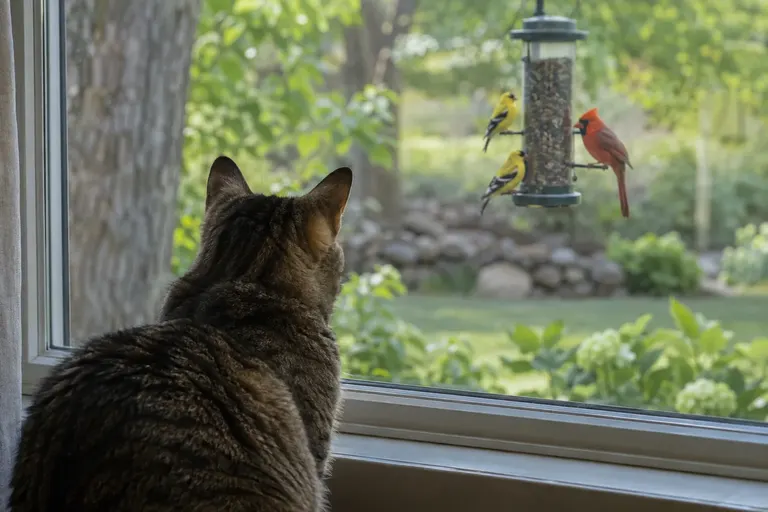
Almost certainly. Cornell Lab lists woodpeckers, nuthatches, chickadees and jays as the birds most drawn to suet. Chickadees are easy to attract with suet, sunflower seed and peanuts, and the Cornell Lab notes they don’t mind tiny hanging feeders that swing in the wind. That’s why a “chickadee feeder” and a woodpecker feeder are often the same thing.
In Europe the RSPB says suet can be enjoyed by Long-tailed Tits, nuthatches, house sparrows and woodpeckers, and the BTO says peanut cake attracts Long-tailed Tits. Germany’s NABU notes that woodpeckers and tits switch partly to seeds in winter and also take sunflower seeds, and that nuthatches take fat directly from trees. See our guide to the Black-capped Chickadee for more on chickadees.
Where should you hang a woodpecker feeder?
On or near a tree trunk, high enough to keep cats away and in a spot you can see from the house.
- Near trunks and big limbs. Woodpeckers forage on bark, so a feeder close to a trunk fits the way they already move through the yard.
- Out of reach of cats. The RSPB says to hang feeders high enough that ground predators can’t reach them, and a couple of meters from thick cover such as bushes.
- Balance cover and squirrels. FeederWatch suggests that about 10 feet from cover is a good compromise between shelter for birds and easy access for squirrels and cats.
- Mind the windows. Audubon recommends placing feeders closer than 3 feet or more than 30 feet from a window.
- Shade in warm weather. Soft suet is a problem, so hang suet in shade once temperatures rise.
- Move feeders now and then. The RSPB suggests moving feeders regularly, ideally weekly, to stop droppings and disease building up in one spot.
How do you keep starlings and squirrels off a woodpecker feeder?
Pick the feeder design to match the pest. An upside-down suet feeder, which only opens at the bottom, is the standard answer to starlings: the Cornell Lab says starlings have trouble feeding that way while woodpeckers and chickadees manage well.
For squirrels, use a caged feeder, which lets small birds through and keeps squirrels and large birds out, or mount the feeder on a pole with a baffle. FeederWatch also mentions surrounding feeders with wire mesh wide enough for small birds only. Keep in mind that a cage small enough to stop a squirrel will also stop a Red-bellied Woodpecker. Our guide to squirrel-proof bird feeders compares the options.
When should you feed woodpeckers?
Mainly from late autumn to early spring, when natural food is scarce. National advice differs, so follow your local guidance.
| Country | Guidance |
|---|---|
| United States and Canada | The Cornell Lab advises offering raw suet only in winter, because it goes rancid above freezing |
| United Kingdom | The RSPB and BTO ask people to feed seeds and peanuts from November to April and pause from May to October; suet and mealworms can still be offered in moderation |
| Germany | NABU says winter feeding helps most from November to February and advises no peanuts, whole or chopped, while young are raised |
| France | The LPO recommends feeding in winter, especially in long cold spells, and reducing amounts gradually in spring |
| Netherlands | Vogelbescherming says to offer peanuts only in a peanut feeder and to keep fat products out of the sun |
Summer suet needs care. The Cornell Lab warns that soft suet can coat belly feathers, and the RSPB advises heat-resistant suet in warm months rather than homemade fat cakes.
How do you clean a woodpecker feeder?
Clean suet and peanut feeders every week or two, and more often in wet weather or heavy use.
- Remove leftover suet or peanuts, especially anything soft, moldy or rancid.
- Scrub grease off the wire with a stiff brush and hot, soapy water.
- Soak in a solution of one part bleach to nine parts water for 10 minutes, as FeederWatch recommends, or use a mild disinfectant, as the RSPB suggests.
- Rinse thoroughly and let the feeder dry completely before refilling.
- For log feeders, scrub out each hole, since grease and droppings collect there.
FeederWatch also reminds you to keep suet cage lids secured so animals can’t get stuck inside. For step-by-step detail, see our guide on how to clean bird feeders.
Common mistakes with woodpecker feeders
- Hanging the feeder in the open lawn. Woodpeckers find feeders near trunks much more easily.
- Using plastic nets. Fat balls and peanuts in nets can trap feet and tongues. Use rigid metal mesh.
- Putting out salted or roasted nuts. Use plain, unsalted peanuts from a careful supplier.
- Skipping cleaning. Greasy feeders spoil food and help disease spread.
Sources

Frequently asked questions
What is the best feeder for woodpeckers?
A suet cage is the most reliable woodpecker feeder, because woodpeckers cling and feed the way they do on bark. Cages that open only at the bottom also discourage starlings, according to Project FeederWatch. A rigid wire peanut feeder is the next best choice, and a hanging log feeder filled with suet plugs suits small woodpeckers, nuthatches and chickadees. Hang any of them close to a tree trunk.
Do woodpeckers eat from peanut feeders?
Yes. The Cornell Lab lists peanuts among the foods that attract Downy, Hairy and Red-bellied Woodpeckers, and the RSPB describes Great Spotted Woodpeckers as bold, regular visitors to peanut feeders in winter. Use shelled, unsalted peanuts in a rigid steel mesh feeder, so birds peck off small pieces. Never use soft plastic nets, which can trap a woodpecker's barbed tongue.
What is a tail prop suet feeder?
It's a suet cage with a board or panel extending below it. Woodpeckers brace on their stiff tail feathers while they climb and feed, and the extra surface gives them something to press against. Small Downy Woodpeckers manage fine on a plain cage, but larger birds such as Red-bellied Woodpeckers, Northern Flickers and Pileated Woodpeckers feed more comfortably with the support.
Where should I hang a woodpecker feeder?
Hang it on or near the trunk of a large tree, where woodpeckers already forage, at a height you can reach for refilling. Keep it high enough that cats can't reach birds, and place it either closer than 3 feet or farther than 30 feet from windows, as Audubon advises, to cut collision risk. In warm weather, choose a shaded spot so suet stays firm.
Will a woodpecker feeder attract chickadees too?
Usually, yes. The Cornell Lab says chickadees are easy to attract with suet, sunflower seed and peanuts, and they don't mind small hanging feeders that swing. Nuthatches and titmice use the same suet cages and peanut feeders. In Europe, blue tits, great tits, long-tailed tits and nuthatches share woodpecker feeders, which is why one well-placed feeder often serves a whole group of clinging birds.