Caged Bird Feeders: How Guardian Cages Work
A caged bird feeder puts a wire guard around seed, suet or fat balls so small birds get in while squirrels and big birds mostly stay out. Gaps, limits, care.
In this article
- How does a caged bird feeder work?
- What mesh gap sizes are used, and which birds fit?
- Which kinds of feeders can you put a cage around?
- Is a caged feeder starling proof?
- What about a squirrel proof suet feeder?
- What are the limits of caged feeders?
- How do you clean a caged bird feeder?
- Where should you put a caged feeder?
- Is a caged feeder right for your yard?
- Sources
- Frequently asked questions
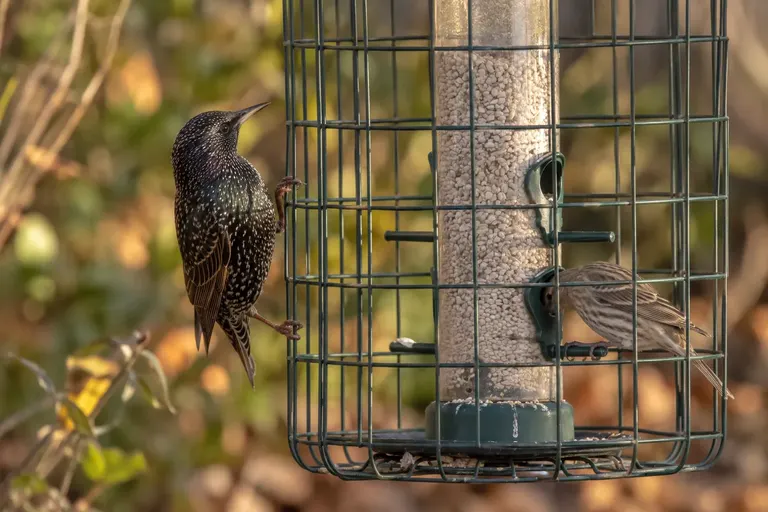
A caged bird feeder is a seed, peanut, suet or fat ball feeder inside a wire guard. Small birds slip through the gaps to feed, while pigeons, larger birds and most adult squirrels can’t reach the food. The RSPB calls these guardian feeders, and gaps of roughly 3 to 4 cm are typical.
They are one of the simplest ways to keep a feeder for small birds only. They also have real limits: young squirrels and slim starlings can sometimes get in, mid-sized birds you might want to feed are shut out, and the cage adds a little work at cleaning time. Here is how they work, which birds fit, and how to set one up well.
How does a caged bird feeder work?
The cage is a sorting gate. Any bird or animal small enough to pass through the mesh can reach the food; anything bigger has to stay outside and stretch for it.
Two measurements decide how well that works:
- Gap size. The openings in the mesh decide who gets in. Smaller gaps mean fewer large visitors, and fewer kinds of birds.
- Distance from cage to food. A squirrel or crow clinging to the outside will reach in as far as it can. The RSPB lists 3.5 cm between its guardian and the perches on seed feeders, and 8 cm between guardian and mesh on nut feeders, so a long tongue or bill can’t empty the feeder from outside.
The Cornell Lab of Ornithology recommends an outer cage that keeps squirrels from reaching the seeds when you choose a tube feeder. Project FeederWatch suggests feeders surrounded by wire mesh large enough for only small birds to get through.
What mesh gap sizes are used, and which birds fit?
Most small-bird guards use gaps of about 3 to 4 cm, and wider mesh lets more species in. These are the published figures from two national bird charities’ own guards:
| Guard | Gap size | What the maker says |
|---|---|---|
| RSPB hanging feeder guardian | 4 x 3.5 cm | Resistant to larger birds and adult squirrels |
| LPO cage for silo feeders | 3 x 4 cm | Small garden birds feed; larger birds have limited access |
| RSPB narrow-mesh ground cage | 4 x 6 cm | Keeps out blackbirds, thrushes, doves, pigeons and most adult squirrels; small or young squirrels and starlings may still get in |
In practice, birds sort roughly by body size. Treat the table below as a general guide, not a promise, because individual birds and cages vary.
| Bird | With small-bird mesh (about 3 to 4 cm) |
|---|---|
| Blue tit, great tit, coal tit, chickadees, titmice | Usually get in easily |
| Goldfinch, siskin, house finch, sparrows, nuthatches | Usually get in |
| Robin, dunnock | Often get in, though they prefer feeding low |
| Starling | Sometimes; slim enough to squeeze through wider gaps |
| Blackbird, thrushes | Kept out by narrow mesh (RSPB) |
| Pigeons and doves | Kept out (RSPB) |
| Grackles, jays, crows, magpies | Generally kept out of small-bird mesh |
| Grey squirrels | Adults mostly kept out; young ones may get in |
FeederWatch notes that feeders built for small birds exclude larger birds such as grackles and jays. Mid-sized birds, such as Northern Cardinals or Great Spotted Woodpeckers, sit on the borderline and may not fit, so a caged feeder works best as one feeder among several rather than your only one.
Which kinds of feeders can you put a cage around?
Almost any hanging feeder. The cage can come built in, or you can buy a separate guard sized to fit over a feeder you already own.
Seed tubes and silos
The most common type is a tube or silo feeder inside a cylinder of mesh. Tits and finches pass through and feed from the ports. Check that the perches sit well inside the cage, as in the RSPB figure above, so nothing can reach them from outside. For more on tube styles, see our guide to tube bird feeders.
Peanut feeders
The BTO says peanuts are best offered behind wire mesh, so a bird can’t carry off a whole peanut. A caged peanut feeder adds a second layer: a mesh tube for the nuts, and an outer guard to keep squirrels and large birds back.
Suet and fat ball feeders
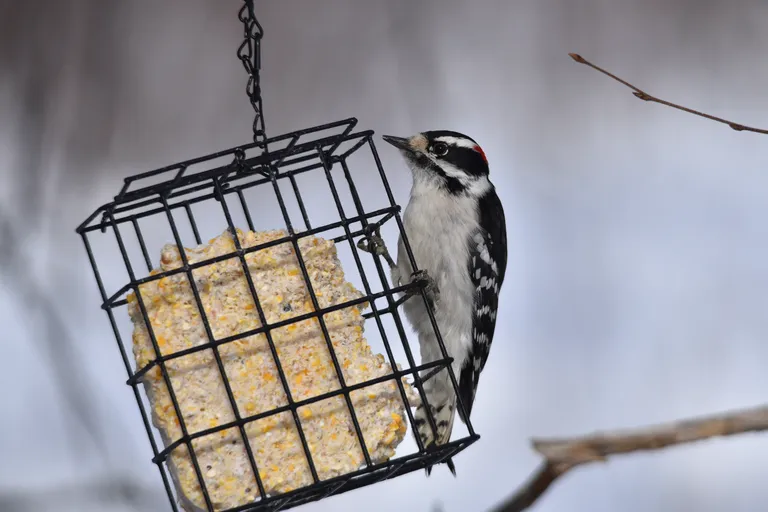
A caged fat ball feeder puts a rigid fat ball holder inside an outer guard. Tits feed easily, since the LBV notes that all tit species prefer hanging food and handle it better than other birds. Squirrels love fat, so an outer guard helps here too.
Never hang fat balls in the plastic nets they are sold in. The RSPB says mesh bags can trap birds’ feet and even break legs, and NABU asks people to avoid them for the same reason. Our guide to fat balls for birds covers safe holders.
Ground and table cages
Low cages over a ground tray let small birds feed near the ground while keeping pigeons off. Be aware that the RSPB has stopped selling bird tables and feeder guardians with trays because finches can be more exposed to disease on flat surfaces. If you use one, keep it very clean, or choose a caged hanging feeder instead.
Is a caged feeder starling proof?
Not fully. A small-mesh cage around a seed tube keeps most starlings off the ports, but starlings are slim, and the RSPB notes they may still get into its narrow-mesh ground cage. Starlings are often most persistent at suet and fat.
For suet, the better answer is an upside-down feeder:
- How it works. The suet cake faces downward, so birds must cling underneath to feed.
- Who benefits. The Cornell Lab says this design favors agile birds such as woodpeckers and nuthatches. FeederWatch adds that chickadees feed this way easily too.
- Why starlings struggle. FeederWatch recommends starling-proof suet feeders that allow access only from the bottom, because starlings find it hard to feed hanging upside down.
Some feeders combine both ideas: a suet cage inside a guard, opening only at the bottom. If starlings are your main problem, our full guide on keeping starlings off bird feeders covers food choices too, and our suet feeder guide compares designs.
What about a squirrel proof suet feeder?
A caged suet feeder is the usual answer, with two conditions. The gap has to be small enough to stop adult squirrels, and the suet has to sit far enough inside that a squirrel can’t pull it out with its paws.
Expect some squirrels to keep trying. FeederWatch says squirrels often find a way into squirrel-proof feeders, and that baffles are usually the best way to keep them off. It also notes that squirrels can jump to feeders less than 10 feet (about 3 m) from a tree or building. Combine the cage with good placement and a baffle, and see our guides to squirrel-proof bird feeders and squirrel baffles.
What are the limits of caged feeders?
Caged feeders filter visitors, which is the point, but the filter isn’t perfect. Know the trade-offs before you buy.
| Limit | What happens | What helps |
|---|---|---|
| Young squirrels | Small or juvenile squirrels may fit through (RSPB) | Smaller mesh, baffle, placement away from jump points |
| Starlings | Can squeeze through wider gaps | Narrow mesh for seed; bottom-only access for suet |
| Mid-sized birds shut out | Cardinals, woodpeckers or blackbirds may not fit | Add a second, open feeder for them |
| Trapped birds | A loose lid, bent wire or awkward pocket can hold a bird | Secure lids, check the cage when cleaning |
| Ground feeders ignored | Robins, dunnocks and blackbirds prefer feeding low | Offer food near the ground for them too |
| Harder cleaning | The guard has to come off to reach the feeder | Choose a guard that detaches easily |
Trapping is rare but worth taking seriously. FeederWatch advises securing suet cage lids so that no animal can get stuck inside. A cage with bent or broken wires can create a gap that a bird squeezes into but can’t easily turn around in, so replace damaged guards rather than patching them.
How do you clean a caged bird feeder?
Take the cage off and clean both parts on a regular schedule. The RSPB advises washing feeders weekly with a mild disinfectant and hot water, rinsing fully and drying before refilling. Project FeederWatch suggests cleaning seed and suet feeders every week or two, and more often in wet weather or heavy use.
- Remove the guard. Most guards unscrew or lift off; the RSPB guardian screws into place over the feeder.
- Empty old food. Throw out clumped or damp seed, which Vogelbescherming Nederland says should be discarded.
- Scrub. Use hot soapy water and a brush on the feeder, ports and the inside of the mesh.
- Disinfect. FeederWatch suggests soaking cleaned parts for 10 minutes in a solution of one part bleach to nine parts water.
- Rinse and dry. Let everything dry fully before you refill and reassemble.
- Clean underneath. Sweep up husks and droppings below the feeder.
NABU recommends wearing rubber gloves and washing your hands afterwards. Our step-by-step guide to cleaning bird feeders has more detail.
Where should you put a caged feeder?
Hang it where small birds feel safe and squirrels can’t jump onto it. A cage doesn’t help much if a squirrel can land on top and reach in from a branch.
- Near cover, but not too near. The RSPB suggests feeders be a couple of meters from thick cover, and FeederWatch suggests about 10 feet as a good compromise between shelter and cat or squirrel access.
- Away from jump points. Keep it clear of fences, walls and overhanging branches.
- Out of reach of cats. NABU advises an open spot where cats can’t creep up unseen.
- Safe from windows. Vogelbescherming Nederland says window strike risk is highest when feeders hang 5 to 10 m from a window, so place them closer or farther away.
- Not under perches. The RSPB suggests avoiding spots under trees where birds perch, to keep droppings off the food.
For a full checklist, see our guide on where to put a bird feeder.
Is a caged feeder right for your yard?
A caged feeder is a good choice if pigeons, squirrels, crows or jays empty your feeders before the small birds get a turn. It’s less useful if you want to feed blackbirds, cardinals or doves, which may not fit.
Many people get the best result from a mix: one caged feeder for tits, finches and sparrows, one open feeder or low tray for larger birds, and an upside-down suet feeder for woodpeckers. That way the cage protects the small birds without shutting everyone else out.
Sources
- RSPB: How and what to feed your garden birds
- Project FeederWatch: Feeding birds
- Cornell Lab of Ornithology, All About Birds: How to choose the right kind of bird feeder
- BTO: Feeding garden birds
- RSPB shop: Ultimate bird feeder guardian, product details
- RSPB shop: Ground feeding sanctuary, narrow mesh
- LPO boutique: Cage de protection pour mangeoires silos (French)
- LBV: Welcher Vogel mag welches Futter? (German)
- NABU: Vögel richtig füttern
- Vogelbescherming Nederland: Hygiënisch vogels bijvoeren, 6 tips

Frequently asked questions
What is a caged bird feeder?
It's a feeder with a wire guard around the food. The RSPB describes guardian feeders as cages that small birds can slip through while larger creatures can't. The cage can surround a seed tube, a peanut feeder, a fat ball holder or a suet cake. Small birds such as tits, finches and sparrows feed inside, while pigeons, larger birds and most adult squirrels are kept out.
What size gaps should a caged feeder have?
Gaps of roughly 3 to 4 cm (about 1.2 to 1.6 inches) are typical for small-bird guards. The RSPB lists 4 x 3.5 cm gaps on its own feeder guardian, and the LPO lists 3 x 4 cm mesh on its silo cage. Its narrow-mesh ground cage uses 4 x 6 cm gaps, which stops blackbirds, doves and pigeons but can still let starlings in.
Do caged feeders really stop squirrels?
Mostly, but not always. The RSPB says its narrow-mesh cage keeps out most adult squirrels, yet small and young squirrels may still get through. Project FeederWatch warns that squirrels often find a way into so-called squirrel-proof feeders. Leave enough space between cage and food, hang the feeder away from jumping points and add a baffle if squirrels keep winning.
Are caged feeders starling proof?
Partly. A small-mesh cage around a seed tube keeps most starlings away from the ports, but starlings are slim enough to squeeze through some wider guards, and the RSPB notes they may get into its narrow-mesh ground cage. For suet, Project FeederWatch recommends feeders that only allow access from the bottom, because starlings struggle to feed hanging upside down.
Can small birds get trapped in a caged feeder?
It can happen if the guard is damaged, the lid isn't fastened or there are odd pockets where a bird can't turn around. Project FeederWatch says to secure suet cage lids so no animal gets stuck inside. Check the cage for bent wires and loose parts when you clean it, and never put food in soft mesh bags, which the RSPB says can trap birds' feet.