How to Attract American Goldfinches to Your Yard
How to attract American goldfinches: offer fresh nyjer and sunflower in a finch feeder, grow coneflowers and native thistles, add water and keep feeders clean.
In this article
- American goldfinch at a glance
- How to identify an American goldfinch in every season
- What do American goldfinches eat?
- Best feeders for American goldfinches
- Plants that attract American goldfinches
- Water for goldfinches
- Do goldfinches use birdhouses? Nesting explained
- When do goldfinches come to feeders? A seasonal calendar
- Why aren’t goldfinches coming to my feeder?
- Common mistakes when attracting goldfinches
- Keeping goldfinches healthy at feeders
- Conservation status
- The short version
- Sources
- Frequently asked questions
The quickest answer to how to attract American goldfinches is a small-port finch feeder filled with fresh nyjer or sunflower hearts, hung roughly 10 feet from shrubs, plus seed-producing flowers like coneflowers, sunflowers and native thistles. Goldfinches are seed specialists, so food quality and freshness matter more than feeder style. Add a shallow bird bath and keep the ground under feeders clean, and most yards in their range will see them, especially from fall through spring.
This guide covers identification in every season, the foods and feeders that work, the plants that feed goldfinches for free, and why they seem to vanish in summer and turn brown in winter.
American goldfinch at a glance
| Trait | Details |
|---|---|
| Size | 4.3 to 5.1 in long, 0.4 to 0.7 oz, wingspan 7.5 to 8.7 in |
| Range | Much of North America, except deep forests; year-round across a broad band of the US, summer in the north, winter in the south |
| Season in yards | Fall through spring at most feeders; year-round in many areas |
| Diet | Almost entirely seeds: composites (sunflower, thistle, aster), grasses, birch, alder, elm |
| Best feeder foods | Nyjer, sunflower hearts, black oil sunflower |
| Feeder type | Tube or mesh finch feeder with small ports; also hoppers and platforms |
| Nesting | Open cup in shrubs or saplings, June to August; no nest boxes |
| Clutch | 2 to 7 pale bluish eggs, 1 to 2 broods |
Figures are from the Cornell Lab of Ornithology’s All About Birds species account.
How to identify an American goldfinch in every season
Goldfinches are small finches, smaller than a Tufted Titmouse, with a short conical bill, small head, long wings and a short notched tail. That shape stays the same all year, even when the colors change completely.
Breeding male
From spring into summer, males are unmistakable: bright lemon yellow with a black forehead, black wings marked with white, and white patches above and below the tail. The bill turns orange-pink in the breeding season.
Female
Females are duller yellow below and olive above, with black wings and white wingbars. They lack the male’s black forehead.
Nonbreeding (winter) birds
After the late-summer molt, both sexes turn drab: unstreaked brown or olive, with blackish wings and two pale wingbars. Winter males often keep a hint of yellow at the face and throat and show bolder black wings than females. This is why so many people think their goldfinches leave in winter. The birds are still at the feeder, just wearing brown.
Juveniles
Young birds are brown above and pale yellow below, shading to buff on the sides, with two buffy wingbars on dark wings.
Similar species
- Pine Siskin: similar size and also a nyjer lover, but heavily streaked brown with yellow flashes in the wings and tail. Goldfinches have no streaking.
- Lesser Goldfinch: a western bird with a greenish or black back in males and yellow underparts all year. In much of California and the Southwest, both species can visit the same feeder.
- House Finch: larger, streaked, and males are red, not yellow.
- Yellow warblers and other yellow birds: thin, pointed insect-eating bills rather than the stubby conical finch bill.
Two molts a year are the key fact. The Cornell Lab notes goldfinches molt in late winter and again in late summer, and during molt they can look oddly patchy, with blotches of yellow and brown. Spring birds turning yellow in March and April are often mistaken for a new species.
What do American goldfinches eat?
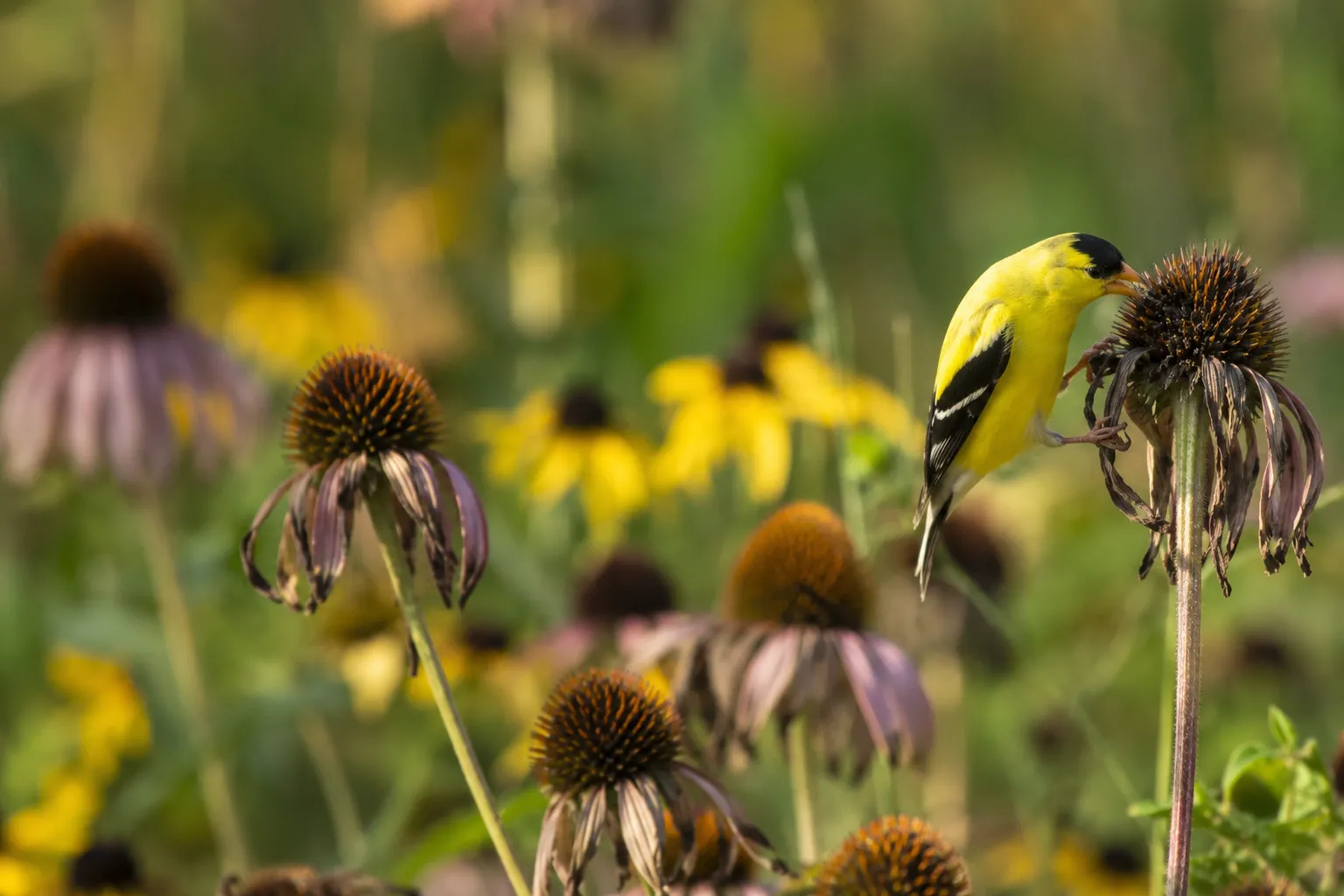
Goldfinches are among the strictest vegetarians of North American birds. The Cornell Lab describes their diet as almost entirely seeds, mostly from composite plants such as sunflowers, thistles and asters, plus grasses and small tree seeds from alder, birch, western red cedar and elm. Audubon adds buds, bark and sap to the list, with very few insects.
This matters in two ways. First, food at feeders is only part of the picture. A yard with seed-bearing flowers will hold goldfinches through late summer when feeders are quiet. Second, the diet explains an odd fact about their nesting: goldfinch parents feed their young seeds, not insects. When a Brown-headed Cowbird lays an egg in a goldfinch nest, the cowbird chick seldom survives more than three days on that all-seed diet.
Is nyjer or sunflower better for goldfinches?
Both work. The Cornell Lab lists nyjer and sunflower as their preferred feeder foods.
- Nyjer: a tiny black seed from the African plant Guizotia abyssinica. Project FeederWatch points out it is not related to North American thistles despite the “thistle seed” nickname. It draws goldfinches, siskins and other small finches, and larger birds and squirrels show less interest in it than in sunflower.
- Sunflower hearts (chips): hulled kernels that small bills handle easily, with no shells left on the ground. They attract goldfinches plus chickadees, titmice, nuthatches and many others.
- Black oil sunflower in the shell: goldfinches eat it, but they work harder at it than at hearts. It is the best all-round seed for a mixed feeder. See our guide to black oil sunflower seed.
A practical setup is one dedicated finch feeder with nyjer or a nyjer and sunflower chip blend, and a second feeder with sunflower for everyone else. If you want a single seed that serves goldfinches and a broad cast of other birds, sunflower hearts are the simplest choice.
Why goldfinches ignore nyjer (and how to fix it)
The most common complaint about finch feeders is that goldfinches visited once and never came back. Owners frequently trace this to old seed. Nyjer is small and oily, and once it dries out, gets wet and clumps, or molds, finches tend to abandon it. To keep it attractive:
- Buy smaller bags you will use within a few weeks rather than a bulk sack that sits all season.
- Store it cool, dry and sealed. An airtight container kept out of the sun works well.
- Fill feeders partway so seed turns over quickly, especially in summer.
- Dump and replace any seed that is caked in the bottom of the tube after rain.
- Shake the feeder occasionally to loosen seed packed around ports.
Best feeders for American goldfinches
“Almost any kind of bird feeder may attract American Goldfinches,” the Cornell Lab notes, “including hopper, platform, and hanging feeders.” They will also pick spilled seed off the ground. That said, feeder design affects who else shows up and how much seed you waste.
Tube feeders with small ports
A tube built for nyjer has tiny slots that let finches extract seed one piece at a time while keeping it from pouring out. Short perches favor small finches and discourage larger birds. Many are designed so birds can feed from multiple ports at once, which suits goldfinch flocks that arrive together.
Mesh (sock or screen) feeders
Metal mesh feeders let goldfinches cling anywhere on the surface, which matches how they feed on seedheads in the wild. They hold a lot of birds at once. Cloth socks are cheap but hold moisture, so metal mesh is the better long-term choice.
Upside-down feeders
Some finch feeders put the ports below the perches, so birds must hang upside down to feed. Goldfinches manage this easily. Owners commonly report this style cuts down on House Finches, which can crowd a standard tube, though results vary from yard to yard.
Sunflower heart feeders
Any tube or hopper with ports large enough for sunflower chips will draw goldfinches alongside chickadees and titmice.
We compare specific models in our roundup of the best finch feeders for nyjer seed. If squirrels are a problem where you live, nyjer alone often solves it, since squirrels generally leave it alone. For sunflower feeders, see how to keep squirrels off bird feeders.
Where to hang a goldfinch feeder
Goldfinches like semi-open country with trees and shrubs nearby for shelter. Place feeders in the open enough that birds can see approaching hawks, but close enough to cover that they can dart into it. Roughly 10 feet from dense shrubs or trees is a widely used compromise. Our guide to where to put a bird feeder explains height, distance and cover in more detail, and how to stop birds hitting windows covers glass safety. Project FeederWatch recommends marking the outside of windows with patterns such as dots spaced no more than 2 inches apart.
Plants that attract American goldfinches
Plants are the long-term answer, because they feed goldfinches when they visit feeders least. The Cornell Lab specifically recommends growing native thistles, other composite plants and native milkweed. Audubon describes their habitat as “semi-open areas having open weedy ground and some trees and bushes for shelter.”
Flowers that feed goldfinches
Composite (daisy family) flowers are the core of the menu. Let them go to seed instead of deadheading.
- Purple coneflower (Echinacea): goldfinches cling to the dried heads in late summer.
- Black-eyed Susan and other Rudbeckia: reliable seed through fall.
- Sunflowers: annual sunflowers are an obvious win; leave the heads on the stalks.
- Asters: late seed for fall migrants and winter flocks.
- Native thistles (for example, field thistle): a classic goldfinch plant. Choose native species, not invasive ones like Canada thistle or bull thistle, and check your state’s noxious weed list.
- Goldenrod: seeds are eaten in fall and winter.
- Zinnias and cosmos: non-native garden annuals, but goldfinches readily eat the seed.
Trees and shrubs
Birch, alder and elm seeds are eaten in winter, and the Cornell Lab lists western red cedar seed as food in the West. Dense deciduous shrubs and saplings provide nest sites.
Native plants by region
| Region | Seed plants to consider |
|---|---|
| Northeast and Midwest | Purple coneflower, black-eyed Susan, New England aster, field thistle, goldenrod, gray birch |
| Southeast | Purple coneflower, black-eyed Susan, native asters, tall thistle, river birch, tickseed (Coreopsis) |
| Great Plains | Maximilian sunflower, prairie coneflower, native asters, goldenrod |
| West and Pacific Northwest | Native sunflowers, gumweed, asters, red alder, western red cedar |
| Southwest | Native sunflowers, Coreopsis, native asters |
Check with your state’s native plant society or cooperative extension service for species native to your county.
Water for goldfinches
Seed eaters need to drink, and a clean bird bath draws goldfinches in summer when feeders are slow. Keep the water shallow, an inch or two at most, with a rough surface for footing. Change it every few days. In freezing climates, a heated bird bath gives winter flocks open water when natural sources are frozen, which our winter bird feeding guide covers.
Do goldfinches use birdhouses? Nesting explained
No. American goldfinches do not use nest boxes. Instead, the female builds an open cup in a shrub or sapling in a fairly open setting, usually where two or three vertical branches meet. According to the Cornell Lab:
- The nest is made of rootlets and plant fibers, lined with plant down, often from thistle or milkweed seedheads, and bound with spider silk.
- Building takes about six days.
- The finished nest is about 3 inches across on the outside.
- Clutches are 2 to 7 pale bluish white eggs, sometimes faintly spotted.
- Incubation lasts 12 to 14 days, and nestlings leave after 11 to 17 days.
- Pairs raise 1 or 2 broods a year.
Goldfinches breed later than most North American birds. Males sing in spring, but nesting waits until June or July, when thistle, milkweed and other plants have produced the fibrous down that lines the nest and the seeds that feed the young. Audubon reports that most nesting activity happens in July and August.
To help nesting goldfinches:
- Leave thistle, milkweed and other downy plants standing through midsummer.
- Plant dense native shrubs in sunny, open parts of the yard.
- Delay heavy shrub pruning until after nesting, typically late summer or fall.
- Keep cats indoors.
When do goldfinches come to feeders? A seasonal calendar
| Season | What goldfinches are doing | What to offer |
|---|---|---|
| Winter (Dec to Feb) | Drab brown flocks, often mixed with siskins; wander widely for food | Nyjer, sunflower hearts, open water |
| Early spring (Mar to Apr) | Molting back into yellow; patchy birds common | Keep feeders full; clean before the busy season |
| Late spring (May to Jun) | Males singing, pairs forming, bright colors | Fresh nyjer, sunflower hearts, water |
| Midsummer (Jul to Aug) | Nesting; heavy use of wild seedheads | Water, flowers left to seed, smaller amounts of fresh nyjer |
| Late summer (Aug to Sep) | Molting into winter plumage; young birds following parents | Coneflower and sunflower heads, nyjer |
| Fall (Oct to Nov) | Flocks forming, migrants moving south in the north | Fill finch feeders fully again |
Migration is irregular. Audubon notes that more goldfinches stay in the North in winters with good food supplies, with migration peaking in mid-fall and early spring. The Cornell Lab’s range map shows year-round birds across a wide band of the central and northern United States, with birds breeding into Canada and wintering south to the Gulf Coast and Mexico.
Why aren’t goldfinches coming to my feeder?
If you have the right food and still see no goldfinches, work through these causes.
- It’s summer. Goldfinches are nesting and eating wild seed. A quiet feeder in July is normal.
- The nyjer is stale or wet. Replace it and fill partway.
- The feeder is new. It can take time for birds to find a new station. Keep it filled with fresh seed and be patient.
- House Finches or House Sparrows dominate. Try an upside-down finch feeder or mesh feeder.
- The feeder is too exposed or too far from cover. Move it nearer shrubs.
- A hawk is hunting nearby. Flocks may avoid the yard for days.
Common mistakes when attracting goldfinches
- Buying a huge bag of nyjer. It goes stale before you use it.
- Deadheading everything. Seedheads are goldfinch food in late summer, fall and winter.
- Planting invasive thistles. Stick to native thistle species and composites.
- Letting seed pile up under feeders. The Cornell Lab advises keeping the ground well raked to prevent disease transmission.
- Skipping feeder cleaning. Finch flocks crowd together at ports, which helps diseases spread.
- Assuming brown birds are a different species. They are probably your goldfinches in winter plumage.
Keeping goldfinches healthy at feeders
Because goldfinches feed shoulder to shoulder, feeder hygiene matters. Project FeederWatch recommends cleaning seed feeders every week or two and disinfecting with one part bleach to nine parts water, soaking for 10 minutes, then rinsing and drying. Clean mesh feeders and tube ports with a bottle brush.
Watch for birds with swollen, crusty or closed eyes. Goldfinches are among the finches that can contract mycoplasmal conjunctivitis, the eye disease best known from House Finches. If you see sick birds, take feeders down, clean them and wait a week or so before refilling. Our guide to sick birds at the feeder explains what to look for. For full cleaning steps, see how to clean a bird feeder.
Conservation status
American goldfinches are common and rated a species of low conservation concern. The Cornell Lab, citing the North American Breeding Bird Survey, reports a decline of about 0.6 percent per year from 1966 to 2019, a cumulative drop of 27 percent, with a global breeding population estimated at 44 million. Backyards with native seed plants and clean feeders are a small but real contribution.
The short version
Offer fresh nyjer or sunflower hearts in a small-port feeder near cover. Grow coneflowers, sunflowers, asters and native thistles and let them go to seed. Add shallow water. Clean feeders every week or two and rake up old seed. Then expect crowds from fall to spring, quieter visits in midsummer while the birds nest, and a flock of brown goldfinches in winter that turns yellow again each spring.
Sources
Frequently asked questions
What is the best food to attract American goldfinches?
Nyjer seed and sunflower seed are the two foods the Cornell Lab lists as goldfinch favorites at feeders. Sunflower hearts are especially easy for their small bills because there is no shell to crack. Keep nyjer fresh and dry, since finches tend to abandon old, dried-out or clumped seed, and offer it in a feeder with small ports.
Why do goldfinches disappear in summer?
They usually do not leave. American goldfinches nest late, mostly in July and August, and in summer they feed heavily on natural seed from thistles, coneflowers, sunflowers and other composites. With so much wild food, feeder visits drop. Numbers typically rise again in fall as family groups and winter flocks form and return to feeders.
Where did my bright yellow goldfinches go in winter?
They are probably still there in a different outfit. American goldfinches molt twice a year. After the late-summer molt, males lose their bright yellow and look drab brown or olive with blackish wings and pale wingbars, much like females. Many people assume the flock has left when the birds have simply changed color.
When do American goldfinches nest?
Later than almost any other common backyard songbird. Nesting usually begins in late June or July, timed to the ripening of thistle, milkweed and other plants whose fibers and down line the nest and whose seeds feed the young. The female builds a tightly woven cup in a shrub or sapling and lays 2 to 7 pale bluish eggs.
Do American goldfinches use birdhouses?
No. Goldfinches build open cup nests in the forks of shrubs and small trees, usually where two or three upright branches meet. They do not use nest boxes. To support nesting, grow native shrubs and leave thistle, milkweed and other plants standing so females can collect down and fibers in midsummer.
Are goldfinches vegetarian?
Almost entirely. The Cornell Lab describes the American goldfinch as one of the strictest vegetarians among North American birds, and even the nestlings are raised on seeds. They may take an occasional insect by accident, but their diet is built around seeds from composite flowers, grasses and trees such as birch, alder and elm.