
House Finch vs Purple Finch: How to Tell Them Apart
House Finch vs Purple Finch: check the flanks, face and tail. House Finches have streaky sides and a plain face; Purple Finches look washed in raspberry.
In this article
- What are the main differences at a glance?
- How do you tell male House Finches and Purple Finches apart?
- How do you tell female House Finches and Purple Finches apart?
- Does the bill or tail shape help?
- Where and when will you see each finch?
- How do their songs and calls differ?
- Why do House Finches outnumber Purple Finches at feeders?
- How can you attract both finches to your yard?
- Sources
- Frequently asked questions
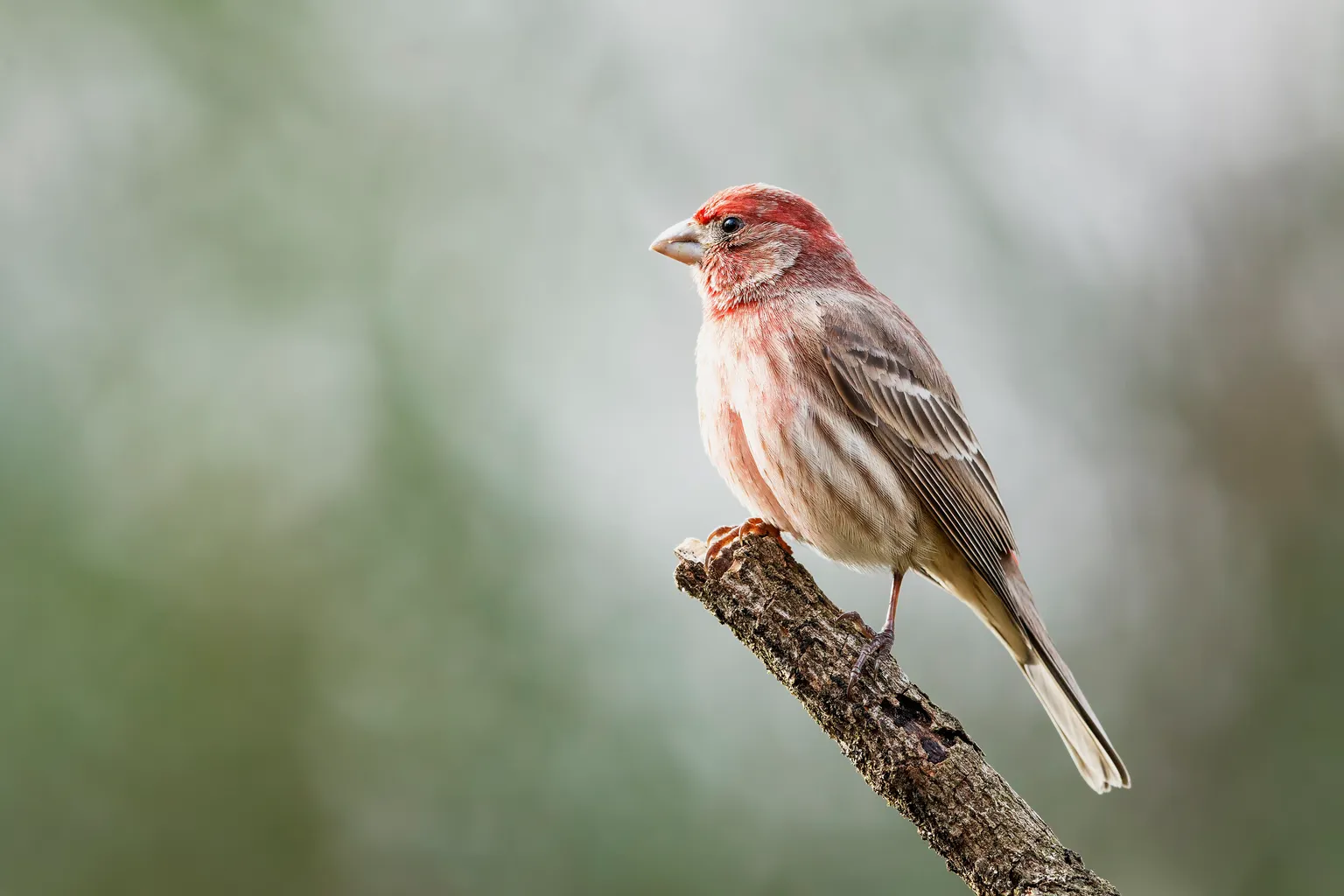
To tell a House Finch from a Purple Finch, check three things: the flanks, the face and the tail. Male House Finches have bright red patches and heavy brown streaks on the sides; male Purple Finches look evenly washed in raspberry with faint streaking. Female Purple Finches have a bold striped face; female House Finches have a plain one.
These two red finches are close relatives in the genus Haemorhous, and they overlap across much of the eastern United States, southern Canada and the Pacific Coast. The House Finch is the everyday feeder bird of towns and suburbs. The Purple Finch is a bird of northern and western forests that often turns up at feeders only in winter. Learning the differences takes a few minutes and pays off every time a “different-looking” red bird lands on your feeder.
What are the main differences at a glance?
The House Finch is slimmer and longer-tailed, with streaky sides and a plain female face; the Purple Finch is chunkier, shorter-tailed and cleaner below, with a strongly marked female face. The table below pulls together the field marks from Project FeederWatch, the Cornell Lab and Audubon.
| Feature | House Finch | Purple Finch |
|---|---|---|
| Scientific name | Haemorhous mexicanus | Haemorhous purpureus |
| Length | 5.1 to 5.5 in | 4.7 to 6.3 in |
| Weight | 0.6 to 0.9 oz | 0.6 to 1.1 oz |
| Shape | Slender, long flat head, longer tail | Chunky, shorter tail |
| Male color | Red to orange or even yellow, mostly on forehead, eyebrow, throat, breast and rump | Pinkish raspberry red over most of the head, back and breast |
| Male face | Red “headband” against a brown cap and brown cheek | Color spreads over the cheek, nape and whisker area |
| Male flanks and belly | Conspicuous brown streaks on the sides | Faint streaks or nearly clean |
| Female face | Plain, no strong pattern | Bold white eyebrow, dark cheek patch, white stripe below |
| Female underparts | Dull white with long, thin, blurry streaks | Bright white with short, thick streaks |
| Undertail feathers (female) | Broad dark streaks | Usually plain white |
| Bill | Short and stubby, with a curved upper edge | Short, straight-edged cone |
| Tail | Fairly long, shallow notch | Short, deeply notched |
| Song | Jumbled warble, about 3 seconds, often ends in a buzzy slur | Rich, fast, fluid warble |
| Call | Sharp “cheep” | Short, low “tek” or “tick” |
| Typical habitat | Towns, suburbs, farms, backyards | Coniferous and mixed forest; backyards mainly in winter |
How do you tell male House Finches and Purple Finches apart?
Start with the belly and sides. Project FeederWatch describes male House Finches as having “conspicuously streaked sides”, while male Purple Finches have a “variable but usually faintly streaked lower breast and belly”.
Then look at where the color sits:
- House Finch: The red is concentrated on the forehead, eyebrow, throat and upper breast, and on the rump, which shows in flight. FeederWatch describes it as a red “headband” that contrasts with a brown cap and brown cheek patch. The back, belly and tail stay streaky brown.
- Purple Finch: The color looks like a wash rather than a patch. It covers most of the head, back and chest and spreads over the cheek, nape and whisker area. The Cornell Lab calls the Purple Finch a “delicately colored, cleaner version” of the House Finch, with a cloudy white belly.
Shade helps too. The Cornell Lab notes that male House Finch color depends on diet: birds that eat more carotenoid pigments are redder, and some males are orange or even yellow. FeederWatch adds that House Finch color is “almost always less purple or rosy” than in the Purple Finch. So an orange or yellowish male finch with streaky sides is a House Finch. A deep raspberry male with a clean belly is likely a Purple Finch.
One trap: western Purple Finches are duller. The Cornell Lab says western males show more olive-green tones and brownish marks on the sides, so clean flanks alone are less reliable on the Pacific Coast.
How do you tell female House Finches and Purple Finches apart?
Look at the face first. FeederWatch says the female Purple Finch has a “bold face pattern with a bright white eyebrow, a dark cheek patch, and a white stripe”, while the female House Finch “lacks a strong facial pattern”.
Females of both species have no red at all, so beginners often assume they’re sparrows. Use these clues:
- Face: Striped and contrasty on Purple Finch, plain and blank-looking on House Finch. The Cornell Lab also mentions a dark line down the side of the throat on female Purple Finches.
- Streaks: Female Purple Finches are bright white below with short, thick streaks. Female House Finches are dull white with long, thin, smudgy streaks that run together.
- Under the tail: FeederWatch calls unstreaked white undertail feathers on a female Purple Finch “diagnostic if visible”. Female House Finches have broad dark streaks there.
If you get a good view of a streaky brown finch from below, that undertail check settles it. For more help reading field marks in general, see our guide on how to identify birds.
Does the bill or tail shape help?
Yes. House Finches have a stubby bill with a curved upper edge and a fairly long, shallowly notched tail; Purple Finches have a straighter, more pointed cone and a short, deeply notched tail.
Structure is useful because it doesn’t change with lighting or diet. The Cornell Lab describes the House Finch as having a fairly large bill and a long, flat head, with short wings that make the tail look long. The Purple Finch, by contrast, has a powerful conical bill and a short tail that’s “clearly notched at the tip”. Audubon sums it up: the Purple Finch looks chunkier and shorter-tailed than the House Finch.
At a feeder, a slim finch with a long tail and a rounded bill is usually a House Finch. A compact, big-headed finch with a notched stub of a tail is worth a second look for Purple Finch. Good optics make these details far easier to see; our picks for the best binoculars for backyard birding are chosen with feeder distances in mind.
Where and when will you see each finch?
House Finches live year-round in towns and suburbs across most of the United States, southern Canada and Mexico. Purple Finches breed in northern and western forests and appear at many backyard feeders only in winter, in numbers that change from year to year.
The House Finch’s range has an unusual history. It’s native to the western United States and Mexico. According to the Cornell Lab, birds released on Long Island, New York, in 1940, after failed attempts to sell them as cage birds, spread across almost all of the eastern United States and southern Canada within about 50 years. Audubon notes that western birds are mostly permanent residents, while some eastern birds move south in winter. House Finches favor lawns, weedy areas, trees and buildings and avoid unbroken forest.
Purple Finches are forest birds. The Cornell Lab says they breed mainly in coniferous or mixed woods across northern North America and along the West Coast, then spend winter in shrublands, old fields, forest edges and backyards. Audubon adds that they’re rare in most of the Rocky Mountain region and migrate in flocks, mostly by day.
| Where you live | House Finch | Purple Finch |
|---|---|---|
| Eastern US suburbs | Common all year | Mainly a winter visitor, some years more than others |
| Northern forests and southern Canada | Around towns | Breeds; may stay all year |
| Pacific Coast | Common all year | Present in forested areas |
| Interior West and Rockies | Common | Rare in most areas |
If you’re in the Mountain West, also consider Cassin’s Finch, a third look-alike whose males have a bright red crown. Our House Finch species guide covers Cassin’s Finch in its comparison section.
How do their songs and calls differ?
The House Finch sings a long, jumbled, slightly rough warble that often ends in a buzzy slur; the Purple Finch sings a richer, faster, more fluid warble. Their calls differ too: a sharp “cheep” for House Finch, a short, low “tek” for Purple Finch.
The Cornell Lab describes the House Finch song as a warble of short notes lasting about 3 seconds that usually finishes with an upward or downward slur. It adds that House Finch songs sound “slower, rougher, and somewhat less fluid” than those of Purple and Cassin’s finches. Audubon describes the ending as a “zeee” and compares the song to a canary without the musical trills.
Purple Finch males sing a fast, rising and falling string of 6 to 23 notes, according to the Cornell Lab, and some include imitations of other birds such as American Goldfinches and Barn Swallows. Audubon notes a distinctive “tick” call in flight.
A sound ID app can help confirm what you hear. Our guide to Merlin Sound ID explains how to use it without over-trusting the results.
Why do House Finches outnumber Purple Finches at feeders?
House Finches are town birds that travel in flocks and win most feeder disputes. The Cornell Lab cites a behavioral study in which Purple Finches lost out to House Finches more than 95 percent of the time.
That competition matters. The Cornell Lab lists the Purple Finch as a species of low conservation concern overall but notes that eastern populations have declined, partly because of competition with House Finches. House Finches, in turn, carry mycoplasmal conjunctivitis, a bacterial eye disease that has also been confirmed in Purple Finches. Cleaning feeders regularly protects both species; our page on sick birds at the feeder explains what to look for.
How can you attract both finches to your yard?
Offer black oil sunflower seed in a tube or hopper feeder, keep it clean, and plant or keep conifers. That setup serves House Finches all year and gives wandering Purple Finches a reason to stop in winter.
The Cornell Lab recommends black oil sunflower seed for both species and notes that Purple Finches are drawn to conifers. Practical steps:
- Fill a tube feeder with several ports so more than one finch can feed at once. Our roundup of finch feeders compares designs that suit small finches.
- Use black oil sunflower as the main seed. Our guide to black oil sunflower seed explains why it’s the best all-round choice.
- Keep conifers such as spruce, pine or hemlock if you have them, and leave seed heads standing into winter.
- Spread feeders out so House Finch flocks don’t crowd every perch.
- Scrub feeders every couple of weeks and rake up old seed below them.
In a winter when Purple Finches move south in numbers, a clean, well-stocked feeder near trees gives you the best chance of seeing both birds side by side, which is the easiest way to learn the differences for good.
Sources
- Project FeederWatch: Tricky Bird ID, Cassin’s Finch, House Finch and Purple Finch
- Cornell Lab of Ornithology, All About Birds: Purple Finch Identification
- Cornell Lab of Ornithology, All About Birds: House Finch Identification
- Cornell Lab of Ornithology, All About Birds: Purple Finch Overview
- Audubon Guide to North American Birds: Purple Finch
- Audubon Guide to North American Birds: House Finch
Each of these guides answers a different question:
- Best Finch Feeders for Nyjer SeedThe best finch feeder for most yards is a nyjer mesh feeder like the More Birds 13 Inch Finch Screen: room for many goldfinches, easy to fill. 6 picks compared.
- How to Attract American Goldfinches to Your YardHow to attract American goldfinches: offer fresh nyjer and sunflower in a finch feeder, grow coneflowers and native thistles, add water and keep feeders clean.
- How to Attract House Finches (and Keep Them Healthy)How to attract House Finches: black oil sunflower in a tube or hopper feeder, clean feeders to prevent eye disease, and shrubs or ledges nearby for nesting.
- Seed Heads to Leave Standing for Winter FinchesThe best seed heads to leave standing for winter finches: coneflowers, sunflowers, asters, goldenrod, grasses and more, plus when to cut them back in spring.

Frequently asked questions
What is the easiest way to tell a House Finch from a Purple Finch?
Look at the sides of the belly. Project FeederWatch notes that male House Finches have conspicuously streaked sides, while male Purple Finches usually show only faint streaking below. For females, check the face: a female Purple Finch has a bold white eyebrow and dark cheek patch, while a female House Finch has a plain, unmarked face. Those two clues solve most feeder sightings.
Is a Purple Finch actually purple?
No. Audubon describes the male Purple Finch as dull red on the head and foreparts rather than true purple. Roger Tory Peterson famously called it a sparrow dipped in raspberry juice. The color is a pinkish, wine-red wash that spreads over the head, back and breast, which is more even and rosy than the brighter, patchier red of a male House Finch.
Can female House Finches and Purple Finches be told apart?
Yes, and females are often easier than males. Project FeederWatch says female Purple Finches have a bold face pattern with a bright white eyebrow, a dark cheek patch and a white stripe below it, plus crisp, short streaks on bright white underparts. Female House Finches have a plain face and long, thin, blurry streaks. Unstreaked white feathers under the tail point to Purple Finch.
Do Purple Finches come to backyard feeders?
Yes, mostly in winter. The Cornell Lab describes Purple Finches as erratic winter feeder visitors whose numbers vary a lot from year to year. They breed mainly in coniferous and mixed forests across the north and along the West Coast. Black oil sunflower seed is the best offering, and nearby conifers make a yard more attractive to them.
Why are there so many more House Finches than Purple Finches at feeders?
House Finches thrive in towns and suburbs, gather in flocks that the Cornell Lab says can reach 50 or more birds, and dominate their rivals. In one behavioral study cited by the Cornell Lab, Purple Finches lost out to House Finches more than 95 percent of the time. The Cornell Lab links declines in eastern Purple Finches partly to that competition.


