Wood Duck Box: Size, Placement, Guards and Best Boxes
A wood duck box needs a 4 x 3 inch oval hole, a 24-inch-deep box, wood shavings and a predator guard on a pole near water. Size, placement, cleaning and picks.
If you buy through links on this page we may earn a commission, at no cost to you. It never decides what we recommend. How we earn
In this article
- Quick answer: wood duck box basics
- How we chose
- What is a wood duck box, and which birds use it?
- What size should a wood duck box be?
- Where should you put a wood duck box?
- How do you protect a wood duck box from predators?
- When should you put up a wood duck box?
- How do you clean a wood duck box?
- What is dump nesting, and how do you prevent it?
- Wood duck box decision table
- How much does a wood duck box cost, and should you build one?
- Best wood duck boxes to buy
- What are the alternatives to a wood duck box?
- Sources
- Gear mentioned in this guide
- Frequently asked questions
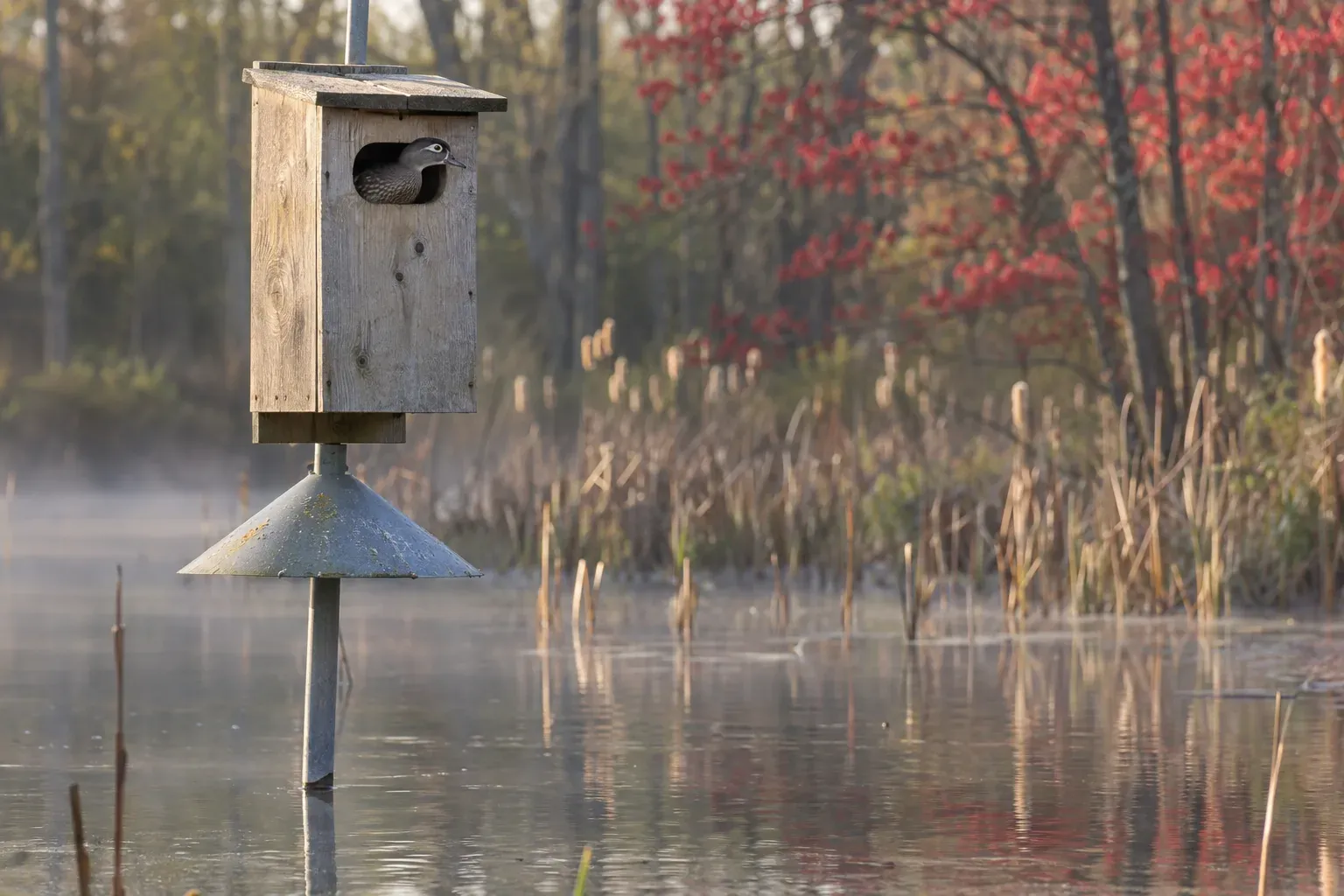
A wood duck box is a tall, deep nest box with a 4-inch-wide by 3-inch-high oval entrance, about 24 inches (61 cm) deep, filled with 3 to 4 inches of wood shavings. Mount it on a pole with a predator guard, within 100 feet of calm wooded water, and have it up by late winter. That is the whole recipe.
The details below decide whether a box raises ducklings or feeds raccoons.
Quick answer: wood duck box basics
- Entrance: a horizontal oval about 4 inches wide by 3 inches high (10 x 7.5 cm).
- Box: inside floor about 10 x 10 to 12 x 12 inches, inside depth about 24 inches, hole roughly 16 to 20 inches above the floor.
- Inside: 3 to 4 inches of coarse wood shavings, plus a ladder of hardware cloth or rough grooves under the hole so ducklings can climb out.
- Mount: on a smooth pole in or beside the water, with a metal guard below the box. Trees are riskier.
- Place: within about 100 feet (30 m) of water, entrance facing the water, boxes spread out rather than clustered.
- Timing: up by late winter. Clean and refill every year before nesting starts.
How we chose
We have not installed or monitored these boxes ourselves. This is a research-led guide. Box dimensions, mounting heights and spacing come from Cornell Lab’s NestWatch, Ducks Unlimited and state wildlife agency guidance. For the products, we used only specs published on the makers’ own product pages, then looked for repeated patterns in verified owner feedback. Where we could not confirm a number, we left it out.
What is a wood duck box, and which birds use it?
A wood duck box is a man-made tree cavity for ducks that nest in holes. Wood Ducks cannot excavate their own cavity, so they depend on old woodpecker holes, rotted limbs and boxes.
Wood Ducks are the main tenant across most of the US and southern Canada. Cornell Lab notes that a clutch usually holds 6 to 16 eggs, and that the ducklings leave the nest the day after hatching by jumping from the entrance, sometimes from a long drop, without being hurt. They never return to the box. That jump is why the inside ladder matters: a day-old duckling has to climb about 20 inches of vertical wall to reach the hole.
Other cavity-nesting ducks use the same or similar boxes:
- Hooded Merganser. Uses standard wood duck boxes readily, and the two species sometimes lay in the same box. Look for it on wooded ponds and beaver wetlands.
- Common Goldeneye and Barrow’s Goldeneye. Northern and mountain ducks that take wood duck boxes and slightly larger duck boxes near lakes and rivers.
- Common Merganser. A bigger duck that needs a larger entrance; Coveside sells a separate box for it.
- Bufflehead. A small northern duck that uses smaller cavities, often old flicker holes.
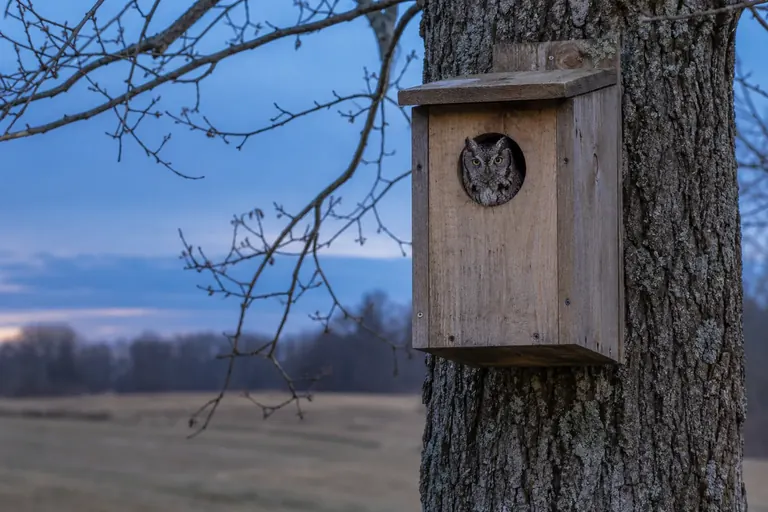
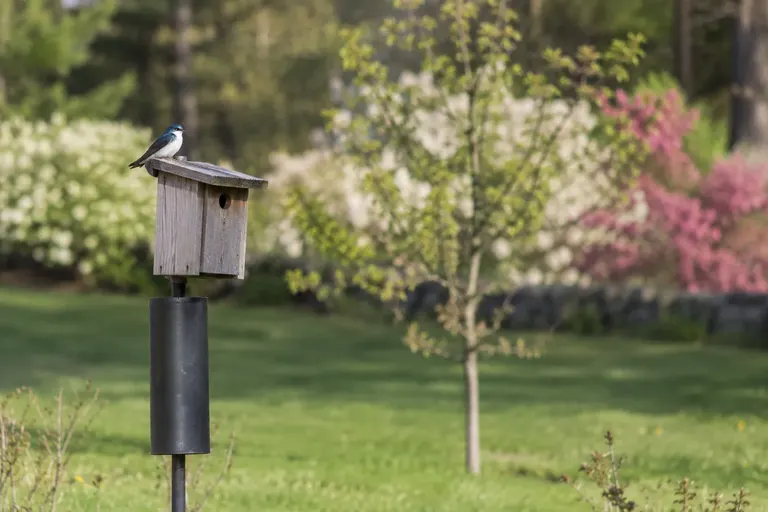
American Kestrels, Eastern Screech-Owls, starlings and squirrels also move in at times. If you are mainly after owls, a purpose-built box works better; see our owl box guide.
What size should a wood duck box be?
Build or buy a box with an inside floor of 10 x 10 to 12 x 12 inches, an inside depth of about 24 inches, and a 4 x 3 inch oval entrance about 16 to 20 inches above the floor. Everything else is a detail that makes the box last or makes cleaning easier.
Wood duck box sizing chart
| Feature | Recommended size | Why it matters |
|---|---|---|
| Entrance | 4 in W x 3 in H oval (10 x 7.5 cm) | Admits a hen Wood Duck, keeps out most raccoons |
| Hole above floor | About 16 to 20 in (40 to 50 cm) | Puts eggs out of reach of an arm through the hole |
| Inside floor | 10 x 10 to 12 x 12 in (25 to 30 cm) | Room for a clutch plus the hen |
| Inside depth | About 24 in (61 cm) | Standard in NestWatch and state plans |
| Wood thickness | 3/4 to 1 in (19 to 25 mm) | Insulation and durability |
| Ladder | 1/4 in hardware cloth or rough grooves below the hole | Lets ducklings climb out |
| Nest material | 3 to 4 in of coarse wood shavings | Ducks bring none |
| Drainage and vents | Holes in the floor, gaps under the roof | Keeps eggs dry and cool |
| Access | Hinged side or front door | Annual cleaning and checks |
| Perch | None | Perches help predators, not ducks |
For comparison with other cavity nesters, our birdhouse hole sizes chart lists entrance sizes for songbirds, woodpeckers, kestrels and owls.
Wood, cedar or plastic?
Cedar and pine are the usual choices. Rough-sawn cedar resists rot and needs no finish. Pine is cheaper and fine if the outside is left bare or given a light, water-based exterior stain, never on the inside. Recycled plastic lumber lasts longest in wet sites, but NestWatch advises against plastic boxes because they can overheat, so keep any plastic box in shade.
Where should you put a wood duck box?
Put it within about 100 feet (30 m) of calm, shallow water with trees and cover nearby, with the entrance facing the water. Wooded ponds, beaver wetlands, slow rivers, swamps and quiet lake coves are ideal. Open, windswept lakes with bare shores are poor sites.
Good habitat has shallow water with plants and insects for ducklings, shoreline cover such as buttonbush or willow, and trees overhead.
Pole, post or tree: which mount is best?
A smooth pole in the water, with a guard, is the safest mount. A post on the shore is next best. A tree is the easiest but also the easiest for raccoons, rat snakes and squirrels to climb.
| Mount | Predator risk | Best guard | Height | Notes |
|---|---|---|---|---|
| Pole or post standing in water | Lowest | Metal cone or cylinder below the box | At least 3 ft above high water, often 4 to 6 ft | Needs waders or a boat for checks; check ice heave |
| Pole or post on the shore | Medium | Cone or cylinder, at least 3 ft above the ground | High enough for the guard to clear the ground by 3 ft | Easiest to reach for cleaning |
| Tree trunk near water | Highest | Wide metal band around the trunk, trimmed branches | 6 to 30 ft on land | Only if limbs cannot bridge to the box |
| Building or barn wall | Medium | Nothing below to climb | 6 ft or more | Rarely near enough to water |
For hardware, hanger brackets, conduit poles and how to set a post securely, see our step-by-step guide on how to mount a birdhouse on a pole, tree or wall.
How high should a wood duck box be?
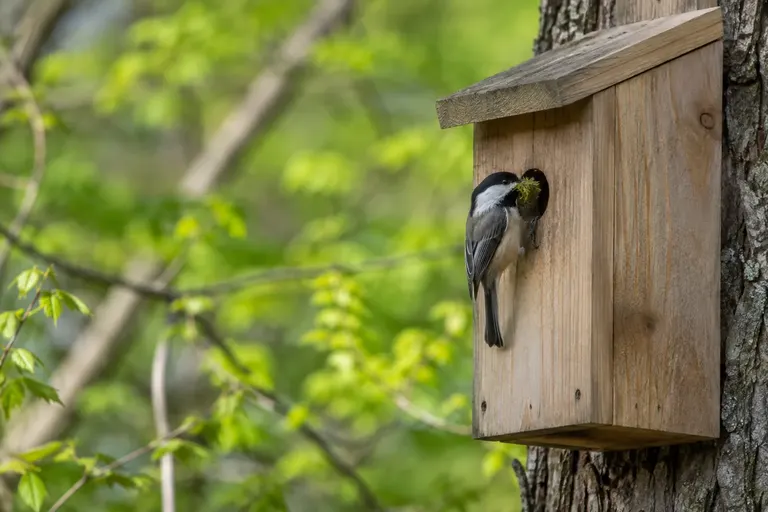
On land, NestWatch lists 6 to 30 feet. Over water, most programs set boxes on poles at least 3 feet above the high-water mark, which in practice often means 4 to 6 feet above the surface. Lower boxes are easier to clean, and you will not keep up with a box you cannot reach. Tilt the box forward very slightly so rain runs off the front rather than into the hole.
How far apart should wood duck boxes be?
Spread them out. NestWatch advises against clustering and suggests boxes at least 600 feet (about 180 m) apart. Boxes set in plain view, in tight groups, attract multiple hens to the same box, which leads to dump nests.
How do you protect a wood duck box from predators?
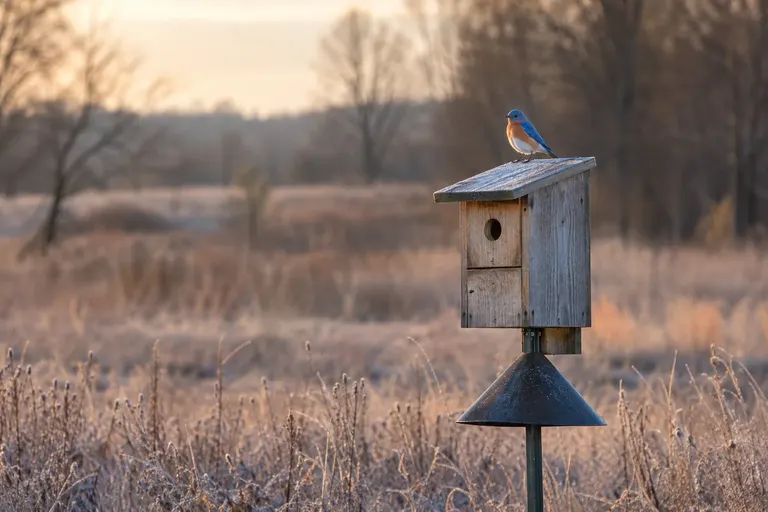
Mount the box on a pole and fit a metal guard below it. Raccoons are the main egg predator, followed by snakes, mink and squirrels. Ducks Unlimited and the Maryland Department of Natural Resources both publish guard designs, and all of them work the same way: a smooth, wide barrier a climbing animal cannot get around.
The three common guard types:
- Cone guard. A 36-inch circle of 26-gauge sheet metal with a wedge cut out, riveted into a cone and fastened to the pole below the box. This is the Ducks Unlimited design.
- Cylinder or pipe guard. A 36-inch piece of metal or plastic pipe at least 8 inches in diameter, bolted around the pole, with chicken wire stuffed in the top so snakes and mice cannot climb inside.
- Sheet guard. A folded 28-gauge steel sheet wrapped around a post roughly 2 inches under the box.
A few rules make any guard work:
- Keep the guard at least 3 feet above the ground or high water, and higher where snow piles up.
- Make sure no branch, cattail clump or dock is within about 5 feet of the box. Raccoons jump.
- On trees, use a wide metal band and trim limbs that reach the box.
- Never add a perch below the hole.
When should you put up a wood duck box?
Put it up in fall or winter so it is ready by late winter. Wood Ducks form pairs in fall and winter, and hens start checking cavities early. In the southern US, nesting can start in January and February. In the North, hens arrive and start laying from March to May as the ice goes out.
Wood Ducks in the South often raise two broods in a season, so a box put up in spring is not wasted. It just misses the first round. Our guide on when to put up birdhouses covers the same timing question for songbirds and owls.
How long before ducks use a new box?
Some boxes are used the first spring; others take one to three seasons. If a box stays empty for three seasons, move it to quieter water with more cover.
How do you clean a wood duck box?
Clean it once a year in late winter, before the first hens return. Open the door, scrape out the old shavings, shell membranes and down, check for damage, then add 3 to 4 inches of fresh coarse wood shavings.
Step by step:
- Pick a late winter day, before nesting starts in your region. In the North, use the ice to walk out to water-mounted boxes safely only where you know the ice is thick.
- Knock on the box before opening it. Screech-owls, squirrels and flying squirrels roost in duck boxes in winter.
- Remove all old material. Old down and shell carry mites and fungus.
- Remove any starling nest. European Starlings are an unprotected invasive species in the US. Native birds and their nests are protected, so leave any active native nest alone.
- Check the ladder, hinges and floor. Replace worn hardware cloth and plug any rotted spot.
- Refill with shavings. Coarse pine or cedar shavings, 3 to 4 inches deep. Avoid sawdust, hay and straw.
- Check the guard and pole. Ice can tilt water-mounted poles. Straighten them and reset the guard.
In the South, a quick second clean-out after the first brood leaves helps a second nesting attempt. NestWatch recommends swapping in fresh shavings once a brood is complete. For general nest box cleaning tips, see when and how to clean out a birdhouse.
What is dump nesting, and how do you prevent it?
Dump nesting, or brood parasitism, is when hens lay eggs in another hen’s box. Wood Ducks do it often. A dump nest can hold 20 or more eggs, far more than one hen can cover, and hatching success falls sharply.
Signs of a dump nest:
- 14 or more eggs in one box.
- Eggs of mixed shades or sizes.
- Hooded Merganser eggs (rounder and whiter) mixed with Wood Duck eggs.
How to reduce it:
- Spread boxes out. At least 600 feet apart, as NestWatch suggests.
- Make boxes less visible. Boxes tucked into shoreline trees or cover are found by fewer hens than boxes standing in open water in a row.
- Move boxes that keep getting dumped.
If you find a dump nest, leave it alone. Removing or moving eggs of native waterfowl is regulated, and it rarely helps.
Wood duck box decision table
This table is our own summary of the guidance above. Use it to decide what to do on your property before you buy anything.
| Your situation | Best move |
|---|---|
| Wooded pond or beaver wetland on your land | One wood duck box on a guarded pole in the water, entrance facing open water |
| Pond with open, mowed banks and no trees | Plant shoreline shrubs first; a box can wait a season |
| Slow river or creek with steep banks | Guarded post on the bank or a tree box with a wide metal band |
| Northern lake with goldeneyes or mergansers | Wood duck box for goldeneyes and Hooded Mergansers; a larger merganser box for Common Mergansers |
| Several ponds on one property | One box per pond or at least 600 ft between boxes |
| You cannot reach the box for yearly cleaning | Do not put one up, or mount lower on a shore post |
| No water within a few hundred feet | Skip the duck box; consider a kestrel or screech-owl box instead |
| Box already used by starlings every year | Clean it in late winter and check again in early spring; relocate nearer the water |
How much does a wood duck box cost, and should you build one?
Commercial boxes vary widely in price, and a good guard can cost as much as the box. The box is only part of the job: budget for a pole, a guard, shavings and hardware.
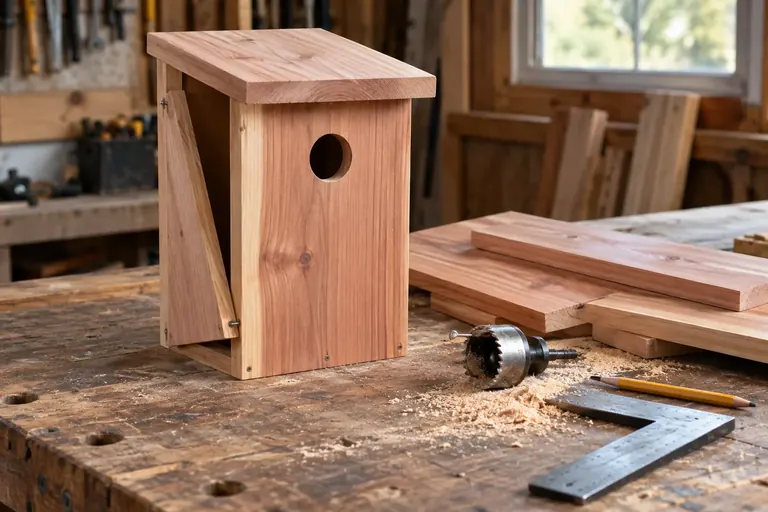
Building your own is common and easy. One 1 x 12 cedar or pine board, 10 to 12 feet long, covers most published plans. State wildlife agencies, Ducks Unlimited chapters and extension services publish free plans. Our how to build a birdhouse guide covers tools, cuts and fasteners, and the dimensions in the sizing chart above convert any simple box plan into a duck box.
Best wood duck boxes to buy
None of these includes a pole, and only one includes a guard.
Coveside Wood Duck House: best overall
The Coveside Wood Duck House is a US-made box of 3/4-inch pine with a 4 x 3 inch oval entrance. It measures 15 x 10.75 x 24 inches. One side opens in two latched sections, the top for looking in and the bottom for cleaning. It has drainage slots, vent slots, a rough interior with a ladder, and a bag of wood chips.
- Skip it if: you want everything, including a guard, in one box.
JCS Wildlife Cedar Wood Duck House with Predator Guard: best with a guard
This JCS Wildlife box pairs a cedar body with a recycled poly roof, and the listing includes a pole-mount predator guard. It measures 24.5 inches tall, 12 inches wide and 12.25 inches deep, with a 4 x 3 inch oval entrance, interior grooves for ducklings, drainage holes, a side door and two bags of pine shavings. JCS recommends mounting it 4 to 5 feet above land or water.
- Skip it if: you plan to mount on a tree trunk.
JCS Wildlife Recycled Poly Lumber Wood Duck House: longest lasting
This US-made box is built entirely from recycled HDPE poly lumber, which does not rot. It measures 26 x 9.75 x 11.25 inches, has a 4 x 3 inch oval entrance and drainage holes, and comes with two bags of pine shavings. Owners commonly buy poly boxes for permanently flooded sites where wood rots out.
- Skip it if: the box will stand in full sun, especially in the South.
Coveside Common Merganser Duck House: for larger ducks
For northern rivers and lakes with Common Mergansers, Coveside makes a box with a larger 4.75 x 3.75 inch entrance. It is 3/4-inch pine, 15 x 10.625 x 24.375 inches, with a perch-free entrance, an internal ladder, side panels that open and a bag of wood chips.
- Skip it if: your water mainly holds Wood Ducks or Hooded Mergansers.
What are the alternatives to a wood duck box?
The best alternative is habitat: keep dead and dying trees standing near water where it is safe to do so, because natural cavities form in them. Pileated Woodpecker holes and rotted limbs are the Wood Duck’s original nest sites.
Other options:
- Nest tubes suit Mallards, not Wood Ducks.
- A different box for a different bird. If you have no water, a kestrel box, an owl box or songbird boxes from our list of the best birdhouses are better uses of the money.
If you add one of our picks for birdhouse cameras, keep wiring off the pole below the guard, where it gives raccoons a grip.
Sources
- Wood Duck nest box guidance, NestWatch, Cornell Lab of Ornithology
- Wood Duck life history, All About Birds, Cornell Lab of Ornithology
- Dealing with predators, NestWatch
- Build a duck box predator guard, Ducks Unlimited
- Maryland Wood Duck Initiative predator guards, Maryland DNR
- Coveside Wood Duck House product page
- JCS Wildlife Cedar Wood Duck House with Predator Guard product page
Gear mentioned in this guide
Coveside Wood Duck House
A US-made pine box with an oval entrance, a two-section side door for checking and cleaning, drainage and vent slots, an interior ladder and a bag of wood chips included.
- Best for
- Most ponds and wetland edges where you will add your own pole and guard.
- Skip it if
- You want a box that ships with a predator guard, because the guard and post adapter are separate.
- Entrance
- 4 in W x 3 in H oval
- Size
- 15 in L x 10.75 in W x 24 in H
- Material
- 3/4 in pine
JCS Wildlife Cedar Wood Duck House with Recycled Poly Lumber Roof and Predator Guard
A cedar box with a recycled poly roof, interior climb-out grooves, a side clean-out door, drainage holes, a pole-mount guard and two bags of pine shavings.
- Best for
- Anyone who wants the box and the guard sorted in one purchase.
- Skip it if
- You plan to mount on a tree, where a pole guard does not help.
- Entrance
- 4 in x 3 in oval
- Size
- 24.5 in H x 12 in W x 12.25 in D
- Material
- Cedar, poly lumber roof
JCS Wildlife Recycled Poly Lumber Wood Duck House
A US-made box built from recycled HDPE poly lumber that will not rot, with a 4 x 3 inch oval entrance, drainage holes and two bags of pine shavings.
- Best for
- Shaded, permanently wet sites where wooden boxes rot out in a few years.
- Skip it if
- Your box will sit in full sun in a hot climate, since NestWatch advises against plastic boxes because of overheating.
- Entrance
- 4 in x 3 in oval
- Size
- 26 in H x 9.75 in W x 11.25 in D
- Material
- Recycled poly lumber (HDPE)
Coveside Common Merganser Duck House
A deeper-entry pine box with a larger oval hole for bigger cavity-nesting ducks, a perch-free entrance, an internal ladder, opening side panels and wood chips included.
- Best for
- Northern rivers and lakes with Common Mergansers or Common Goldeneyes.
- Skip it if
- Wood Ducks are your target, because the standard 4 x 3 inch hole fits them better.
- Entrance
- 4.75 in W x 3.75 in H
- Size
- 15 in L x 10.625 in W x 24.375 in H
- Material
- 3/4 in pine

Frequently asked questions
What size should a wood duck box be?
Aim for an inside floor of about 10 x 10 to 12 x 12 inches (25 to 30 cm), an inside depth of about 24 inches (61 cm) and a horizontal oval entrance 4 inches wide by 3 inches high, set roughly 16 to 20 inches above the floor. Add a ladder of hardware cloth or rough grooves below the hole so ducklings can climb out.
How high should a wood duck box be off the ground?
NestWatch lists 6 to 30 feet on land, within about 100 feet of water. Over water, most boxes sit on a guarded pole at least 3 feet above the high-water mark, often 4 to 6 feet above the surface, which keeps them easy to reach for cleaning. Height matters less than a working predator guard.
When should I put up a wood duck box?
Have it up by late winter. Wood Ducks pair up in fall and winter and hens start searching for cavities early, from January in the South to March or April farther north. Fall or early winter installation is ideal. A box put up in May will usually miss the first nesting wave, although it may still catch a second brood.
Do wood duck boxes need wood shavings?
Yes. Wood Ducks bring no nest material; the hen lays on whatever is in the box and adds her own down later. Put 3 to 4 inches of coarse wood shavings or chips in the bottom. Avoid sawdust, which packs and stays wet, and avoid hay or straw, which can mold. Replace the shavings every late winter.
Why is my wood duck box full of eggs but no duck is sitting on them?
It is probably a dump nest. Several hens have laid in one box, the clutch has grown too large to cover, and incubation often fails. Clutches of 14 or more eggs, or eggs of mixed shades, are the usual signs. Spread boxes farther apart and place them where they are less visible from the water.