
Downy vs Hairy Woodpecker: 5 Ways to Tell Them Apart
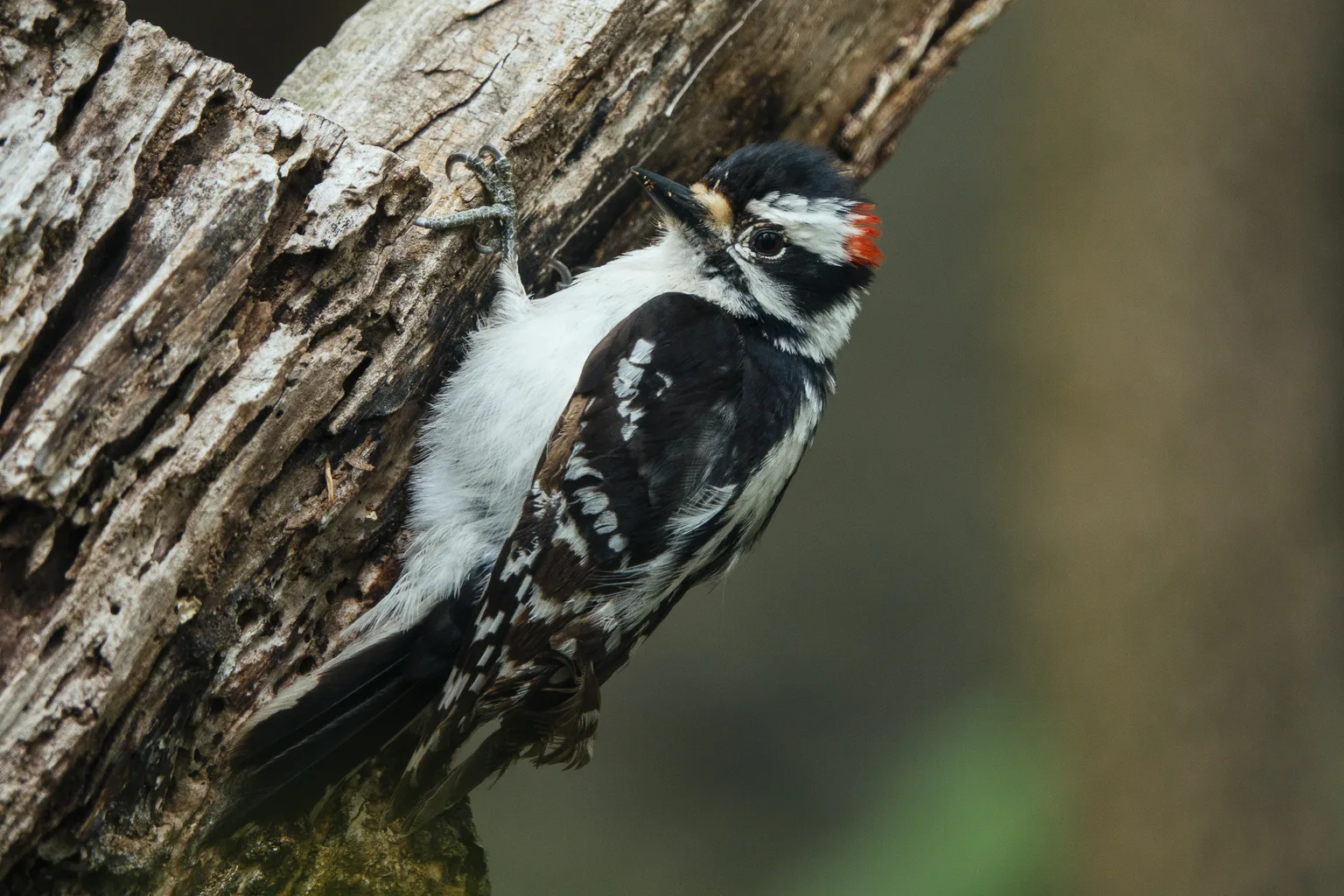
Downy vs hairy woodpecker: check the bill first. A downy's bill is about a third of its head length, a hairy's about as long. Then tail spots, size and calls.
In this article
- What’s the difference between a downy and a hairy woodpecker?
- 1. How do the bills compare?
- 2. How big is each woodpecker?
- 3. What do the outer tail feathers show?
- 4. What about the head and shoulder pattern?
- 5. How do their calls differ?
- Do downy and hairy woodpeckers behave differently?
- Which one comes to bird feeders?
- Why do downy and hairy woodpeckers look so alike?
- What if you still can’t tell them apart?
- Is there a European look-alike pair?
- Sources
- Frequently asked questions
To tell a downy from a hairy woodpecker, look at the bill first. A downy’s bill is short and dainty, about a third as long as its head, while a hairy’s is a long chisel about as long as its head. Then check the outer tail feathers, overall size, the shoulder mark and the call.
These two black-and-white woodpeckers are one of the first identification puzzles most backyard birders run into. The Cornell Lab of Ornithology calls them “one of the first identification challenges that beginning bird watchers master.” They share the same white back stripe, the same checkered wings and the same red patch on the back of the male’s head. The good news is that five clues, checked in the right order, will sort out almost every bird at your feeder.
This page is purely about telling the two apart. If you want to bring more of them to your yard, our guides on how to attract downy woodpeckers and how to attract hairy woodpeckers cover food, feeders and habitat for each species.
What’s the difference between a downy and a hairy woodpecker?
The hairy woodpecker is bigger and has a much longer bill. The downy is smaller, with a short bill and, usually, black spots on its white outer tail feathers.
Here are the five clues side by side:
| # | Clue | Downy Woodpecker | Hairy Woodpecker |
|---|---|---|---|
| 1 | Bill length | Short and dainty, about one-third the distance from bill base to back of head | Long and chisel-like, about as long as the distance from bill base to back of head |
| 2 | Size | About 6.5 in (17 cm); House Sparrow sized | About 9.25 in (23 cm) on average; robin sized |
| 3 | Outer tail feathers | White, usually with black bars or spots | Completely white in most of the eastern US |
| 4 | Shoulder mark | Black “comma” from shoulder onto breast, often not obvious | Well-developed black “comma” from shoulder onto breast |
| 5 | Calls | Sharp pik; whinny that descends in pitch | Louder, lower peek; rattle that doesn’t descend at the end |
Clues from Project FeederWatch, the Cornell Lab and Audubon.
No single clue is perfect, so look for two or three that agree. Bill length is the strongest because it works on a lone bird.
1. How do the bills compare?
The hairy’s bill is about as long as its head; the downy’s is about a third of that. This is the single most reliable mark.
Project FeederWatch puts it in exact terms. On a downy, the bill is “rather short and dainty, about one-third as long as the distance from the base of the bill to the back of the head.” On a hairy, it’s “long, chisel-like, about as long as the distance from the base of the bill to the back of the head.” Audubon’s Karl Mechem describes the hairy’s bill as “a railroad spike in comparison.”
To use this clue, picture a line from where the bill meets the face to the back of the head. Then compare the bill with that line:
- Bill covers only a small part of the head length: downy.
- Bill covers roughly the whole head length: hairy.
The Cornell Lab also notes that the downy’s bill is smaller for the bird’s size than in other woodpeckers. A downy’s face can look almost cute and stubby, while a hairy’s looks long and serious.
2. How big is each woodpecker?
The hairy is about one-third larger than the downy. Side by side the difference is obvious, but alone, either bird can fool you.
| Measurement | Downy Woodpecker | Hairy Woodpecker |
|---|---|---|
| Length | 5.5-6.7 in (14-17 cm) | 7.1-10.2 in (18-26 cm) |
| Weight | 0.7-1.0 oz (21-28 g) | 1.4-3.4 oz (40-95 g) |
| Wingspan | 9.8-11.8 in (25-30 cm) | 13.0-16.1 in (33-41 cm) |
| Reference bird | House Sparrow | American Robin |
Sizes from the Cornell Lab’s All About Birds identification pages.
Audubon suggests comparing each bird with a familiar species: a downy is about House Sparrow size, and a hairy is about robin size. If a chickadee, nuthatch or House Finch lands next to your woodpecker, use it as a ruler. A downy looks only a little bigger than those small birds; a hairy towers over them.
Judging size on a single bird with nothing nearby is hard, so treat size as a supporting clue rather than proof.
3. What do the outer tail feathers show?
Black spots or bars on the white outer tail feathers point to a downy; plain white points to a hairy. You’ll see this best when the woodpecker is clinging to a trunk or suet cage with its tail pressed against it.
The Cornell Lab says the downy’s outer tail feathers are “typically white with a few black spots,” and Project FeederWatch says they’re “usually barred in black, giving a spotted effect.” For the hairy, FeederWatch says that “in most of the Eastern U.S., Hairys have completely white outer tail feathers.”
Notice the careful wording: “usually” and “most of the Eastern U.S.” This clue is strong but not absolute, especially outside the East, so combine it with the bill.
4. What about the head and shoulder pattern?
Look for a black “comma” on the side of the breast. On a hairy it’s well developed; on a downy it’s often faint or not obvious.
Project FeederWatch describes the hairy as having a “well-developed ‘comma-shaped’ black mark extending from the shoulder onto the breast.” Downies can show the same mark, but it’s often weaker.
The red patch on males is another small hint. Both species share a vertical white stripe down the back, and males of both have a red patch on the back of the head; females have none. Audubon notes that the male hairy’s red patch is often split in two, while the downy’s is not. That takes a close look, so treat it as a bonus clue.
Hairy woodpeckers also vary by region. The Cornell Lab describes eastern birds as extensively white below with heavily spotted wings, Rocky Mountain birds as less spotted, and Pacific Northwest birds as darker overall. If you live in the West, rely more on the bill than on the amount of white.
5. How do their calls differ?
The hairy’s call is a lower, more emphatic peek, and its rattle stays level. The downy gives a sharper pik and a whinny that falls in pitch.
According to the Cornell Lab, the downy’s whinny is “a somewhat excited string of hoarse, high-pitched notes that descend in pitch,” lasting about two seconds. Its other call is “a very sharp pik note.” The hairy’s peek is “very similar to Downy Woodpeckers, but slightly lower pitched and often sounding more emphatic,” and its rattle or whinny is like the downy’s “but does not descend in pitch at the end.”
The difference is subtle at first. Playing the recordings on the Cornell Lab’s sound pages a few times, or running Merlin Sound ID when you hear a woodpecker calling, makes it much easier to pick out by ear.
Do downy and hairy woodpeckers behave differently?
Yes, and their behavior can tip you off before you see the bill. Downies often forage on small branches and even weed stems, while hairies spend more time on trunks and main branches.
The Cornell Lab notes that the two “occur together throughout most of their ranges” and split their food sources: “The Downy Woodpecker uses smaller branches while the Hairy Woodpecker tends to spend more time on trunks.” Downies are acrobatic enough to hammer goldenrod galls to reach the fly larvae inside. Audubon adds that downies will settle for small birches and cattails, while hairies prefer big trees and deeper woods.
So a small black-and-white woodpecker working a weed stalk or a thin twig is very likely a downy. One hitching steadily up a big trunk in mature woods could be either, and is worth a closer look.
Which one comes to bird feeders?
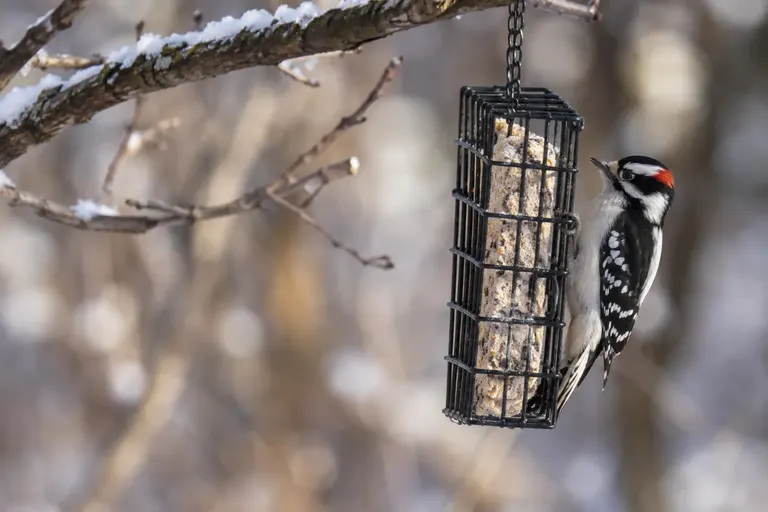
Both do, and you may get both at the same feeder. Suet is the food that draws them most reliably, and peanuts and black oil sunflower seeds also help.
The Cornell Lab says downies visit feeders readily and especially like suet, along with black oil sunflower seeds, millet, peanuts and chunky peanut butter. For hairy woodpeckers, it suggests suet, peanut and black oil sunflower feeders, especially in winter.
A suet feeder is also the best place to compare the two. The bird clings still, often with its tail pressed flat, so you can check both the bill and the outer tail feathers. Our guide to the best suet feeders covers cage and tail-prop designs that suit both species, and the guide to the best suet for birds explains which cakes and blends to buy.
Why do downy and hairy woodpeckers look so alike?
They may have evolved to look alike. Despite the near-identical plumage, their lineages split from a shared ancestor more than 6 million years ago, according to the Cornell Lab’s Living Bird magazine.
A 2019 study in Nature Communications, covered by the Cornell Lab, found that some woodpeckers seem to evolve to resemble other species that live alongside them. One idea is that the smaller downy benefits from looking like the larger, more aggressive hairy. As the Cornell Lab puts it, a nuthatch or titmouse “might think twice about competing with a Downy Woodpecker at the bird feeder if it thinks it’s going up against the more formidable Hairy Woodpecker.”
Researchers still describe this as a hypothesis, but it explains why the two look like a small and a large version of the same bird.
What if you still can’t tell them apart?
Then take a photo and check it against the clues later. A clear side view of the head and a view of the tail settle most birds.
A simple routine helps:
- Check the bill against the head. Short means downy; head-length means hairy.
- Look at the outer tail feathers. Black spots point to downy; plain white points to hairy.
- Compare size with a nearby bird such as a chickadee or House Finch.
- Listen. A falling whinny suggests downy; a loud, level rattle suggests hairy.
If you’re new to working through field marks like this, our guide on how to identify birds explains a routine that works for any species. The bill-to-head comparison is also much easier with a pair of binoculars at the window. Our guide to the best binoculars for backyard birding covers models that focus well at short indoor distances.
Is there a European look-alike pair?
Not these two: downy and hairy woodpeckers are North American birds. In European gardens, the closest small-and-large pair is the Great Spotted Woodpecker and the Lesser Spotted Woodpecker, though they differ in pattern as well as size.
| Great Spotted Woodpecker | Lesser Spotted Woodpecker | |
|---|---|---|
| Length | 23-26 cm | 14-16 cm |
| Size comparison | About Blackbird size, but more slender | About House Sparrow size |
| Back and wings | Large white shoulder patches | Black and white barring, no shoulder patches |
| Red under the tail | Yes | No |
| Male’s red | Patch on the back of the head | Red crown |
Sources: RSPB and Vogelbescherming Nederland.
Vogelbescherming Nederland notes that young Great Spotted Woodpeckers have a red crown and can be mistaken for smaller relatives, and that the Lesser Spotted’s drumming lasts longer and sounds more like a sewing machine. The RSPB says Great Spotted Woodpeckers are often bold, regular visitors to peanut and suet feeders in winter, while Lesser Spotted Woodpeckers spend much of their time high in the trees and can be very hard to find.
Sources
- Project FeederWatch: Tricky Bird IDs, Downy Woodpecker and Hairy Woodpecker
- Cornell Lab of Ornithology, All About Birds: Downy Woodpecker Identification
- Cornell Lab of Ornithology, All About Birds: Hairy Woodpecker Identification
- Cornell Lab of Ornithology, All About Birds: Hairy Woodpecker Sounds
- National Audubon Society: How to Tell a Hairy Woodpecker From a Downy Woodpecker
- Cornell Lab of Ornithology, Living Bird: Are Woodpeckers Evolving to Look Like Each Other?
Each of these guides answers a different question:
- How to Attract Downy Woodpeckers: Suet, Food and HabitatHow to attract downy woodpeckers: offer suet, peanuts and black oil sunflower, keep native plants with seed heads and galls, and leave safe dead limbs standing.
- How to Attract Hairy Woodpeckers: Suet, Trees and SnagsHow to attract hairy woodpeckers: offer suet, peanuts and black oil sunflower in winter, keep mature trees near feeders, and leave safe dead trees standing.
- How to Attract Red-bellied Woodpeckers: Suet, Nuts, FruitHow to attract red-bellied woodpeckers: offer suet, peanuts, sunflower and fruit near large trees, keep dead limbs standing, and limit starlings near nests.
- How to Attract Pileated Woodpeckers: Dead Wood and SuetHow to attract Pileated Woodpeckers: keep dead trees and logs, offer suet in a feeder with a tail prop, and live near mature woods. What works and what doesn't.
- Why Do Woodpeckers Peck Wood? Food, Nests and DrummingWhy do woodpeckers peck wood? To dig out insects, carve nest and roost holes, and drum loud signals that claim territory and attract mates. Here is the science.
- Why Don't Woodpeckers Get Headaches? The Brain ScienceWhy don't woodpeckers get headaches? A small, tightly packed brain, brief impacts, straight-line strikes and a stiff skull protect them. Here is the science.

Frequently asked questions
What is the easiest way to tell a downy from a hairy woodpecker?
Compare the bill with the head. Project FeederWatch describes the downy's bill as about one-third as long as the distance from the base of the bill to the back of the head, while the hairy's bill is about as long as that distance. This works on a lone bird, which matters because size is hard to judge when there's nothing next to the woodpecker for comparison.
How much bigger is a hairy woodpecker than a downy?
The Cornell Lab describes the hairy as about one-third larger. It lists the downy at 5.5 to 6.7 inches (14 to 17 cm) and 0.7 to 1.0 ounces (21 to 28 g), and the hairy at 7.1 to 10.2 inches (18 to 26 cm) and 1.4 to 3.4 ounces (40 to 95 g). Project FeederWatch puts the downy near House Sparrow size and the hairy near robin size.
Do downy woodpeckers have spots on their tail?
Usually, yes. The Cornell Lab says the downy's white outer tail feathers typically carry a few black spots, and Project FeederWatch says they are usually barred in black, giving a spotted look. In most of the eastern United States, hairy woodpeckers have completely white outer tail feathers. The clue is helpful but not perfect everywhere, so check the bill as well.
Do downy and hairy woodpeckers sound different?
Yes, a little. The Cornell Lab says the hairy's peek call is very similar to the downy's pik but slightly lower pitched and often more emphatic. Both give a whinny or rattle. The downy's whinny descends in pitch, while the hairy's rattle does not descend at the end. Listening for that falling whinny is a useful extra clue.
Do downy and hairy woodpeckers live in Europe?
No. Both are North American species. The Cornell Lab notes that the two occur together throughout most of their ranges in North America, and the hairy also lives in mountain forests in Central America. In Europe, the nearest backyard look-alike pair is the Great Spotted Woodpecker and the much smaller Lesser Spotted Woodpecker, which differ in pattern as well as size.


