
Golden Eagle vs Bald Eagle: How to Tell Them Apart
Bald Eagle vs Golden Eagle: adults differ by head color, but check legs, bill and wing angle too. Bald Eagles soar flat; Golden Eagles hold a shallow V.
In this article
- Which is bigger, a Bald Eagle or a Golden Eagle?
- How do you tell a Bald Eagle from a Golden Eagle?
- How do you tell adult Bald and Golden Eagles apart?
- How do you tell a juvenile Bald Eagle from a Golden Eagle?
- How do you tell them apart in flight?
- Where do Bald and Golden Eagles live?
- Is there a Bald Eagle in Europe?
- Are Bald and Golden Eagles related?
- What if you can’t tell which eagle it is?
- What helps you see these field marks?
- Sources
- Frequently asked questions
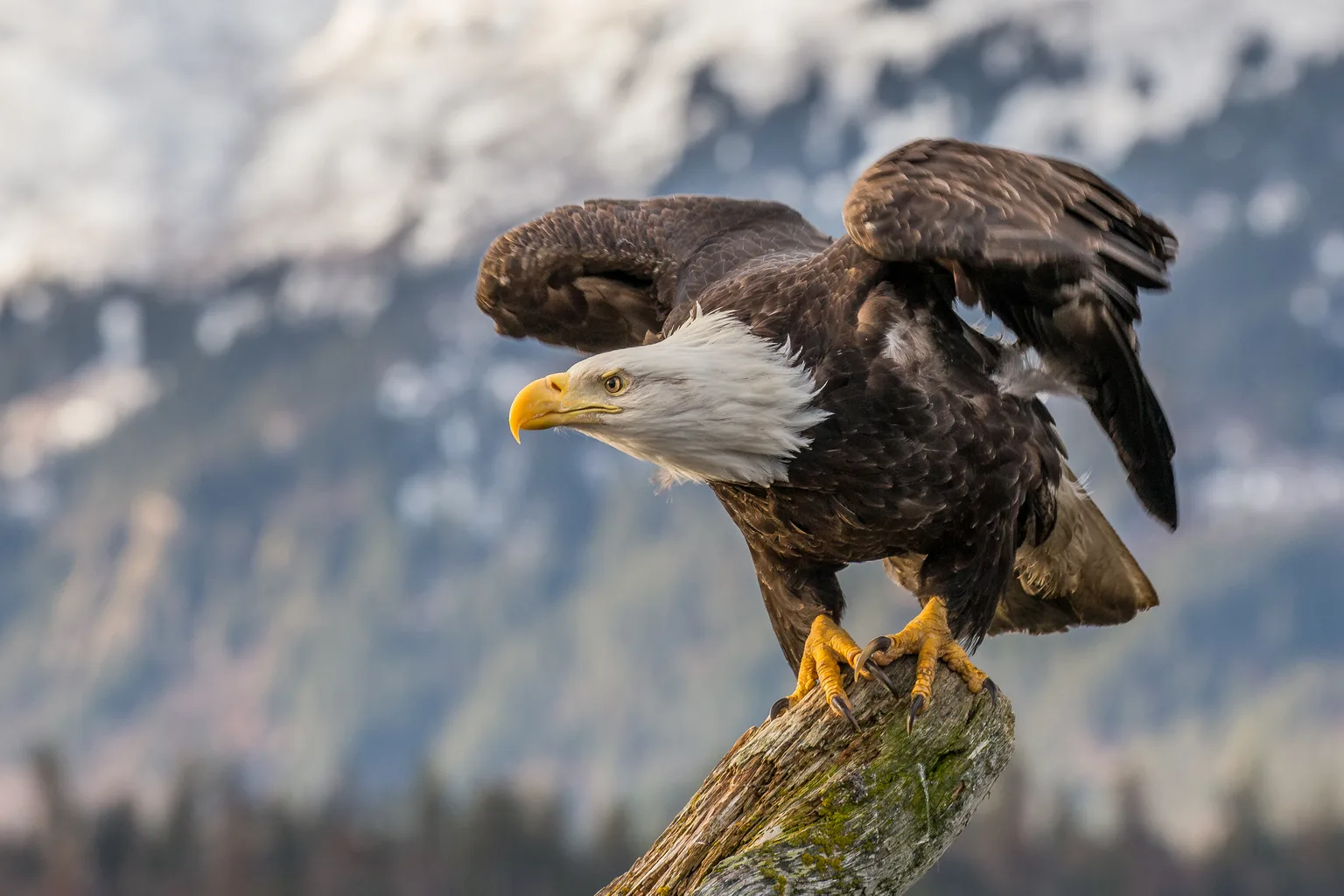
An adult Bald Eagle has a white head, white tail and a huge yellow bill, so it’s easy. The hard part is young birds. Golden Eagles have legs feathered to the toes, a smaller bill, neat white wing patches when young and wings held in a slight V. Bald Eagles show bare yellow legs, blotchy white and flat wings.
These are North America’s two big eagles, and they overlap in size, color and range for much of the year. A brown eagle on a fence post or soaring over a ridge could be either one, because a young Bald Eagle takes about five years to grow its white head and tail. The good news is that a few structural clues work at every age. The Golden Eagle also lives across Europe, Asia and North Africa, while the Bald Eagle is North American, so there’s a short section on European eagles near the end.
Which is bigger, a Bald Eagle or a Golden Eagle?
Neither, really. The two species overlap almost completely in length and weight, so size won’t settle an identification on its own.
| Measurement | Bald Eagle | Golden Eagle |
|---|---|---|
| Length | 27.9-37.8 in (71-96 cm) | 27.6-33.1 in (70-84 cm) |
| Weight | 105.8-222.2 oz (3,000-6,300 g) | 105.8-216.1 oz (3,000-6,125 g) |
| Wingspan | about 80 in (204 cm) | 72.8-86.6 in (185-220 cm) |
Sizes from the Cornell Lab’s All About Birds identification pages.
The Cornell Lab calls both “one of the largest birds in North America.” What differs is how that size is arranged. The Bald Eagle has a heavy body, a large head and a long, hooked bill. The Golden Eagle has a relatively small head and a long tail, so in flight the tail projects farther behind the wings than the head sticks out in front.
How do you tell a Bald Eagle from a Golden Eagle?
Start with the head, then check the legs, the bill and the wing angle. Those four clues work on almost every bird, adult or young.
| # | Clue | Bald Eagle | Golden Eagle |
|---|---|---|---|
| 1 | Adult head | White | Dark brown with a golden sheen on the back of the head and neck |
| 2 | Bill | Massive, about one third of the head’s length | Large but in proportion, so the head looks shorter |
| 3 | Legs | Bare, yellow lower legs | Feathered all the way to the toes |
| 4 | Wings when soaring | Held flat, like a board | Lifted into a slight V, with spread “fingers” at the tips |
| 5 | Head and tail in flight | Big head that sticks out well in front | Small head; long tail projects farther behind than the head in front |
| 6 | Young birds from below | Blotchy, dirty white mottling on the underwings and body | Neat white patches in the wings and at the base of the tail |
| 7 | Underwing coverts | Pale mottling on immatures | Solid dark |
| 8 | Favorite places | Lakes, rivers, reservoirs, marshes and coasts | Open country, especially mountains, hills and cliffs |
Clues from the Cornell Lab, Audubon and Birds of the World.
No single clue is perfect, so stack them. A dark eagle with feathered legs, a modest bill and a clean white patch in each wing is a young Golden Eagle. A dark eagle with yellow bare legs, a bill that looks too big for its head and messy white splotches is a young Bald Eagle.

How do you tell adult Bald and Golden Eagles apart?
By the head. The Cornell Lab describes adult Bald Eagles as having white heads and tails with dark brown bodies and wings, plus bright yellow legs and bill. Nothing else in North America looks quite like that.
An adult Golden Eagle is dark brown all over, with a golden sheen on the back of the head and neck. The Cornell Lab notes that this golden nape shows up even from a long way off in good light. In flight, the adult’s tail is dark, never the clean white of an adult Bald Eagle.
The tricky part is that a brown head is not proof of a Golden Eagle. Audubon’s Pete Dunne points out that juvenile Bald Eagles have all-dark heads that are easily confused with a Golden Eagle’s brown head. So whenever you see a dark-headed eagle, move on to the legs, the bill and the white in the wings.
How do you tell a juvenile Bald Eagle from a Golden Eagle?
Check the legs and the white in the plumage. Juvenile Bald Eagles are the birds most often mistaken for Golden Eagles, and the Cornell Lab says Bald Eagles take about five years to reach full adult plumage.
- Legs. Audubon puts it simply: Golden Eagle legs are feathered to the foot, while the Bald Eagle has unfeathered, yellow ankles. The Cornell Lab notes that only three American raptors have legs fully feathered to the toes, and the Golden Eagle is one of them.
- Bill. A young Bald Eagle’s bill is enormous, about a third of the length of the head. A Golden Eagle’s bill is big but in proportion, so its head looks shorter and neater.
- White patches. The Cornell Lab describes young Golden Eagles as having neatly defined white patches at the base of the tail and in the wings, which fade as the bird matures. Young Bald Eagles are patchy white beneath and lack those clean oval wing patches. Audubon calls the Bald Eagle’s white a “dirtier shade.”
- Body. Golden Eagles stay dark-bodied as they age, with the white mostly limited to the wings. Second-year Bald Eagles often show a white belly with brown mottling, a brown chest and a brown mask behind the eye.
Over the next few years, young Bald Eagles get steadily whiter in the face and tail. Audubon notes that three- and four-year-old birds already show a whitish face. Any eagle with white in the face is a Bald Eagle.
How do you tell them apart in flight?
Look at the wing angle and the head. The Cornell Lab says Bald Eagles soar with their broad wings held flat, like a board, while Golden Eagles soar or glide with the wings lifted into a slight V and the wingtip feathers spread like fingers.
Next, compare the head and the tail. A Bald Eagle has a large head that juts out well in front of the wings. A Golden Eagle’s head is relatively small and its tail is long. Birds of the World adds one more clue for young birds overhead: Bald Eagles have pale mottling on the underwing coverts, the feathers along the front half of the wing, while those feathers are solid dark on a Golden Eagle.
Distant soaring birds can also be Turkey Vultures, which hold their wings in a V too. The Cornell Lab notes that Turkey Vultures have smaller, unfeathered red heads than Golden Eagles. If you see a tiny head on a big dark bird, it’s probably a vulture. Our guide on how to identify birds explains how to work through shape, behavior and habitat in a set order, which helps a lot with raptors.

Where do Bald and Golden Eagles live?
Bald Eagles stick close to water and Golden Eagles prefer open country. Habitat won’t prove an ID, but it tells you which eagle to expect.
| Bald Eagle | Golden Eagle | |
|---|---|---|
| Habitat | Lakes, reservoirs, rivers, marshes and coasts | Open country, especially around mountains, hills and cliffs; also tundra, grassland and farmland |
| Main food | Mostly fish; also scavenges and steals other birds’ catches | Mainly rabbits, hares, ground squirrels and prairie dogs |
| North American range | Widespread; most widespread in winter along coasts, rivers, lakes and reservoirs | Breeds mostly in the West, Canada and Alaska; in winter found in every U.S. state |
| Outside North America | Not found (rare vagrant) | Widespread across Europe, Asia and North Africa |
Sources: Cornell Lab All About Birds and Birds of the World.
The Cornell Lab describes the Bald Eagle as a fish-eater that often steals from other birds, harassing Ospreys until they drop their catch. The Golden Eagle is one of the fastest, nimblest raptors in North America and hunts mostly mammals by soaring or diving over open land.
Ranges overlap more than many people expect. Birds of the World notes that Golden Eagles turn up in winter in every U.S. state and are more common than once thought in eastern North America. So an eagle in the East in winter isn’t automatically a Bald Eagle. If you’re out looking for raptors in the cold months, our winter birding guide has tips on where and when to look.
Is there a Bald Eagle in Europe?
No, not as a regular bird. The Bald Eagle lives in North America, and Birds of the World lists only a handful of European records: single juveniles in Ireland in November 1987 and in Northern Ireland in January 1973, plus two unaccepted reports from Britain.
The Golden Eagle is different. It’s a native bird across much of Europe and Asia and into North Africa, so European birders can see it in mountain regions such as the Scottish Highlands, the Alps and the Pyrenees.
The Bald Eagle’s European counterpart is the White-tailed Eagle (Haliaeetus albicilla). Birds of the World says the Bald Eagle is sister to the White-tailed Eagle of Eurasia, and the two form a superspecies. The RSPB describes it as the UK’s largest bird of prey, with a pale head and neck that can look almost white on older birds, a white tail on adults and a huge yellow bill.
In Europe, the same Bald vs Golden puzzle becomes White-tailed vs Golden. The RSPB notes that the White-tailed Eagle soars on flat wings, much broader than a Golden Eagle’s, while the Golden Eagle holds its wings in a V. The White-tailed Eagle’s head is pale and turns almost white only on older birds, so it rarely matches the bright white head of an adult Bald Eagle.
Are Bald and Golden Eagles related?
Only distantly. The Bald Eagle (Haliaeetus leucocephalus) is a fish-eagle, or sea eagle. The Golden Eagle (Aquila chrysaetos) belongs to a different genus, Aquila. The two look alike mainly because both are big, dark eagles, which is why structural clues like the legs and the bill are more useful than color.
Both are national symbols, though. The Cornell Lab notes that the Bald Eagle has been the national emblem of the United States since 1782, and that the Golden Eagle is the national emblem of five countries.

What if you can’t tell which eagle it is?
Then don’t force it. A distant brown eagle soaring into the light can be hard to call, even for experienced birders. eBird lets you record a bird as “eagle sp.” so your checklist stays honest. Our guide on how to use eBird shows how to log a bird like this.
To give yourself a better chance next time:
- Note the wing angle while the bird soars: flat or a shallow V.
- Try to see the legs on a perched bird. Feathered or bare yellow is one of the most reliable clues.
- Take photos of the bird from below and in profile, then compare them with the tables above or run them through one of the best bird ID apps.
Keep your distance from nests and roosts. Our guide to bird photography ethics explains how to get good views without pushing birds off a perch.
What helps you see these field marks?
Good binoculars. Eagles are usually seen at a distance, perched on a far tree or circling high over a ridge, and the clues that matter most, such as leg feathering, bill size and the shape of the white patches, are small at that range. A bright, sharp pair makes those details visible.
Our guide to the best binoculars for birding covers the options. If you’re deciding on magnification for open country and distant raptors, 8x42 vs 10x42 explains the trade-off between extra reach and a steadier, wider view.
Sources
- Cornell Lab of Ornithology, All About Birds: Bald Eagle Identification
- Cornell Lab of Ornithology, All About Birds: Golden Eagle Identification
- National Audubon Society: Is That Golden Eagle Actually a Bald Eagle?
- Birds of the World: Bald Eagle, Systematics
- Birds of the World: Golden Eagle
- RSPB: White-tailed Eagle



Frequently asked questions
Which is bigger, a Bald Eagle or a Golden Eagle?
They're about the same size. The Cornell Lab lists Bald Eagles at 27.9 to 37.8 inches long and 3 to 6.3 kg, and Golden Eagles at 27.6 to 33.1 inches and 3 to 6.1 kg. Both are among the largest birds in North America, so size alone won't separate them. Look at the head, bill, legs and the angle of the wings instead.
How can you tell a juvenile Bald Eagle from a Golden Eagle?
Check the legs, the bill and the white in the wings. Golden Eagles have legs feathered all the way to the toes, while Bald Eagles show bare yellow lower legs. A young Bald Eagle has a huge bill and blotchy, dirty white mottling under the wings. A young Golden Eagle has neat white patches in the wings and at the base of the tail.
Do Golden Eagles have a golden head?
Not the whole head. Adult Golden Eagles are dark brown with a golden sheen on the back of the head and neck, which the Cornell Lab says can be seen from a long way off in good light. The face and crown look brown. Young Bald Eagles also have all-dark heads, so a brown head alone doesn't prove you're looking at a Golden Eagle.
Can you see Bald Eagles in Europe?
Almost never. The Bald Eagle is a North American bird. Birds of the World lists only single juveniles in Ireland in 1987 and Northern Ireland in 1973, plus two unaccepted reports from Britain. A large eagle with a white tail in Europe is almost certainly a White-tailed Eagle, the Bald Eagle's closest relative, which soars on flat wings like a Bald Eagle.
How do Bald and Golden Eagles fly differently?
Look at the wing angle when the bird soars. The Cornell Lab says Bald Eagles hold their broad wings flat, like a board, while Golden Eagles soar with the wings lifted into a slight V and the wingtip feathers spread like fingers. A Golden Eagle also has a smaller head and a longer tail, so its tail sticks out farther behind than its head does in front.


