
Crow vs Raven: How to Tell Them Apart
Crow vs raven: ravens are bigger, with a wedge-shaped tail, shaggy throat and deep croak. Crows are smaller, with a fan-shaped tail and a cawing call.
In this article
- What is the difference between a crow and a raven?
- How big is a raven compared to a crow?
- How do you tell a crow from a raven by the tail?
- How do crows and ravens sound different?
- How do you tell them apart in flight?
- How do you tell a perched crow from a raven?
- Where do crows and ravens live?
- Do crows and ravens behave differently?
- What about crows and ravens in Europe?
- What helps you tell crows and ravens apart?
- Sources
- Frequently asked questions
Ravens are bigger than crows, about the size of a Red-tailed Hawk, with a heavy, curved bill, shaggy throat feathers and a wedge-shaped tail in flight. Crows are smaller, with a fan-shaped or squared tail and a cawing call. Ravens croak. Ravens usually travel alone or in pairs, while crows often gather in groups.
Both birds are all black, from bill to feet, and both are clever corvids that thrive near people. That’s why so many people mix them up. In North America the comparison is almost always between the Common Raven and the American Crow, and that’s the pair this guide covers first. If you’re more curious about what these birds can do than how to name them, read are crows really that smart. This page sticks to identification.
What is the difference between a crow and a raven?
The quickest checks are tail shape in flight, voice and size. A wedge-shaped tail, a deep croak and a hawk-sized body point to a raven; a fan-shaped tail, a caw and a smaller body point to a crow.
| Feature | Common Raven | American Crow |
|---|---|---|
| Length | 22.1-27.2 in (56-69 cm) | 15.8-20.9 in (40-53 cm) |
| Wingspan | 45.7-46.5 in (116-118 cm) | 33.5-39.4 in (85-100 cm) |
| Weight | 24.3-57.3 oz (689-1,625 g) | 11.2-21.9 oz (316-620 g) |
| Size comparison | About the size of a Red-tailed Hawk | About two-thirds the size of a raven |
| Tail in flight | Wedge- or diamond-shaped | Fan-shaped, rounded or squared |
| Bill | Very large, thick and curved | Heavy and straight, smaller |
| Throat | Shaggy throat feathers | Smooth |
| Wings | Long, narrow, with long “fingers” | Broad and rounded |
| Flight | Soars and glides, often on thermals | Steady rowing wingbeats, short glides |
| Main call | Deep, gurgling croak | Hoarse caw |
| Social habits | Alone or in pairs, except at food | Often in groups, sometimes huge flocks |
Measurements and descriptions from the Cornell Lab’s All About Birds identification pages and Audubon.
No single clue settles every bird, especially a lone bird seen at a distance. Use two or three clues together, and the answer usually becomes obvious.
How big is a raven compared to a crow?
A raven is much bigger, but size is hard to judge on its own. The Cornell Lab calls the Common Raven about 50 percent larger than an American Crow, and Audubon compares it to a Red-tailed Hawk.
The weight gap is the clearest way to picture it. A big raven can weigh more than twice as much as a big crow. The Cornell Lab describes the raven as “not just large but massive,” with a thick neck and a bill like a Bowie knife. A crow looks compact by comparison.
The trouble is that a black bird on a distant pole has nothing next to it for scale. Size works best when the bird sits beside something you know, such as a gull, a hawk or a pigeon. Otherwise, use shape and sound.
How do you tell a crow from a raven by the tail?
Wait for the bird to fly and look at the spread tail. Audubon explains that a crow’s tail feathers are all about the same length, so the tail opens like a fan, while a raven’s middle tail feathers are longer, so the open tail looks wedge-shaped.
The Cornell Lab describes the raven’s tail as diamond-shaped in flight, and the crow’s as short and rounded or squared. This is the single most useful clue for a bird flying overhead, and it works even when you can’t hear it or judge its size.
Watch out for molting birds. A crow missing a few tail feathers can show an odd outline for a while, so check the wings and flight style too.
How do crows and ravens sound different?
Crows caw, ravens croak. The Cornell Lab describes the raven’s most common call as a loud, gurgling croak that can carry for more than a mile, while the American Crow is known for its hoarse, full-throated caw.
Audubon sums it up neatly: crows caw and purr, while ravens croak and can make a wide range of other sounds. Both species have big vocabularies, so you’ll hear odd clicks, rattles and gurgles from each. But a low, rolling croak from overhead is a strong sign of a raven, and a series of sharp caws from a treetop is classic crow.
Voice is often the fastest way to tell them apart, because you’ll hear the bird before you see it well. If you want to practice, start with the routine in how to bird by ear, and let Merlin Sound ID suggest a match while you learn.
How do you tell them apart in flight?
Watch how the bird uses its wings. Audubon notes that ravens ride thermals and soar, while crows do more flapping.
- Raven: The Cornell Lab describes buoyant, graceful flight, with soaring and gliding mixed with slow wingbeats. The wings are long and narrow, with long, separated feather tips like fingers. A soaring raven can look surprisingly like a hawk until you notice the big head and wedge tail.
- Crow: The Cornell Lab describes a distinctive rowing motion, sometimes with short glides. The wings are broader and more rounded, and crows rarely soar for long.
Ravens are also acrobats. The Cornell Lab notes they sometimes fly upside down for long stretches, and young ravens play by dropping sticks and catching them in mid-air.
How do you tell a perched crow from a raven?
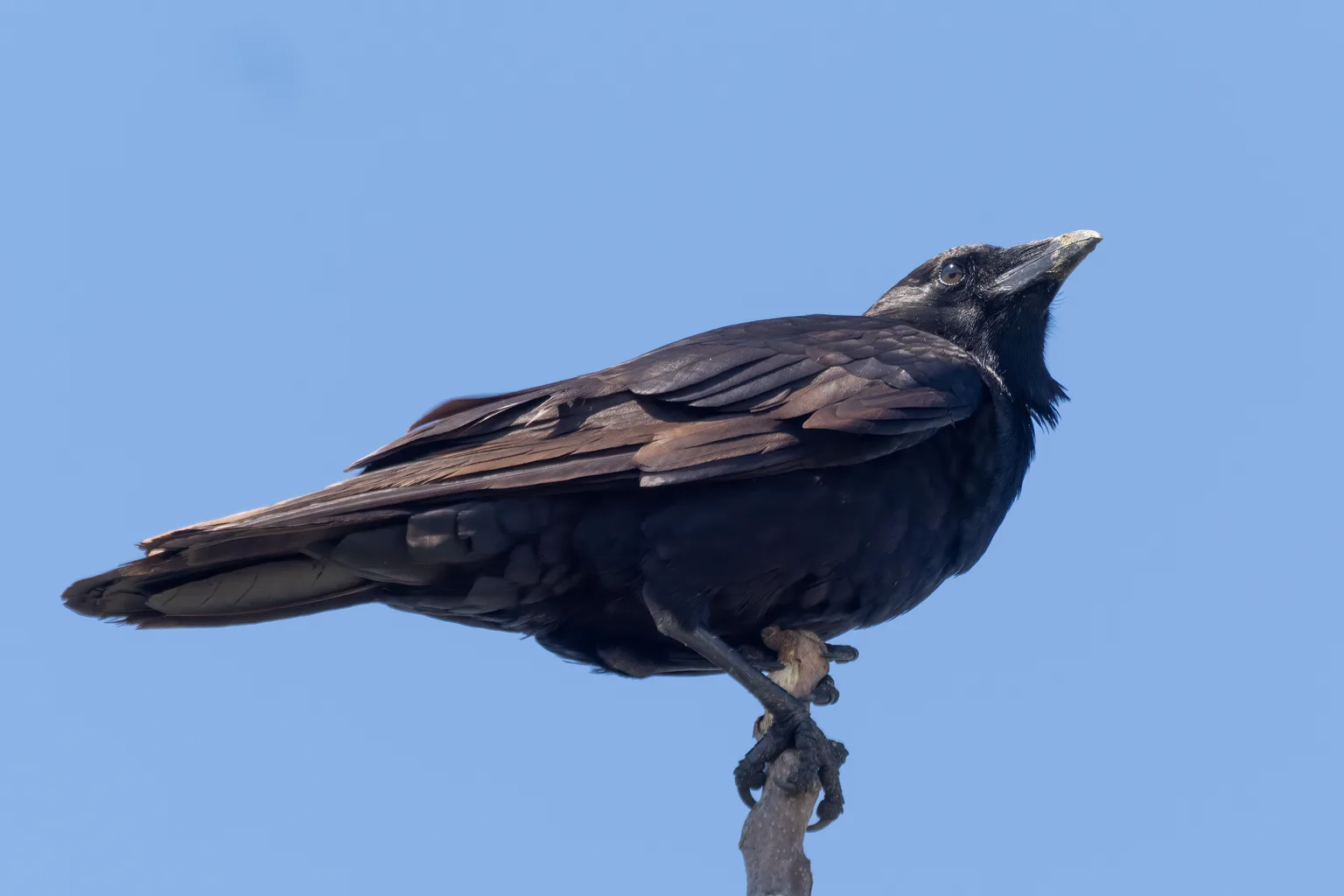
Look at the head, bill and throat. A perched raven has a heavier head, a thick, curved bill and shaggy throat feathers. A crow has a smaller, straighter bill and a smooth, neat throat.
- Bill: Audubon says ravens have bigger, curvier bills relative to crows. The bristles over the base of the bill are also noticeably longer on a raven.
- Throat: The Cornell Lab points to the raven’s shaggy throat feathers.
- Overall shape: The raven looks heavy-headed and thick-necked. The crow looks tidier and more compact.
- Walk: The Cornell Lab notes that ravens strut or bound forward with light two-footed hops.
If you’re new to sorting out similar birds, our guide on how to identify birds walks through a routine of size, shape, behavior and voice that works for any species.
Where do crows and ravens live?
In North America, ravens dominate the West and North, while crows are the familiar black bird across most of the continent. Audubon notes that Common Ravens are much less common than American Crows in the eastern United States.
The Cornell Lab says Common Ravens live year-round across the Northern Hemisphere and use a wide range of habitats, from forests and mountains to deserts, sea coasts and tundra, as well as town outskirts and landfills. American Crows are birds of fields, open woodland and forest edges that have adapted well to people. They’re common on lawns, in parking lots, at dumps and around farms.
So location narrows things down fast. A big black bird in a suburban yard in the East is very likely a crow. In mountains, deserts or wild country in the West, a raven is a real possibility.

Do crows and ravens behave differently?
Yes. Crows are social; ravens are usually seen alone or in pairs. The Cornell Lab notes ravens aren’t as social as crows, gathering mainly at food sources, while crows sometimes form huge flocks.
Group size is a handy clue. A noisy group of a dozen black birds working a field or mobbing a hawk is almost certainly crows. The Cornell Lab notes that crows often chase larger birds, including hawks and owls. Two big black birds soaring together over a ridge are more likely a pair of ravens.
Diet overlaps heavily. Both eat almost anything, from insects and seeds to carrion and human food scraps. Neither is a typical feeder bird, but crows do turn up in yards to pick over spilled food. If they’re bullying smaller birds at your feeders, the tips in dealing with starlings and grackles apply to other big, bold birds too.
What about crows and ravens in Europe?
The Common Raven is the same species in Europe, but the crows are different. Europe has no American Crow; its common crows are the Carrion Crow and the Hooded Crow, plus the Rook.
- Carrion Crow: All black, like the American Crow. The RSPB calls it one of the most adaptable birds in the UK, found from cities to moorland.
- Hooded Crow: Gray body with black head, wings and tail. In the UK it replaces the Carrion Crow in the north and west of Scotland and in Ireland, and the two sometimes interbreed.
- Rook: About crow-sized, but adults have a bare, grayish-white face and a thinner, pointed bill, and they spend much of the year in groups.
The same raven clues work in Europe: the RSPB describes the raven as much bigger and chunkier than crows and rooks, with shaggy throat feathers and a wedge-shaped tail in flight.
What helps you tell crows and ravens apart?
A clear look at the tail, bill and throat. These details are easy to miss on a black bird against a bright sky, and black plumage hides shape in poor light. A pair of binoculars lets you see the throat feathers and bill shape on a perched bird and the tail outline on a flying one. Our guide to the best binoculars for birding compares the options, and the best binoculars for backyard birding focuses on watching from home.
If you still can’t decide, leave the bird unidentified rather than guessing. A wrong record does more harm than a missing one, and our guide on how to use eBird explains how to keep your checklists accurate.
Sources
- Cornell Lab of Ornithology, All About Birds: Common Raven Identification
- Cornell Lab of Ornithology, All About Birds: American Crow Identification
- Cornell Lab of Ornithology, All About Birds: Common Raven Similar Species
- Cornell Lab of Ornithology, All About Birds: Common Raven Overview
- National Audubon Society: How to Tell a Raven From a Crow
- RSPB: Raven




Frequently asked questions
What is the main difference between a crow and a raven?
Size, tail shape and voice. The Cornell Lab lists Common Ravens at 22 to 27 inches long and American Crows at 16 to 21 inches, so a raven is roughly the size of a Red-tailed Hawk. In flight a raven's tail is wedge-shaped, while a crow's opens like a fan. Ravens give a deep, gurgling croak; crows give the familiar caw.
How can you tell a crow from a raven in flight?
Look at the tail first. The Cornell Lab describes the raven's tail as wedge- or diamond-shaped and the crow's as short and rounded or squared. Ravens also have longer, narrower wings with long fingers at the tips, and they often soar and glide like hawks. Crows fly with a steady, rowing wingbeat and glide only briefly.
Are ravens just big crows?
Not quite. Both belong to the genus Corvus, so they are close relatives, but the Common Raven and the American Crow are separate species with different calls, shapes and habits. The Cornell Lab says the raven is about 50 percent larger than the American Crow and far less social, usually seen alone or in pairs rather than in flocks.
Do ravens come to backyards and feeders?
Sometimes, depending on where you live. The Cornell Lab says Common Ravens feed on grain, pet food, carrion and human refuse and live on town outskirts and around landfills. They are much less common than crows in the eastern United States, so most big black birds in an eastern yard are American Crows. In the West and North, a raven visit is more likely.
Do ravens and crows live in Europe?
Yes. The Common Raven is the same species on both sides of the Atlantic, found across the Northern Hemisphere. Europe has no American Crow, though. Its common crows are the all-black Carrion Crow in the west and the gray-and-black Hooded Crow in the north and east, plus the bare-faced Rook, which nests in noisy colonies.


