
Cooper's Hawk vs Sharp-shinned Hawk: How to Tell Them Apart
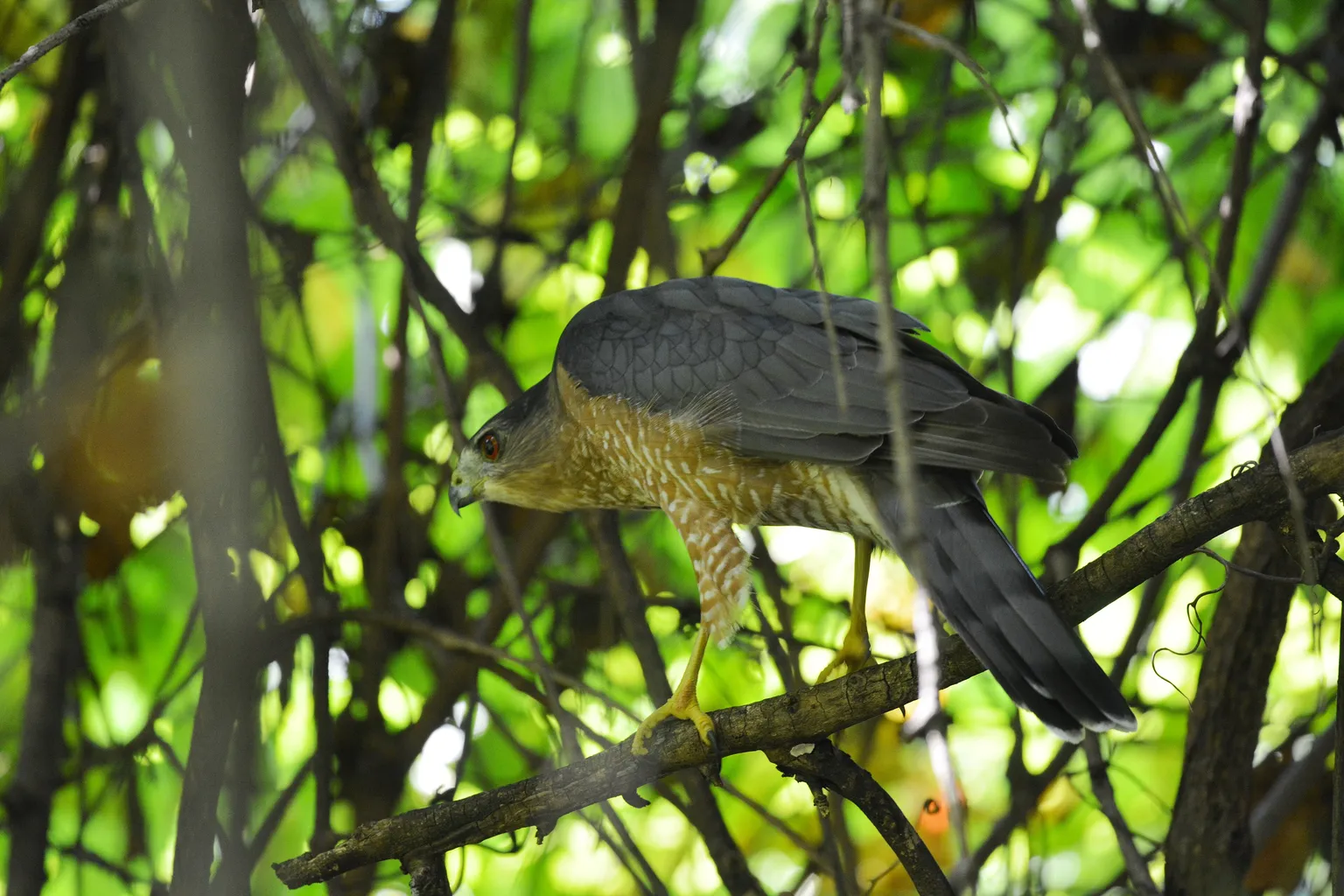
Cooper's Hawk vs Sharp-shinned Hawk: check the head, tail tip and nape first. Cooper's has a big head, rounded tail and dark cap; the Sharpie is small-headed.
In this article
- Which is bigger, a Cooper’s Hawk or a Sharp-shinned Hawk?
- How do you tell a Cooper’s Hawk from a Sharp-shinned Hawk?
- How do you tell them apart when perched?
- How do you tell them apart in flight?
- How do you tell juvenile Cooper’s and Sharp-shinned Hawks apart?
- Which hawk comes to bird feeders?
- Are Cooper’s and Sharp-shinned Hawks closely related?
- What if you can’t tell them apart?
- What helps you see these field marks?
- Sources
- Frequently asked questions
A Cooper’s Hawk is crow-sized, with a big, blocky head, a dark cap over a paler nape and a tail that’s usually rounded at the tip. A Sharp-shinned Hawk is jay-sized, with a small, round head, a hooded look and a square-tipped tail. Check the head and the tail tip first; they settle most sightings.
These two hawks are the classic North American identification puzzle. They share the same colors, the same long tail and short, rounded wings, and the same habit of dashing through backyards after small birds. Both are North American birds, and both turn up at backyard feeders. The good news is that a handful of shape clues, checked in the right order, will sort out most birds.
Which is bigger, a Cooper’s Hawk or a Sharp-shinned Hawk?
The Cooper’s Hawk is bigger, but the sizes overlap. In both species the female is much larger than the male, so a big female Sharp-shinned Hawk can come close to a small male Cooper’s Hawk.
The Cornell Lab of Ornithology says a male Sharp-shinned Hawk is about the size of an American Kestrel, only slightly larger than a jay, and that females are about one-third bigger than males, approaching the size of a male Cooper’s Hawk. The Sharp-shinned Hawk is the smallest hawk in the United States and Canada. A Cooper’s Hawk, by contrast, is about crow-sized.
| Measurement | Sharp-shinned Hawk | Cooper’s Hawk (male) | Cooper’s Hawk (female) |
|---|---|---|---|
| Length | 9.4-13.4 in (24-34 cm) | 14.6-15.3 in (37-39 cm) | 16.5-17.7 in (42-45 cm) |
| Weight | 3.1-7.7 oz (87-218 g) | 7.8-14.5 oz (220-410 g) | 11.6-24.0 oz (330-680 g) |
| Wingspan | 16.9-22.1 in (43-56 cm) | 24.4-35.4 in (62-90 cm) | 29.5-35.4 in (75-90 cm) |
Sizes from the Cornell Lab’s All About Birds identification pages.
Size is only reliable at the extremes. A hawk the size of a Blue Jay is a Sharpie, and one the size of an American Crow is a Cooper’s. Anything in between needs a look at shape. Size is also hard to judge on a lone bird with nothing next to it, so treat it as a hint rather than proof.
How do you tell a Cooper’s Hawk from a Sharp-shinned Hawk?
Check the head first, then the tail tip, then the nape. Those three clues work on most views. Eye position, leg thickness and wingbeat help when you get a longer or closer look.
| # | Clue | Sharp-shinned Hawk | Cooper’s Hawk |
|---|---|---|---|
| 1 | Head size | Small and smoothly rounded; barely projects past the wings in flight | Large and blocky; sticks out well in front of the wings in flight |
| 2 | Tail tip | Square, with prominent corners; may show a small notch | Usually rounded at the tip |
| 3 | White band at tail tip | Narrower | Wider |
| 4 | Cap and nape (adults) | Dark crown and nape the same tone, so the bird looks hooded | Dark crown over a paler nape, so the bird looks capped |
| 5 | Eye position | Close to halfway between the front and back of the head | Close to the front of the head |
| 6 | Legs | Thin, pencil-like, with small feet | Thicker, shorter-looking, with larger feet |
| 7 | Wingbeats | Several quick, snappy wingbeats, then a short glide | Slower, stiffer wingbeats, then a short glide |
Clues from Project FeederWatch, the Cornell Lab and Audubon.
No single clue is perfect. Project FeederWatch uses words like “typically” and “usually” for the tail, and a molting or fanned tail can look different from the textbook shape. The more clues that point the same way, the more confident you can be.
How do you tell them apart when perched?
On a perched adult, start with the head and the back of the neck. The Cornell Lab describes adult Cooper’s Hawks as rather square-headed with a dark cap, while perched Sharp-shinned Hawks have a rounder head and no cap.
- Head shape. Audubon describes the Cooper’s Hawk’s head as a big dome, like a block stacked on its body. Project FeederWatch notes that raised feathers on the back of the head can give a Cooper’s a slightly crested look. A Sharpie’s head looks small and smoothly rounded.
- Cap vs hood. On an adult Cooper’s Hawk, the nape feathers are lighter than the crown, so the dark color stops like a cap. On an adult Sharpie, the crown and nape are the same dark blue-gray, which reads as a hood.
- Eye position. A Cooper’s Hawk’s eye sits close to the front of the head. A Sharpie’s eye looks closer to the middle.
- Legs. The Cornell Lab calls leg thickness a great clue on perched birds seen up close. Cooper’s Hawks have thicker legs and larger feet; Sharpies have thin, pencil-like legs.
- Tail. From below, look for a rounded tip with a wide white band (Cooper’s) or a square tip with sharp corners (Sharpie).
If you’re new to working through field marks like this, our guide on how to identify birds explains a simple routine that works for any species.
How do you tell them apart in flight?
Watch the head against the front edge of the wings. Audubon describes both species as a horizontal “T” in flight, but Sharpies look unbalanced, with small heads that barely project beyond the wings, while Cooper’s Hawks look more proportional, with larger heads sticking out in front.
Both use the flap-and-glide style typical of these forest hawks. Project FeederWatch describes Sharp-shinned Hawks as giving several quick wingbeats followed by a short glide, and Cooper’s Hawks as using slower wingbeats followed by a short glide. The Cornell Lab adds that Cooper’s Hawks rarely flap continuously, even when crossing open ground.
When the bird fans its tail overhead, check the tip again. The Cornell Lab notes the white band at the tail tip is wider on Cooper’s Hawks than on Sharp-shinned Hawks.
How do you tell juvenile Cooper’s and Sharp-shinned Hawks apart?
Look at the streaks on the underside. Juveniles of both species are brown above with streaked underparts for their first year, so the adult cap-and-nape clue doesn’t help.
- Juvenile Cooper’s Hawk: Neat, crisp brown streaks concentrated on the upper breast, with a mostly white lower belly. The Cornell Lab says this gives young Cooper’s Hawks a somewhat hooded look.
- Juvenile Sharp-shinned Hawk: Broad, blurry streaks that run well down the belly. Project FeederWatch describes them as heavy, bold and reddish.
Head size, eye position, leg thickness and tail shape still apply to young birds, so use them alongside the streaking.
Which hawk comes to bird feeders?
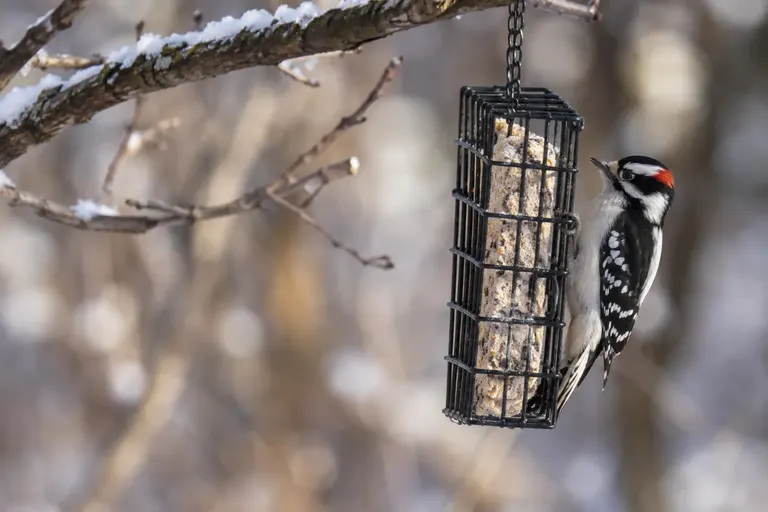
Both do. Project FeederWatch reports that both species have become more common around feeder areas, and the Cornell Lab calls them sometimes unwanted guests at feeders, looking for an easy meal. They are after the birds, not the seed.
What they hunt differs with their size:
| Sharp-shinned Hawk | Cooper’s Hawk | |
|---|---|---|
| Main prey | Songbirds about the size of an American Robin and smaller | Mainly birds, especially medium-sized ones |
| Typical feeder targets | Small songbirds | Mourning Doves, European Starlings, Rock Pigeons, American Robins, jays |
| Hunting style | Speeds through dense cover to surprise prey; does not dive from high overhead | Chases birds through cluttered tree canopies at high speed |
| Where you see it | Occasionally at winter feeders; many migrate south out of Canada in fall | Now fairly common in cities and suburbs |
Sources: Cornell Lab All About Birds species pages.
The Cornell Lab notes that urban Cooper’s Hawks often target Rock Pigeons and Mourning Doves, and that small birds are actually safer around Cooper’s Hawks than medium-sized ones. So a hawk that grabs a dove is more likely a Cooper’s, while one that picks off a House Finch or junco could be either.
Studies summarized by the Cornell Lab suggest feeders don’t greatly increase a bird’s chances of being taken by a Sharp-shinned Hawk. If a hawk starts hunting your yard every day, the usual advice is to take the feeders down for a week or two so the small birds disperse. Our guide to hawks at bird feeders covers that step by step, and placing feeders near dense shrubs, as explained in where to put a bird feeder, gives songbirds somewhere to escape. A brush pile does the same job in a yard without much cover.
Are Cooper’s and Sharp-shinned Hawks closely related?
Not as closely as they look. In 2025 the American Ornithological Society moved Cooper’s Hawk out of the genus Accipiter and into the genus Astur, based on genetic evidence, while the Sharp-shinned Hawk stays in Accipiter. The AOS put it simply: people have trouble telling the two apart, but they are not that closely related.
That’s why you’ll now see Cooper’s Hawk listed as Astur cooperii in newer checklists and apps, while older field guides still use Accipiter cooperii. The birds haven’t changed; only the family tree has.
What if you can’t tell them apart?
Then leave it open. Audubon says it’s okay not to have a definitive answer, because these two look almost exactly alike. eBird has a “Sharp-shinned/Cooper’s Hawk” option for exactly this situation, which keeps your checklist accurate without forcing a guess. Our guide on how to use eBird shows how to log birds like this.
To give yourself a better chance next time:
- Take several photos from different angles, especially the head in profile and the tail from below.
- Note what the hawk was chasing or eating, and what it perched near, so you can compare sizes later.
- Compare the photos with the tables above, then try a photo ID feature in one of the best bird ID apps.
What helps you see these field marks?
A clear, bright view. Eye position, the edge of the cap, the width of the white tail band and leg thickness are small details, and a hawk rarely sits still for long. A good pair of binoculars kept by the window makes the difference between “a hawk” and “a Cooper’s Hawk”. Our guide to the best binoculars for birding covers the options, and the best binoculars for backyard birding focuses on close-range viewing from home.
Sources
- Cornell Lab of Ornithology, All About Birds: Cooper’s Hawk Identification
- Cornell Lab of Ornithology, All About Birds: Sharp-shinned Hawk Identification
- Cornell Lab of Ornithology, All About Birds: Sharp-shinned Hawk Similar Species
- Project FeederWatch: Tricky Bird IDs, Sharp-shinned Hawk and Cooper’s Hawk
- National Audubon Society: A Beginner’s Guide to IDing Cooper’s and Sharp-shinned Hawks
- American Ornithological Society: 66th Supplement to the Check-list of North American Birds

Frequently asked questions
Which is bigger, a Cooper's Hawk or a Sharp-shinned Hawk?
The Cooper's Hawk is bigger. The Cornell Lab lists Cooper's Hawks at 14.6 to 17.7 inches long, about crow-sized, and Sharp-shinned Hawks at 9.4 to 13.4 inches, about jay-sized. Females of both species are larger than males, so a big female Sharp-shinned Hawk can come close to a small male Cooper's Hawk. That overlap is why shape clues matter more than size.
What is the easiest way to tell a Cooper's Hawk from a Sharp-shinned Hawk?
Look at the head and the tail tip. A Cooper's Hawk has a large, blocky head and a tail that is usually rounded at the tip, with a wider white band at the end. A Sharp-shinned Hawk has a small, rounded head and a square-tipped tail that can show a small notch. On perched adults, a dark cap over a paler nape points to Cooper's.
How do you tell Cooper's and Sharp-shinned Hawks apart in flight?
Watch how far the head sticks out in front of the wings. Audubon describes both as a horizontal T in flight, but a Sharp-shinned Hawk's small head barely projects past the wings, while a Cooper's Hawk's larger head juts out in front. Project FeederWatch adds that Sharpies use several quick wingbeats before a short glide, while Cooper's Hawks flap more slowly.
Do Cooper's Hawks and Sharp-shinned Hawks come to bird feeders?
Yes, both hunt at feeders, and Project FeederWatch reports that both have become more common around feeder areas. They are after the birds, not the seed. Sharp-shinned Hawks mostly take songbirds the size of a robin or smaller, while Cooper's Hawks often go for medium-sized birds such as Mourning Doves, European Starlings and Rock Pigeons.
What if I can't tell whether it's a Cooper's or a Sharp-shinned Hawk?
That is normal, and Audubon says it is okay not to have a definitive answer because the two look so alike. eBird lets you report the bird as Sharp-shinned/Cooper's Hawk instead of guessing. Photos of the head in profile and the tail from below give you the best chance of a firm ID later.


