
Red-tailed Hawk Identification: Field Marks and Lookalikes
Red-tailed Hawk identification: check for a dark bar on the wing's leading edge, a streaked belly band, a pale V on the back and a rusty tail on adults.
In this article
- How big is a Red-tailed Hawk?
- What does a Red-tailed Hawk look like perched?
- How do you identify a Red-tailed Hawk in flight?
- Why doesn’t my Red-tailed Hawk have a red tail?
- Are there dark or pale Red-tailed Hawks?
- Red-tailed Hawk vs Red-shouldered Hawk: how do you tell them apart?
- What other hawks look like a Red-tailed Hawk?
- What does a Red-tailed Hawk sound like?
- Do Red-tailed Hawks hunt at bird feeders?
- How can you be sure of a hawk ID?
- What helps you see a hawk’s field marks?
- Sources
- Frequently asked questions
To identify a Red-tailed Hawk, check four things: a dark bar on the front edge of the underwing, a pale chest with a band of dark streaks across the belly, a pale V on the back of a perched bird, and a rusty-red tail on adults. A big, bulky hawk on a roadside pole is very often a Red-tail.
The Cornell Lab of Ornithology calls the Red-tailed Hawk probably the most common hawk in North America. That’s good news for beginners, but it comes with a catch. Red-tails vary a lot in color, young birds don’t have red tails at all, and several other large hawks share the same broad-winged shape. The checklists below put the field marks in the order that settles most sightings.
How big is a Red-tailed Hawk?
A Red-tailed Hawk is a large, heavy hawk with a wingspan of roughly 4 feet. Females are bigger than males, and the Cornell Lab notes that a large female can look almost eagle-sized from a distance, even though the biggest females weigh only about 3 pounds.
| Measurement | Male | Female |
|---|---|---|
| Length | 17.7-22.1 in (45-56 cm) | 19.7-25.6 in (50-65 cm) |
| Weight | 24.3-45.9 oz (690-1,300 g) | 31.8-51.5 oz (900-1,460 g) |
| Wingspan | 44.9-52.4 in (114-133 cm) | 44.9-52.4 in (114-133 cm) |
Sizes from the Cornell Lab’s All About Birds identification page.
Red-tails are buteos, the group of soaring hawks with very broad, rounded wings and short, wide tails. Audubon describes them as hefty, “beefy” birds, which separates them from slimmer falcons and from the long-tailed forest hawks such as Cooper’s Hawk.
What does a Red-tailed Hawk look like perched?
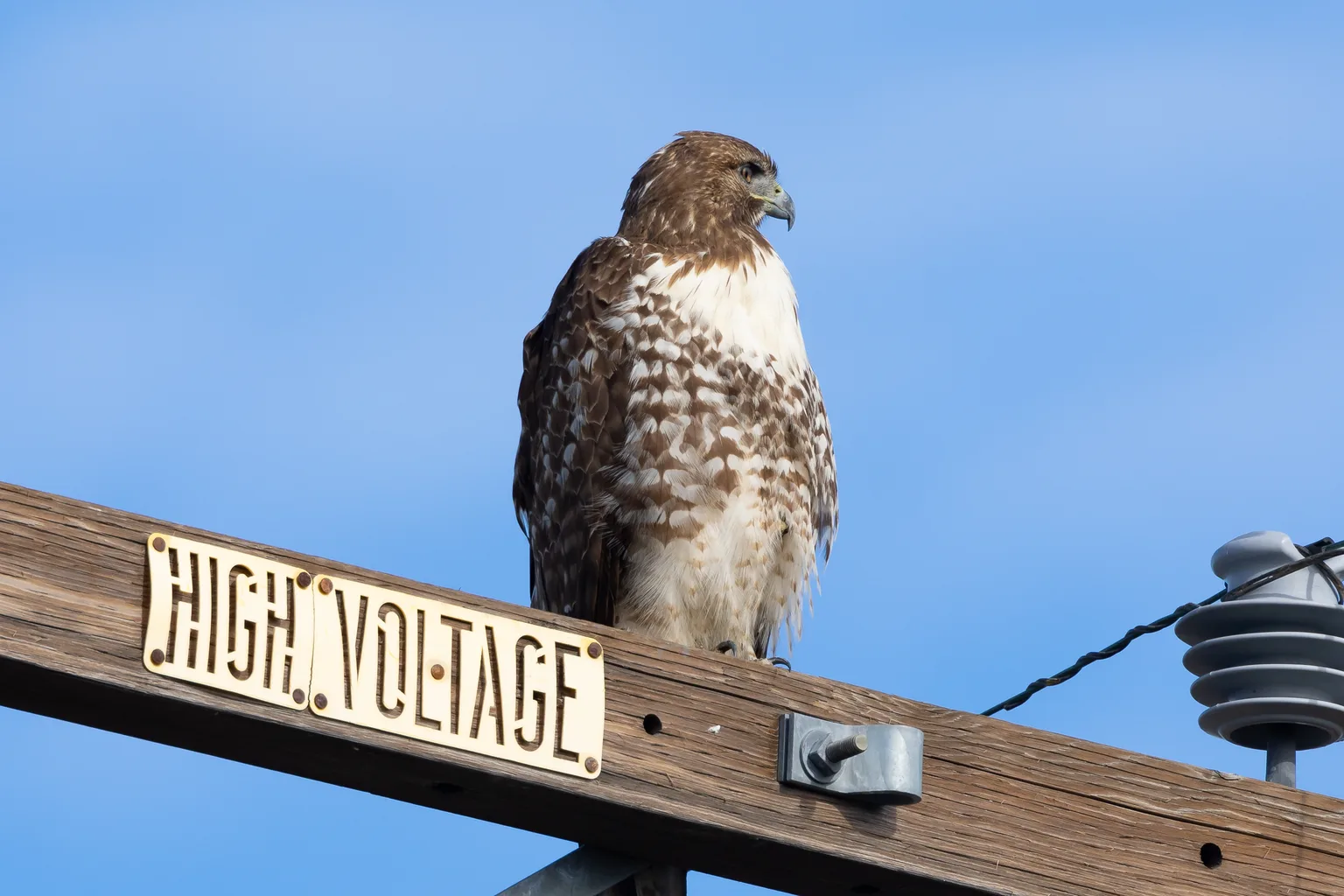
Most perched Red-tails are rich brown above and pale below, with a streaked belly. Work through these marks in order:
- Belly band. Look for a pale chest with a band of dark streaks across the belly. Audubon notes that some birds have a dark belly band and others are dark brown or blackish across the whole front, but a Red-tail never shows a bib-like dark chest.
- Pale V on the back. Pale feathers on the shoulders form a rough white V when you see the bird from behind. Audubon points out that young Swainson’s Hawks can show something similar, so use it with the other marks.
- Bulky shape. A heavy chest, broad body and short, thick look. Falcons and Sharp-shinned Hawks look slim next to it.
- Legs. Rough-legged and Ferruginous Hawks have legs feathered down to the toes, so they look like they’re “wearing pants”, as Audubon puts it. A Red-tail’s lower legs aren’t fully feathered.
- Tail. Adults are cinnamon-red above. On a perched bird you may only catch it when the wings shift or the bird turns.
Where it sits is a clue too. The Cornell Lab describes Red-tails as birds of open country that perch on telephone poles, fenceposts and trees standing alone or along field edges. The Lab’s own tip for finding one is simple: go for a drive and watch the fenceposts and the sky.
How do you identify a Red-tailed Hawk in flight?
From below, look for the dark bar along the leading edge of the wing, between the body and the wrist. Birders call it the patagial bar, and the USGS Patuxent identification guide says this dark mark is present on all ages and races of Red-tailed Hawk and is unique to the species.
Check these in order on a soaring bird:
- Dark bar on the leading edge. The single most useful mark, because it works on juveniles and dark birds as well as typical adults.
- Shape. Very broad, rounded wings and a short, wide tail.
- Tail color. Adults are pale below and cinnamon-red above, so the red shows best when the bird banks and you see the upper side. Audubon notes that lighting affects how much red you can see from below.
- Pale flight feathers. The Cornell Lab says all ages and morphs of Red-tailed Hawk have pale flight feathers, which helps with Swainson’s Hawk (see below).
- Behavior. Red-tails soar in wide circles over fields. In strong wind they can hang in place without flapping, eyes on the ground, and they often attack in a slow, controlled dive with legs outstretched.
| Field mark | Where to look | Reliability |
|---|---|---|
| Dark leading-edge bar | Underwing, between body and wrist | Present on all ages and forms (USGS) |
| Streaked belly band | Lower chest and belly | Most birds; south Texas birds can lack it |
| Pale V on back | Shoulders, seen from behind | Helpful, but young Swainson’s Hawks can show one |
| Rusty-red tail | Upper side of the tail | Adults only; Harlan’s Hawk often lacks red |
| Bulky buteo shape | Whole bird | Shared with other buteos |
Why doesn’t my Red-tailed Hawk have a red tail?
It’s probably a juvenile. The Cornell Lab says young Red-tails have brown tails with dark bands, heavy streaking below and bold barring on the wings. The red tail comes with adult plumage.
There’s a second reason. Harlan’s Hawk, a distinctive dark form of the Red-tail found in Alaska and northwestern Canada, often has a pale, mottled tail with little or no red, according to Audubon. Audubon also notes that some western adults show narrow bars across the red tail.
So don’t rule out a Red-tail because the tail isn’t red. Go back to the leading-edge bar, the belly band and the bulky shape.
Are there dark or pale Red-tailed Hawks?
Yes, and they’re one reason the species can be confusing. The Cornell Lab describes several forms:
- Dark morph: all chocolate-brown, with a warm red tail on adults.
- Rufous morph: reddish-brown on the chest with a dark belly.
- Western light morph: streakier than eastern birds.
- “Krider’s” Red-tail: a pale bird of the Great Plains with a whitish head.
- Harlan’s Hawk: a dark form of Alaska and northwestern Canada, often without a red tail.
The Lab notes that dark birds are most common in the West. Whatever the color, the dark bar on the leading edge of the underwing is still there, which is why it’s the mark to check first on a strange-looking bird.
Red-tailed Hawk vs Red-shouldered Hawk: how do you tell them apart?
Look at the tail and the underparts. The Cornell Lab says Red-shouldered Hawks are smaller than Red-tails, with a banded tail and warm reddish barring below, while Red-tailed Hawks have a mostly unbanded tail and streaks, not bars, on the underparts.
| Red-tailed Hawk | Red-shouldered Hawk | |
|---|---|---|
| Wingspan | 44.9-52.4 in (114-133 cm) | 37.0-43.7 in (94-111 cm) |
| Adult tail | Mostly plain rusty red | Black with narrow white bands |
| Underparts | Pale chest, streaked belly band | Warm reddish barring across the breast |
| In flight | Dark bar on leading edge of wing | Narrow pale crescents near the wingtips |
| Call | Hoarse, screaming kee-eeeee-arr | Rising, whistled kee-rah |
| Habitat | Open country, poles, lone trees | Deciduous woods, often near rivers and swamps |
Sources: Cornell Lab All About Birds identification pages.
Red-shouldered Hawks also have checkered black-and-white wings and, says the Cornell Lab, soar with their wingtips pushed slightly forward in a “reaching” posture. Juveniles of the two species are harder, since young Red-shouldered Hawks are brown above and streaked below. On those birds, the leading-edge bar and the size difference are your best clues.
What other hawks look like a Red-tailed Hawk?
Three more birds cause most of the confusion, and each has one clear difference:
- Swainson’s Hawk. A summer bird of the Great Plains and the West. The Cornell Lab says light-morph adults have dark flight feathers that contrast with white wing linings, while all Red-tails have pale flight feathers. Many show a dark or reddish-brown chest, and they soar with wings in a shallow V.
- Rough-legged Hawk. An Arctic breeder that spends the winter in open country across the US and southern Canada. Look for dark patches at the bend of the wing, legs feathered to the feet, and a habit of hovering into the wind. It’s slightly smaller and less bulky than a Red-tail.
- Turkey Vulture. From a distance a soaring vulture can pass for a Red-tail, but the Cornell Lab notes it has longer, more rectangular wings held above horizontal in an obvious V.
If a large hawk is chasing songbirds through your yard, it’s probably not a buteo at all. Cooper’s and Sharp-shinned Hawks are the usual feeder hunters, and our guide to Cooper’s Hawk vs Sharp-shinned Hawk shows how to tell those two apart.
What does a Red-tailed Hawk sound like?
The Cornell Lab describes the call as a hoarse, screaming kee-eeeee-arr that lasts 2 to 3 seconds and is usually given while soaring. During courtship, birds also give a shrill chwirk, sometimes several in a row.
You’ve probably heard it even if you’ve never looked for the bird. The Cornell Lab notes that the raspy scream is the sound Hollywood uses for nearly every raptor in its movie soundtracks. A sound ID app helps confirm it in the field; our guide to Merlin Sound ID explains how it works.
Do Red-tailed Hawks hunt at bird feeders?
Rarely. The Cornell Lab says you’re unlikely to see a Red-tail in a backyard unless it’s a big one, because it mostly hunts small mammals such as voles and rabbits from a high perch over open ground. It visits feeders less often than other hawks, and the Lab calls attacks on pets extremely rare.
If a hawk is raiding your feeders, see our guide to hawks at bird feeders for what to do. Winter is also when you’re most likely to notice Red-tails: the Cornell Lab says numbers are higher across most of the continent in winter, and our winter birding guide covers other birds to look for on a cold-weather drive.
How can you be sure of a hawk ID?
Use several marks, not one. Red-tails are so variable that a single feature, even the red tail, can mislead you. The dark leading-edge bar, the belly band, the bulky buteo shape and the open-country perch together make a confident ID.
A few habits help:
- Note where the bird was perched and what it was doing before it flew.
- Take photos of the underwing and the tail if you can, then compare them with the tables above or a photo ID feature in one of the best bird ID apps.
- If you still can’t decide, log the bird as “Buteo sp.” on eBird rather than guessing. Our guide on how to use eBird shows how.
Our step-by-step guide on how to identify birds explains this routine for any species.
What helps you see a hawk’s field marks?
Good binoculars. Hawks are usually far away and often against a bright sky, so small details such as the leading-edge bar or a faint belly band are hard to pick out by eye. A pair with good brightness and contrast makes those marks much easier to see. Our guide to the best binoculars for birding compares options that suit distant raptors as well as backyard birds.
Sources
- Cornell Lab of Ornithology, All About Birds: Red-tailed Hawk Identification
- Cornell Lab of Ornithology, All About Birds: Red-tailed Hawk Overview
- Cornell Lab of Ornithology, All About Birds: Red-shouldered Hawk Identification
- Cornell Lab of Ornithology, All About Birds: Rough-legged Hawk Identification
- National Audubon Society: Six Quick Questions to Help You Identify Red-tailed Hawks
- USGS Patuxent Wildlife Research Center: Red-tailed Hawk Identification Tips

Frequently asked questions
How can you tell if a hawk is a Red-tailed Hawk?
Check four field marks. Look for a dark bar on the front edge of the underwing between the shoulder and the wrist, a pale chest with a band of dark streaks across the belly, a pale V on the back of a perched bird, and a rusty-red tail on adults. The USGS calls the dark underwing mark unique to the species and present on all ages.
Why doesn't my Red-tailed Hawk have a red tail?
It's most likely a juvenile. The Cornell Lab says young Red-tailed Hawks have brown tails crossed by narrow dark bands, and the red tail only comes with adult plumage. Harlan's Hawk, a dark form that breeds in Alaska and northwestern Canada, also often shows a pale, mottled tail with little or no red. Check the underwing bar and body shape instead.
How big is a Red-tailed Hawk?
It's a large, heavy hawk. The Cornell Lab lists a wingspan of 44.9 to 52.4 inches (114 to 133 cm) and a length of 17.7 to 25.6 inches (45 to 65 cm), with females larger than males. Even so, the biggest females weigh only about 3 pounds. From a distance, a large female can look almost eagle-sized.
What is the difference between a Red-tailed Hawk and a Red-shouldered Hawk?
Look at the tail and the underparts. The Cornell Lab says Red-shouldered Hawks are smaller, with a black tail crossed by narrow white bands and warm reddish barring across the whole chest. Adult Red-tails have a mostly plain rusty tail and a pale chest with streaks, not bars. In flight, Red-shouldered Hawks show pale crescents near the wingtips.
Do Red-tailed Hawks come to bird feeders?
Not often. The Cornell Lab says you're unlikely to see one in a backyard unless it's a big one, because Red-tailed Hawks mostly eat small mammals such as voles and rabbits rather than songbirds. The hawks that chase small birds at feeders are usually Cooper's and Sharp-shinned Hawks. Attacks on pets by Red-tails are extremely rare.


