How to Attract Red-breasted Nuthatches Near Conifers
How to attract red-breasted nuthatches: offer peanuts, sunflower hearts and suet near conifers, and watch for irruption years when they move south in numbers.
In this article
- Quick answer: what red-breasted nuthatches need
- Red-breasted nuthatch at a glance
- How to identify a red-breasted nuthatch
- Where do red-breasted nuthatches live?
- Why red-breasted nuthatches irrupt some winters
- What do red-breasted nuthatches eat?
- Best feeders for red-breasted nuthatches
- Plants and habitat that attract red-breasted nuthatches
- Water for red-breasted nuthatches
- Nesting: do red-breasted nuthatches use birdhouses?
- Seasonal calendar
- Common problems and how to fix them
- Common mistakes when trying to attract red-breasted nuthatches
- Sources
- Frequently asked questions
Here is how to attract red-breasted nuthatches: put shelled peanuts, sunflower hearts or black oil sunflower seed and suet within easy reach of conifers, and keep feeding through the fall. These tiny birds, about 4.3 inches long, breed in northern and mountain evergreen forests, so where you live and what the cone crop is doing up north matter as much as your feeder setup. In irruption years they can appear far south of their breeding range, often by September.
Quick answer: what red-breasted nuthatches need
| Need | What works best | Notes |
|---|---|---|
| Food | Shelled peanuts, sunflower hearts, black oil sunflower seed, suet | The Cornell Lab lists peanuts, sunflower seeds and suet as their feeder foods |
| Feeder | Tube, hopper, mesh peanut feeder, suet cage | Small birds, so almost any clinging-friendly feeder works |
| Cover | Spruce, fir, pine, hemlock nearby | Conifers are their core habitat |
| Water | Shallow bird bath, heated in winter | Useful year-round |
| Nesting | Dead trees or dead limbs left standing | They rarely use nest boxes |
| Timing | Fall and winter, especially irruption years | Movements can start in July |
Red-breasted nuthatch at a glance
| Trait | Detail |
|---|---|
| Size | 4.3 in long, 0.3 to 0.5 oz, wingspan 7.1 to 7.9 in |
| Range | Breeds across Canada, Alaska, the northern US and western mountains; winter range varies widely year to year |
| Season in most backyards | Year-round in the north and mountains; fall and winter visitor farther south, mainly in irruption years |
| Diet | Insects and spiders in summer, conifer seeds in fall and winter |
| Feeder foods | Peanuts, sunflower seeds, suet |
| Nesting | Excavates its own cavity in dead or rotting wood, smears conifer resin around the hole |
| Clutch | 2 to 8 eggs, one brood a year |
All measurements and nesting figures above come from the Cornell Lab of Ornithology’s All About Birds species account.
How to identify a red-breasted nuthatch
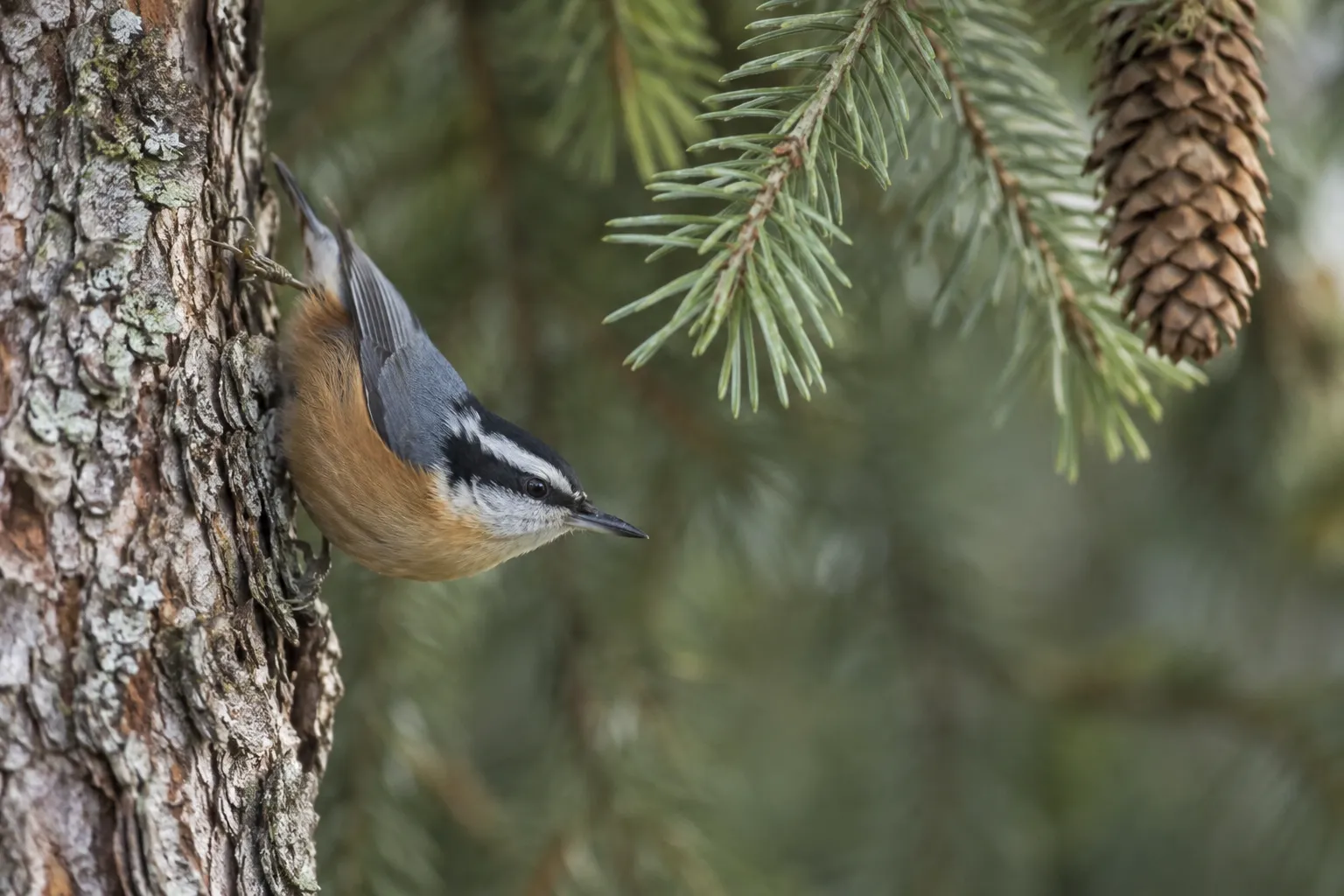
The red-breasted nuthatch is a compact, barrel-chested bird with almost no neck, a very short tail and a long, pointed bill. At 4.3 inches long it is smaller than a sparrow and noticeably smaller than the white-breasted nuthatch that visits many of the same feeders.
The back is blue-gray. The head is the giveaway: a black cap, a bold white stripe over the eye, and a black stripe running through the eye beneath it. The underparts are rusty cinnamon.
Like other nuthatches, it moves freely in any direction on a trunk, including straight down headfirst, using a strong backward-pointing hind toe for grip. Woodpeckers and creepers almost always climb upward, so a small bird walking down a tree is a strong nuthatch clue.
Male vs female
The sexes are similar but separable with a good look. According to the Cornell Lab:
- Males have a deep black cap and richer rusty underparts.
- Females have a grayer cap and paler, washed-out rusty underparts.
In side-by-side views at a feeder, the difference in cap color is usually the easiest mark.
Juveniles
Young birds are patterned like adults but with a duller cap and paler underparts. In late summer, a pale bird with a weak cap is often a juvenile rather than a female.
Red-breasted vs white-breasted nuthatch
This is the most common mix-up at feeders.
| Feature | Red-breasted nuthatch | White-breasted nuthatch |
|---|---|---|
| Size | 4.3 in, very small and stubby | Larger, closer to sparrow size and longer-bodied |
| Face | Black eye stripe under a white eyebrow | Plain white face, no eye stripe |
| Underparts | Rusty cinnamon | White, with some rust under the tail |
| Preferred trees | Conifers | Mainly deciduous trees, especially oaks |
| Call | High, nasal, tinny yank-yank | Lower, more nasal yank or quank |
If you want the full picture on the larger species, see our guide to attracting white-breasted nuthatches.
Other similar species
The Cornell Lab lists pygmy nuthatch, brown-headed nuthatch, brown creeper and black-and-white warbler as possible confusion species. Pygmy and brown-headed nuthatches lack the black eye stripe and have brownish caps, and each has a limited range: pygmy in western pines, brown-headed in southeastern pine woods. Brown creepers are streaky brown and spiral up trunks. Black-and-white warblers are streaked all over.
What does a red-breasted nuthatch sound like?
Often you will hear this bird before you see it. The Cornell Lab describes its call as a nasal yank-yank that sounds like a tiny tin horn. It is higher and more tinny than the white-breasted nuthatch’s call. If you use a sound ID app to confirm, double-check against a visual sighting, since nuthatch calls are easy to mix up.
Where do red-breasted nuthatches live?
The breeding range covers the “north woods and western mountains,” in the Cornell Lab’s words: Canada, Alaska, the northern tier of the United States, the Appalachians and the western mountain ranges. In these areas many birds are present year-round.
Habitat
Red-breasted nuthatches are conifer specialists. The Cornell Lab lists spruce, fir, pine, hemlock, larch and western red cedar as primary habitat. In the East they also use deciduous woods such as aspen, birch, poplar, oak, maple and basswood. Audubon notes they prefer mature forest with decaying wood suitable for nesting.
During irruptive winters they turn up in less typical places: orchards, scrub, parks, plantations and shade trees. That is when they become backyard birds for many people in the southern and central states.
Why red-breasted nuthatches irrupt some winters
The single biggest factor in whether you see this bird is not your feeder. It is the conifer cone crop hundreds of miles north.
In fall and winter, red-breasted nuthatches eat mostly conifer seeds. When cone crops are poor across their breeding forests, many birds move south to find food. Audubon notes that their winter range “varies tremendously from year to year, especially in the east.” In good cone years, many birds stay put and southern feeders may see none at all.
The Cornell Lab adds a useful timing detail: red-breasted nuthatches start moving earlier than many irruptive species. Movements may begin in early July and reach their southernmost point by September or October. So if you live south of the breeding range, late summer and early fall are the time to have feeders full and watch the conifers.
How to know if this is an irruption year
- Watch eBird reports in your county from August onward. Early sightings well south of the breeding range are a strong signal. Our guide to using eBird covers how to set up alerts.
- Listen for the tin-horn yank call in pines and spruces on fall walks.
- Winter bird forecasts published each fall by northern bird groups often include this species, since its movements track the same cone crops as winter finches.
What do red-breasted nuthatches eat?
In the warmer months, the diet is mostly insects and other arthropods. The Cornell Lab lists beetles, caterpillars, spiders, ants and earwigs. Nestlings are fed almost exclusively arthropods, according to Audubon. During spruce budworm outbreaks, the Cornell Lab notes that red-breasted nuthatches respond strongly to the extra food.
In fall and winter they switch to conifer seeds, many of which they cached earlier in the year in bark crevices.
Best foods for red-breasted nuthatches at feeders
- Shelled peanuts or peanut pieces. High in fat and protein, and small pieces are easy for a tiny bill. Offer them in a mesh feeder so birds peck out pieces, or as chips in a tube or tray.
- Sunflower hearts (hulled sunflower). No shell to crack, so each trip yields more food. They also leave less debris under the feeder.
- Black oil sunflower seed. The standard all-round seed. Red-breasted nuthatches handle it well, typically wedging a seed into bark and hammering it open. See our guide to black oil sunflower seed for why it is the one seed to start with.
- Suet. Plain or peanut suet in a cage gives them concentrated fat in cold weather. Our roundup of the best suet cakes and blends covers no-melt options for warmer months.
The Cornell Lab notes they select heavier items when given a choice and wedge oversized food into bark before hammering it open. In practice, that means they respond well to foods that deliver a lot per trip.
Why they grab one seed and fly off
Red-breasted nuthatches cache food. A bird may land, take one seed or peanut piece, and fly to a nearby tree to tuck it into the bark. It will be back within seconds. This caching behavior means a single bird can empty a surprising amount of peanut chips over a morning. It also means you should keep feeders stocked during fall, when birds are building their winter stores.
Best feeders for red-breasted nuthatches
Because they are small, agile and happy to cling, red-breasted nuthatches use almost any feeder style. The better question is which feeder keeps the food they want dry and available.
| Feeder type | Food | Why it works | Watch out for |
|---|---|---|---|
| Tube feeder with small ports | Sunflower hearts, black oil sunflower | Keeps seed dry, suits clinging birds | Cheap tubes can let hearts spoil in wet weather |
| Mesh peanut feeder | Shelled peanuts | Birds peck out bits, no whole nuts carried off | Needs regular cleaning |
| Suet cage | Suet cakes | Nuthatches cling easily | Starlings can dominate plain cages |
| Hopper feeder | Mixes with sunflower | Visible and easy to find | Larger birds may crowd them out |
| Window feeder | Sunflower hearts | Close views | Needs a clean, stable mount |
If you are starting from scratch, our roundup of the best suet feeders covers specific models.
Where to place the feeder
Place feeders close to conifers or other trees, so birds can make quick trips to cache food and duck into cover. Red-breasted nuthatches are bold at feeders, and the Cornell Lab notes they sometimes dominate larger species there, but they still prefer a short, sheltered flight path.
For window safety, either mount feeders directly on or very close to the glass, or place them well back and treat nearby windows. The old one-size distance rule is no longer considered reliable, so read our guide on where to put a bird feeder for current advice.
Plants and habitat that attract red-breasted nuthatches
Feeders bring them in during irruption years, but conifers keep them around and are the only realistic way to host nesting birds.
Native conifers by region
Choose species native to your area. A local native plant society or cooperative extension office can confirm what suits your soil and climate.
- Northeast and Great Lakes: eastern white pine, red spruce or white spruce, balsam fir, eastern hemlock, tamarack (larch).
- Southeast and Mid-Atlantic: eastern white pine at higher elevations, eastern hemlock where it grows naturally, native southern pines. Red-breasted nuthatches mainly reach the Southeast as winter visitors.
- Rocky Mountains: Engelmann spruce, subalpine fir, lodgepole pine, ponderosa pine, Douglas-fir.
- Pacific Northwest: Douglas-fir, western red cedar, western hemlock, Sitka spruce.
- California mountains: native firs and pines suited to your elevation.
A mix of species is useful because cone crops vary between tree species and years. Mature trees produce far more cones than young ones, so if you already have large conifers, protecting them matters more than planting new ones.
Leave dead wood when it is safe
Red-breasted nuthatches excavate nests in dead trees or dead sections of live trees, and the Cornell Lab notes they prefer soft wood such as aspen when available. A dead trunk or limb that poses no risk to people, buildings or power lines is valuable nesting habitat. You can often cut a hazardous dead tree down to a tall, safe stub rather than removing it entirely.
Dead wood also holds the bark insects these birds eat in summer.
Water for red-breasted nuthatches
A shallow bird bath with sloping sides and 1 to 2 inches of water at the deepest point serves nuthatches and most other small songbirds. In freezing climates, a heated bath gives birds open water when natural sources are iced over. Refresh water every few days and scrub the basin regularly. Our winter bird feeding guide covers heated water in more detail.
Nesting: do red-breasted nuthatches use birdhouses?
Rarely. The Cornell Lab states plainly that they rarely use artificial nest boxes. Nuthatches are among the few non-woodpeckers that dig their own cavities in solid or rotting wood.
How they nest
- Site: dead trees or dead parts of live trees, often aspen where available. Audubon gives typical heights of 5 to 40 feet.
- Excavation: both sexes dig, with the female doing more. The Cornell Lab notes excavation can take up to 18 days and produces a cavity 2.5 to 8 inches deep.
- Nest: the female builds a bed of grass, bark strips and pine needles, lined with fur, feathers, fine grasses or shredded bark.
- Resin: both sexes smear sticky conifer resin around the entrance. The male tends to apply it outside and the female inside. The resin may deter predators or competitors. The birds avoid getting stuck by diving straight through the hole, and they sometimes use a piece of bark to apply it.
- Eggs: 2 to 8 white, creamy or pinkish-white eggs speckled with reddish brown.
- Incubation: 12 to 13 days.
- Nestling period: 18 to 21 days.
- Broods: one per year.
If you want to try a nest box
NestWatch, the Cornell Lab’s nest-monitoring program, publishes these specs:
| Spec | Value |
|---|---|
| Floor | 5.5 x 5.5 in |
| Interior depth | 8 in |
| Entrance hole | 1.25 in |
| Mounting height | 5 to 15 ft |
| Spacing | 150 ft between boxes |
| Floor fill | 1 in of wood shavings |
| Habitat | Mature, conifer-dominated forest |
NestWatch rates likelihood of use as low to moderate and notes boxes are more likely to succeed where dead trees are absent. Face the entrance away from prevailing wind, add a predator guard, and put the box up well before breeding season.
Seasonal calendar
This is a general pattern. Local timing varies with latitude, elevation and the year’s cone crop.
| Months | What red-breasted nuthatches are doing | What to do |
|---|---|---|
| January to March | Eating cached and fresh conifer seeds, visiting feeders | Keep peanuts, sunflower and suet stocked; keep water open |
| April to May | Pairing, excavating cavities, applying resin | Leave safe snags; put up any box well before this |
| June to July | Feeding young mostly insects; fledglings appear | Feeder use may drop; keep water fresh |
| July to September | Irruptive birds may start moving south | Refill feeders in late summer if you live south of the breeding range |
| September to December | Caching food heavily; irruptive birds arrive | Offer peanuts and sunflower hearts; expect frequent grab-and-go visits |
Common problems and how to fix them
“I had them last winter but none this year”
This is almost always the irruption cycle, not something you did. If cone crops were good in the north, birds had no reason to move. Keep feeders going and check eBird for your area.
Nuthatches visit but never stay
That is normal caching behavior. A bird takes one item and hides it nearby. Keep feeders near trees so each trip is short.
Larger birds crowd them out
Offer food in a small-port tube or mesh peanut feeder that large birds find awkward. Starlings and grackles in particular can take over suet and open feeders. Our guide to keeping starlings and grackles off feeders has specific fixes.
Squirrels empty the peanut feeder
Mount feeders on a pole with a properly sized baffle, away from launch points such as branches, fences and roofs.
Moldy food or sick birds
Peanuts and sunflower hearts spoil fast in wet weather. Offer only what birds eat in a day or two, and clean feeders regularly. A scrub with hot soapy water, a rinse and full drying before refilling is the basic routine.
Common mistakes when trying to attract red-breasted nuthatches
- Expecting them every winter in the South. South of the breeding range they are irregular. Plan for them, but do not judge your setup by one year.
- Offering only cheap mixed seed. Milo, wheat and red millet do little for nuthatches. Sunflower, peanuts and suet are what draw them.
- Removing every dead tree. Where it is safe, a standing snag is their preferred nest site.
- Letting feeders run empty in September. That is often when irruptive birds arrive and cache food.
- Placing feeders far from trees. Long exposed flights discourage the quick trips caching birds make.
Sources
Frequently asked questions
What do red-breasted nuthatches eat at feeders?
The Cornell Lab lists peanuts, sunflower seeds and suet as their main feeder foods. Shelled peanuts and sunflower hearts are easy for such a small bird to handle, and suet adds fat in cold weather. They often grab a single item, fly off, and wedge it into bark to eat or store later, so steady traffic does not always mean they are eating on the spot.
Why do red-breasted nuthatches show up some winters and not others?
They are irruptive. When cone crops fail in the northern and mountain conifer forests where they breed, many birds move south in search of seeds. The Cornell Lab notes these movements can begin as early as July and reach their southern extent by September or October. In good cone years, most stay north and southern feeders may see none.
How can I tell a red-breasted nuthatch from a white-breasted nuthatch?
The red-breasted is much smaller, about 4.3 inches long, with a black stripe through the eye under a white eyebrow and rusty-cinnamon underparts. The white-breasted is larger, with a plain white face, white breast and no eye stripe. Their calls differ too: the red-breasted gives a higher, nasal, tinny yank-yank.
Do red-breasted nuthatches use birdhouses?
Rarely. The Cornell Lab notes they usually excavate their own cavities in dead or rotting wood. NestWatch gives box specs of a 5.5 by 5.5 inch floor, 8 inch depth and 1.25 inch hole mounted 5 to 15 feet up, but says boxes are most likely to work where dead trees are absent. Leaving safe snags standing is usually the better bet.
What trees attract red-breasted nuthatches?
Conifers above all. The Cornell Lab lists spruce, fir, pine, hemlock, larch and western red cedar as core habitat, with aspen, birch and other deciduous trees also used in the East. Mature conifers supply the seeds they eat in fall and winter and the bark insects they eat in summer, so planting native evergreens is the long-term way to attract them.