
Winter Duck Identification: Common Ducks on Your Pond
Winter duck identification in two steps: dabbler or diver, then one key mark on the head, bill or sides. Field marks for common ducks on open winter water.
In this article
- Dabbler or diver: what’s the first thing to check?
- Which dabbling ducks are common in winter?
- Which diving ducks show up on winter lakes and rivers?
- Which look-alike ducks cause the most confusion?
- How do you identify female ducks?
- How do you identify ducks that are far away?
- Why do some ducks only show up in winter?
- Sources
- Frequently asked questions
To identify a winter duck, first decide if it’s a dabbler (tips up to feed, sits near the edges, springs straight into the air) or a diver (disappears under the surface, prefers deeper water, patters along the water to take off). Then look for one key mark on the head, bill or sides. That narrows most ducks to one or two species.
Winter is a great season to learn ducks. Males are in their bright breeding plumage, and ducks that nest far to the north move to any water that stays open. A reservoir, river or big park pond can suddenly hold species you never see there in summer.
Dabbler or diver: what’s the first thing to check?
Watch how the duck feeds. If it tips up with its tail in the air, it’s a dabbler. If it vanishes completely, it’s a diver. That single split does most of the work, and the other clues in the table back it up.
| Clue | Dabbling ducks | Diving ducks |
|---|---|---|
| How they feed | Skim the surface or tip up, head underwater | Dive out of sight, some to 40 feet or more |
| Where | Shallow water close to shore, marshes, flooded fields | Larger, deeper open water |
| Legs | Centered on the body, walk well on land | Set far back, built for power swimming |
| Takeoff | Shoot straight up out of the water | Patter or taxi across the surface first |
| Examples | Mallard, Gadwall, wigeon, pintail, shoveler, teal | Canvasback, Redhead, Ring-necked Duck, scaup, goldeneye, mergansers |
Once you know which group you’re looking at, the lists below take you the rest of the way. If you’re new to bird ID in general, our guide on how to identify birds covers the basic habits of looking at size, shape and behavior before color.
Which dabbling ducks are common in winter?
The dabblers you’ll see most are Mallards, American Black Ducks, Gadwalls, American Wigeons, Northern Pintails, Northern Shovelers and Green-winged Teal. Most can be named from the head and bill of the male.
Mallard. The male has a glossy green head and a bright yellow bill, a brown breast and a black rear. The female is mottled brown with an orange-and-brown bill. Both show a blue wing patch bordered by two white bars. Mallards live on almost any wetland, including city ponds.
American Black Duck. Looks like a very dark female Mallard with a pale greyish face. The male’s bill is bright yellow and the female’s is duller olive. Its wing patch is purple with no white borders. It’s a bird of eastern North America, found in winter on protected ponds, marshes and bays.
Gadwall. The male is finely patterned grey and brown with a crisp black rear end. The female looks like a female Mallard but has a thinner, darker bill with an orange edge, a steeper forehead and a white patch on the inner wing.
American Wigeon. The breeding male has a gleaming white cap and a wide green stripe behind the eye. Both sexes have a short, pale grey bill with a black tip. Wigeons often waddle through fields and grassy areas, plucking plants with that goose-like bill.
Northern Pintail. The male is long and elegant, with a chocolate-brown head, a white line running up the side of the neck, a white breast and a very long black tail. The female is plain tan-headed and mottled brown, but she has the same long neck and slim shape.
Northern Shoveler. The giveaway is the huge, spoon-shaped bill, black on the male and orange on the female. The male has a green head, white chest and rusty sides. Groups often swim in circles to stir up food, then sweep their bills from side to side to filter it out.
Green-winged Teal. The smallest dabbling duck in North America. The male has a cinnamon head with a green crescent running back from the eye, plus a vertical white stripe on the side of the breast. Both sexes flash green wing patches in flight.
Which diving ducks show up on winter lakes and rivers?
The divers to learn first are Ring-necked Duck, Lesser and Greater Scaup, Canvasback, Redhead, Bufflehead, Common Goldeneye, Hooded and Common Mergansers and Ruddy Duck. Look at head shape, bill pattern and patches of white.
Ring-necked Duck. The male is glossy black with grey sides and a white wedge at the shoulder. The chestnut neck ring that gives the species its name is usually hard to see, so look at the bill instead: grey with a black tip bordered by a white band. The female is brown with a pale cheek and a whitish eye-ring. Ring-necks like small waters, including beaver ponds, small lakes and even flooded fields.
Lesser and Greater Scaup. Males look black and white from a distance, with a dark head, black chest and rear, and a pale grey back. Females are brown with a white patch next to the bill. Lesser Scaup use inland lakes more than Greater Scaup, which gather on coastal bays in big numbers.
Canvasback and Redhead. Both males have a rusty head and a black chest. The Canvasback has a long, gently sloping forehead that runs in one line to the bill tip and a very pale back. The Redhead has a rounded head, a greyer back and a blue-grey bill with a black tip.
Bufflehead. A tiny, compact diver with a big rounded head. The male has a white body, black back and a dark head with a large white patch wrapping around the back. The female is grey-brown with an oval white cheek patch.
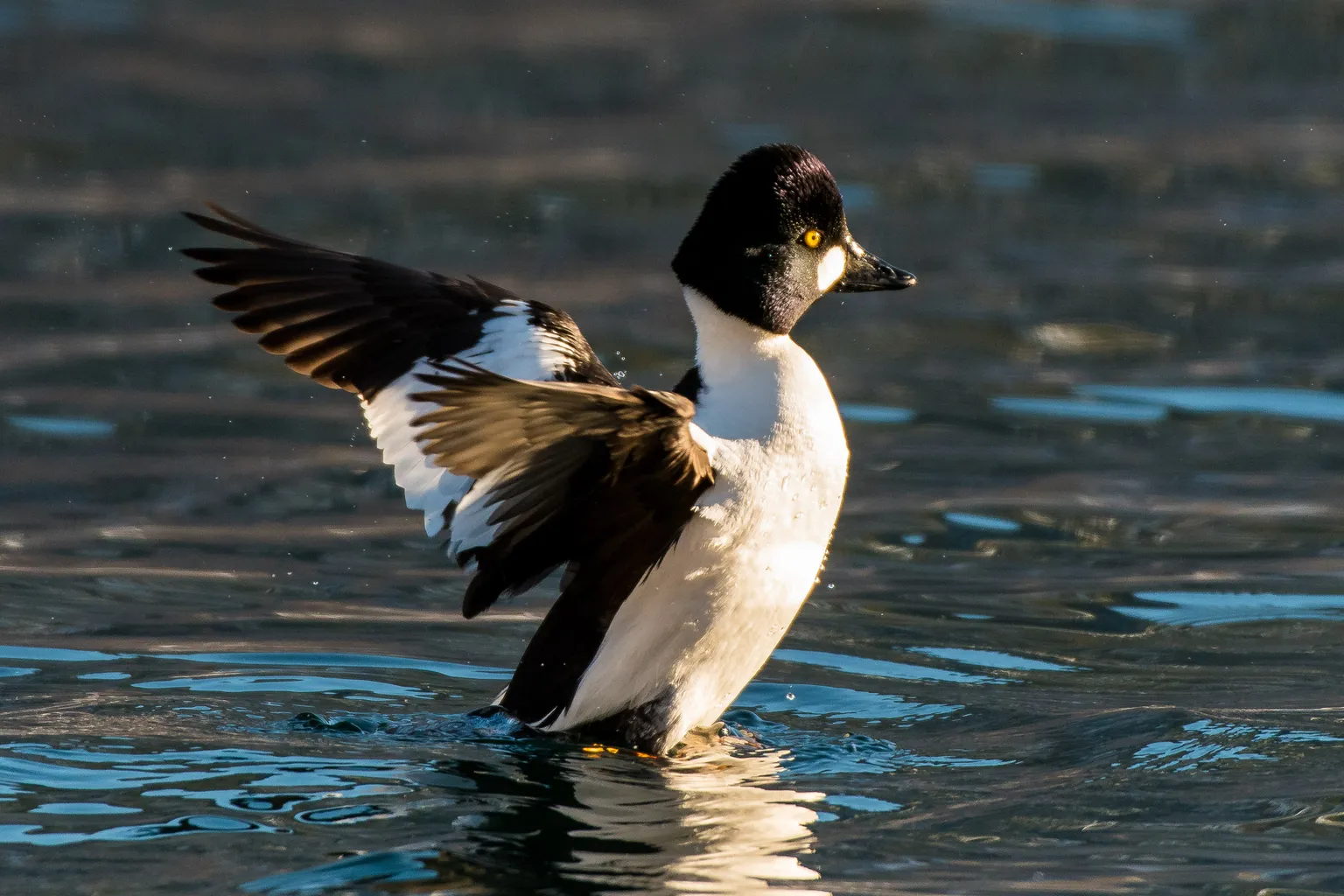
Common Goldeneye. The male is mostly black and white, with a round white spot near the bill and a bright yellow eye. The female has a brown head, a grey body, a white collar and a dark bill with a yellow tip. The triangular head shape is a good clue on both.
Hooded Merganser. The male raises a fan-shaped crest with a big white patch edged in black, and has chestnut flanks. The female has a warm cinnamon crest. In winter they use larger freshwater lakes, marshes and sheltered saltwater bays.
Common Merganser. A big, long-bodied diver with a thin red bill. The male has a gleaming white body and a dark green head. The female is grey with a rusty head and a shaggy crest.
Ruddy Duck. Small and chunky, with a scoop-shaped bill and a stiff tail it often holds cocked up. Outside the breeding season it’s brownish, and the male shows a clean pale cheek. Ruddy Ducks often sleep during the day with their head tucked under a wing.
Which look-alike ducks cause the most confusion?
Five pairs cause most of the trouble. In each case one clear structural mark settles it, so check shape before you worry about color.
- Lesser vs Greater Scaup. Lesser Scaup has a small peak at the back of the crown. Greater Scaup has a smoothly rounded head and a broader bill. Head gloss (purple or green) changes with the light, so don’t rely on it.
- Common vs Red-breasted Merganser (females). The female Common Merganser has a sharp break between the rusty head and the whitish upper breast. On the Red-breasted, the colors blend gradually, and the bill is thinner. Red-breasted Mergansers are also more common on salt or brackish water in winter.
- Canvasback vs Redhead. Look at the profile. A straight, sloping line from forehead to bill tip means Canvasback. A rounded head with a distinct forehead means Redhead.
- Gadwall vs female Mallard. The Gadwall is square-headed with a steep forehead and a thinner, darker bill. In flight, a white wing patch means Gadwall and a white-bordered blue patch means Mallard.
- American Coot. Not a duck at all. It’s dark grey with a bright white bill and forehead, and has lobed toes rather than webbed feet.
How do you identify female ducks?
Match the brown bird to the males nearby, then confirm with shape and bill. In a winter flock, half the birds may be brown females, and most identification pages only show males, so these two habits help a lot.
- Use the company it keeps. Ducks travel in mixed-sex flocks, and some pair up early. Gadwalls, for example, form pairs as early as late fall. The brown bird swimming beside a male shoveler is probably a female shoveler.
- Look at shape and bill first, color second. The spoon bill of a shoveler, the thin serrated bill of a merganser, the white-banded bill of a Ring-necked Duck and the long neck of a pintail all work on females too.
Wing patches are the tiebreaker. Wait for a duck to stretch or fly and the colored patch on the inner wing often tells you the species.
How do you identify ducks that are far away?
Ducks often sit in the middle of the water, so use light, behavior and white patches. You can often name a duck at long range without seeing any fine detail.
- Keep the sun behind you. Backlit ducks turn into black shapes.
- Watch behavior. Diving, tipping up, circling as a group and grazing on grass are all visible at a distance.
- Look for white. Big white areas on Buffleheads, goldeneyes, mergansers and scaup show up before anything else. Goldeneyes’ yellow eyes can also be visible from fairly far off.
- Take a photo, even a bad one. Zoom in later or run it through one of the best bird ID apps.
Binoculars make the biggest difference with far-off rafts of ducks. See our guide to the best binoculars for birding, and read 8x42 vs 10x42 if you’re weighing up extra magnification for open water.
Why do some ducks only show up in winter?
Because their breeding waters freeze. Many ducks nest far to the north: Ruddy Ducks mainly in the prairie pothole marshes, and Green-winged Teal as far north as Alaska. When ice closes those lakes, the birds move to water that stays open.
That’s why a reservoir that holds only Mallards in July can hold scaup, goldeneyes and mergansers in January. Hard cold snaps push more ducks onto the last open water, which is when a mixed flock is most worth scanning. Ducks cope with icy water thanks to their feathers and circulation. Read why ducks don’t get wet and how birds stay warm in winter for how that works.
If you watch ducks at a park pond, skip the bread. It fills birds up without giving them much nutrition, and our guide on whether bread is bad for birds explains better options. And if you live near wooded water, Wood Ducks and Hooded Mergansers nest in tree cavities, so a wood duck box can bring them close in spring.
Sources
- Cornell Lab of Ornithology, All About Birds: duck species identification accounts
- Cornell Lab of Ornithology, All About Birds: Lesser Scaup identification
- Cornell Lab of Ornithology, All About Birds: American Coot identification
- U.S. Fish and Wildlife Service: Ducks at a Distance, a waterfowl identification guide
- Missouri Department of Conservation: Dabblers vs Divers

Frequently asked questions
How do I tell dabbling ducks from diving ducks?
Watch how they feed and take off. Dabbling ducks tip up with their tail in the air, stay near shallow edges and spring straight up into flight. Diving ducks vanish completely under the surface, prefer deeper open water and patter along the water before they get airborne. Their legs sit far back on the body, which makes them clumsy on land.
Why do some ducks only show up in winter?
Many ducks nest far to the north, in places like the prairie pothole wetlands, Canada and Alaska. When those lakes and marshes freeze, the birds have to move to water that stays open. That is why a park pond or reservoir that holds only Mallards in summer can hold scaup, goldeneyes, Buffleheads and mergansers in the middle of winter.
How do I identify female ducks?
Start with the males they swim with, because ducks travel in mixed flocks, then confirm with shape and bill. A huge spoon-shaped bill means Northern Shoveler, a thin serrated bill and shaggy crest means merganser, and a white band near the tip of a grey bill means Ring-necked Duck. Wing patches, seen when a bird stretches or flies, settle most of the rest.
Is a coot a duck?
No. The American Coot swims with ducks and sometimes dives, but it belongs to the rail family and is more closely related to cranes and rails than to Mallards. Look for an all dark grey body, a bright white bill with a white forehead shield, and long lobed toes instead of webbed feet. On land it walks rather than waddles.
What is the smallest duck I'm likely to see in winter?
Among dabbling ducks, the Green-winged Teal is the smallest in North America, at roughly 12 to 15 inches long. Among divers, the Bufflehead is similar in size, a compact little duck with a big rounded head. The male Bufflehead's large white head patch and the teal's cinnamon head with a green crescent make both easy to name once you get a clear look.


