Project FeederWatch: How to Join and Count Birds
Project FeederWatch runs November 1 to the end of April. How to join, pick a count site and count days, count birds the right way and send in your data.
In this article
- Quick answer: FeederWatch at a glance
- What is Project FeederWatch?
- Who can join and what does it cost?
- How do you choose a count site?
- How do count days work?
- How do you count birds the FeederWatch way?
- How do you send in your counts?
- Which birds will you count?
- How does FeederWatch compare with other bird counts?
- Can you do FeederWatch outside North America?
- Sources
- Frequently asked questions
Project FeederWatch is a winter bird count you do from home. From November 1 to the end of April you count the birds at your feeders, water or garden on two days in a row, as often as once a week or as rarely as once a winter, and send the numbers to the Cornell Lab of Ornithology or Birds Canada.
It’s one of the easiest ways to turn feeder watching into real science. This guide covers how to sign up, how to choose a count site and count days, the one counting rule that trips people up, and how FeederWatch compares with the other big citizen science counts.
Quick answer: FeederWatch at a glance
| Question | Answer |
|---|---|
| Season | November 1 to the end of April (last count can start April 29) |
| Who runs it | Cornell Lab of Ornithology (U.S.) and Birds Canada (Canada) |
| Who can join | People in the United States and Canada, any skill level |
| Cost | $18 a year in the U.S.; any donation to Birds Canada in Canada |
| Count days | Two consecutive days, at most one pair a week |
| How often | As often as weekly, or just once a winter |
| How you count | Highest number of each species seen at one time |
| How you report | FeederWatch app, website or paper tally sheets |
What is Project FeederWatch?
FeederWatch is a long-running survey of the birds that visit backyards, nature centers and community spaces in North America in winter. It began in 1976 as the Ontario Bird Feeder Survey, then grew into a continent-wide project in the 1987-88 season, when more than 4,000 people across most of the United States and Canada signed up.
Today the Cornell Lab of Ornithology runs it in the U.S. and Birds Canada runs it in Canada. Because thousands of people count the same way every winter, the combined data show how feeder bird numbers and ranges shift over time, something no single researcher could track alone.
Who can join and what does it cost?
People in the United States and Canada can take part. FeederWatch welcomes families, classrooms, retirees, youth groups, nature centers and bird clubs, and beginners are welcome. You only need to identify the birds you count, and a good bird ID app covers most feeder species.
U.S. participants pay an $18 annual fee. In Canada you join by donating any amount to Birds Canada. In return you get:
- Online tools and a mobile app to log and explore your counts
- Winter Bird Highlights, the year-end summary of results
- An optional poster of common feeder birds for your region and an optional calendar
- Digital access to the Cornell Lab’s Living Bird magazine (U.S. participants)
To sign up, use the join page on the FeederWatch website. You can join before November 1 or partway through the season.
How do you choose a count site?
Your count site is the area you’ll watch every time. FeederWatch asks you to pick an area as large as you can watch consistently from week to week. It should include the things that draw birds: feeders, water or plantings you maintain.
A few practical rules from the instructions:
- Most count sites are roughly the size of two tennis courts, but a smaller area is fine.
- Use obvious boundaries such as a fence, a hedge or the edge of a lawn.
- Watch from one main viewpoint if you can, like a kitchen window.
- You don’t need a feeder at all. A garden with berry shrubs or a heated bird bath works too.
If you’re still setting up, our guide on where to put a bird feeder helps you place feeders where you can see them clearly from indoors.
How do count days work?
Count days are two consecutive days on which you count the birds at your site. They always come in pairs, for example Saturday and Sunday.
Pick them with these rules in mind:
- Count no more than one pair of days per week.
- Leave at least five days without counting between your pairs.
- Choose your days in advance when you can.
- Don’t move a count because an unusual bird turned up. Picking days by what you see biases the data.
You don’t have to watch all day. Count whenever you’re looking during those two days, and keep track of roughly how much time you spent actually watching. Time spent in the kitchen without looking out doesn’t count.
There’s no minimum. Counting every week gives the richest data, but a single pair of count days in February is still useful.
How do you count birds the FeederWatch way?
For each species, record the largest number of individuals you saw in view at the same time during your two count days. This is the rule people most often get wrong.
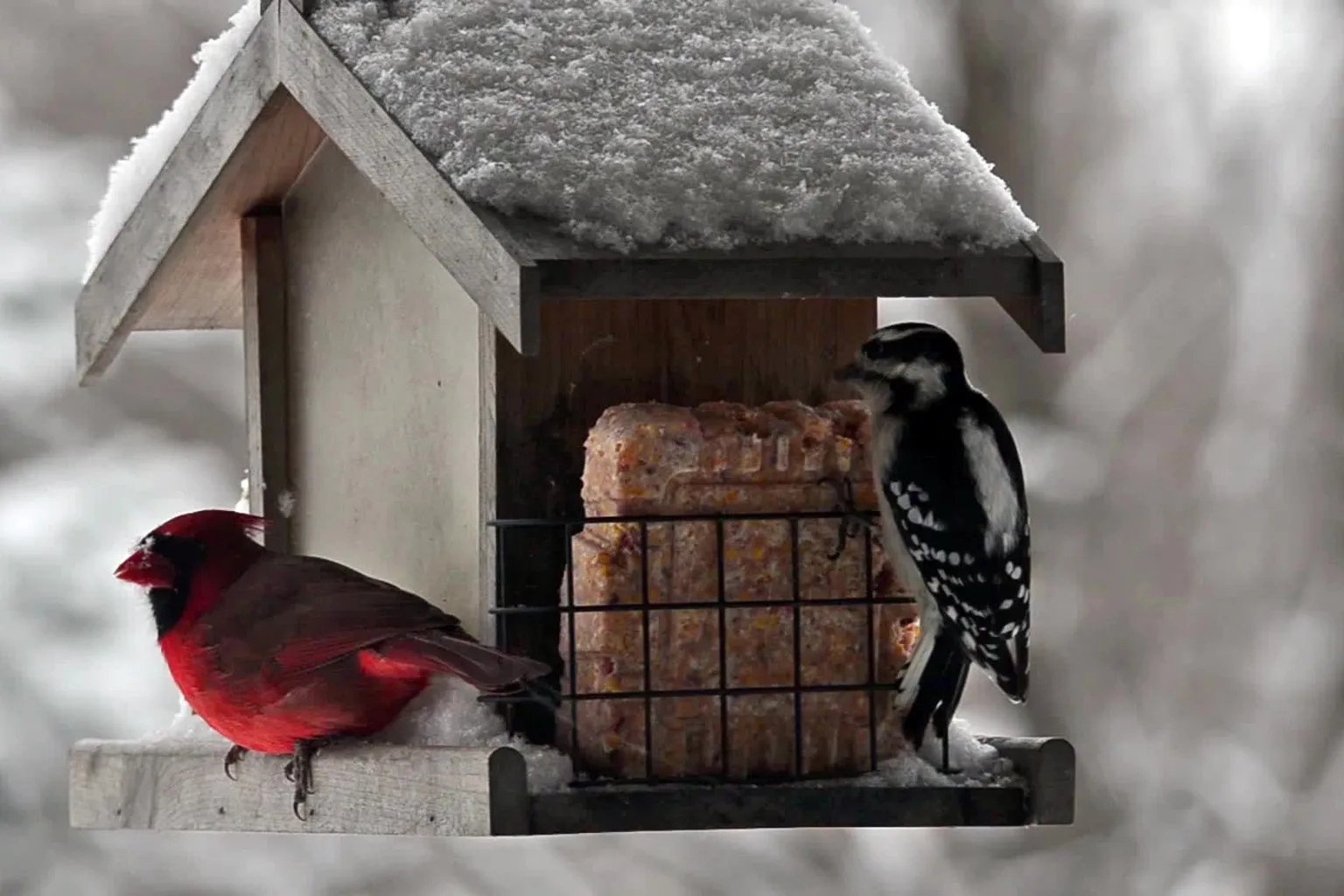
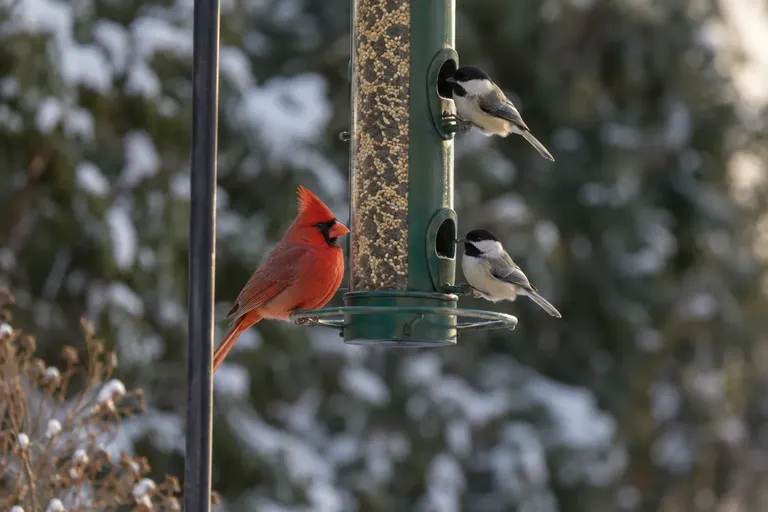
Don’t add your sightings together. If you see one Northern Cardinal in the morning and two in the afternoon, you report two, not three. The single cardinal may well have been one of the pair.
| What you saw over two days | What you report |
|---|---|
| 1 cardinal Saturday morning, 2 together Saturday afternoon, 1 Sunday | 2 cardinals |
| 5 chickadees at once, later 3 at once | 5 chickadees |
| 2 Blue Jays together, later 1 on its own | 2 Blue Jays |
| 4 juncos, then 6 juncos, then 2 juncos | 6 juncos |
This “maximum at one time” method avoids counting the same bird twice. Birds come and go all day, so adding up visits would inflate the numbers.
You’ll also record the average snow depth at your site over the two days. Other weather information is filled in automatically.
How do you send in your counts?
You can enter counts in the FeederWatch mobile app or on the website, or note them on a paper tally sheet first and type them in later. On the website, open the “Your Data” section, enter the species and numbers, and click the “Finish Count” button to confirm the count.
If you already keep a birding journal, FeederWatch counts slot neatly into it. Note the date, time watched and weather alongside each count.
Which birds will you count?
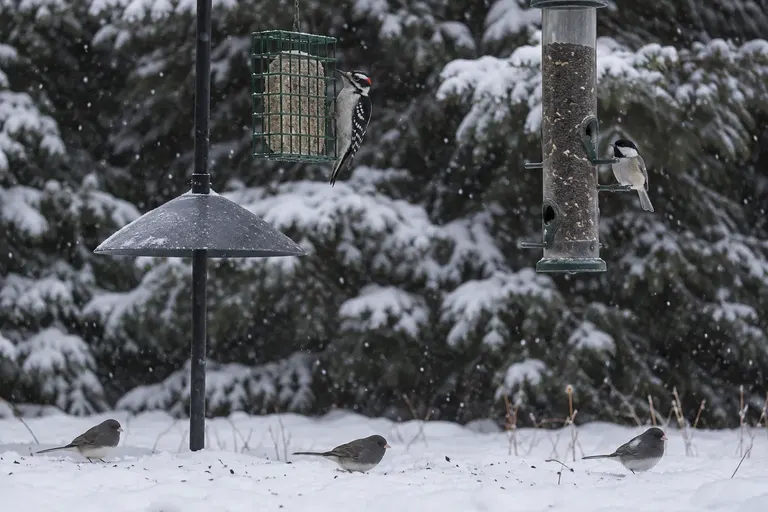
Whatever visits your site. In much of North America that means the usual winter regulars: chickadees, titmice, nuthatches, Downy Woodpeckers, Northern Cardinals, Blue Jays, House Finches, American Goldfinches and Dark-eyed Juncos.
Winter is the best season for it because feeders are busiest when natural food is scarce. High-energy foods like black oil sunflower seed and suet, plus open water, bring in the most species. Our winter bird feeding guide covers what to put out, and our best bird feeders guide covers the hardware.
How does FeederWatch compare with other bird counts?
FeederWatch is the only one of the big North American counts that runs all winter from your own yard. The others are short events or year-round open platforms.
| Project | When | Where you count | Cost |
|---|---|---|---|
| Project FeederWatch | November 1 to end of April, any number of two-day counts | Your own count site | $18 a year in the U.S., donation in Canada |
| Christmas Bird Count | One day in a set count circle, December 14 to January 5 | Assigned count circle, or your feeder inside it | Free |
| Great Backyard Bird Count | Four days each February | Anywhere, worldwide | Free |
| eBird | Any day, all year | Anywhere, worldwide | Free |
Many people do more than one. The winter counts complement each other: the Christmas Bird Count and the Great Backyard Bird Count give big one-off snapshots, while FeederWatch follows the same yards all season.
Can you do FeederWatch outside North America?
No. FeederWatch is a North American project, but Britain and much of Europe run their own garden counts:
- UK: the BTO Garden BirdWatch runs all year and is free. You record the species in your garden each week, for at least 20 minutes a week. It has run since 1995.
- Germany: NABU’s Stunde der Wintervögel asks you to count for one hour and note the highest number of each species seen at once. The next one runs January 8-10, 2027, and in Bavaria it’s run with the LBV.
- Netherlands: Vogelbescherming’s Nationale Tuinvogeltelling is a half-hour count on January 29-31, 2027. In 2026, 136,903 people counted 1,898,916 birds.
- France: Oiseaux des Jardins, run by the LPO and the National Museum of Natural History, takes garden records all year, with national count weekends at the end of January and the end of May.
Sources

Frequently asked questions
When does the Project FeederWatch season start?
The FeederWatch season starts on November 1 and runs through the end of April. The last day you can start a two-day count is April 29. You can sign up before or during the season, and there is no minimum number of counts, so joining in December or January still adds useful data for that winter.
How much does Project FeederWatch cost?
For U.S. residents the annual participation fee is $18. Canadians take part by donating any amount to Birds Canada, which runs the project in Canada together with the Cornell Lab of Ornithology. The fee covers the online tools and app, the year-end Winter Bird Highlights report and, for U.S. members, digital access to Living Bird magazine.
Do you need a bird feeder to do FeederWatch?
No. FeederWatch says you don't even need a feeder. Your count site can include feeders, water or plantings that attract birds, and it can be a backyard, a nature center or a community area. What matters is that you watch the same area each time, ideally from one main viewpoint with clear boundaries.
How do you count birds for FeederWatch?
For each species, report the largest number of individuals you saw in view at the same time during your two count days. Don't add sightings together. If you see one cardinal in the morning and two in the afternoon, you report two, not three. You also note roughly how long you watched and the average snow depth.
Can people in Europe join Project FeederWatch?
FeederWatch is a North American project, run by the Cornell Lab of Ornithology in the United States and Birds Canada in Canada. In Europe, similar garden counts are the BTO Garden BirdWatch in the UK, NABU's Stunde der Wintervögel in Germany, Oiseaux des Jardins in France and the Nationale Tuinvogeltelling in the Netherlands.