Why Do Birds Chirp at Night?
Why do birds chirp at night? Unmated males singing for mates, city light and noise, migrants calling overhead and night birds like owls explain most of it.
In this article
- Quick facts: night singing and calling
- Who is singing at night?
- Why do unmated males sing at night?
- Do streetlights and noise make birds sing at night?
- Does the moon make birds sing at night?
- What are the chirps I hear in the sky at night?
- Which birds are naturally active at night?
- Why do birds chirp at night when disturbed?
- Do birds sing in their sleep?
- When in the year do birds chirp at night?
- How can you figure out which bird is singing at night?
- Is it really a bird? Night sounds that fool people
- Myths vs facts about birds chirping at night
- How does light at night affect birds?
- What can backyard birders do?
- Common mistakes people make
- The bottom line
- Sources
- Frequently asked questions
Birds chirp at night for a handful of clear reasons. Most often it is an unmated male, such as a Northern Mockingbird or a Common Nightingale, singing to attract a female. In cities, artificial light and daytime noise can push songbirds like robins to sing after dark; a 2007 study of robins in Sheffield found daytime noise predicted night singing better than light. In spring and fall, the chirps overhead are usually migrants calling in flight. And owls and nightjars are simply active at night.
Below, we sort out who is singing, why, and what it means for you and the birds.
Quick facts: night singing and calling
- Unmated males are the most common night singers among songbirds.
- Northern Mockingbirds are the classic night singers across much of the United States.
- Common Nightingales sing at night in Europe, Turkey and western Asia, especially unpaired males.
- City birds such as American Robins and European Robins may sing at night near lights or in noisy areas.
- Migrating songbirds give short flight calls overhead on spring and fall nights.
- Owls, nightjars, rails and some shorebirds are naturally vocal after dark.
- Disturbance by a predator, storm or bright light can trigger alarm calls at night.
Who is singing at night?
The Northern Mockingbird
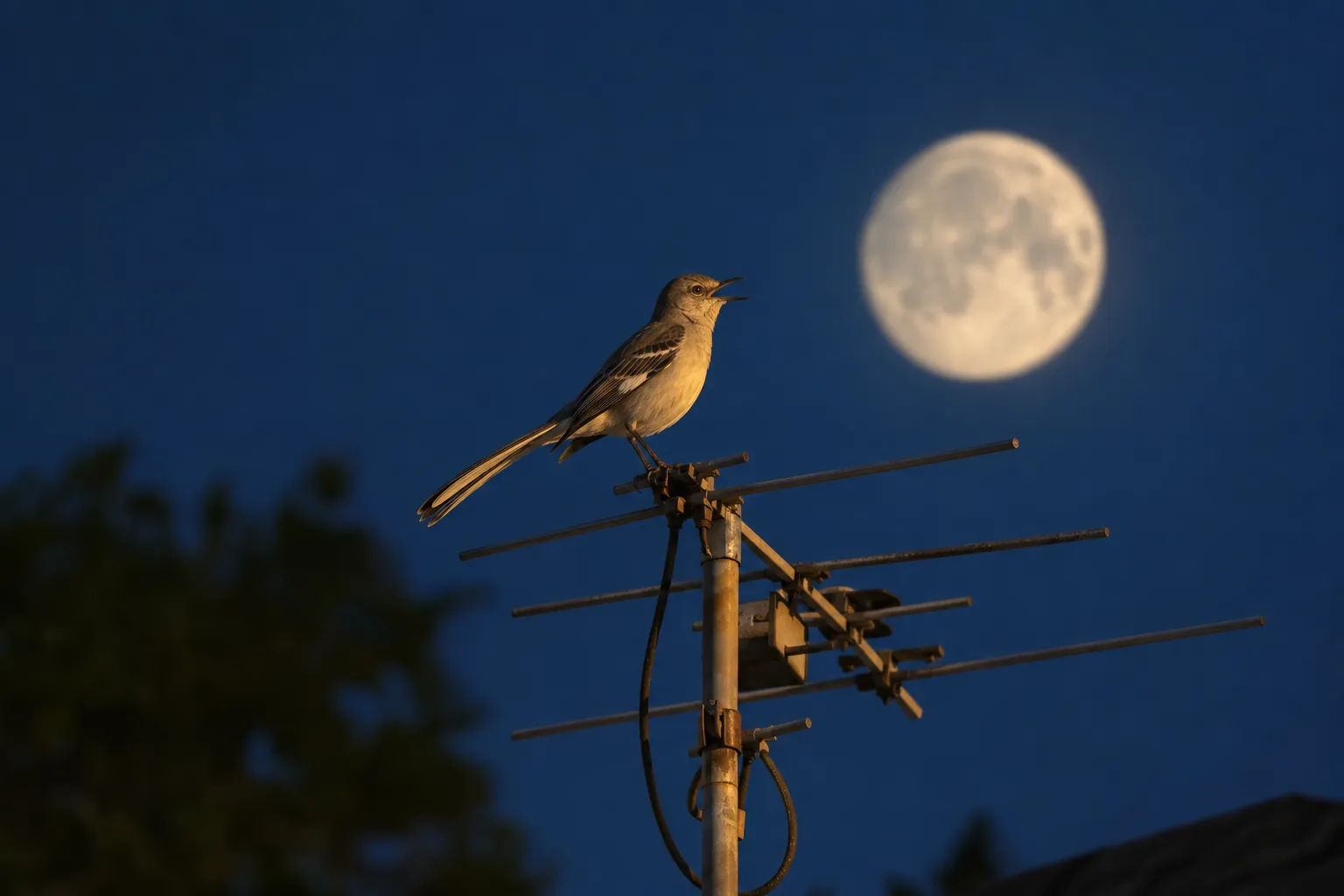
If you live in the southern or eastern United States and hear a bird cycling through dozens of different phrases at 2 a.m., it is very likely a Northern Mockingbird. According to the Cornell Lab of Ornithology, unmated males are the ones most likely to sing at night, especially during the breeding season and often under a bright moon or near artificial light. Mockingbirds also sing in fall, when they defend winter feeding territories, though night singing is mostly a spring and summer phenomenon.
A mockingbird’s night song can go on for hours. Once the male finds a mate, night singing typically drops off.
The Common Nightingale
In Europe, Turkey, North Africa and western Asia, the famous night singer is the Common Nightingale. Its rich, fluty song has inspired poets for centuries, and in Turkish culture the nightingale, or bülbül, is a beloved symbol. Research on nightingales in Europe has found that it is primarily unpaired males that sing at night, and that nocturnal song tends to stop once a male attracts a female. Daytime song, which continues after pairing, seems to play more of a role in territory defense.
That pattern suggests night song is aimed at females, perhaps migrant females moving through at night looking for a territory.
Other night singers
- American Robin: often sings in the dark before dawn and sometimes late at night near streetlights.
- European Robin: a well-known night singer in lit, noisy cities in Britain and Europe.
- Yellow-breasted Chat and some wrens: occasionally sing at night in the breeding season.
- Sedge Warbler, Reed Warbler and other European warblers: may sing at night during the breeding season.
- Rufous-bellied Thrush: in Brazil, the sabiá-laranjeira is often reported singing in the night hours in large cities, a behavior widely associated with urban light and noise.
Why do unmated males sing at night?
Singing at night appears to be a way for males to maximize their chances of attracting a mate. Several possible advantages have been proposed:
- Quieter airwaves. There is less competition from other birds and less background noise at night, so a song may carry further and be heard more clearly.
- Reaching migrating females. Many songbirds migrate at night. A male singing at night might attract females passing overhead or those settling into an area.
- Showing condition. Singing at night uses energy that could otherwise go toward rest. It may serve as an honest signal that the singer is healthy and well fed.
These explanations are not mutually exclusive, and which applies best may vary by species. What is well established is the link to mating status: in several species, night singing drops sharply once a male is paired.
Do streetlights and noise make birds sing at night?
Increasingly, yes, in at least some species. Urban light and noise both affect bird singing, though untangling the two can be tricky.
Artificial light
Birds use daylight as a strong cue for their daily rhythms. Bright artificial light can make the night seem more like dawn, and some studies in Europe have found that songbirds near streetlights start their dawn chorus earlier than those in darker areas. Light at night has also been linked in some studies to changes in hormones and sleep in birds.
Daytime noise
A widely cited 2007 study by Richard Fuller, Philip Warren and Kevin Gaston, published in Biology Letters, looked at European Robins in Sheffield, England. They found that robins were more likely to sing at night in places that were noisy during the day, and that daytime noise predicted night singing better than light pollution did. The interpretation is that some robins shift singing to the quieter night hours, when their songs are less likely to be masked by traffic.
So a robin singing at midnight outside your window may be responding to both the streetlight and the traffic you hear by day.
For a closer look at the daytime side of this story, read why do birds sing in the morning?
Does the moon make birds sing at night?
Moonlight seems to play a part for some species. Observers have long noted that mockingbirds sing more on bright, moonlit nights, and the Cornell Lab mentions full moons alongside artificial light as conditions linked to night singing. Studies on some European songbirds have also found that dawn singing can begin earlier around the full moon. The effect appears to vary between species and is less studied than the effects of streetlights, so treat it as a plausible factor rather than a rule.
For nocturnal birds, moonlight matters in other ways. Some nightjars, including the Eastern Whip-poor-will, are thought to forage more effectively on moonlit nights, when flying insects are easier to see, and some research suggests their breeding is timed so that chicks hatch near the full moon. Owls, by contrast, hunt successfully even on dark nights, relying heavily on their hearing.
What are the chirps I hear in the sky at night?
On spring and fall nights, especially in the hours after dark, you may hear short, high chirps, buzzes or “seeps” from the sky. These are nocturnal flight calls, and they come from migrating birds.
Many songbirds, including thrushes, warblers, sparrows and tanagers, migrate at night. Flying at night may help them avoid many predators, use calmer air, and navigate by the stars and other cues, then refuel during the day. As they fly, many give brief calls that may help keep loose flocks together and coordinate movement. Some calls are distinctive enough that experts can identify the species, such as the soft, rising “queep” of a Swainson’s Thrush.
Researchers use microphones to record these calls and track migration, and projects like BirdCast use weather radar to forecast how many birds are aloft on a given night. On a peak night, tens of millions of birds may be migrating over the continental United States.
If you want to try identifying what you hear, see our guide on how birds know where to migrate, and our tips for using Merlin Sound ID without getting fooled. Night flight calls are hard even for experts, so treat app suggestions as a starting point.
Which birds are naturally active at night?
Some birds are simply nocturnal or crepuscular, active at dusk and dawn:
- Owls: Great Horned Owls hoot through winter nights, Eastern Screech-Owls whinny and trill, and Barred Owls ask “who cooks for you?” In Europe, the Tawny Owl gives the classic “twit-twoo,” which is actually a female’s “kewick” and a male’s hoot combined.
- Nightjars: Eastern Whip-poor-wills and Chuck-will’s-widows repeat their names through the night in parts of eastern North America. In Europe and Turkey, the European Nightjar makes a long, mechanical churring sound.
- Rails and marsh birds: Virginia Rails, soras and others call at night in wetlands.
- Shorebirds: Killdeer and other plovers may call at night, especially when disturbed.
- Loons: Common Loons are famous for their haunting night calls on northern lakes.
- Herons: Black-crowned Night-Herons are most active at dusk and night, and give a harsh “quok” in flight.
Why do birds chirp at night when disturbed?
Sometimes a single chirp or burst of alarm calls at night signals that something woke the birds up. Owls, raccoons, cats and other predators can prompt roosting birds to give alarm calls. Storms, fireworks, sudden bright lights and even passing cars can do the same. These calls are usually short and irregular, unlike the steady songs of a mockingbird or nightingale.
If you want to know where birds spend their nights, see where do birds go at night?
Do birds sing in their sleep?
There is intriguing evidence that songbirds “rehearse” song in their brains while sleeping. In a well-known 2000 study published in Science, Amish Dave and Daniel Margoliash recorded neurons in the song system of sleeping Zebra Finches. They found patterns of activity during sleep that resembled the patterns produced when the birds sang while awake, a kind of neural replay.
That does not mean the birds were making sounds. It suggests that sleep may play a role in song learning and maintenance. Whether birds occasionally vocalize in their sleep is less clear, so treat claims about “birds singing in their dreams” with caution. For more on how song develops, see how do birds learn songs?
When in the year do birds chirp at night?
Night singing and calling follow the seasons. In North America and Europe, the pattern looks roughly like this, though timing shifts with latitude and species.
| Season | What you are likely hearing at night |
|---|---|
| Late winter | Great Horned Owls and Tawny Owls calling as they set up territories and pair up |
| Spring | Unmated mockingbirds, nightingales and robins singing; migrant flight calls overhead; frogs joining in |
| Early summer | Night singing from males still unpaired or between nesting attempts; whip-poor-wills and nightjars |
| Late summer and fall | Migrant flight calls on clear nights with favorable winds; some fall mockingbird song |
| Winter | Owls; occasional alarm calls from disturbed roosts; robins singing under city lights in parts of Europe |
In the Southern Hemisphere, including Brazil, the breeding season and therefore peak night singing falls roughly in the southern spring and summer, from about September onward.
How can you figure out which bird is singing at night?
A few simple steps usually narrow it down:
- Listen to the pattern. A long, varied song that repeats each phrase several times before switching is classic mockingbird. A rich, loud song with long pauses and repeated whistles and trills suggests a nightingale in Europe or Turkey. A steady caroling of short phrases is often a robin.
- Note the time and season. Hooting in midwinter points to owls. A repeating three-syllable name called hundreds of times in a row on a summer night in the eastern US is likely a whip-poor-will.
- Check where it is coming from. A song from a rooftop, antenna or treetop is probably a songbird. Short chirps coming from high in the sky, moving, are almost certainly migrants.
- Record it. A phone recording can be compared with reference recordings from the Macaulay Library or run through an identification app. Treat app results as suggestions, not verdicts.
- Rule out non-birds. Plenty of night sounds that people blame on birds come from other animals.
Is it really a bird? Night sounds that fool people
Before blaming a bird, consider the other night singers:
- Frogs and toads. Spring peepers give high, bird-like peeps in early spring in eastern North America. Gray treefrogs trill in trees, often well above the ground, which makes them easy to mistake for birds.
- Insects. Katydids, crickets and cicadas dominate late-summer nights in many regions, and some produce rhythmic chirps.
- Mammals. Foxes produce startling screams, and some bats make audible squeaks, though most bat calls are too high for people to hear.
If the sound is continuous, rhythmic and coming from many places at once in late summer, it is more likely insects than birds. If it is a complex, varied song from one spot, it is probably a bird.
Myths vs facts about birds chirping at night
| Myth | Fact |
|---|---|
| Birds that sing at night are confused or sick | Night singing is normal for many species, especially unmated males |
| Only owls make noise at night | Many songbirds, nightjars, rails, loons and migrants are vocal after dark |
| Night song is always caused by streetlights | Light can contribute, but noise, mating status and species behavior matter too |
| Nightingales are the only night-singing songbirds | Mockingbirds, robins and several warblers and thrushes also sing at night |
| Night chirps in fall are birds that got lost | They are usually migrants calling in flight, a normal part of migration |
How does light at night affect birds?
Artificial light at night is one of the major concerns for migrating birds. Bright lights, especially from tall buildings, can attract and disorient night migrants, drawing them into cities where many die from collisions with glass. Programs such as Lights Out, promoted by the National Audubon Society and partners in many US cities, encourage building owners and homeowners to turn off unnecessary lights during migration seasons.
Light pollution may also alter daily rhythms in resident birds, affecting when they sing, sleep and breed. Scientists are still working out the long-term effects.
What can backyard birders do?
- Turn off unneeded outdoor lights, especially during peak spring and fall migration.
- Use shielded, downward-facing fixtures and warmer-colored bulbs where you need light.
- Use motion sensors or timers so lights are not on all night.
- Reduce window collisions, which increase when migrants are drawn into lit areas. Our guide to stopping birds from hitting windows has practical fixes.
- Listen and learn. Night singing and flight calls offer a window into bird life you cannot see. Our guide to birding by ear is a good start.
Common mistakes people make
- Assuming a night-singing mockingbird is lost or distressed. It is usually a healthy male looking for a mate.
- Trying to scare off a night singer. It is likely to stop on its own once paired, and native songbirds are legally protected in the United States.
- Leaving bright floodlights on all night during migration.
- Relying on apps alone to identify night calls; flight calls are short and easily confused.
The bottom line
Most night chirping comes from unmated male songbirds singing for a mate, city birds adjusting to light and noise, migrants calling in flight, or birds that are naturally nocturnal. If a mockingbird or robin keeps you awake, it will usually quiet down once it pairs up. In the meantime, you can help birds by turning off lights you do not need and enjoying the chance to hear a side of bird life most people sleep through.
Sources
- Cornell Lab of Ornithology, All About Birds: Northern Mockingbird life history
- Fuller, Warren and Gaston (2007), Daytime noise predicts nocturnal singing in urban robins, Biology Letters
- Dave and Margoliash (2000), Song replay during sleep and computational rules for sensorimotor vocal learning, Science
- BirdCast: migration forecasts and live migration maps
Frequently asked questions
What bird sings at night in the spring?
In much of the United States, the most common night singer is the Northern Mockingbird, usually an unmated male. American Robins also sing at night near bright lights. In Europe, the Common Nightingale is the classic night singer, along with European Robins in lit cities. Owls, whip-poor-wills and other nightjars are true nocturnal birds that call after dark by nature.
Why is a mockingbird singing all night?
It is most likely an unmated male advertising for a female. Unpaired male mockingbirds are known to sing through the night in spring and early summer, especially on moonlit nights or near artificial light. Night singing usually drops off once the male attracts a mate, although it can return between nesting attempts.
Do streetlights make birds sing at night?
They can contribute. Studies in Europe and North America link artificial light to earlier dawn singing and to some night singing in songbirds such as robins. One study of urban European Robins in England found that daytime noise predicted night singing better than light did, suggesting birds may shift singing to quieter hours.
What are the chirps I hear in the sky at night in fall?
They are likely nocturnal flight calls from migrating songbirds. Many thrushes, warblers and sparrows migrate at night and give short, high calls as they fly, which may help flocks stay in contact. Researchers record these calls to monitor migration, and on busy nights you can hear dozens or hundreds of them.
Is it bad that birds are singing at night?
Not necessarily. Night singing is a natural behavior for many species. However, heavy artificial light at night is linked to disrupted daily rhythms in some birds and draws migrating birds into cities, where they collide with buildings. Turning off unneeded outdoor lights, especially during migration, helps.