What to Do With an Injured Bird, Step by Step
What to do with an injured bird: contain it in a ventilated box, keep it dark, warm and quiet, give no food or water, and call a licensed rehabilitator.
In this article
- Quick answer: the five steps
- How do you know if a bird is really injured?
- How do you safely pick up an injured bird?
- What kind of box should you put an injured bird in?
- Should you keep an injured bird warm?
- Why should you not give an injured bird food or water?
- How do you find a licensed wildlife rehabilitator?
- How should you transport an injured bird to a rehabilitator?
- Is it legal to care for an injured wild bird yourself?
- What should you do for specific injuries?
- Common mistakes to avoid
- What if the bird dies?
- Quick facts
- Sources
- Frequently asked questions
Here is what to do with an injured bird: gently place it in a ventilated cardboard box lined with a soft cloth, close the lid, and keep it somewhere dark, quiet and warm, away from pets and children. Do not give it food or water. Then contact a licensed wildlife rehabilitator as soon as you can, and follow their instructions. A bird merely stunned by a window often recovers after 1 to 2 hours of quiet rest in the box.
The rest of this guide explains why each of those steps matters, how to tell whether a bird actually needs help, and how to handle the most common situations: window strikes, cat attacks, birds hit by cars, and birds tangled in fishing line.
Quick answer: the five steps
- Check whether it really needs help. Many young birds on the ground are healthy fledglings, not injured.
- Protect yourself and the bird. Wear gloves or use a towel, and keep pets and children away.
- Contain it. Gently put it in a ventilated cardboard box lined with a soft, non-looped cloth, and close the lid.
- Keep it dark, warm and quiet. Stress kills injured birds. Do not open the box to check on it.
- Call a licensed wildlife rehabilitator. Do not give food or water, and do not try to treat the bird yourself.
How do you know if a bird is really injured?
Not every bird on the ground is in trouble, and taking a healthy bird away from its parents does real harm. Start by watching from a distance for a few minutes.
Signs a bird needs help
- It has been caught by a cat or dog, even if it looks unhurt.
- There is visible blood, a wound, or a limb hanging at an odd angle.
- One wing droops noticeably lower than the other.
- It cannot stand or keeps falling over.
- It sits fluffed up with its eyes closed and does not move away as you approach.
- It is covered in oil, glue or another substance, or tangled in fishing line, netting or string.
- It is shivering, wet and cold, or lying on its side.
- It is a nestling (few or no feathers) on the ground with no nest you can reach.
Signs a bird is probably fine
- It is a fully feathered young bird with a stubby tail, hopping on the ground and flapping. This is almost certainly a fledgling, which leaves the nest before it can fly well and is still fed by its parents nearby.
- It is alert, moves away from you, and its wings fold neatly against its body.
- An adult bird is calling nearby or bringing food.
If you are unsure about a young bird, our guide found a baby bird? explains how to tell nestlings from fledglings and when to intervene. The long-standing myth that parent birds reject young that humans have touched is not true for most songbirds, as we explain in do mother birds reject babies touched by humans?
How do you safely pick up an injured bird?
Protect yourself first
Wear gloves if you have them, or use a towel or cloth. Birds can carry bacteria and parasites, and some diseases, including avian influenza and Salmonella, can occasionally pass to people. Wash your hands thoroughly afterward even if you wore gloves.
Take extra care with certain birds:
- Hawks, owls and eagles have powerful talons and can cause serious puncture wounds. Do not try to handle them without guidance. Call a rehabilitator or your state wildlife agency.
- Herons, egrets, loons and gannets strike at the face with sharp bills and can injure eyes. Leave them to professionals, or wear eye protection if you are specifically instructed to help.
- Waterfowl, gulls and raptors that look sick should not be handled during periods of avian influenza activity. Report them to your wildlife agency instead. See our guide to bird flu and backyard feeders.
- Swans and geese can hit hard with their wings. Call for help.
How to pick up a small songbird
- Prepare a box first, so the bird spends as little time in your hands as possible.
- Approach calmly and quietly from behind if you can.
- Gently drape a light towel or cloth over the bird. Darkness calms birds.
- Scoop it up with both hands, keeping the wings folded against the body. Do not squeeze. Birds breathe by moving their body wall, and pressure on the chest can suffocate them.
- Place it in the box, remove the towel if it comes away easily, and close the lid.
Keep handling to the minimum. Every extra minute in human hands raises stress hormones, and capture stress can kill birds on its own.
What kind of box should you put an injured bird in?
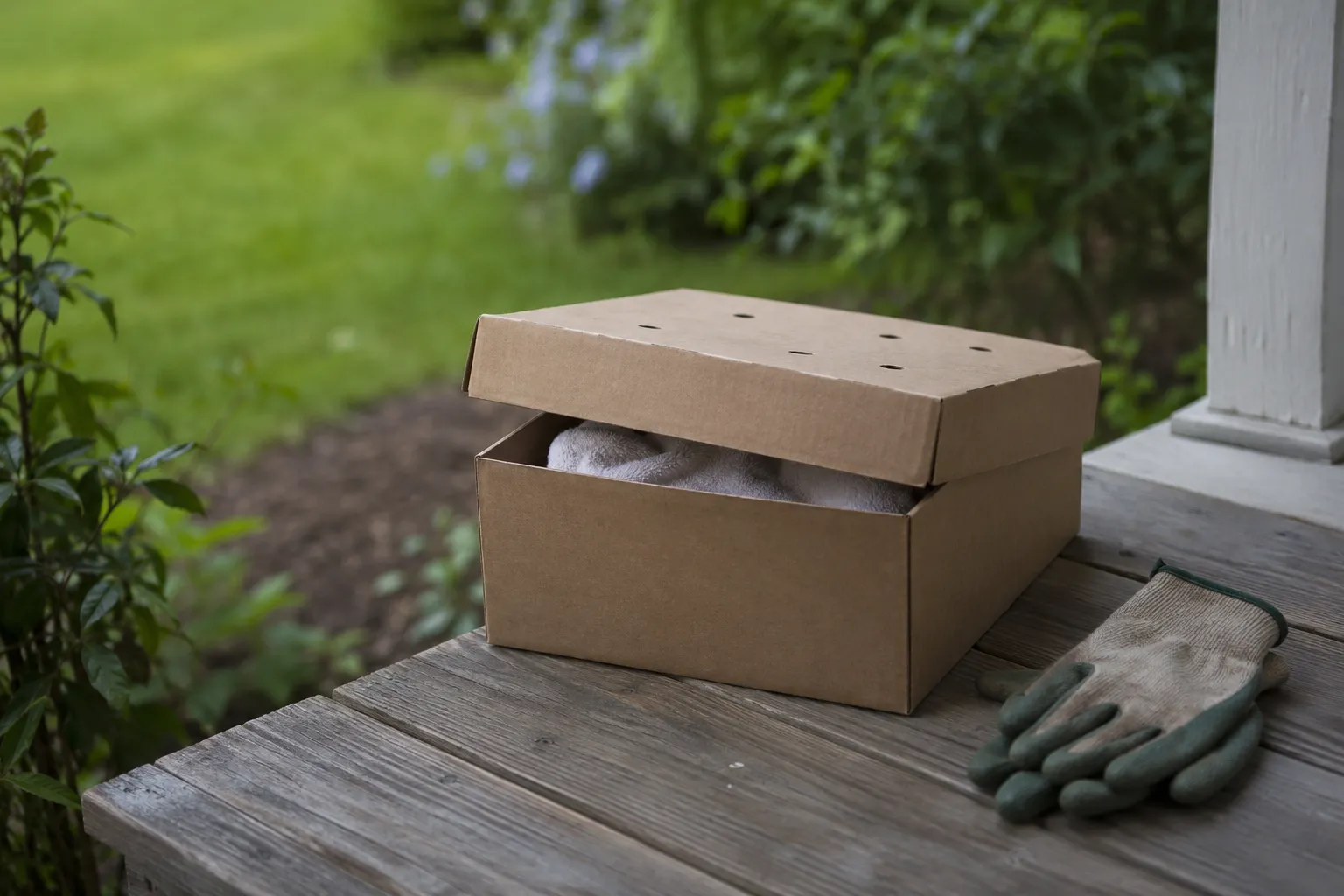
A plain cardboard box is best. Choose one just big enough for the bird to stand and turn around, but not so large that it can flap and injure itself further. For most small backyard birds, a shoe box works.
- Punch small air holes in the lid or sides. Do this before the bird goes in.
- Line the bottom with a soft cloth, such as a T-shirt or paper towel. Avoid terry towels with loops, which can catch toes and claws.
- Close the lid securely and tape it if needed. Injured birds can suddenly recover enough to escape indoors.
- Do not use a wire cage. Birds panic, hit the bars and damage feathers.
- Do not put the box in a car trunk or leave it in a hot vehicle.
Should you keep an injured bird warm?
Yes, usually. Injured and shocked birds lose heat quickly, and hypothermia is a common cause of death after an accident. Keep the box somewhere indoors at room temperature, away from drafts.
If the bird is cold, a rehabilitator may advise gentle extra heat. A common method is to place a heating pad set on low under half of the box, so the bird can move away if it gets too warm. A bottle filled with warm (not hot) water and wrapped in a cloth can also work. Overheating is dangerous too: if the bird starts panting or holding its wings away from its body, remove the heat source.
Why should you not give an injured bird food or water?
This is the rule people find hardest to follow, but it matters:
- Aspiration risk. A weak bird may not swallow properly. Dripping water into its beak can send it into the airway, where it causes drowning or pneumonia.
- Wrong diet. Different species need very different food. Bread, milk and seed can cause serious illness in many birds, and some injured birds cannot digest anything until they are stabilized.
- Time is on your side. Healthy adult birds can go many hours without food or water. Stabilizing the bird in a dark, warm, quiet box matters far more.
A rehabilitator will tell you if and when fluids or food are appropriate, and in what form. For more on why human food is risky, see what not to feed birds.
How do you find a licensed wildlife rehabilitator?
Wildlife rehabilitators are trained and licensed to care for injured, sick and orphaned wild animals and release them back to the wild. Many work from home under permit, others at wildlife centers, nature centers or veterinary clinics.
In the United States and Canada
- Animal Help Now (ahnow.org) uses your location to list nearby rehabilitators, wildlife hotlines and emergency services. It is the fastest starting point.
- Your state wildlife agency (often called the Department of Natural Resources or Fish and Wildlife) keeps a list of licensed rehabilitators.
- Local veterinarians, animal control offices and nature centers can often refer you, and some vets will stabilize wild birds for free.
In the UK and Europe
- In England and Wales, the RSPCA handles injured wildlife calls, and in Scotland the Scottish SPCA. Many independent wildlife hospitals operate locally.
- Across Europe and elsewhere, contact a local wildlife rescue center, a veterinary clinic or the national bird conservation organization for referral.
What to tell them when you call
- The species, if you know it, or a description (size, colors, bill shape).
- What happened, as far as you know: window strike, cat, car, found on the ground.
- Visible injuries and behavior.
- Where exactly you found it. This matters, because rehabilitated birds are ideally released close to where they were found.
- How long ago you found it.
How should you transport an injured bird to a rehabilitator?
Once a rehabilitator agrees to take the bird, the drive itself is part of the care. A few simple habits make a real difference:
- Keep the box closed and secure it on the floor of the car or on a seat with a seatbelt, so it cannot slide or tip.
- Keep the car quiet. Turn off the radio, avoid talking near the box, and do not let children open it to look.
- Control the temperature. Aim for a comfortable room temperature. Never leave the box in a parked car in summer or winter, and keep it out of direct sun and away from strong air-conditioning or heater vents.
- Write down the details before you leave: exact location found, time, what happened and anything you observed. Tape the note to the box if someone else is driving it.
- Go straight there. Stops and detours add stress and delay treatment.
If you truly cannot transport the bird, say so when you call. Some areas have volunteer drivers or rescue services that can collect it.
Is it legal to care for an injured wild bird yourself?
In most cases, no, and there are good reasons for that. In the US, the Migratory Bird Treaty Act protects the great majority of native bird species, and keeping them, even temporarily for care, requires state and federal permits. Short-term containment to get a bird to a licensed rehabilitator is expected and accepted. Keeping it for days or raising it yourself is not.
A few introduced species, such as House Sparrows, European Starlings and feral Rock Pigeons, are not protected under that federal law, but many rehabilitators still accept them, and some groups specialize in pigeons. The UK protects wild birds under the Wildlife and Countryside Act 1981 but allows people to take an injured bird to tend it solely so it can be released once fit. In practice, a wildlife rescue or vet is still the right place for it.
Beyond the law, successful rehabilitation requires species-specific diets, pain relief, antibiotics, X-rays for fractures and flight conditioning before release. Birds released too early often die.
What should you do for specific injuries?
Bird hit a window
Window strikes are one of the most common reasons backyard birders find a stunned bird. Many birds that hit windows are temporarily dazed and recover, but some have head injuries that are not obvious at first.
- Place the bird in a ventilated box and keep it somewhere dark, quiet and safe for one to two hours.
- Do not open the box to check on it. When you hear it moving around actively, it may be ready.
- Take the box outside, near cover, and open it. Stand back.
- If it flies off strongly, the job is done.
- If it cannot fly after a couple of hours, has a drooping wing, blood around the eyes or beak, a tilted head, or seems unable to balance, contact a rehabilitator.
Release birds in daylight, not at dusk, so they have time to find shelter. To reduce future strikes, see how to stop birds hitting windows.
Bird caught by a cat
Treat every cat-caught bird as an emergency. Cat saliva contains bacteria, especially Pasteurella, that can cause a fast, fatal infection in birds. Even a puncture too small to see can be enough, and many rehabilitators describe these infections as killing birds within a day or two without treatment. A cat-caught bird needs antibiotics from a rehabilitator or vet quickly, ideally within hours. Do not release it, even if it looks fine. Our guide to cats and birds covers prevention.
Bird hit by a car
If it is safe to stop, and only then, check the bird. Contain it as described above and call a rehabilitator. Never put yourself at risk in traffic. For large birds such as hawks or owls hit on roads, call your state wildlife agency or local police non-emergency line.
Bird tangled in fishing line or string
Fishing line, netting and kite string cause severe constriction injuries. If a small bird is lightly tangled, you can sometimes cut the line away with small scissors while someone gently holds the bird wrapped in a towel. Cut carefully away from the body and do not pull line that has cut into skin. Line wrapped tightly around legs, wings or the tongue, or any bird with swelling, needs professional care.
Bird covered in oil or sticky substance
Do not try to wash it yourself. Detergents, water temperature and drying all matter, and home washing can cause hypothermia. Contain it and call a rehabilitator or oil spill response line.
Bird sick at a feeder
A fluffed-up bird with swollen eyes, growths, or trouble swallowing may be sick rather than injured. Take down your feeders for about two weeks and disinfect them, and call a rehabilitator for advice. Our guide to sick birds at the feeder gives full details.
Common mistakes to avoid
- Giving water or food. It is the most frequent well-meant mistake.
- Checking on the bird repeatedly. Every opening of the box causes stress.
- Letting children or pets near it. Noise and faces are frightening to a wild bird.
- Keeping it for days while “seeing how it goes.” Time lost matters, especially for cat attacks.
- Releasing a bird that cannot fly well. A bird that cannot fly strongly cannot escape predators or find food.
- Handling raptors or herons without guidance. Talons and bills cause serious human injuries.
- Assuming a fledgling is injured. Healthy fledglings spend days on the ground while their parents feed them.
What if the bird dies?
Despite everyone’s best efforts, some injured birds do not survive. Shock and internal injuries are common after collisions and attacks. If a bird dies, wear gloves to handle it, place it in a sealed bag, and dispose of it in the trash or bury it. If you find several dead birds in one place, or suspect disease, report it to your state wildlife agency, which may want to test the birds. Wash your hands thoroughly afterward.
Quick facts
- Contain an injured bird in a ventilated cardboard box, and keep it dark, warm and quiet.
- Never give an injured bird food or water unless a rehabilitator tells you to.
- Cat-caught birds need antibiotics within hours, even without visible wounds.
- Stunned window-strike birds often recover after one to two hours of quiet rest in a box.
- Most native birds are legally protected, and only licensed rehabilitators may care for them long term.
- Many “injured” young birds on the ground are healthy fledglings being fed by their parents.
Sources
Frequently asked questions
Should I give an injured bird water?
No. Do not give an injured or stunned bird food or water. A weak bird can inhale water into its airway and drown or develop pneumonia, and the wrong food can cause serious harm. Birds can go many hours without eating or drinking. Keep the bird dark, warm and quiet, and let a licensed wildlife rehabilitator decide on fluids and diet.
How do I find a wildlife rehabilitator near me?
In the US and Canada, Animal Help Now (ahnow.org) finds nearby rehabilitators and wildlife emergency services from your location. You can also call your state wildlife agency, a local veterinarian or an animal control office for a referral. In the UK, the RSPCA in England and Wales, the Scottish SPCA and local wildlife rescues can advise.
Can I keep an injured wild bird and nurse it back to health?
In most cases, no. In the US, the Migratory Bird Treaty Act protects most native birds, and caring for them requires state and federal permits. Other countries have similar laws. Beyond the law, wild birds need specialist diets, medication and conditioning before release, and well-meant home care often fails. Get the bird to a licensed rehabilitator.
What should I do if a bird hits my window?
If it is stunned but uninjured, place it in a ventilated box somewhere dark, quiet and safe from pets for one to two hours, then take the box outside and open it. If the bird flies off strongly, you are done. If it cannot fly, has a drooping wing, bleeding or a head that tilts, call a rehabilitator.
Does a bird caught by a cat need help even if it looks fine?
Yes. Cat saliva carries bacteria that can cause a fatal infection in birds, often within a day or two, even from a tiny puncture you cannot see. Any bird that has been in a cat's mouth needs antibiotics from a rehabilitator or veterinarian as soon as possible, ideally within hours. Do not release it, even if it seems unhurt.