Why Do Woodpeckers Peck Wood? Food, Nests and Drumming
Why do woodpeckers peck wood? To dig out insects, carve nest and roost holes, and drum loud signals that claim territory and attract mates. Here is the science.
In this article
- Quick facts
- What are the three reasons woodpeckers peck?
- How can you tell drumming from feeding?
- Why don’t woodpeckers get hurt?
- Why do woodpeckers peck on houses and metal?
- Do woodpeckers hurt trees?
- Why woodpecker holes matter to other wildlife
- Myths vs facts about woodpecker pecking
- What this means for backyard birders
- Why this behavior evolved
- Sources
- Frequently asked questions
Why do woodpeckers peck wood? For three main reasons: to find food, to carve out holes for nesting and sleeping, and to drum, which is a loud, rhythmic signal that tells other woodpeckers “this territory is taken” and advertises to potential mates. Feeding and excavation make holes; drumming usually does not. When a woodpecker hammers on a metal gutter or the side of a house, it is almost always drumming, not hunting.
That simple answer hides a remarkable piece of evolution. A woodpecker’s bill, skull, tongue, feet and tail are all shaped around hitting wood hard and often. Here is what each kind of pecking does, how the birds get away with it, and what it means when a woodpecker picks your house.
Quick facts
- Woodpeckers (family Picidae) include more than 200 species worldwide, found in the Americas, Europe, Africa and Asia. They are absent from Australia, New Zealand, Madagascar and Antarctica.
- There are three kinds of pecking: foraging, excavating and drumming. Each sounds different.
- Drumming is communication. It is the woodpecker equivalent of song, and both sexes do it.
- Drumming peaks in late winter and spring. Excavation peaks in spring (nests) and fall (roost holes).
- Special features include a chisel-tipped bill, stiff tail feathers used as a prop, strong gripping feet, feathered nostrils that keep out dust, and a very long tongue.
What are the three reasons woodpeckers peck?
1. Foraging: digging out food
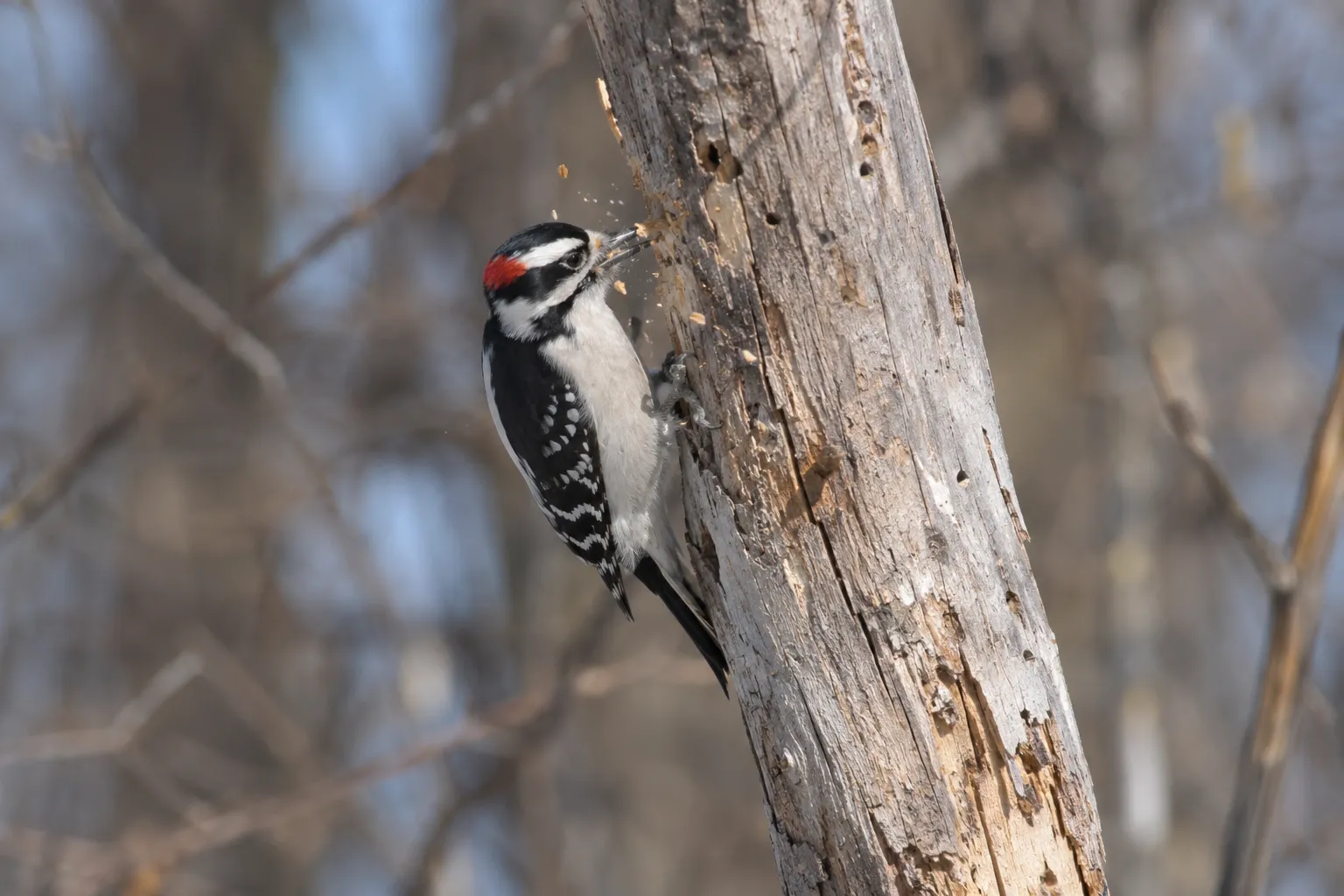
Most woodpeckers eat insects, especially beetle larvae, carpenter ants and other invertebrates that live under bark or inside wood. A foraging woodpecker moves along a trunk or limb, taps, listens and probes. When it finds a promising spot, it chips and pries away bark or wood to reach the prey.
Once the bird has opened a hole, its tongue does the rest. Woodpecker tongues are long, often with a barbed or bristly tip and coated in sticky saliva. In many species the tongue is supported by a long, flexible set of bones and cartilage called the hyoid apparatus, which wraps around the back of the skull when retracted. That lets the tongue extend well beyond the bill tip to spear or glue up grubs deep in tunnels.
Foraging styles differ by species:
- Downy and Hairy Woodpeckers, common at North American feeders, flake bark and drill small holes to reach larvae. Downies often work thin twigs and even weed stems.
- Pileated Woodpeckers dig large, often rectangular holes into dead trees and stumps to reach carpenter ant colonies. The holes can be deep enough to break smaller trees.
- Northern Flickers in North America and European Green Woodpeckers in Europe spend much of their time on the ground, digging into soil and lawns for ants rather than into wood.
- Great Spotted Woodpeckers in Europe and Turkey wedge pine and spruce cones into a crevice, sometimes called an anvil, then hammer out the seeds. You can find piles of discarded cones below a favorite spot.
2. Sap and storage: the specialists
Two groups use pecking in unusual ways.
Sapsuckers drill neat rows of small holes, called sap wells, into living trees. They return to lap up the sap and eat insects drawn to it. These wells matter to other animals too. In eastern North America, Ruby-throated Hummingbirds are known to feed at sapsucker wells in early spring before many flowers bloom.
Acorn Woodpeckers of western North America and parts of Central America live in family groups and drill thousands of small holes into a dead tree, utility pole or wooden building, then wedge an acorn into each one. These “granaries” can hold tens of thousands of acorns and are defended by the group. The pecking here is about storage, not eating on the spot.
3. Excavation: building homes
Almost all woodpeckers are primary cavity nesters. That means they dig their own nest holes rather than using an existing space. A pair typically excavates a fresh cavity each breeding season, usually in dead or decaying wood that is softer inside. The work can take from about a week to several weeks depending on species and wood hardness, and in many species both male and female take turns.
The finished cavity usually has a round entrance and a chamber that widens below it. Wood chips are tossed out rather than used as nesting material, so the eggs rest on a bed of fine chips at the bottom.
Woodpeckers also dig roost holes where they sleep, especially in fall and winter. These cavities give shelter from wind, cold and predators. This explains why some homeowners find new, round holes in wooden siding in autumn: a woodpecker is building a bedroom.
4. Drumming: the woodpecker’s song
Drumming is fast, rhythmic hammering on a resonant surface. It does not make a hole and is not about food. Woodpeckers pick objects that carry sound well: hollow limbs, dead snags, and in towns, metal gutters, downspouts, chimney caps, vents, utility poles, street signs and satellite dishes.
Drumming does the job that song does for songbirds. It advertises that a territory is occupied and helps attract and keep a mate. Both males and females drum. Many species also have true vocal calls, such as the whinny of a Downy Woodpecker or the loud “wick-a-wick” of a flicker, but drumming carries farther in a forest.
Each species has a characteristic drumming pattern. Hairy Woodpeckers drum faster than Downies. Yellow-bellied Sapsuckers are famous for an irregular rhythm that starts with a quick roll and then trails off in slower, uneven taps, often compared to Morse code. Experienced birders can identify many species by drumming alone. If you want to learn sounds like these, our guide to birding by ear and our tips on using Merlin Sound ID are good places to start.
How can you tell drumming from feeding?
Once you know the difference, it is easy to hear.
| Type of pecking | What it sounds like | Where it happens | What it leaves behind | Peak season |
|---|---|---|---|---|
| Drumming | Fast, even rolls lasting a second or two, repeated from the same spot | Resonant surfaces: dead limbs, gutters, poles, chimney caps | Usually nothing, or tiny dents | Late winter to spring |
| Foraging | Irregular taps and chipping, bird moves around | Bark, dead wood, insect-infested trim | Scattered holes, flaked bark, irregular gouges | Year round |
| Sap wells | Quiet, careful drilling | Living trees such as birches, maples and fruit trees | Neat horizontal rows of small holes | Spring and summer mostly |
| Excavation | Slow, steady, heavy chiseling for long periods | Dead or soft wood, sometimes siding | One round hole with chips below | Spring (nests), fall (roosts) |
Why don’t woodpeckers get hurt?
A woodpecker’s head hits wood many times a minute, sometimes at high speed. Several features seem to protect it, and the science here has been revised in recent years.
Is the skull a shock absorber?
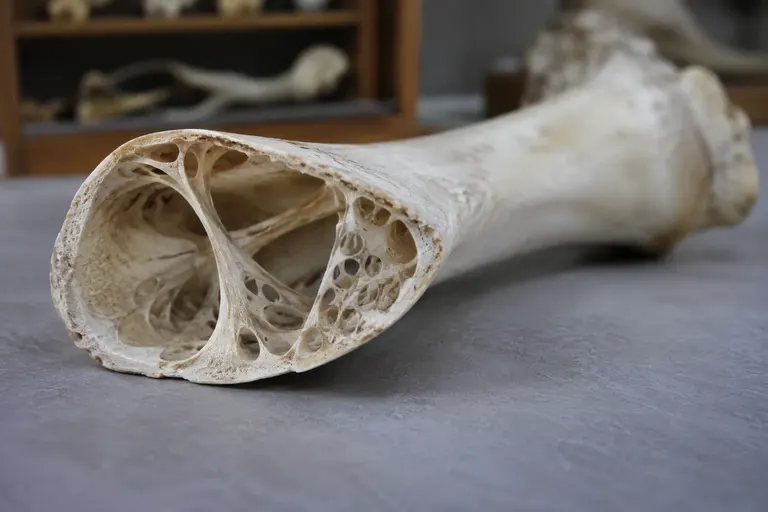
For decades, popular accounts said the woodpecker skull contains spongy bone and a wrap-around tongue that cushions the brain like a helmet. A 2022 study led by Sam Van Wassenbergh and published in Current Biology challenged that idea. Using high-speed video of several species, the researchers found the head does not absorb much of the impact. Instead, it behaves more like a stiff hammer. Absorbing the shock would actually waste energy and make pecking less effective.
So why no concussions? The same study pointed to size. Woodpecker brains are tiny, and the forces that cause concussion scale with brain size. Their calculations suggested that even hard strikes stay below the threshold that would injure a brain that small. The short, straight-line nature of each strike, with little twisting, likely helps too.
The question is not fully closed. A 2018 study found build-up of a protein called tau in woodpecker brains, which in humans is linked to head trauma. The authors noted it may not mean injury in birds and could even be protective. For a fuller look at this debate, see our article on why woodpeckers do not get headaches.
Other built-in tools
- Bill: straight, hard and chisel-tipped, with a tough outer layer that keeps growing as it wears.
- Feet: most species have two toes forward and two back, a layout called zygodactyl, giving a strong grip on vertical bark. A few species, such as the three-toed woodpeckers, have three toes.
- Tail: stiffened central tail feathers press against the trunk, forming a tripod with the two feet. Woodpeckers molt these feathers in a way that keeps the key central pair in place until the new ones are ready.
- Nostrils: covered by bristly feathers that help keep out wood dust.
- Eyes: a protective inner eyelid, the nictitating membrane, closes just before impact, which is widely thought to shield the eye from flying chips.
Why do woodpeckers peck on houses and metal?
This is the question most homeowners actually want answered. There are four common causes, and each needs a different fix.
- Drumming. Gutters, metal flashing, chimney caps and hollow siding make loud, satisfying noise. Early in the year a woodpecker may drum there many times each morning. It is not looking for food and will not usually damage anything beyond the noise.
- Insects in the wood. Carpenter bees, beetle larvae and other insects in siding, eaves or trim attract foraging woodpeckers. Rows of irregular holes and flaked paint suggest this.
- Nest or roost excavation. A single, round hole about the size of the bird, often in cedar or other soft siding, means the bird is building a cavity. Spring holes are usually nests; fall holes are often roosts.
- Stored food. In the western United States, Acorn Woodpeckers may drill many small holes in wooden siding or poles to store acorns.
Some species are more likely culprits than others. In North America, Northern Flickers and Downy, Hairy, Red-bellied and Pileated Woodpeckers are frequently involved. In Europe, Great Spotted Woodpeckers sometimes enlarge nest box entrances to reach chicks inside, and in parts of Europe and Turkey, Syrian Woodpeckers are common around orchards, parks and villages.

What actually stops woodpeckers pecking a house?
Wildlife agencies and the Cornell Lab of Ornithology generally recommend non-lethal steps matched to the cause:
- Identify the reason. Look at the damage and the season. Drumming makes noise but few holes. Feeding makes scattered holes. Excavation makes one large round hole.
- Deal with insects. If insects are present, have the wood treated or replaced. Removing the food removes the reason to dig.
- Change the surface. For drumming, cover or pad the resonant spot, or temporarily hang lightweight netting a few inches out from the wall so the bird cannot land.
- Add visual deterrents quickly. Moving, reflective strips or streamers near the spot can discourage birds, especially if used as soon as the problem starts.
- Fill holes promptly, but check first. Make sure no bird is inside before sealing a hole, and do not seal an active nest.
- Give them somewhere else. A dead tree left standing where it is safe, or a suitable nest box for flickers, can redirect the activity. Offering suet may keep birds busy nearby, though it will not stop drumming, which is not about food.
In the US, harming woodpeckers or removing an active nest is illegal without a permit, so avoid sticky repellents, traps or anything that can injure a bird.
Do woodpeckers hurt trees?
Mostly, no. The majority of woodpecker feeding happens in wood that is already dead or decaying, where insect larvae live. A living tree with many woodpecker holes often already has a problem with boring insects or rot, and the woodpeckers are responding to it, not causing it. In that sense they act as natural pest control. Studies of bark beetle outbreaks in conifer forests have found woodpeckers can eat large numbers of beetle larvae.
Sapsuckers are the partial exception. Their sap wells go into living wood, and a tree that is targeted heavily, year after year, can be weakened, and occasionally girdled and killed. Most trees survive, and sapsuckers favor certain species, so damage tends to be concentrated on a few individual trees.
Why woodpecker holes matter to other wildlife
Woodpeckers are often called ecosystem engineers, because the holes they make become homes for many other species. Birds that need a cavity but cannot dig one, called secondary cavity nesters, rely on old woodpecker holes. In North America these include bluebirds, Tree Swallows, some owls, Wood Ducks, nuthatches and chickadees, as well as squirrels and bats.
The same pattern holds worldwide. In Europe, old Black Woodpecker cavities are used by Stock Doves, Tengmalm’s (Boreal) Owls and other species. In South America, woodpeckers such as the Campo Flicker, which often nests in termite mounds or earth banks as well as trees, create cavities that other animals later use.
This is one reason conservationists encourage leaving standing dead trees, known as snags, where they are safe. Each snag can support a chain of occupants over many years. If you have room, a dead tree away from paths and buildings can be one of the most valuable features in a bird-friendly garden.
Myths vs facts about woodpecker pecking
Myth: A woodpecker hammering on metal is looking for bugs. Fact: It is drumming. Metal is chosen because it is loud, not because there is anything to eat.
Myth: Woodpeckers only damage sick trees. Fact: Mostly true for insect foraging, but sapsuckers drill into healthy living trees.
Myth: The skull is a spongy shock absorber. Fact: Recent high-speed video research suggests the head works more like a rigid hammer, and small brain size is a big part of why they avoid injury.
Myth: Only males drum. Fact: Females drum too, and in many species they answer males or defend territory with their own drumming.
Myth: Every hole is a nest. Fact: Many holes are feeding holes or roost holes. Nest holes are made mainly in spring; roosts are often excavated in fall.
What this means for backyard birders
Woodpeckers are some of the most rewarding birds to watch, and much of their pecking is easy to observe from a window. A few practical points:
- Suet is a reliable draw. Downy, Hairy and Red-bellied Woodpeckers and flickers commonly visit suet, especially in colder months. See our guide to suet cakes and blends, and offer it in a spot with a trunk or post nearby that the birds can brace against.
- Watch where they tap. A bird tapping quietly and moving is foraging. One returning to the same resonant branch with loud rolls is drumming, often in the first hours after sunrise.
- Learn the species. If you want to attract and identify specific birds, start with our species pages on the Downy Woodpecker, Red-bellied Woodpecker and Pileated Woodpecker.
- Keep dead wood where safe. Snags and fallen logs feed woodpeckers and later house other birds.
- Be patient with drumming. Spring drumming is usually temporary. Once territories and pairs are settled, it tends to fade.
Why this behavior evolved
Pecking wood gave woodpeckers access to two resources few other birds can reach: insects hidden inside trees and safe cavities for nesting. Food inside wood is available even in winter, when leaves and flying insects are gone, which helps explain why many woodpeckers are year-round residents in cold climates. A cavity in solid wood protects eggs and chicks from weather and many predators better than an open cup nest.
Drumming built on that same toolkit. A bird already equipped to strike wood hard and fast could turn that ability into a signal that carries through dense forest. Over time, each species settled on its own rhythm, and today that rhythm is as much a part of its identity as its plumage.
Sources
- Pileated Woodpecker overview, Cornell Lab All About Birds
- Acorn Woodpecker overview, Cornell Lab All About Birds
- Yellow-bellied Sapsucker overview, Cornell Lab All About Birds
- Great spotted woodpecker, RSPB
- Van Wassenbergh et al. 2022, Woodpeckers minimize cranial absorption of shocks, Current Biology
Frequently asked questions
Why do woodpeckers peck on my house?
Usually for one of three reasons. In late winter and spring they drum on resonant surfaces such as gutters, siding, chimney caps and vents to claim territory. They may also be chasing insects living in the siding or trim, or trying to excavate a nest or roost hole, especially in cedar or other soft wood. Working out which it is tells you how to stop it.
Does pecking hurt a woodpecker's head?
Woodpeckers do not appear to suffer the concussions a human would. Their small brains, the short duration of each strike and the way the skull, bill and neck are built keep forces below injury levels. A 2022 study in Current Biology found the skull acts more like a stiff hammer than a shock absorber, and small brain size is a key part of why that works.
Do woodpeckers kill trees by pecking them?
Rarely. Most woodpeckers feed on insects in dead or already decaying wood, and holes in a living tree are often a sign it already has insect or fungal problems. Sapsuckers are the main exception: their rows of sap wells can weaken or occasionally kill heavily targeted trees, but most trees tolerate them.
What time of year do woodpeckers drum the most?
Drumming peaks from late winter through spring, when woodpeckers set up territories and form pairs. Both males and females drum. Feeding and excavation happen year round, and fall is a common time for birds to dig roost holes, which is why some homeowners see new holes in siding in autumn.
Are woodpeckers protected?
In the United States, native woodpeckers are protected under the federal Migratory Bird Treaty Act, so harming or killing them, or disturbing an active nest, requires a permit. Most European countries protect them under national laws and the EU Birds Directive. Non-lethal deterrents are the legal and effective route for problem birds.