Do Birds Have Regional Accents?
Do birds have regional accents? Yes. Songbirds learn songs from neighbors, so local dialects form, spread and change over time, much like human accents.

In this article
- Quick answer: bird accents at a glance
- Why do birds have regional accents?
- What are the best-known examples of bird dialects?
- How do scientists study bird accents?
- How fast can bird accents change?
- Why would a bird need an accent?
- Do cities give birds a different accent?
- Myths vs facts about bird accents
- What does this mean for backyard birders and travelers?
- Quick facts
- Sources
- Frequently asked questions
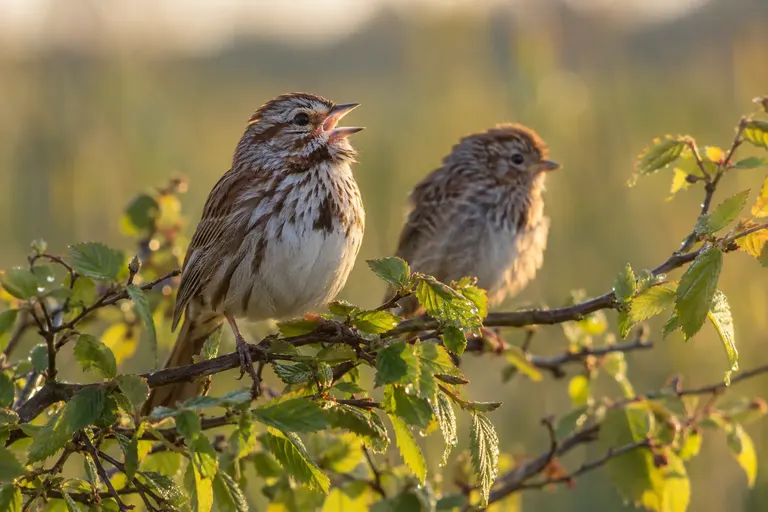
Yes, many birds have regional accents. Songbirds and parrots learn their songs and calls from the birds around them, and small copying differences add up over generations into local versions, called dialects. A White-crowned Sparrow in one San Francisco neighborhood can sound noticeably different from one a few miles away, and some accents spread fast: the White-throated Sparrow’s doublet song ending crossed thousands of miles in about 20 years.
Bird dialects are one of the clearest examples of culture in non-human animals: information passed on by learning rather than genes. This guide explains how dialects form, the best-studied examples worldwide, how songs can sweep across a continent, why accents might matter to birds, and what it means when you listen in your own yard or while traveling.
Quick answer: bird accents at a glance
- Only vocal learners have true dialects. That means songbirds, parrots and hummingbirds. Birds with innate calls vary much less by place.
- Dialects form through copying. Young birds learn from local adults and occasionally make errors or innovations that neighbors then copy.
- Boundaries can be sharp or gradual. Some species have distinct dialect districts; others change slowly across a range.
- Accents change. Songs can drift within decades, and new variants can spread quickly across huge areas.
- They seem to matter to birds. Territorial males often react more strongly to local songs, and in some species females appear to prefer them.
Why do birds have regional accents?
The answer starts with how birds learn to sing. Young songbirds memorize the songs of adults near them during a sensitive period, then practice until their own singing matches that memory. We cover the full process in how do birds learn songs.
Learning is not perfect copying. Three things drive local differences:
- Copying errors. A young bird may drop a note, add one or change its pitch slightly. If neighbors copy the changed version, it becomes part of the local song.
- Innovation. Occasionally a bird invents a new element. Most innovations vanish, but some catch on.
- Limited movement. In many species, young birds settle not far from where they learned to sing, or they learn from neighbors after settling. That keeps local variants local.
Over generations, these small changes build up. This is similar to how human accents and slang develop, with one key difference: bird dialects involve song structure, not meaning.
Is it a dialect or an accent?
Researchers usually use these terms:
| Term | What it means | Example |
|---|---|---|
| Dialect | A shared local song variant with a relatively sharp boundary | White-crowned Sparrow districts around San Francisco Bay |
| Geographic variation | Gradual change in song features across a large range | Many widespread songbirds change song slowly from east to west |
| Microgeographic variation | Differences between neighborhoods or small patches | Neighboring groups of Indigo Buntings sharing song types |
| Song type sharing | Neighbors singing the same songs as each other | Song Sparrows often share several song types with nearby males |
In everyday speech, people use “accent” for all of these, and that is a fair approximation.
What are the best-known examples of bird dialects?
White-crowned Sparrows in California
In the late 1950s and early 1960s, Peter Marler and Miwako Tamura recorded White-crowned Sparrows around San Francisco Bay and found distinct song dialects, each shared by birds within an area and different from neighboring areas. Their paper in Science in 1964 became a landmark in the study of learned animal behavior.
The same birds have since shown how dialects change. David Luther and Luis Baptista compared recordings made decades apart and reported that some San Francisco dialects had changed or disappeared, and that urban songs had shifted to higher minimum frequencies, likely in response to low-pitched city noise. Our guide to attracting White-throated Sparrows covers a close relative that has its own dialect story.
White-throated Sparrows across Canada
The White-throated Sparrow’s song is often written as “Oh sweet Canada Canada Canada” in Canada or “Old Sam Peabody Peabody Peabody” in New England. The repeated ending notes were traditionally sung in groups of three, called triplets.
In a study published in Current Biology in 2020, Ken Otter and colleagues showed that a version ending in doublets, two-note groups, originated in western Canada and spread eastward. By the late 2010s, it had reached beyond Ontario and into Quebec, replacing the triplet ending across a large part of the range. Using recordings from citizen scientists and their own fieldwork, the researchers tracked the spread over about two decades.
How did a song cross a continent so quickly? The researchers suggested that birds from western and eastern breeding areas mix on shared wintering grounds, where young males may pick up the new version. The reason the doublet version was favored is unclear. The authors noted that it does not appear to be more attractive to females in any obvious way, and they raised the possibility that novelty itself may help.
Chaffinches and Yellowhammers in Europe
The Common Chaffinch was one of the first birds whose song learning was studied scientifically, and it shows regional variation across Europe, particularly in the flourish that ends each song. Chaffinches were introduced to New Zealand in the 1800s, and studies there have compared song in the new and old populations.
Yellowhammers, whose song British birders render as “a little bit of bread and no cheese,” have well-defined dialects. The species was also introduced to New Zealand in the 1800s. A research project led by Pavel Pipek and colleagues, working with citizen scientists in the Czech Republic and New Zealand, reported that New Zealand Yellowhammers sing dialects that match those found in Britain, including some that are now rare or no longer detected in Britain itself. The introduced population appears to preserve older British accents, a bit like how some features of old British English survive in other countries.
Black-capped Chickadees and an island accent
The Black-capped Chickadee’s clear “fee-bee” whistle is remarkably uniform across most of its huge North American range, which is unusual for a learned song. Isolated populations are the exception. On Martha’s Vineyard in Massachusetts, research by Donald Kroodsma and colleagues found chickadees singing different versions from the mainland. Our Black-capped Chickadee guide describes the song in more detail.
Savannah Sparrows on Kent Island
On Kent Island in the Bay of Fundy, New Brunswick, researchers have followed Savannah Sparrows for decades. A study led by Heather Williams, published in 2013, used recordings spanning about 30 years and showed that the population’s song changed steadily, with some elements disappearing and new ones spreading. Because the island’s birds are individually banded, researchers could see how particular variants were passed along and replaced.
Parrots in Costa Rica
Parrots are vocal learners too. Research by Timothy Wright on Yellow-naped Amazons in Costa Rica found that the birds’ contact calls fall into regional dialects with sharp boundaries, and birds at the boundaries could use both. Later work found that these dialects were stable over roughly a decade or more. Parrots in introduced populations around the world are also being studied for how quickly new regional calls arise.
Crossbills: when “accents” may mean different species
Red Crossbills in North America use flight calls that fall into several distinct “call types.” Each type tends to be associated with particular conifers and bill sizes. In 2017, the American Ornithological Society recognized birds of call type 9 in the South Hills and Albion Mountains of southern Idaho as a separate species, the Cassia Crossbill. This is an unusual case where what sounds like a regional accent points to populations that are becoming genetically distinct.
How do scientists study bird accents?
Bird dialect research depends on careful recording and comparison. The basic toolkit has changed a lot since the 1950s, but the logic has stayed the same.
- Record many birds in many places. Researchers record individual males, ideally banded or otherwise identifiable, across a region. Public archives of recordings now add thousands of samples.
- Turn sound into pictures. A spectrogram, also called a sonogram, plots pitch against time. Each note becomes a visible shape, which makes it possible to compare songs that sound similar to the ear.
- Break songs into parts. Songs are divided into notes, syllables and phrases. Researchers then classify syllable types and note which regions share them.
- Map the variants. Plotting variants on a map shows whether boundaries are sharp, as in dialects, or gradual, as in geographic variation.
- Test responses. Playback experiments play local and foreign songs to territorial birds and compare their reactions, such as approach distance and counter-singing.
- Follow changes over time. Comparing old and new recordings from the same place, as in the San Francisco and Kent Island studies, reveals how accents drift.
Machine learning has made steps 3 and 4 much faster. Algorithms can now sort tens of thousands of syllables into types, letting researchers compare songs across whole continents. That is one reason recent studies can track changes, such as the White-throated Sparrow’s shift, in close to real time.
Do calls have accents too, or only songs?
Mostly songs, because songs are learned in most songbirds while many calls are innate. There are exceptions. Parrot contact calls are learned and show dialects, as the Costa Rica studies found. Red Crossbill flight calls fall into distinct types. Some finches and chickadees also learn aspects of their calls from flock mates, so a flock can develop a shared signature.
How fast can bird accents change?
It depends on the species and the situation.
- Some dialects are stable. Studies of parrots and some sparrows report dialects persisting for decades.
- Some drift steadily. Kent Island’s Savannah Sparrows show gradual change over years.
- Some sweep rapidly. The White-throated Sparrow’s doublet ending spread across thousands of miles in about 20 years.
- Some are lost. When populations shrink, dialects can disappear. The critically endangered Regent Honeyeater in Australia has so few wild adults that many young males now sing abnormal songs or songs of other species, and a 2021 study linked this to lower breeding success.
Why would a bird need an accent?
Scientists have tested several ideas.
Does a local accent help defend a territory?
Playback experiments often find that territorial males respond more strongly to songs of local rivals than to songs from farther away. Matching neighbors’ songs may help males communicate, for example by matching a neighbor’s song type as an escalating signal. Song Sparrows are a well-studied example of this song matching.
Does a local accent help attract a mate?
In some species, females appear to respond more strongly to local songs. If females prefer local accents, males that learn the local version may breed more successfully. Evidence varies between species.
Do dialects keep populations separate?
An old and much-debated idea is that dialects act like barriers, keeping birds breeding with locals and adapting to local conditions. Some studies of White-crowned Sparrows found genetic differences that lined up with dialect boundaries; others did not. Current evidence suggests dialects can contribute to separation in some cases, but they are not usually strong barriers on their own.
Is it just a side effect of learning?
Sometimes, yes. Dialects may arise simply because birds learn from local adults and do not travel far. Some dialect variation probably has no special function and is just cultural drift, like regional words for a sandwich.
Do cities give birds a different accent?
City birds face constant low-frequency noise from traffic and machinery. Several studies show that urban birds adjust their songs.
- Great Tits in European cities sing with higher minimum frequencies than forest birds, as reported by Hans Slabbekoorn and Margriet Peet in Nature in 2003.
- San Francisco White-crowned Sparrows shifted their songs upward in pitch as city noise increased, and there is evidence that the change happened both through learning and through birds adjusting in real time.
- During the quieter period of 2020 pandemic lockdowns, a study in Science reported that San Francisco White-crowned Sparrows sang more softly and with better performance, suggesting birds respond quickly to changes in noise.
This is an “urban accent” of a practical kind: a way to be heard over the din.
Myths vs facts about bird accents
| Claim | Verdict | Explanation |
|---|---|---|
| All birds have regional accents. | False | Mainly vocal learners do. Doves, chickens and most flycatchers vary much less. |
| Bird accents are fixed forever. | False | They drift, spread, and sometimes vanish over years to decades. |
| Bird accents mean birds can’t understand each other. | Misleading | Birds generally still recognize their species’ songs from other areas, though responses may be weaker. |
| Bird accents come from genetics. | Mostly false | Dialects are learned; genes shape the general template but not local details. |
| City birds just sing louder. | Partly | Many sing at higher pitch, adjust timing, or sing at quieter times, not only louder. |
What does this mean for backyard birders and travelers?
Will birds sound different on vacation?
Often, yes. A familiar species can sound slightly off in another region. That is normal and useful to know if you learn songs by ear. Our guide to birding by ear with 10 songs suggests learning the rhythm and quality of a song, which often stays more consistent across regions than exact notes.
Can apps handle regional variation?
Sound ID apps are trained on recordings from many places, and they generally handle regional variants of common species. Unusual dialects, young birds’ practice songs and mimicry can still trip them up. Our guide to using Merlin Sound ID without getting fooled has tips for confirming results.
Can I help researchers study bird dialects?
Yes. The White-throated Sparrow research relied partly on recordings submitted by the public. Uploading recordings to eBird checklists, which are archived in the Cornell Lab’s Macaulay Library, adds to the data scientists use. See how to use eBird to get started. Noting the date and exact location of each recording is what makes it useful.
Quick facts
- Birds that learn their songs, mainly songbirds and parrots, develop regional dialects.
- Dialects form through copying errors, innovation and limited movement.
- White-crowned Sparrow dialects around San Francisco were described in the early 1960s.
- A doublet-ending White-throated Sparrow song spread from western Canada into Quebec within about two decades.
- New Zealand Yellowhammers appear to preserve dialects that are rare or lost in Britain.
- The Cassia Crossbill was recognized as a species in 2017, partly based on its distinctive calls.
- City noise pushes some birds to sing at higher pitches.
- Rare species can lose their songs when young birds lack adult tutors.
Sources
- Marler, P. and Tamura, M. (1964). Culturally transmitted patterns of vocal behavior in sparrows. Science
- Otter, K. A. et al. (2020). Continent-wide shifts in song dialects of White-throated Sparrows. Current Biology
- Slabbekoorn, H. and Peet, M. (2003). Birds sing at a higher pitch in urban noise. Nature
- Crates, R. et al. (2021). Loss of vocal culture and fitness costs in a critically endangered songbird. Proceedings of the Royal Society B


Frequently asked questions
Do birds of the same species sound different in different places?
Yes, in many songbirds. Because young birds learn songs from adults around them, small copying differences build up into local versions called dialects. White-crowned Sparrows in the San Francisco Bay Area, for example, sing distinct dialects in neighborhoods only a few miles apart. Birds that do not learn their songs, such as doves and most flycatchers, show much less local variation.
What is the difference between a bird dialect and an accent?
Scientists usually say dialect for a shared local song variant with a fairly sharp boundary between areas, like a regional vocabulary. Gradual changes in song across a large range are called geographic variation, which is closer to what people mean by an accent. In everyday speech the two words are often used interchangeably, and both describe learned, culturally transmitted differences.
Can bird dialects change over time?
Yes. The best-known example is the White-throated Sparrow, whose song ending in doublets spread from western Canada across the continent between about 2000 and 2019, replacing the older triplet ending in much of the range. White-crowned Sparrow dialects in California have also shifted over decades, and Savannah Sparrow songs on an island in New Brunswick changed measurably over a long-term study.
Do female birds prefer males with the local accent?
In some species there is evidence that females respond more strongly to local songs, and males usually react more aggressively to songs of local rivals in playback experiments. The idea that dialects keep populations genetically separate has been tested many times with mixed results. It seems to matter in some species and not in others.
Do parrots have dialects?
Yes. Parrots learn their contact calls, and several species show regional call dialects. Research on Yellow-naped Amazons in Costa Rica found distinct call dialects with sharp boundaries, and follow-up work reported that these dialects stayed stable over many years. Wild parrots introduced to new regions can also develop local variants.